



Build Your Custom Market Intelligence Report
Customize Your ReportSouth Korea Anti-Aging Skincare Market Insights & Analysis
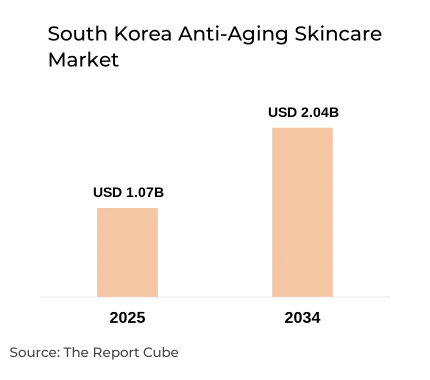
The South Korea Anti-Aging Skincare Market is anticipated to register a CAGR of 7.45% during 2026-2034. The market size was valued at USD 1.07 billion in 2025 and is projected to reach USD 2.04 billion by 2034. South Korea’s global leadership in beauty innovation, coupled with a deeply ingrained skincare culture, continues to position the country as a high-growth market for anti-aging skincare solutions.
The market is strongly influenced by rising life expectancy, increasing aesthetic awareness, and a growing emphasis on preventative skincare among younger consumers. Unlike conventional anti-aging markets, South Korea demonstrates early adoption behavior, with consumers in their late 20s and early 30s actively investing in wrinkle prevention, hydration enhancement, and skin barrier repair. This proactive mindset is supported by strong dermatological research, ingredient transparency, and rapid product innovation cycles.
Furthermore, the global popularity of K-beauty has elevated domestic demand while simultaneously strengthening export-driven innovation. Local brands consistently integrate advanced actives such as peptides, retinoids, and fermented botanical extracts into multifunctional formulations. As consumer trust in domestic brands remains high, the South Korea Anti-Aging Skincare Market is expected to witness sustained momentum through the forecast period.
South Korea Anti-Aging Skincare Market Recent Developments
- 2025: Amorepacific launched next-generation peptide-based anti-wrinkle serums targeting early aging concerns.
- 2025: LG H&H expanded dermocosmetic anti-aging lines through pharmacy-exclusive product launches.
Government Initiatives & Policies
- K-Beauty Global Expansion Strategy: Government initiative supporting R&D, exports, and global branding of Korean cosmetics.
- Cosmetics Industry Innovation Act: Policy strengthening ingredient safety, labeling standards, and functional cosmetics approval.
South Korea Anti-Aging Skincare Market Dynamics
Key Driver: Strong Consumer Preference for Preventative and Functional Skincare
The South Korea Anti-Aging Skincare Market is primarily driven by the country’s strong preventative skincare culture, where consumers actively adopt anti-aging products well before visible signs appear. This behavior is deeply rooted in skincare education, dermatologist influence, and social acceptance of multi-step skincare routines. Products addressing fine lines, elasticity loss, and skin hydration are no longer limited to mature age groups, as consumers aged 25-40 increasingly invest in functional formulations. This early adoption significantly expands the addressable consumer base, directly supporting long-term market growth.
Book your FREE 30-minute expert consultation today
Contact UsIndustry Trends: Ingredient Innovation and Dermocosmetic Positioning
A key trend shaping the South Korea Anti-Aging Skincare Market is the convergence of cosmetic and dermatological science. Brands are increasingly positioning products as dermocosmetic solutions, emphasizing clinical efficacy and ingredient integrity. Retinoids, peptides, and hyaluronic acid dominate new product development, while botanical extracts rooted in traditional Korean medicine enhance brand differentiation. This trend aligns with rising consumer demand for science-backed yet skin-friendly formulations, strengthening trust and repeat purchasing behavior.
Major Challenge: Market Saturation and Intense Brand Competition
Despite strong demand, the South Korea Anti-Aging Skincare Market faces challenges related to high market saturation and intense competition. Hundreds of domestic and international brands compete across mass, premium, and dermocosmetic categories, making differentiation increasingly difficult. Short product life cycles and high marketing intensity place pressure on margins, particularly for mid-sized players. As a result, brands must continuously innovate while balancing pricing, efficacy claims, and regulatory compliance.
Opportunity: Rising Male and Gender-Neutral Skincare Adoption
An emerging opportunity in the South Korea Anti-Aging Skincare Market lies in the rapid growth of male and unisex skincare segments. South Korea remains one of the most progressive markets for men’s grooming, with increasing acceptance of anti-aging serums, eye creams, and moisturizers among male consumers. Gender-neutral branding and simplified routines further expand this opportunity, allowing companies to capture incremental demand while reinforcing long-term market expansion.
South Korea Anti-Aging Skincare Market Segment-wise Analysis
By Product:
- Facial Serums
- Face Moisturizers
- Eye Care
- Cleansers & Exfoliators
- Masks & Peels
- Sunscreens
- Others
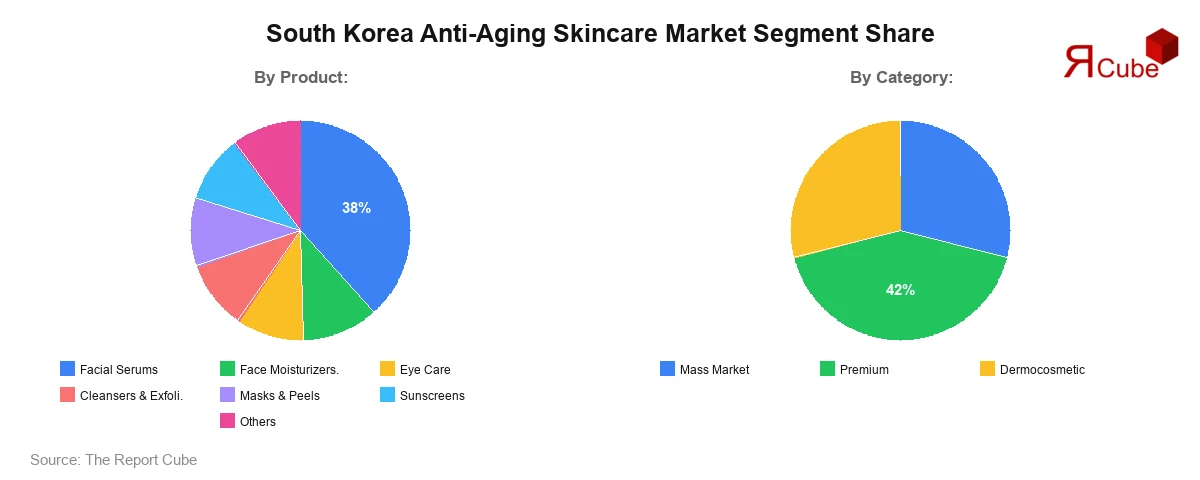
Facial serums lead the South Korea Anti-Aging Skincare Market, accounting for an estimated 38% market share in 2025. Their high concentration of active ingredients and targeted application make them central to Korean skincare routines. Consumers prioritize serums for wrinkle reduction, skin firming, and brightening, reinforcing their dominance across both premium and mass categories.
By Category:
- Mass Market
- Premium
- Dermocosmetic
The premium category holds the largest share of the South Korea Anti-Aging Skincare Market at approximately 42%. Premium brands benefit from strong brand heritage, advanced formulations, and loyal domestic consumers. However, dermocosmetic products are gaining traction through pharmacies and clinics, reflecting growing trust in clinically validated anti-aging solutions.
Regional Projection of South Korea Anti-Aging Skincare Industry
- Capital
- Central
- Honam
- Yeongnam
- Others
The Capital Region dominates the South Korea Anti-Aging Skincare Market, contributing approximately 49% of total revenue. Seoul and its surrounding metropolitan areas benefit from higher disposable incomes, strong retail density, and early adoption of skincare innovations. The concentration of flagship stores, dermatology clinics, and beauty influencers further accelerates product penetration, ensuring the Capital Region remains the leading growth engine through 2034.
Need insights for a specific region within this market?
Request Regional DataWhy Choose This Report?
- Provides a comprehensive overview of the overall market analysis, encompassing key trends, consumer behavior analysis, and risk assessment to support strategic decision-making.
- Provides accurate, up-to-date insights into market size, segmentation, and emerging opportunities, helping to minimize risk & capitalizing on growth.
- Gives deep understanding of target audience preferences, investment habits, and communication channels for enhanced product development & marketing effectiveness.
- Delivers competitive analysis & benchmarking, uncovering the strengths & weaknesses of market competitors to guide strategies.
- Consolidate comprehensive market intelligence, reducing reasoning & streamlining research efforts.
- Facilitates customized market segmentation & risk mitigation strategies, fine-tuned to the business objectives.
- Aids in identifying both market challenges & untapped opportunities within the industry to drive long-term business growth.
- Provides valuable information based on actual customer data & search trends.
Table of Contents
- Introduction
- Objective of the Study
- Product and Category Definition
- Market Segmentation
- Study Variables
- Research Methodology
- Secondary Data Points
- Breakdown of Secondary Sources
- Primary Data Points
- Breakdown of Primary Interviews
- Secondary Data Points
- Executive Summary
- Market Dynamics
- Drivers
- Challenges
- Opportunity Assessment
- Recent Trends and Developments
- Regulatory and Policy Landscape
- South Korea Anti-Aging Skincare Market Overview (2021-2034)
- Market Size, By Value (USD Billion)
- Market Share, By Product
- Facial Serums
- Face Moisturizers
- Eye Care
- Cleansers & Exfoliators
- Masks & Peels
- Sunscreens
- Other Products
- Market Share, By Function
- Anti-Wrinkle
- Skin Firming
- Brightening
- Hydration
- UV Protection
- Market Share, By Ingredient Type
- Retinoids
- Peptides
- Hyaluronic Acid
- Botanical Extracts
- Other Actives
- Market Share, By Category
- Mass Market
- Premium
- Dermocosmetic
- Market Share, By Gender
- Women
- Men
- Unisex
- Market Share, By Age Group
- 18-29 Years
- 30-44 Years
- 45-59 Years
- 60+ Years
- Market Share, By Distribution Channel
- Supermarkets & Hypermarkets
- Pharmacies & Drugstores
- Specialty Beauty Stores
- Online & E-commerce
- Other Channels
- Market Share, By Region
- Capital
- Central
- Honam
- Yeongnam
- Others
- Market Share, By Company
- Revenue Shares & Analysis
- Competitive Landscape
- Capital Region Anti-Aging Skincare Market
- Market Size, By Value (USD Billion)
- Market Share, By Product
- Market Share, By Function
- Market Share, By Ingredient Type
- Market Share, By Category
- Market Share, By Gender
- Market Share, By Age Group
- Market Share, By Distribution Channel
- Central Region Anti-Aging Skincare Market
- Market Size, By Value (USD Billion)
- Market Share, By Product
- Market Share, By Function
- Market Share, By Ingredient Type
- Market Share, By Category
- Market Share, By Gender
- Market Share, By Age Group
- Market Share, By Distribution Channel
- Honam Region Anti-Aging Skincare Market
- Market Size, By Value (USD Billion)
- Market Share, By Product
- Market Share, By Function
- Market Share, By Ingredient Type
- Market Share, By Category
- Market Share, By Gender
- Market Share, By Age Group
- Market Share, By Distribution Channel
- Yeongnam Region Anti-Aging Skincare Market
- Market Size, By Value (USD Billion)
- Market Share, By Product
- Market Share, By Function
- Market Share, By Ingredient Type
- Market Share, By Category
- Market Share, By Gender
- Market Share, By Age Group
- Market Share, By Distribution Channel
- Other Regions Anti-Aging Skincare Market
- Market Size, By Value (USD Billion)
- Market Share, By Product
- Market Share, By Function
- Market Share, By Ingredient Type
- Market Share, By Category
- Market Share, By Gender
- Market Share, By Age Group
- Market Share, By Distribution Channel
- Competitive Outlook and Company Profiles
- Amorepacific Corporation
- Company Overview
- Product Portfolio
- Strategic Alliances/Partnerships
- Recent Developments
- LG H&H
- Company Overview
- Product Portfolio
- Strategic Alliances/Partnerships
- Recent Developments
- The Face Shop
- Company Overview
- Product Portfolio
- Strategic Alliances/Partnerships
- Recent Developments
- Innisfree
- Company Overview
- Product Portfolio
- Strategic Alliances/Partnerships
- Recent Developments
- Laneige
- Company Overview
- Product Portfolio
- Strategic Alliances/Partnerships
- Recent Developments
- Missha
- Company Overview
- Product Portfolio
- Strategic Alliances/Partnerships
- Recent Developments
- Dr. Jart+
- Company Overview
- Product Portfolio
- Strategic Alliances/Partnerships
- Recent Developments
- Hera
- Company Overview
- Product Portfolio
- Strategic Alliances/Partnerships
- Recent Developments
- Sulwhasoo
- Company Overview
- Product Portfolio
- Strategic Alliances/Partnerships
- Recent Developments
- The History of Whoo
- Company Overview
- Product Portfolio
- Strategic Alliances/Partnerships
- Recent Developments
- Others
- Amorepacific Corporation
- Contact Us and Disclaimer
Top Key Players & Market Share Outlook
- Amorepacific Corporation
- LG H&H
- The Face Shop
- Innisfree
- Laneige
- Missha
- Dr. Jart+
- Hera
- Sulwhasoo
- The History of Whoo
- Others
Frequently Asked Questions






