



Build Your Custom Market Intelligence Report
Customize Your ReportIndonesia Anti-Aging Creams Market Insights & Analysis
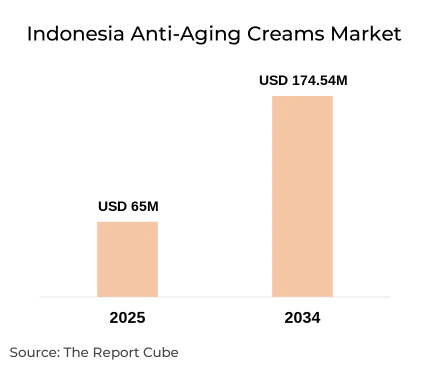
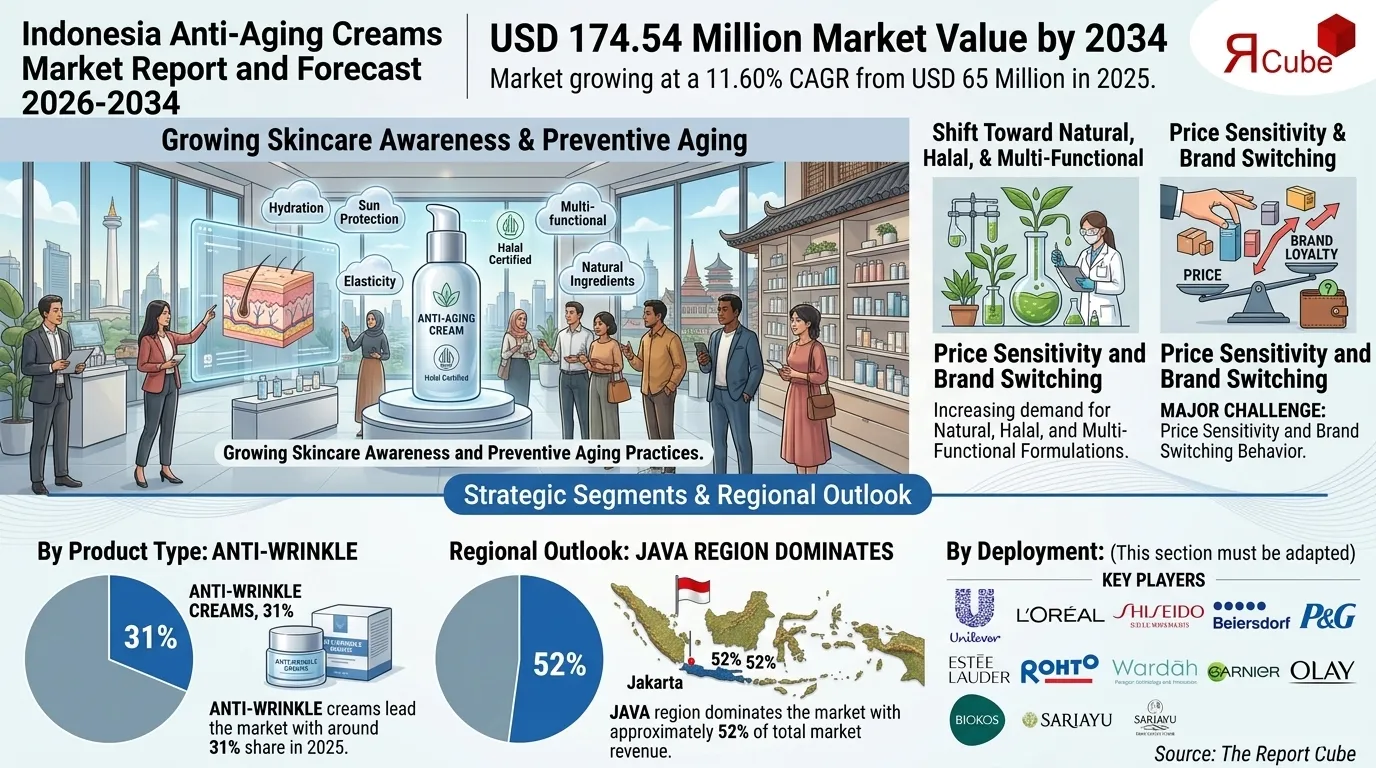
The Indonesia Anti-Aging Creams Market is anticipated to register a CAGR of 11.60% during 2026-2034. The market size was valued at USD 65 million in 2025 and is projected to reach USD 174.54 million by 2034. This robust growth highlights the rapid transformation of Indonesia’s skincare industry, driven by increasing beauty awareness, rising disposable incomes, and strong influence from global beauty trends.
Indonesia’s large and youthful population is gradually becoming more skincare-conscious, with consumers starting anti-aging routines earlier than in previous decades. Social media influence, dermatologist-backed education, and the rapid penetration of international beauty brands have reshaped consumer perceptions of preventive skincare. As a result, anti-aging creams are no longer viewed as niche or premium-only products but are increasingly integrated into daily skincare regimens.
Additionally, the expanding middle-class population and strong growth of e-commerce platforms have improved product accessibility across both urban and semi-urban regions. Domestic halal-certified brands, alongside multinational players, are further strengthening market depth. These combined factors continue to create a favorable environment for sustained expansion of the Indonesia Anti-Aging Creams Market throughout the forecast period.
Indonesia Anti-Aging Creams Market Recent Developments
- 2025: L'Oréal expanded its dermatologist-tested anti-aging skincare portfolio tailored for Southeast Asian skin types.
- 2025: Wardah introduced plant-based anti-aging creams emphasizing halal and clean beauty formulations.
Government Initiatives & Policies
- Halal Product Assurance Law: Strengthens consumer trust in certified cosmetic and skincare products.
- National Industry Development Plan: Supports domestic cosmetic manufacturing and innovation.
Indonesia Anti-Aging Creams Market Dynamics
Key Driver: Growing Skincare Awareness and Preventive Aging Practices
The Indonesia Anti-Aging Creams Market is strongly driven by rising skincare awareness and the growing adoption of preventive aging practices. Consumers aged 25-34 are increasingly investing in anti-aging products to delay visible signs of aging, influenced by dermatological advice and digital beauty content. This behavioral shift is reinforced by improved product affordability and widespread marketing campaigns by global and local brands. As awareness grows, demand extends beyond wrinkle correction to skin firmness, hydration, and brightness, strengthening overall market momentum.
Book your FREE 30-minute expert consultation today
Contact UsIndustry Trends: Shift Toward Natural, Halal, and Multi-Functional Formulations
Building on increased awareness, industry trends in the Indonesia Anti-Aging Creams Market reflect a strong shift toward natural, halal-certified, and multi-functional formulations. Consumers increasingly favor products combining anti-aging benefits with sun protection, brightening, and moisturizing properties. Ingredients such as hyaluronic acid, vitamin C, and botanical extracts are gaining popularity, while clean-label positioning enhances brand credibility. This trend aligns with Indonesia’s cultural preference for safe and ethically produced cosmetics.
Major Challenge: Price Sensitivity and Brand Switching Behavior
Despite strong growth drivers, price sensitivity remains a key challenge in the Indonesia Anti-Aging Creams Market. Many consumers frequently switch brands based on promotions, discounts, or influencer endorsements, making long-term brand loyalty difficult to maintain. Premium and luxury products often face resistance outside major metropolitan areas, requiring companies to carefully balance pricing, perceived value, and product efficacy to sustain market share.
Opportunity: Expanding Male and Unisex Skincare Segments
As skincare adoption broadens, the growing acceptance of male and unisex grooming products presents a major opportunity for the Indonesia Anti-Aging Creams Market. Male consumers are increasingly seeking simple, effective anti-aging solutions, particularly through online channels. Brands that position products as gender-neutral and easy-to-use are well-placed to capture this emerging demand, supporting long-term market expansion.
Indonesia Anti-Aging Creams Market Segment-wise Analysis
By Product Type:
- Anti-Wrinkle Creams
- Skin-Firming Creams
- Skin-Brightening Creams
- Eye Care Creams
- Night Care Creams
- Others
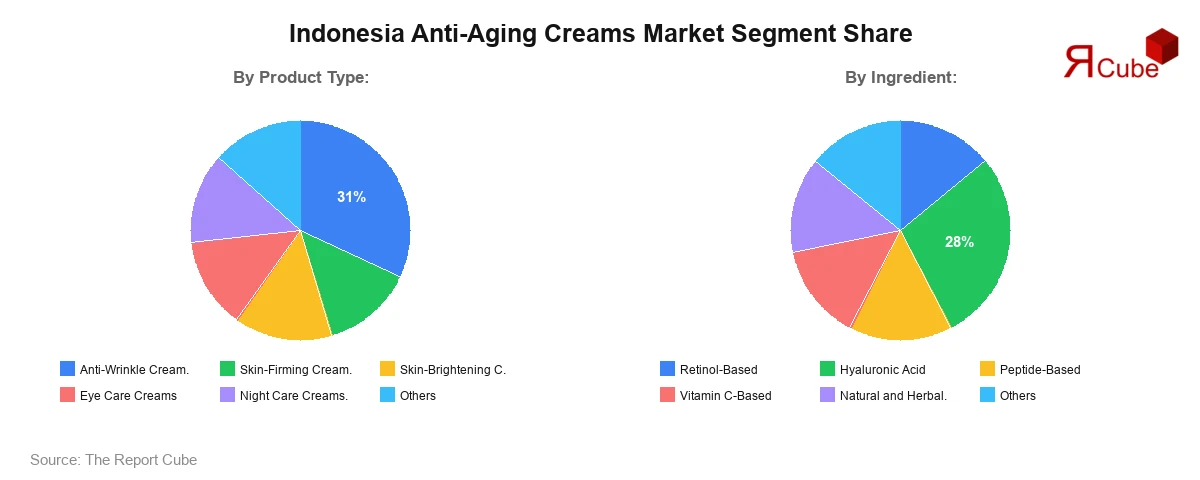
Anti-wrinkle creams lead the Indonesia Anti-Aging Creams Market, accounting for approximately 31% market share in 2025. Their dominance is supported by strong consumer awareness and widespread product availability across mass and premium segments. Skin-brightening and firming creams are also gaining traction, reflecting Indonesia’s cultural emphasis on even-toned and youthful-looking skin.
By Ingredient:
- Retinol-Based
- Hyaluronic Acid
- Peptide-Based
- Vitamin C-Based
- Natural and Herbal
- Others
Hyaluronic acid-based formulations hold a leading position, capturing nearly 28% of ingredient-based demand. Their strong hydration benefits and suitability for tropical climates make them particularly popular among Indonesian consumers, while natural and herbal ingredients are witnessing accelerated growth due to rising clean beauty preferences.
Regional Projection of Indonesia Anti-Aging Creams Industry
- Sumatra
- Java
- Bali and Nusa Tenggara
- Kalimantan
- Sulawesi
- Maluku and Papua
Java dominates the Indonesia Anti-Aging Creams Market, contributing approximately 52% of total market revenue. This leadership is driven by higher urbanization, stronger retail infrastructure, and greater consumer purchasing power in cities such as Jakarta, Bandung, and Surabaya. Java also benefits from a dense concentration of dermatology clinics, beauty salons, and digital-first consumers, reinforcing its central role in shaping national skincare trends.
Need insights for a specific region within this market?
Request Regional DataWhy Choose This Report?
- Provides a comprehensive overview of the overall market analysis, encompassing key trends, consumer behavior analysis, and risk assessment to support strategic decision-making.
- Provides accurate, up-to-date insights into market size, segmentation, and emerging opportunities, helping to minimize risk & capitalizing on growth.
- Gives deep understanding of target audience preferences, investment habits, and communication channels for enhanced product development & marketing effectiveness.
- Delivers competitive analysis & benchmarking, uncovering the strengths & weaknesses of market competitors to guide strategies.
- Consolidate comprehensive market intelligence, reducing reasoning & streamlining research efforts.
- Facilitates customized market segmentation & risk mitigation strategies, fine-tuned to the business objectives.
- Aids in identifying both market challenges & untapped opportunities within the industry to drive long-term business growth.
- Provides valuable information based on actual customer data & search trends.
Table of Contents
- Introduction
- Objective of the Study
- Product and Category Definition
- Market Segmentation
- Study Variables
- Research Methodology
- Secondary Data Points
- Breakdown of Secondary Sources
- Primary Data Points
- Breakdown of Primary Interviews
- Secondary Data Points
- Executive Summary
- Market Dynamics
- Drivers
- Challenges
- Opportunity Assessment
- Recent Trends and Developments
- Regulatory and Policy Landscape
- Indonesia Anti-Aging Creams Market Overview (2021-2034)
- Market Size, By Value (USD Million)
- Market Share, By Product Type
- Anti-Wrinkle Creams
- Skin-Firming Creams
- Skin-Brightening Creams
- Eye Care Creams
- Night Care Creams
- Others
- Market Share, By Ingredient
- Retinol-Based
- Hyaluronic Acid
- Peptide-Based
- Vitamin C-Based
- Natural and Herbal
- Others
- Market Share, By Gender
- Women
- Men
- Unisex
- Market Share, By Age Group
- 25-34 Years
- 35-44 Years
- 45-54 Years
- 55 Years and Above
- Market Share, By Price Range
- Mass
- Premium
- Luxury
- Market Share, By Distribution Channel
- Supermarkets and Hypermarkets
- Specialty Stores
- Pharmacies and Drugstores
- Online Channels
- Beauty Salons
- Market Share, By Region
- Sumatra
- Java
- Bali and Nusa Tenggara
- Kalimantan
- Sulawesi
- Maluku and Papua
- Market Share, By Company
- Revenue Shares & Analysis
- Competitive Landscape
- Sumatra Anti-Aging Creams Market
- Market Size, By Value (USD Million)
- Market Share, By Product Type
- Market Share, By Ingredient
- Market Share, By Gender
- Market Share, By Age Group
- Market Share, By Price Range
- Market Share, By Distribution Channel
- Java Anti-Aging Creams Market
- Market Size, By Value (USD Million)
- Market Share, By Product Type
- Market Share, By Ingredient
- Market Share, By Gender
- Market Share, By Age Group
- Market Share, By Price Range
- Market Share, By Distribution Channel
- Bali and Nusa Tenggara Anti-Aging Creams Market
- Market Size, By Value (USD Million)
- Market Share, By Product Type
- Market Share, By Ingredient
- Market Share, By Gender
- Market Share, By Age Group
- Market Share, By Price Range
- Market Share, By Distribution Channel
- Kalimantan Anti-Aging Creams Market
- Market Size, By Value (USD Million)
- Market Share, By Product Type
- Market Share, By Ingredient
- Market Share, By Gender
- Market Share, By Age Group
- Market Share, By Price Range
- Market Share, By Distribution Channel
- Sulawesi Anti-Aging Creams Market
- Market Size, By Value (USD Million)
- Market Share, By Product Type
- Market Share, By Ingredient
- Market Share, By Gender
- Market Share, By Age Group
- Market Share, By Price Range
- Market Share, By Distribution Channel
- Maluku and Papua Anti-Aging Creams Market
- Market Size, By Value (USD Million)
- Market Share, By Product Type
- Market Share, By Ingredient
- Market Share, By Gender
- Market Share, By Age Group
- Market Share, By Price Range
- Market Share, By Distribution Channel
- Competitive Outlook and Company Profiles
- Unilever
- Company Overview
- Product Portfolio
- Strategic Alliances/Partnerships
- Recent Developments
- L'Oréal
- Company Overview
- Product Portfolio
- Strategic Alliances/Partnerships
- Recent Developments
- Shiseido
- Company Overview
- Product Portfolio
- Strategic Alliances/Partnerships
- Recent Developments
- Beiersdorf
- Company Overview
- Product Portfolio
- Strategic Alliances/Partnerships
- Recent Developments
- P&G
- Company Overview
- Product Portfolio
- Strategic Alliances/Partnerships
- Recent Developments
- Estee Lauder
- Company Overview
- Product Portfolio
- Strategic Alliances/Partnerships
- Recent Developments
- Rohto Pharmaceutical
- Company Overview
- Product Portfolio
- Strategic Alliances/Partnerships
- Recent Developments
- Wardah (Paragon Technology and Innovation)
- Company Overview
- Product Portfolio
- Strategic Alliances/Partnerships
- Recent Developments
- Garnier
- Company Overview
- Product Portfolio
- Strategic Alliances/Partnerships
- Recent Developments
- Olay
- Company Overview
- Product Portfolio
- Strategic Alliances/Partnerships
- Recent Developments
- Others
- Unilever
- Contact Us and Disclaimer
Top Key Players & Market Share Outlook
- Unilever
- L'Oréal
- Shiseido
- Beiersdorf
- P&G
- Estee Lauder
- Rohto Pharmaceutical
- Wardah (Paragon Technology and Innovation)
- Garnier
- Olay
- Others
Frequently Asked Questions






