



Build Your Custom Market Intelligence Report
Customize Your ReportIndonesia Halal Skincare Market Insights & Analysis
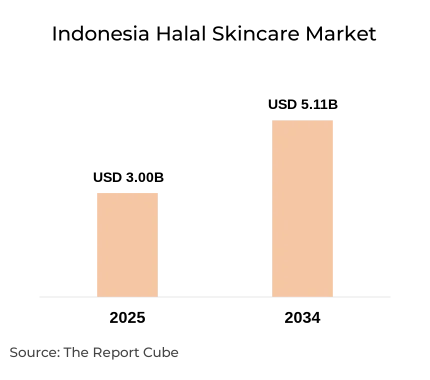
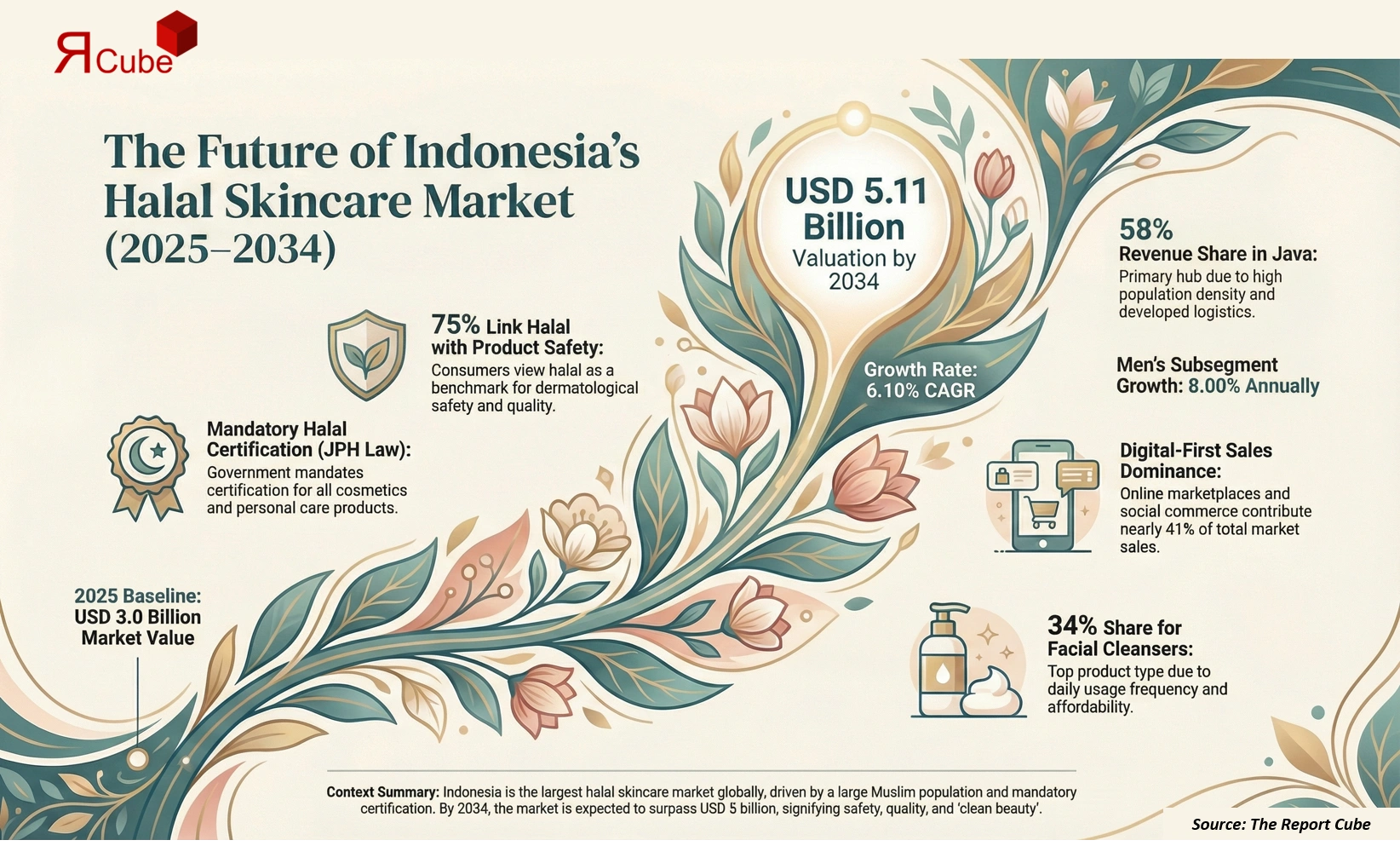
The Indonesia Halal Skincare Market is anticipated to register a CAGR of 6.10% during 2026–2034. The market size was valued at USD 3.0 billion in 2025 and is projected to reach USD 5.11 billion by 2034. Indonesia represents the largest halal skincare market globally, supported by the world’s biggest Muslim population, strong cultural alignment with halal consumption, and increasing awareness of ethical, safe, and Shariah-compliant personal care products.
Halal skincare in Indonesia has evolved beyond religious compliance to encompass clean beauty, dermatological safety, and ethical sourcing. Nearly 75% of Indonesian beauty consumers associate halal certification with product safety and quality, even among non-Muslim buyers. Rising urbanization, growing middle-class income, and strong youth demographics further support sustained demand for halal-certified skincare products.
In addition, Indonesia’s robust local manufacturing ecosystem, digitally driven consumer base, and strong influencer-led social commerce culture continue to accelerate market growth. Domestic brands dominate the competitive landscape, while international halal beauty brands increasingly view Indonesia as a strategic entry point into the global halal cosmetics industry.
Indonesia Halal Skincare Market Recent Developments
- 2025: Wardah Beauty introduced dermatologist-tested halal sunscreens targeting tropical climate needs.
- 2025: ParagonCorp expanded men’s halal skincare under its Kahf brand nationwide.
Government Initiatives & Policies
- Halal Product Assurance Law (JPH Law): Mandates halal certification for cosmetics and personal care.
- National Halal Industry Development Program: Supports halal SMEs and export-oriented beauty brands.
Indonesia Halal Skincare Market Dynamics
Key Driver: Mandatory Halal Certification and Consumer Trust
The strongest driver of the Indonesia Halal Skincare Market is the enforcement of mandatory halal certification under the Halal Product Assurance Law. Consumers increasingly rely on halal logos as indicators of safety, cleanliness, and ethical manufacturing. Halal-certified skincare products are perceived as alcohol-free, non-toxic, and suitable for sensitive skin, supporting mass-market adoption. Additionally, Indonesia’s youthful population, with over 60% under the age of 40, fuels strong demand for daily-use skincare such as cleansers, moisturizers, and sunscreens. Social media-driven beauty education and religious influencers further strengthen consumer trust and brand loyalty.
Industry Trends: Youth-Centric, Digital-First, and Functional Skincare
A key trend shaping the market is the rise of youth-centric and digital-first halal skincare brands. Products addressing acne, oil control, and brightening dominate sales, reflecting tropical climate challenges and young consumer needs. Functional ingredients such as niacinamide, centella asiatica, tea tree, and botanical extracts are widely adopted in halal formulations. Social commerce platforms such as TikTok Shop and Instagram Live now account for over 35% of new product discovery. Men’s halal skincare is also emerging as a fast-growing subsegment, expanding at over 8% annually.
Book your FREE 30-minute expert consultation today
Contact UsMajor Challenge: Price Sensitivity and Regional Distribution Gaps
Despite strong demand, price sensitivity remains a key challenge, particularly outside Java. Mass and masstige segments dominate volume sales, limiting premium brand penetration in secondary regions. Distribution challenges across Indonesia’s archipelagic geography increase logistics costs and create uneven product availability. Smaller brands also face compliance and reformulation costs associated with halal certification, impacting margins and speed-to-market.
Opportunity: Export Growth and Premium Halal Skincare Expansion
Indonesia’s halal skincare brands are increasingly well-positioned for export into ASEAN, Middle East, and South Asian markets. Premium halal skincare, combining clean beauty, dermatological testing, and halal certification, represents a significant growth opportunity. Digital-first exports, cross-border e-commerce, and private-label manufacturing for global brands further enhance Indonesia’s role as a halal beauty manufacturing hub through 2034.
Indonesia Halal Skincare Market Segment-wise Analysis
By Product Type:
- Facial Cleansers & Face Wash
- Toners & Essences
- Moisturizers & Creams
- Serums & Ampoules
Facial cleansers and face wash lead the market, accounting for approximately 34% share due to daily usage frequency and affordability.
By Sales Channel:
- Modern Trade & Health & Beauty Chains
- Traditional Trade
- Online Marketplaces & Brand E-Stores
- Social Commerce & Reseller Networks
Online marketplaces and social commerce collectively contribute nearly 41% of total sales, driven by influencer marketing and reseller networks.
Need insights for a specific region within this market?
Request Regional DataRegional Projection of Indonesia Halal Skincare Industry
- Java
- Sumatra
- Kalimantan
- Sulawesi
- Bali & Nusa Tenggara
- Maluku & Papua
Java dominates the Indonesia Halal Skincare Market with approximately 58% revenue share, supported by high population density, stronger purchasing power, and well-developed retail and logistics infrastructure. Jakarta, West Java, and East Java serve as key consumption and innovation hubs, particularly for youth-focused and premium halal skincare brands.
Why Choose This Report?
- Provides a comprehensive overview of the overall market analysis, encompassing key trends, consumer behavior analysis, and risk assessment.
- Provides accurate, up-to-date insights into market size, segmentation, and emerging opportunities.
- Gives deep understanding of target audience preferences and investment habits.
- Delivers competitive analysis & benchmarking to guide strategies.
- Consolidates comprehensive market intelligence, streamlining research efforts.
- Facilitates customized market segmentation & risk mitigation strategies.
- Aids in identifying both market challenges & untapped opportunities.
- Provides valuable information based on actual customer data & search trends.
Table of Contents
- Introduction
- Objective of the Study
- Product and Category Definition
- Market Segmentation
- Study Variables
- Research Methodology
- Secondary Data Points
- Breakdown of Secondary Sources
- Primary Data Points
- Breakdown of Primary Interviews
- Secondary Data Points
- Executive Summary
- Market Dynamics
- Drivers
- Challenges
- Opportunity Assessment
- Recent Trends and Developments
- Regulatory and Policy Landscape
- Indonesia Halal Skincare Market Overview (2026-2034)
- Market Size, By Value (USD Million)
- Market Size, By Volume (Million Units)
- Market Share, By Product Type
- Facial Cleansers & Face Wash
- Toners & Essences
- Moisturizers & Creams
- Serums & Ampoules
- Sunscreens & Sun Care
- Masks, Scrubs & Exfoliators
- Body & Hand Care
- Market Share, By Skin Concern
- Hydration & Barrier Repair
- Whitening, Brightening & Spot Control
- Anti-Acne & Oil Control
- Anti-Aging & Firming
- Sensitive & Problem Skin
- Market Share, By Ingredient Type
- Natural & Botanical-Based
- Organic & Eco-Certified
- Dermocosmetic & Active-Ingredient-Based
- Alcohol-Free & Allergen-Reduced
- Market Share, By Certification & Claim
- Halal-Certified (BPJPH/MUI & Recognized Bodies)
- Vegan & Cruelty-Free
- Clean Beauty & Non-Toxic
- Dermatologist-Tested & Hypoallergenic
- Market Share, By User Demographic
- Women
- Men
- Teens & Young Adults
- Baby & Family Skincare
- Market Share, By Price Tier
- Mass
- Masstige
- Premium
- Luxury
- Market Share, By Sales Channel
- Modern Trade (Hypermarkets & Supermarkets)
- Health & Beauty Chains
- Traditional Trade & Independent Stores
- Online Marketplaces & Brand E-Stores
- Social Commerce & Reseller Networks
- Market Share, By Region
- Java
- Sumatra
- Kalimantan
- Sulawesi
- Bali & Nusa Tenggara
- Maluku & Papua
- Market Share, By Company
- Revenue Shares
- Competitive Landscape
- Java Indonesia Halal Skincare Market
- Market Size, By Value (USD Million)
- Market Size, By Volume (Million Units)
- Market Share, By Product Type
- Market Share, By Skin Concern
- Market Share, By Ingredient Type
- Market Share, By Certification & Claim
- Market Share, By User Demographic
- Market Share, By Price Tier
- Market Share, By Sales Channel
- Sumatra Indonesia Halal Skincare Market
- Market Size, By Value (USD Million)
- Market Size, By Volume (Million Units)
- Market Share, By Product Type
- Market Share, By Skin Concern
- Market Share, By Ingredient Type
- Market Share, By Certification & Claim
- Market Share, By User Demographic
- Market Share, By Price Tier
- Market Share, By Sales Channel
- Kalimantan Indonesia Halal Skincare Market
- Market Size, By Value (USD Million)
- Market Size, By Volume (Million Units)
- Market Share, By Product Type
- Market Share, By Skin Concern
- Market Share, By Ingredient Type
- Market Share, By Certification & Claim
- Market Share, By User Demographic
- Market Share, By Price Tier
- Market Share, By Sales Channel
- Sulawesi Indonesia Halal Skincare Market
- Market Size, By Value (USD Million)
- Market Size, By Volume (Million Units)
- Market Share, By Product Type
- Market Share, By Skin Concern
- Market Share, By Ingredient Type
- Market Share, By Certification & Claim
- Market Share, By User Demographic
- Market Share, By Price Tier
- Market Share, By Sales Channel
- Bali & Nusa Tenggara Indonesia Halal Skincare Market
- Market Size, By Value (USD Million)
- Market Size, By Volume (Million Units)
- Market Share, By Product Type
- Market Share, By Skin Concern
- Market Share, By Ingredient Type
- Market Share, By Certification & Claim
- Market Share, By User Demographic
- Market Share, By Price Tier
- Market Share, By Sales Channel
- Maluku & Papua Indonesia Halal Skincare Market
- Market Size, By Value (USD Million)
- Market Size, By Volume (Million Units)
- Market Share, By Product Type
- Market Share, By Skin Concern
- Market Share, By Ingredient Type
- Market Share, By Certification & Claim
- Market Share, By User Demographic
- Market Share, By Price Tier
- Market Share, By Sales Channel
- Competitive Outlook and Company Profiles
- Paragon Technology and Innovation (Wardah, Make Over, Emina, Kahf)
- Company Overview
- Product Portfolio
- Strategic Alliances/Partnerships
- Recent Developments
- Wardah Beauty (Halal Skincare Brand under ParagonCorp)
- Company Overview
- Product Portfolio
- Strategic Alliances/Partnerships
- Recent Developments
- PT Unza Vitalis Indonesia (Safi & Other Halal Beauty Lines)
- Company Overview
- Product Portfolio
- Strategic Alliances/Partnerships
- Recent Developments
- Mustika Ratu Tbk (Traditional & Halal Skincare Ranges)
- Company Overview
- Product Portfolio
- Strategic Alliances/Partnerships
- Recent Developments
- Martha Tilaar Group (Halal & Natural Skincare Lines)
- Company Overview
- Product Portfolio
- Strategic Alliances/Partnerships
- Recent Developments
- Viva Cosmetics (Halal-Certified Skincare Portfolio)
- Company Overview
- Product Portfolio
- Strategic Alliances/Partnerships
- Recent Developments
- Emina (Youth-Focused Halal Skincare Brand under ParagonCorp)
- Company Overview
- Product Portfolio
- Strategic Alliances/Partnerships
- Recent Developments
- Kahf (Men’s Halal Grooming & Skincare under ParagonCorp)
- Company Overview
- Product Portfolio
- Strategic Alliances/Partnerships
- Recent Developments
- International Halal Skincare Entrants (Collective – e.g., PHB Ethical Beauty, others)
- Company Overview
- Product Portfolio
- Strategic Alliances/Partnerships
- Recent Developments
- Emerging Indie Digital-First Halal Skincare Brands (Collective)
- Company Overview
- Product Portfolio
- Strategic Alliances/Partnerships
- Recent Developments
- Others
- Paragon Technology and Innovation (Wardah, Make Over, Emina, Kahf)
- Contact Us and Disclaimer
Top Key Players & Market Share Outlook
- Paragon Technology and Innovation
- Wardah Beauty
- PT Unza Vitalis Indonesia
- Mustika Ratu Tbk
- Martha Tilaar Group
- Viva Cosmetics
- Emina
- Kahf
- International Halal Skincare Entrants (Collective)
- Emerging Indie Digital-First Halal Skincare Brands (Collective)
- Others
Frequently Asked Questions






