




Build Your Custom Market Intelligence Report
Customize Your ReportSouth Korea Clean Beauty Products Market Insights & Analysis
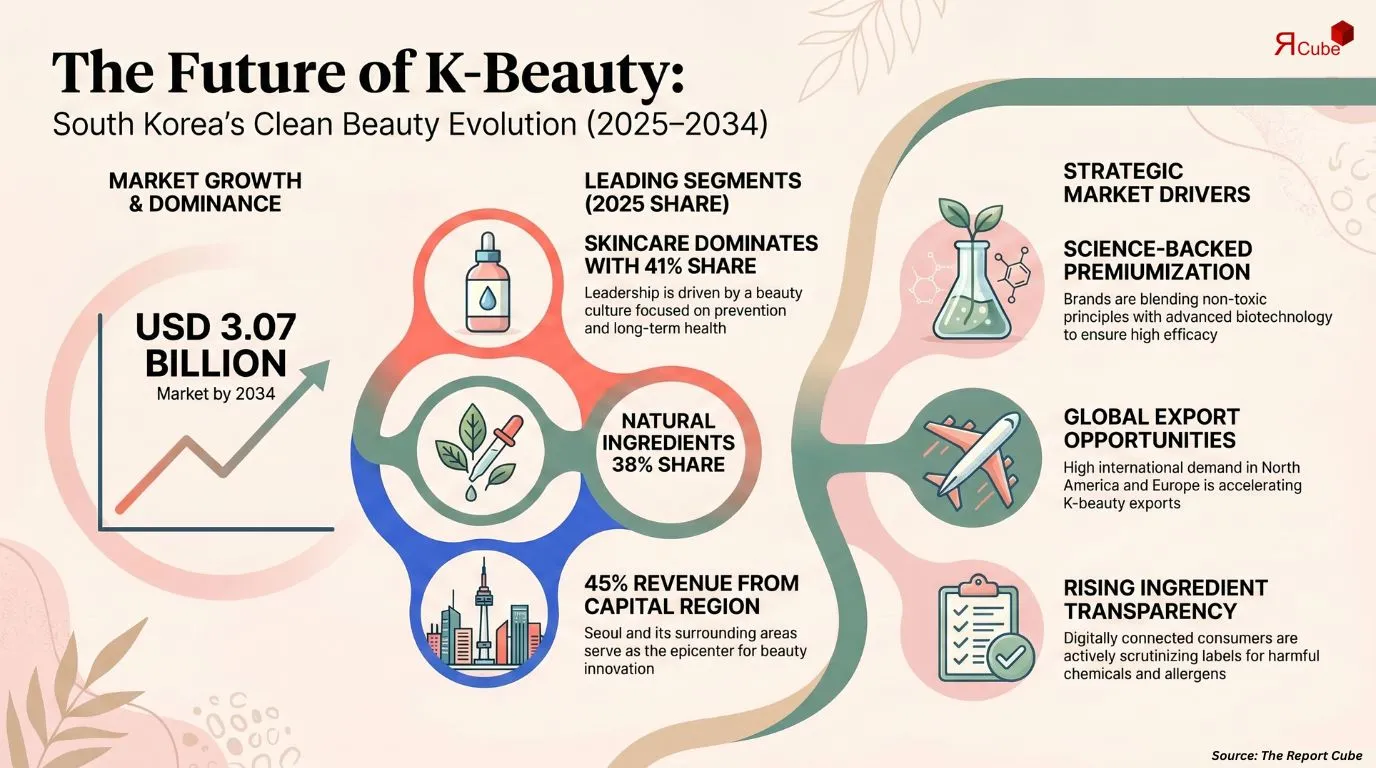
The South Korea Clean Beauty Products Market is anticipated to register a CAGR of 6.10% during 2026-2034. The market size was valued at USD 1.8 billion in 2025 and is projected to reach USD 3.07 billion by 2034. This robust growth outlook reflects South Korea’s strong position as a global beauty innovation hub, where consumer awareness around ingredient safety, sustainability, and ethical sourcing continues to shape purchasing decisions.
Clean beauty has evolved from a niche concept into a mainstream movement within South Korea’s highly competitive cosmetics industry. Consumers are increasingly scrutinizing ingredient labels, favoring products free from parabens, sulfates, synthetic fragrances, and harmful chemicals. This shift is closely aligned with the country’s advanced skincare culture, where long-term skin health, transparency, and product efficacy are prioritized. As a result, both legacy brands and emerging players are reformulating products and launching clean-label alternatives.
Moreover, South Korea’s strong digital ecosystem, social media influence, and beauty-focused retail channels have accelerated consumer education and adoption of clean beauty products. As domestic brands gain international recognition and exports of clean K-beauty products rise, the South Korea Clean Beauty Products Market is expected to maintain sustained momentum through the forecast period.
South Korea Clean Beauty Products Market Recent Developments
- 2025: Amorepacific expanded its clean skincare portfolio using plant-based and biodegradable ingredient formulations.
- 2025: LG H&H Co., Ltd. launched eco-certified clean beauty lines across premium and mass-market brands.
Government Initiatives & Policies
- Ministry of Food and Drug Safety (MFDS) Cosmetic Safety Policy: Strengthens ingredient transparency and consumer safety standards.
- Korea Green New Deal: Supports sustainable manufacturing, eco-friendly packaging, and low-carbon production.
South Korea Clean Beauty Products Market Dynamics
|
Market Dynamic |
Short Impact Analysis |
Impact Level |
|---|---|---|
|
Rising Consumer Awareness of Ingredient Transparency and Skin Health |
Consumers are actively choosing clean, safe, and skin-friendly products, increasing demand for natural, vegan, and cruelty-free beauty products across skincare and cosmetics. |
High |
|
Premiumization and Science-Backed Clean Formulations |
Brands are combining clean ingredients with advanced skincare technology, helping premium products gain stronger consumer trust and higher spending. |
High |
|
Higher Production Costs and Regulatory Compliance |
Expensive raw materials, certifications, and strict regulations increase operational costs, making it difficult for smaller brands to compete on pricing. |
Medium |
|
Expanding Global Demand for Clean K-Beauty Exports |
Growing international demand for clean K-beauty products is creating strong export opportunities, especially in North America and Europe. |
High |
|
Growing Focus on Sustainability and Ethical Beauty |
Eco-friendly packaging, cruelty-free testing, and sustainable sourcing are improving brand image and influencing purchase decisions among younger consumers. |
Medium |
Key Driver: Rising Consumer Awareness of Ingredient Transparency and Skin Health
The primary driver of the South Korea Clean Beauty Products Market is the growing consumer focus on ingredient safety, long-term skin health, and ethical product formulation. South Korean consumers are highly informed and digitally connected, frequently researching cosmetic ingredients through online platforms, beauty apps, and dermatology-backed content. This behavior has increased demand for products formulated with natural, organic, vegan, and cruelty-free ingredients. As concerns over skin sensitivity, allergies, and environmental impact rise, clean beauty products are increasingly perceived as safer and more trustworthy alternatives. This driver is closely connected to broader wellness trends and preventive skincare routines, reinforcing consistent demand across skincare, makeup, and personal care categories.
Book your FREE 30-minute expert consultation today
Contact UsIndustry Trends: Premiumization and Science-Backed Clean Formulations
An important trend shaping the South Korea Clean Beauty Products Market is the convergence of clean beauty principles with advanced dermatological science. Unlike early clean beauty concepts focused solely on natural ingredients, brands are now emphasizing clinically tested, science-backed formulations that deliver visible results while remaining non-toxic. Premium and luxury clean beauty brands are investing in biotechnology-derived ingredients, fermented extracts, and hypoallergenic formulations. This trend aligns with South Korea’s reputation for innovation-driven skincare and is supported by strong R&D capabilities. As a result, clean beauty is no longer positioned as a compromise on performance, but rather as a superior, high-efficacy solution.
Major Challenge: Higher Production Costs and Regulatory Compliance
Despite strong demand, higher production costs remain a key challenge in the South Korea Clean Beauty Products Market. Sourcing certified organic, vegan, or sustainably harvested ingredients often involves higher input costs compared to conventional alternatives. Additionally, compliance with strict domestic and international cosmetic safety regulations increases testing, documentation, and certification expenses. These factors can limit price competitiveness, particularly in the mass-market segment. Smaller brands may also face scalability challenges, which can restrict market penetration despite favorable consumer sentiment.
Opportunity: Expanding Global Demand for Clean K-Beauty Exports
A significant growth opportunity for the South Korea Clean Beauty Products Market lies in the rising global demand for clean K-beauty products. International consumers increasingly associate South Korean cosmetics with innovation, safety, and quality. Clean beauty positioning further strengthens export appeal in regions such as North America and Europe, where regulatory scrutiny and sustainability expectations are high. By leveraging strong branding, digital marketing, and cross-border e-commerce platforms, South Korean manufacturers are well-positioned to expand international sales and offset domestic market saturation.
South Korea Clean Beauty Products Market Segment-wise Analysis
By Product Type:
- Skincare
- Face Products
- Hair Care
- Lip Products
Skincare dominates the South Korea Clean Beauty Products Market, accounting for approximately 41% of total market share in 2025. This leadership is closely tied to South Korea’s skincare-centric beauty culture, where consumers invest heavily in daily routines focused on prevention and long-term skin health. Clean skincare products, including cleansers, serums, and moisturizers, benefit from strong trust in ingredient transparency and dermatological safety. As skincare often serves as the entry point for clean beauty adoption, growth in this segment positively influences demand across adjacent product categories.

By Ingredient Type:
- Natural Ingredients
- Organic Ingredients
- Hybrid Formulations
- Vegan Ingredients
Natural ingredients represent the leading ingredient type segment, holding nearly 38% market share. Consumers favor botanical extracts, fermented ingredients, and plant-based actives that align with clean beauty values while delivering proven efficacy. Hybrid formulations are also gaining momentum, blending natural and lab-engineered ingredients to enhance performance. This balanced approach supports scalability and addresses consumer expectations for both safety and results.
Regional Projection of South Korea Clean Beauty Products Industry
- Capital Region
- Central Region
- Honam Region
- Yeongnam Region
- Gangwon Region
- Jeju Region
The Capital Region leads the South Korea Clean Beauty Products Market, contributing approximately 45% of total revenue. Seoul and its surrounding areas serve as the epicenter of beauty innovation, premium retail, and digital commerce. Higher disposable incomes, trend-driven consumers, and strong presence of flagship stores and specialty beauty retailers support rapid adoption of clean beauty products. This regional dominance also influences nationwide trends, as product launches and marketing strategies tested in the Capital Region often expand to other regions, reinforcing its leadership throughout the forecast period.
Need insights for a specific region within this market?
Request Regional DataWhy Choose This Report?
- Provides a comprehensive overview of the overall market analysis, encompassing key trends, consumer behavior analysis, and risk assessment to support strategic decision-making.
- Provides accurate, up-to-date insights into market size, segmentation, and emerging opportunities, helping to minimize risk & capitalizing on growth.
- Gives deep understanding of target audience preferences, investment habits, and communication channels for enhanced product development & marketing effectiveness.
- Delivers competitive analysis & benchmarking, uncovering the strengths & weaknesses of market competitors to guide strategies.
- Consolidate comprehensive market intelligence, reducing reasoning & streamlining research efforts.
- Facilitates customized market segmentation & risk mitigation strategies, fine-tuned to the business objectives.
- Aids in identifying both market challenges & untapped opportunities within the industry to drive long-term business growth.
- Provides valuable information based on actual customer data & search trends.
Table of Contents
- Introduction
- Objective of the Study
- Product and Category Definition
- Market Segmentation
- Study Variables
- Research Methodology
- Secondary Data Points
- Breakdown of Secondary Sources
- Primary Data Points
- Breakdown of Primary Interviews
- Secondary Data Points
- Executive Summary
- Market Dynamics
- Drivers
- Challenges
- Opportunity Assessment
- Recent Trends and Developments
- Regulatory and Policy Landscape
- South Korea Clean Beauty Products Market Overview (2021-2034)
- Market Size, By Value (USD Billion)
- Market Share, By Product Type
- Skincare
- Face Products
- Hair Care
- Lip Products
- Fragrances
- Nail Care
- Oral Care
- Market Share, By Ingredient Type
- Natural Ingredients
- Organic Ingredients
- Hybrid Formulations
- Vegan Ingredients
- Others
- Market Share, By Form
- Gel
- Liquid
- Powder
- Market Share, By Consumer Group
- Millennials
- Gen Z
- Baby Boomers
- Gen X
- Market Share, By End User
- Women
- Men
- Kids
- Market Share, By Distribution Channel
- Online
- Supermarkets & Hypermarkets
- Specialty Stores
- Convenience Stores
- Others
- Market Share, By Category
- Mass Market
- Premium
- Luxury
- Market Share, By Region
- Capital Region
- Central Region
- Honam Region
- Yeongnam Region
- Gangwon Region
- Jeju Region
- Market Share, By Company
- Revenue Shares and Analysis
- Competitive Landscape
- Capital Region Clean Beauty Products Market
- Market Size, By Value (USD Billion)
- Market Share, By Product Type
- Market Share, By Ingredient Type
- Market Share, By Form
- Market Share, By Consumer Group
- Market Share, By End User
- Market Share, By Distribution Channel
- Market Share, By Category
- Central Region Clean Beauty Products Market
- Market Size, By Value (USD Billion)
- Market Share, By Product Type
- Market Share, By Ingredient Type
- Market Share, By Form
- Market Share, By Consumer Group
- Market Share, By End User
- Market Share, By Distribution Channel
- Market Share, By Category
- Honam Region Clean Beauty Products Market
- Market Size, By Value (USD Billion)
- Market Share, By Product Type
- Market Share, By Ingredient Type
- Market Share, By Form
- Market Share, By Consumer Group
- Market Share, By End User
- Market Share, By Distribution Channel
- Market Share, By Category
- Yeongnam Region Clean Beauty Products Market
- Market Size, By Value (USD Billion)
- Market Share, By Product Type
- Market Share, By Ingredient Type
- Market Share, By Form
- Market Share, By Consumer Group
- Market Share, By End User
- Market Share, By Distribution Channel
- Market Share, By Category
- Gangwon Region Clean Beauty Products Market
- Market Size, By Value (USD Billion)
- Market Share, By Product Type
- Market Share, By Ingredient Type
- Market Share, By Form
- Market Share, By Consumer Group
- Market Share, By End User
- Market Share, By Distribution Channel
- Market Share, By Category
- Jeju Region Clean Beauty Products Market
- Market Size, By Value (USD Billion)
- Market Share, By Product Type
- Market Share, By Ingredient Type
- Market Share, By Form
- Market Share, By Consumer Group
- Market Share, By End User
- Market Share, By Distribution Channel
- Market Share, By Category
- Competitive Outlook and Company Profiles
- Amorepacific Corporation
- Company Overview
- Product Portfolio
- Strategic Alliances/Partnerships
- Recent Developments
- LG H&H Co., Ltd.
- Company Overview
- Product Portfolio
- Strategic Alliances/Partnerships
- Recent Developments
- Innisfree Corporation
- Company Overview
- Product Portfolio
- Strategic Alliances/Partnerships
- Recent Developments
- The Face Shop Co., Ltd.
- Company Overview
- Product Portfolio
- Strategic Alliances/Partnerships
- Recent Developments
- Dr. Jart+ Co., Ltd.
- Company Overview
- Product Portfolio
- Strategic Alliances/Partnerships
- Recent Developments
- HERA Cosmetics
- Company Overview
- Product Portfolio
- Strategic Alliances/Partnerships
- Recent Developments
- Laneige Co., Ltd.
- Company Overview
- Product Portfolio
- Strategic Alliances/Partnerships
- Recent Developments
- Etude Co., Ltd.
- Company Overview
- Product Portfolio
- Strategic Alliances/Partnerships
- Recent Developments
- Olive Young Corporation
- Company Overview
- Product Portfolio
- Strategic Alliances/Partnerships
- Recent Developments
- Whamisa Co., Ltd.
- Company Overview
- Product Portfolio
- Strategic Alliances/Partnerships
- Recent Developments
- Others
- Amorepacific Corporation
- Contact Us and Disclaimer
Top Key Players & Market Share Outlook
- Amorepacific Corporation
- LG H&H Co., Ltd.
- Innisfree Corporation
- The Face Shop Co., Ltd.
- Dr. Jart+ Co., Ltd.
- HERA Cosmetics
- Laneige Co., Ltd.
- Etude Co., Ltd.
- Olive Young Corporation
- Whamisa Co., Ltd.
- Others
Frequently Asked Questions






