



Build Your Custom Market Intelligence Report
Customize Your ReportSouth Korea K-Beauty Market Insights & Analysis
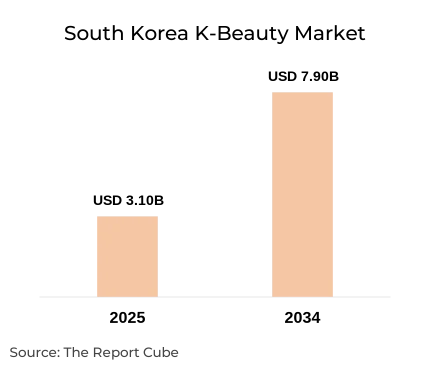
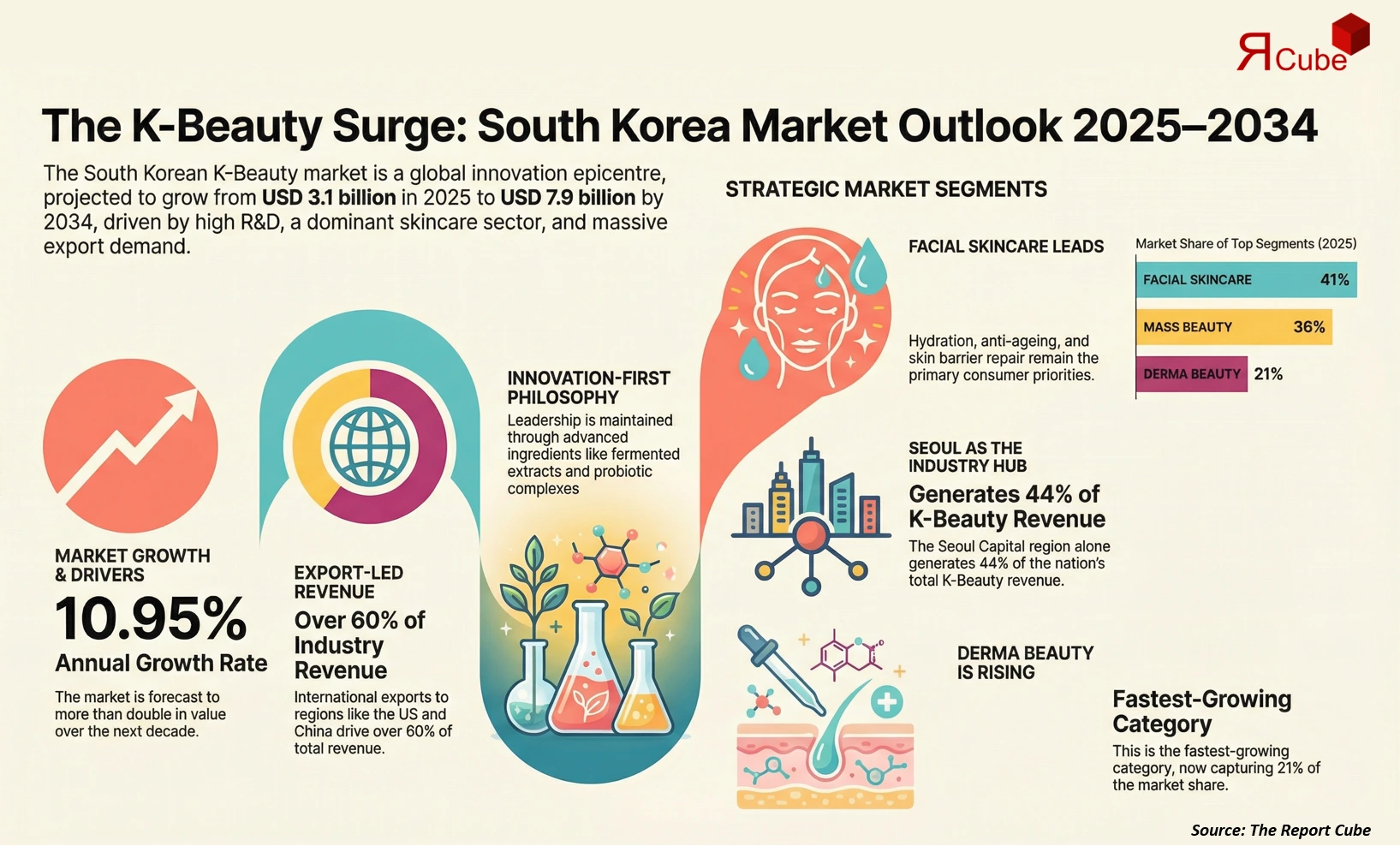
The South Korea K-Beauty Market is anticipated to register a CAGR of 10.95% during the forecast period 2026-2034. The market size was valued at USD 3.1 billion in 2025 and is projected to reach USD 7.9 billion by 2034. This strong growth trajectory reflects South Korea’s position as the global epicenter of beauty innovation, trendsetting formulations, and fast-paced product commercialization.
The market continues to benefit from global demand for Korean skincare philosophies that emphasize prevention, hydration, and skin barrier health. Domestically, rising disposable income, evolving grooming standards, and high consumer awareness around ingredients have strengthened repeat purchases across skincare and cosmetics categories. At the same time, international exports, especially to the United States, China, Japan, and Southeast Asia, have become a critical revenue pillar for Korean beauty brands.
Digital influence also plays a defining role in shaping the K-Beauty ecosystem. Social commerce, influencer-led product launches, and short product life cycles allow brands to respond rapidly to changing consumer preferences. Moreover, South Korea’s strong R&D capabilities, combined with dermatological expertise, continue to fuel innovation in clean beauty, derma cosmetics, and multifunctional skincare. These interconnected factors position the South Korea K-Beauty Market for sustained expansion through 2034.
South Korea K-Beauty Market Recent Developments
- 2025: Amorepacific expanded its clean beauty portfolio with eco-friendly packaging and sensitive-skin formulations.
- 2025: LG H&H launched advanced derma skincare lines targeting global pharmacy and dermatology channels.
Government Initiatives & Policies
- K-Beauty Global Expansion Program: Supports international market entry and export promotion for Korean beauty brands.
- Ministry of SMEs & Startups Cosmetics Support: Encourages R&D and overseas marketing for indie beauty brands.
South Korea K-Beauty Market Dynamics
Key Driver: Global Demand for Innovative and Skin-Centric Beauty Solutions
The primary driver of the South Korea K-Beauty Market is sustained global demand for innovative, skin-centric beauty solutions. Korean brands are widely recognized for introducing advanced ingredients such as fermented extracts, peptides, and probiotic complexes ahead of global trends. This innovation leadership has translated into strong export growth, with cosmetics exports accounting for over 60% of total industry revenue in recent years. Domestically, consumers demonstrate high product literacy and willingness to adopt new routines, reinforcing rapid product turnover. The emphasis on prevention-focused skincare, multi-step routines, and visible skin health outcomes continues to differentiate K-Beauty from traditional Western beauty models, driving consistent demand across premium and mass segments.
Industry Trends: Rise of Clean, Derma, and Personalized Beauty
A key trend reshaping the market is the rapid rise of clean beauty, derma cosmetics, and personalized skincare solutions. Consumers are increasingly scrutinizing ingredient transparency, sustainability, and clinical efficacy. As a result, brands are reformulating products to exclude harsh chemicals while highlighting dermatological testing and skin compatibility. Derma beauty, in particular, is gaining traction among consumers seeking medical-grade efficacy without prescription barriers. Personalized skincare, enabled by AI-driven skin diagnostics and online consultations, is also emerging as a differentiator for premium brands. These trends collectively elevate product value perception while encouraging higher average selling prices across categories.
Major Challenge: Intense Competition and Short Product Life Cycles
Despite strong growth prospects, intense competition remains a major challenge for the South Korea K-Beauty Market. The low barrier to entry has led to market saturation, with hundreds of brands competing for shelf space and digital visibility. Product life cycles are often short, requiring continuous innovation and marketing investment. Smaller brands face pressure to scale quickly or risk obsolescence, while larger players must balance speed with quality control. Additionally, global regulatory differences can delay international expansion, increasing compliance costs. These challenges necessitate agile supply chains and robust brand differentiation strategies.
Opportunity: Expansion of Male Grooming and Clean Beauty Segments
The expanding male grooming and clean beauty segments present significant growth opportunities. Changing cultural norms and increased media influence have normalized skincare and cosmetics usage among men, driving demand for targeted grooming products. Male grooming currently represents a fast-growing niche with double-digit growth rates. Simultaneously, clean beauty appeals to environmentally conscious consumers seeking ethical sourcing and sustainable packaging. Brands that successfully combine clean formulations with proven efficacy are well-positioned to capture premium market share. These segments offer long-term growth potential and help diversify revenue streams across the K-Beauty ecosystem.
South Korea K-Beauty Market Segment-wise Analysis
By Product:
- Facial Skincare
- Body Skincare
- Color Cosmetics
- Haircare
- Masks/Packs
Facial Skincare dominates the product segment, accounting for approximately 41% of the total market share in 2025. This leadership is driven by strong consumer focus on anti-aging, hydration, and skin barrier repair. Products such as essences, serums, and ampoules remain core revenue generators. Masks and packs follow closely, contributing nearly 18% market share due to their affordability and frequent usage. Color cosmetics and haircare continue to grow steadily, supported by hybrid formulations that combine skincare benefits with cosmetic performance. The strong interconnection between skincare and makeup sustains cross-category demand.
By Category:
- Premium Beauty
- Mass Beauty
- Derma Beauty
- Male Grooming
- Clean Beauty
Mass Beauty leads the category segmentation, holding nearly 36% of the market share, supported by accessibility and frequent product launches. However, Derma Beauty is the fastest-growing category, capturing around 21% share due to rising skin sensitivity concerns and dermatologist-backed credibility. Premium Beauty maintains a strong presence through innovation-led pricing strategies, while Clean Beauty is gaining momentum among younger consumers focused on sustainability. Male Grooming, though smaller in share, is expanding rapidly, reflecting evolving grooming habits and targeted product development.
Regional Projection of South Korea K-Beauty Industry
- Seoul Capital
- Yeongnam East
- Honam West
- Hoseo Central
The Seoul Capital region dominates the South Korea K-Beauty Market, accounting for approximately 44% of total revenue. As the country’s economic and cultural hub, Seoul hosts major brand headquarters, R&D centers, and trend-setting consumers. High retail density, advanced e-commerce penetration, and strong influencer culture reinforce regional leadership. Yeongnam East follows, supported by manufacturing clusters and export-oriented facilities. While Honam West and Hoseo Central hold smaller shares, government-backed industrial development and logistics investments are gradually strengthening their market presence. Seoul Capital is expected to maintain its lead throughout the forecast period.
Why Choose This Report?
- Provides a comprehensive overview of the overall market analysis, encompassing key trends, consumer behavior analysis, and risk assessment to support strategic decision-making.
- Provides accurate, up-to-date insights into market size, segmentation, and emerging opportunities, helping to minimize risk & capitalizing on growth.
- Gives deep understanding of target audience preferences, investment habits, and communication channels for enhanced product development & marketing effectiveness.
- Delivers competitive analysis & benchmarking, uncovering the strengths & weaknesses of market competitors to guide strategies.
- Consolidate comprehensive market intelligence, reducing reasoning & streamlining research efforts.
- Facilitates customized market segmentation & risk mitigation strategies, fine-tuned to the business objectives.
- Aids in identifying both market challenges & untapped opportunities within the industry to drive long-term business growth.
- Provides valuable information based on actual customer data & search trends.
Table of Contents
- Introduction
- Objective of the Study
- Product and Category Definition
- Market Segmentation
- Study Variables
- Research Methodology
- Secondary Data Points
- Breakdown of Secondary Sources
- Primary Data Points
- Breakdown of Primary Interviews
- Secondary Data Points
- Executive Summary
- Market Dynamics
- Drivers
- Challenges
- Opportunity Assessment
- Recent Trends and Developments
- Regulatory and Policy Landscape
- South Korea K-Beauty Market Overview (2021-2034)
- Market Size, By Value (USD Million)
- Market Share, By Product
- Facial Skincare
- Body Skincare
- Color Cosmetics
- Haircare
- Masks/Packs
- Market Share, By Category
- Premium Beauty
- Mass Beauty
- Derma Beauty
- Male Grooming
- Clean Beauty
- Market Share, By Channel Type
- Department Stores
- Drugstores
- Hypermarkets
- Online/E-commerce
- Brand Boutiques
- Market Share, By Customer Group
- Teens
- Young Adults
- Adults
- Seniors
- Market Share, By Region
- Seoul Capital
- Yeongnam East
- Honam West
- Hoseo Central
- Market Share, By Company
- Competition Characteristics
- Revenue Shares & Analysis
- Seoul Capital K-Beauty Market
- Market Size, By Value (USD Million)
- Market Share, By Product
- Market Share, By Category
- Market Share, By Channel Type
- Market Share, By Customer Group
- Yeongnam East K-Beauty Market
- Market Size, By Value (USD Million)
- Market Share, By Product
- Market Share, By Category
- Market Share, By Channel Type
- Market Share, By Customer Group
- Honam West K-Beauty Market
- Market Size, By Value (USD Million)
- Market Share, By Product
- Market Share, By Category
- Market Share, By Channel Type
- Market Share, By Customer Group
- Hoseo Central K-Beauty Market
- Market Size, By Value (USD Million)
- Market Share, By Product
- Market Share, By Category
- Market Share, By Channel Type
- Market Share, By Customer Group
- Competitive Outlook and Company Profiles
- Amorepacific Corp
- Company Overview
- Brand Portfolio
- Strategic Alliances/Partnerships
- Recent Developments
- LG H&H Co Ltd
- Company Overview
- Brand Portfolio
- Strategic Alliances/Partnerships
- Recent Developments
- The Face Shop Inc
- Company Overview
- Brand Portfolio
- Strategic Alliances/Partnerships
- Recent Developments
- Innisfree Corp
- Company Overview
- Brand Portfolio
- Strategic Alliances/Partnerships
- Recent Developments
- Tonymoly Co Ltd
- Company Overview
- Brand Portfolio
- Strategic Alliances/Partnerships
- Recent Developments
- Clio Cosmetics Co
- Company Overview
- Brand Portfolio
- Strategic Alliances/Partnerships
- Recent Developments
- Cosrx Inc
- Company Overview
- Brand Portfolio
- Strategic Alliances/Partnerships
- Recent Developments
- Nature Republic
- Company Overview
- Brand Portfolio
- Strategic Alliances/Partnerships
- Recent Developments
- Banila Co
- Company Overview
- Brand Portfolio
- Strategic Alliances/Partnerships
- Recent Developments
- Dr Jart Plus
- Company Overview
- Brand Portfolio
- Strategic Alliances/Partnerships
- Recent Developments
- Others
- Amorepacific Corp
- Contact Us and Disclaimer
Top Key Players & Market Share Outlook
- Amorepacific Corp
- LG H&H Co Ltd
- The Face Shop Inc
- Innisfree Corp
- Tonymoly Co Ltd
- Clio Cosmetics Co
- Cosrx Inc
- Nature Republic
- Banila Co
- Dr Jart Plus
- Others
Frequently Asked Questions






