



Build Your Custom Market Intelligence Report
Customize Your ReportIndia Apparel & Footwear Market Insights & Analysis
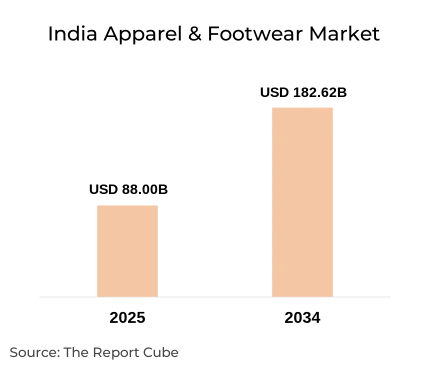
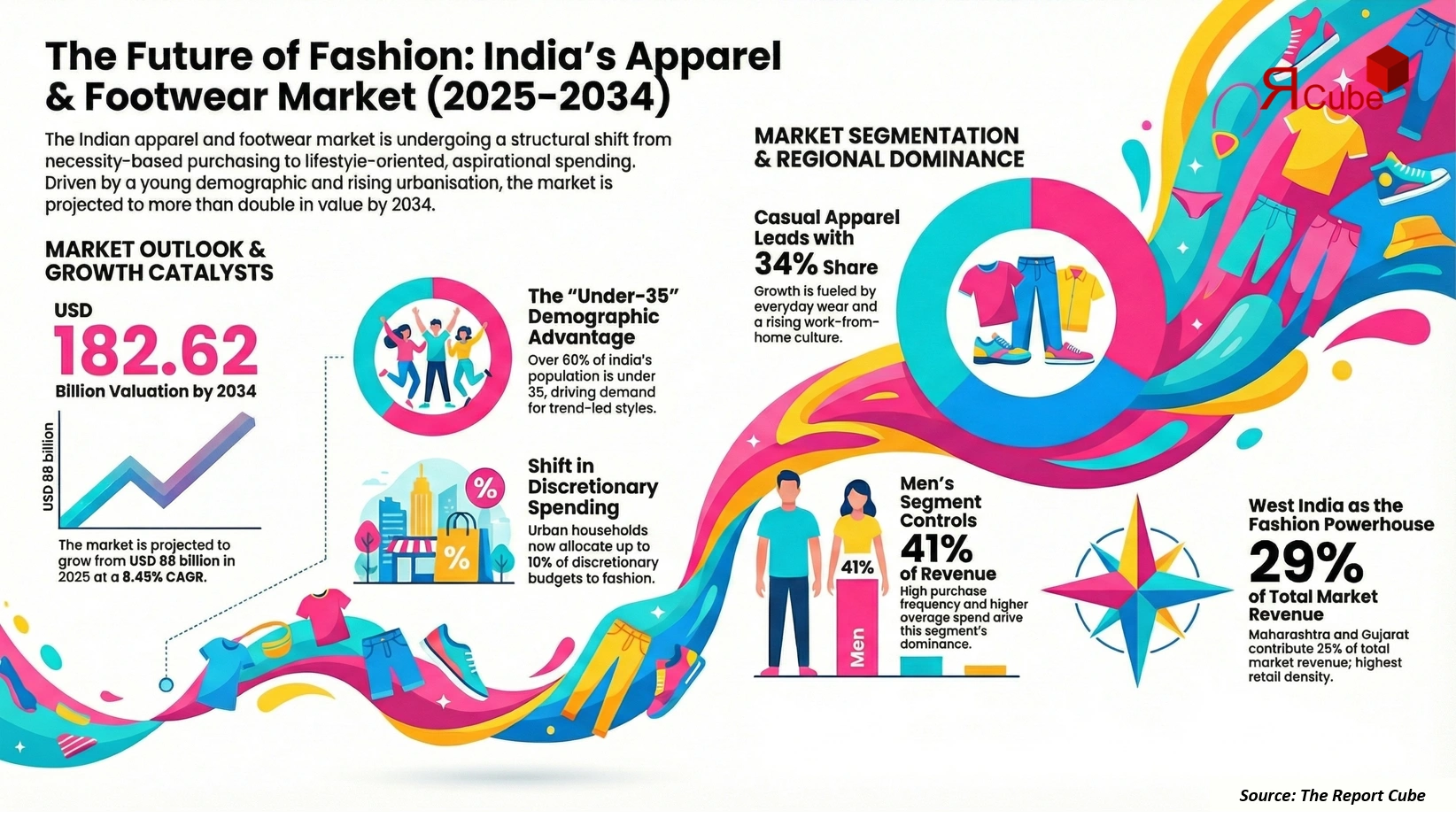
The India Apparel & Footwear Market is anticipated to register a 8.45% CAGR during 2026-2034. The market size was valued at USD 88 Billion in 2025 and is projected to reach USD 182.62 Billion by 2034. This growth is strongly anchored in India’s expanding middle-income population, rising urbanization, and the increasing influence of fashion consciousness across age groups. Apparel and footwear are no longer viewed purely as necessity-driven categories; instead, they increasingly reflect lifestyle preferences, brand identity, and aspirational spending. The surge of organized retail, growth of omnichannel platforms, and deep penetration of e-commerce into tier-2 and tier-3 cities have widened product accessibility and price transparency.
Additionally, favorable demographics with over 60% of the population under 35 continue to fuel demand for trend-driven casual wear, sportswear, and affordable branded footwear. Policy support for domestic manufacturing, coupled with rising private-label strategies by large retailers, further strengthens market fundamentals. Collectively, these factors position the India apparel and footwear industry as one of the most resilient and structurally sound consumer markets through 2034.
India Apparel & Footwear Market Recent Developments
- 2025: Reliance Retail Fashion expanded its private-label apparel portfolio, targeting value-driven consumers across tier-2 and tier-3 cities.
- 2025: Campus Activewear launched new mass-premium sneaker collections to strengthen its youth-focused retail presence.
Government Initiatives & Policies
- Production Linked Incentive (PLI) Scheme for Textiles: Supports large-scale manufacturing of man-made fiber apparel to boost exports and domestic capacity.
- PM MITRA Parks Scheme: Establishes integrated textile parks to improve supply-chain efficiency and reduce production costs.
India Apparel & Footwear Market Dynamics
Key Driver: Rising disposable income and fashion-led consumption
Rising disposable income and a strong shift toward fashion-led consumption remain the primary drivers of the India apparel and footwear market. Over the past decade, household spending on discretionary categories has increased steadily, with apparel and footwear capturing a growing share of monthly consumer budgets. Urban households now allocate nearly 8-10% of discretionary spending to clothing and footwear, compared to approximately 6% a decade earlier. Increased workforce participation, especially among women, has accelerated demand for formal and semi-formal wear, while younger consumers prioritize casual and athleisure styles. Social media influence, celebrity endorsements, and fast-fashion cycles have shortened trend adoption timelines, encouraging higher purchase frequency. In parallel, improved credit access through buy-now-pay-later and no-cost EMI options further supports premium product uptake. These dynamics collectively strengthen consumption momentum across both mass and premium segments.
Industry Trends: Premiumization, athleisure growth, and omnichannel retail
The Indian apparel and footwear industry is experiencing clear structural trends centered on premiumization, athleisure expansion, and omnichannel retail integration. Sportswear and casual apparel categories are growing nearly 1.4 times faster than traditional formal wear, driven by hybrid work culture and lifestyle-oriented dressing. Athleisure now accounts for an estimated 18-20% of total apparel sales in urban markets, supported by growing health awareness and fitness participation. Brands are also investing heavily in omnichannel strategies, blending online discovery with offline experience centers and faster last-mile delivery. Data-driven inventory planning and localized assortments help retailers reduce markdown risks while improving sell-through ratios. Additionally, sustainability-focused collections using recycled fabrics and ethical sourcing are gaining traction among urban consumers, enhancing brand loyalty and long-term value perception.
Major Challenge: Intense price competition and margin pressure
Despite robust demand, intense price competition remains a major challenge for the India apparel and footwear market. A fragmented vendor landscape, aggressive discounting during festive and online sales, and rapid entry of direct-to-consumer brands have placed pressure on operating margins. Rising raw material costs, logistics expenses, and compliance requirements further compress profitability, particularly for mid-sized players. Consumers exhibit high price sensitivity, frequently switching brands based on promotions rather than loyalty. Additionally, managing inventory cycles in fashion-driven categories increases the risk of unsold stock and markdown losses. To mitigate these challenges, leading players are investing in private labels, backward integration, and demand forecasting tools to maintain margin stability while remaining price competitive.
Opportunity: Private labels, regional fashion, and kidswear expansion
Significant growth opportunities lie in private-label expansion, regional fashion integration, and the rapidly growing kidswear segment. Private labels allow retailers to improve gross margins by 6-10 percentage points while offering competitively priced products. Regional apparel, including ethnic and fusion wear, continues to see strong demand during festivals and weddings, particularly in non-metro markets. Kidswear is emerging as a high-growth sub-segment, supported by rising nuclear families and increased spending per child. Organized kidswear retail is expanding at an estimated double-digit rate, driven by brand trust, quality assurance, and design variety. Companies that align design innovation with efficient sourcing and localized merchandising are well positioned to capture these emerging opportunities.
India Apparel & Footwear Market Segment-wise Analysis
By Product Type:
- Casual Apparel
- Formal Apparel
- Ethnic Apparel
- Sportswear Apparel
- Non-Athletic Footwear
- Athletic Footwear
Casual apparel represents the leading product segment, accounting for an estimated 34% share of total market revenue. Growth is driven by everyday wear demand, work-from-home culture, and increased preference for comfort-led clothing. Sportswear apparel and athletic footwear are the fastest-growing categories, expanding at rates exceeding the overall market average due to fitness adoption and youth-centric branding. Ethnic apparel maintains strong relevance during festive seasons, contributing stable revenue volumes. Footwear demand remains evenly split between non-athletic and athletic categories, with sneakers and casual shoes gaining prominence in urban markets.
By End User:
- Men
- Women
- Kids
The men’s segment leads the market with approximately 41% revenue share, supported by higher purchase frequency and greater average spend per transaction. Women’s apparel and footwear follow closely, driven by workforce participation and expanding fashion variety across price points. The kids segment, though smaller in absolute value, is growing at a faster pace, supported by higher brand awareness among parents and increased focus on quality and durability. Retailers are actively expanding kidswear-exclusive formats to capitalize on this momentum.
Regional Projection of India Apparel & Footwear Industry
- North India
- West India
- South India
- East India
- Central India
West India leads the India apparel and footwear market, contributing an estimated 29% of total revenue, driven by strong urban consumption in Maharashtra and Gujarat. High retail density, fashion-forward consumers, and strong presence of organized retail support regional dominance. North India follows closely, supported by wedding-driven ethnic wear demand and strong winter apparel sales. South India demonstrates consistent growth due to higher per-capita income and brand-conscious consumers, while East and Central India offer long-term growth potential as organized retail penetration improves.
Why Choose This Report?
- Provides a comprehensive overview of market trends, consumer behavior, and competitive risks.
- Delivers accurate insights into market size, segmentation, and future growth potential.
- Enhances understanding of investment patterns and demand drivers.
- Offers detailed competitive benchmarking and strategic intelligence.
- Reduces research effort through consolidated and structured market insights.
- Supports customized segmentation and expansion strategies.
- Identifies market challenges and untapped growth opportunities.
- Leverages real-world demand patterns and industry signals.
Table of Contents
- Introduction
- Objective of the Study
- Product and Category Definition
- Market Segmentation
- Study Variables
- Research Methodology
- Secondary Data Points
- Breakdown of Secondary Sources
- Primary Data Points
- Breakdown of Primary Interviews
- Secondary Data Points
- Executive Summary
- Market Dynamics
- Drivers
- Challenges
- Opportunity Assessment
- Recent Trends and Developments
- Regulatory and Policy Landscape
- India Apparel & Footwear Market Overview (2021-2034)
- Market Size, By Value (USD Billion)
- Market Share, By Product Type
- Casual Apparel
- Formal Apparel
- Ethnic Apparel
- Sportswear Apparel
- Non Athletic Footwear
- Athletic Footwear
- Market Share, By End User
- Men
- Women
- Kids
- Market Share, By Price Range
- Value
- Mid Range
- Premium
- Luxury
- Market Share, By Distribution Channel
- Department Stores
- Specialty Stores
- Supermarkets Hypermarkets
- Exclusive Brand Outlets
- Ecommerce Platforms
- Others
- Market Share, By Region
- North India
- West India
- South India
- East India
- Central India
- Market Share, By Company
- Revenue Shares
- Competitive Landscape
- North India Apparel & Footwear Market
- Market Size, By Value (USD Billion)
- Market Share, By Product Type
- Market Share, By End User
- Market Share, By Price Range
- Market Share, By Distribution Channel
- West India Apparel & Footwear Market
- Market Size, By Value (USD Billion)
- Market Share, By Product Type
- Market Share, By End User
- Market Share, By Price Range
- Market Share, By Distribution Channel
- South India Apparel & Footwear Market
- Market Size, By Value (USD Billion)
- Market Share, By Product Type
- Market Share, By End User
- Market Share, By Price Range
- Market Share, By Distribution Channel
- East India Apparel & Footwear Market
- Market Size, By Value (USD Billion)
- Market Share, By Product Type
- Market Share, By End User
- Market Share, By Price Range
- Market Share, By Distribution Channel
- Central India Apparel & Footwear Market
- Market Size, By Value (USD Billion)
- Market Share, By Product Type
- Market Share, By End User
- Market Share, By Price Range
- Market Share, By Distribution Channel
- Competitive Outlook and Company Profiles
- Reliance Retail Fashion
- Company Overview
- Brand Portfolio
- Strategic Alliances Partnerships
- Recent Developments
- Aditya Birla Fashion
- Company Overview
- Brand Portfolio
- Strategic Alliances Partnerships
- Recent Developments
- Tata Trent Fashion
- Company Overview
- Brand Portfolio
- Strategic Alliances Partnerships
- Recent Developments
- Shoppers Stop Limited
- Company Overview
- Brand Portfolio
- Strategic Alliances Partnerships
- Recent Developments
- Arvind Fashions Limited
- Company Overview
- Brand Portfolio
- Strategic Alliances Partnerships
- Recent Developments
- Page Industries Limited
- Company Overview
- Brand Portfolio
- Strategic Alliances Partnerships
- Recent Developments
- Bata India Limited
- Company Overview
- Product Portfolio
- Strategic Alliances Partnerships
- Recent Developments
- Relaxo Footwears Limited
- Company Overview
- Product Portfolio
- Strategic Alliances Partnerships
- Recent Developments
- Metro Brands Limited
- Company Overview
- Product Portfolio
- Strategic Alliances Partnerships
- Recent Developments
- Campus Activewear Limited
- Company Overview
- Product Portfolio
- Strategic Alliances Partnerships
- Recent Developments
- Others
- Reliance Retail Fashion
- Contact Us and Disclaimer
Top Key Players & Market Share Outlook
- Reliance Retail Fashion
- Aditya Birla Fashion
- Tata Trent Fashion
- Shoppers Stop Limited
- Arvind Fashions Limited
- Page Industries Limited
- Bata India Limited
- Relaxo Footwears Limited
- Metro Brands Limited
- Campus Activewear Limited
- Others
Frequently Asked Questions






