



Build Your Custom Market Intelligence Report
Customize Your ReportGlobal Footwear Market Insights & Analysis
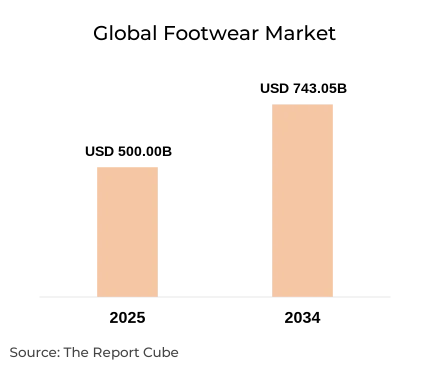
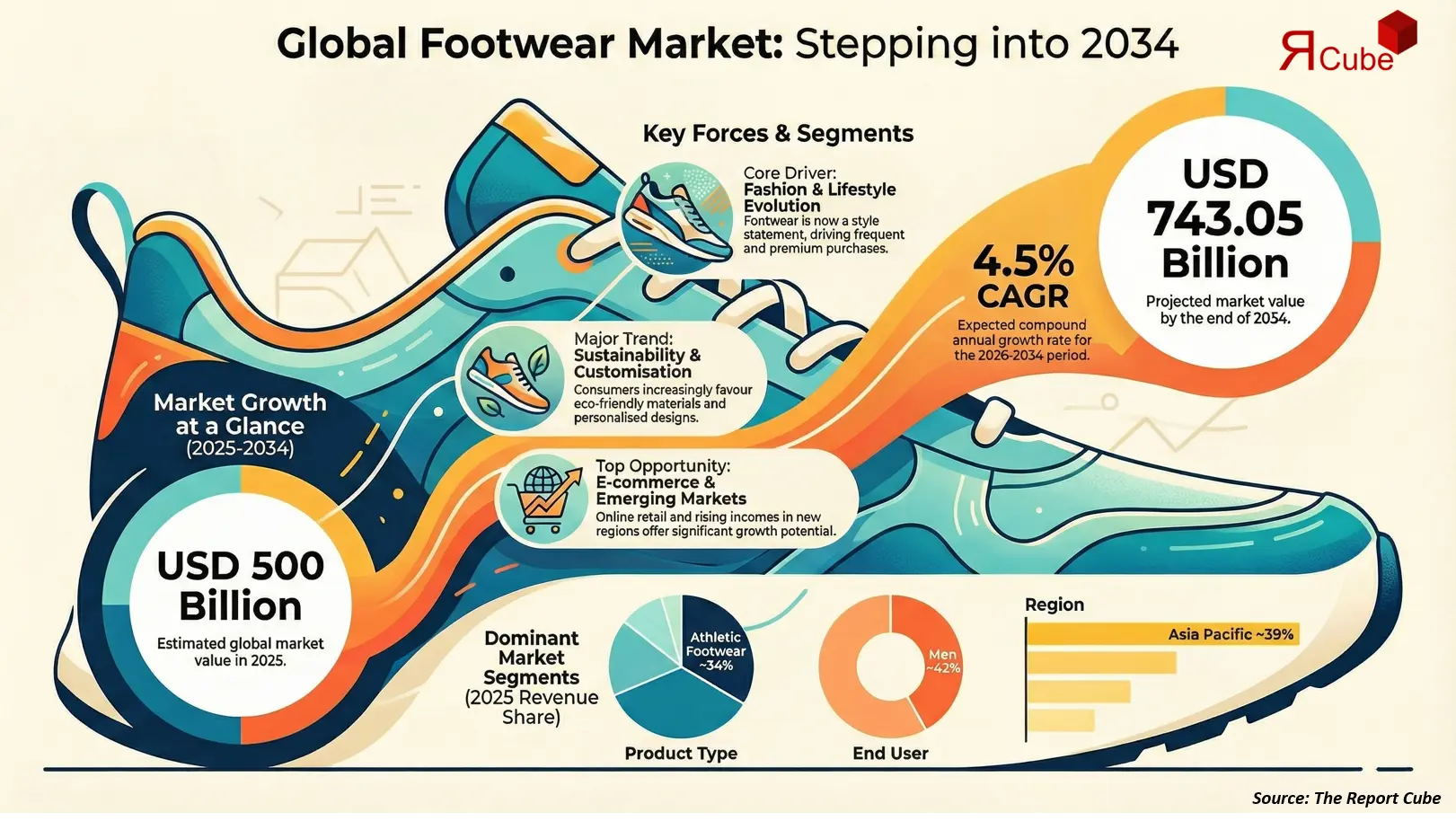
The Global Footwear Market is anticipated to register a CAGR of 4.5% during the forecast period 2026-2034. The market size was valued at USD 500 Billion in 2025 and is projected to reach USD 743.05 Billion by 2034. This steady growth is driven by rising consumer spending on apparel and lifestyle products, increasing urbanization, and evolving fashion trends across both developed and emerging economies. Footwear has transitioned from being a purely functional necessity to a key fashion and lifestyle statement, significantly influencing purchasing behavior.
The global footwear industry reflects a dynamic blend of fashion, performance, and utility. Changing consumer preferences, increasing health awareness, and growing participation in sports and outdoor activities are reshaping demand patterns. At the same time, rapid expansion of e-commerce platforms and direct-to-consumer brand strategies is transforming distribution models. Footwear manufacturers are focusing on innovation in materials, comfort, sustainability, and design to differentiate products in a highly competitive market. As income levels rise and fashion consciousness spreads globally, the footwear market continues to expand steadily.
Global Footwear Market Recent Developments
- 2025: Nike expanded its sustainable footwear portfolio using recycled and bio-based materials.
- 2025: Adidas increased direct-to-consumer sales through enhanced digital and customization platforms.
Government Initiatives & Policies
- EU Circular Economy Action Plan: Encourages sustainable materials and recycling in footwear manufacturing.
- India Production Linked Incentive (PLI) Scheme for Footwear: Supports domestic manufacturing and exports.
Global Footwear Market Dynamics
Key Driver: Rising Fashion Awareness and Lifestyle Changes
The primary driver of the global footwear market is rising fashion awareness and lifestyle evolution among consumers. Footwear is increasingly viewed as an extension of personal style, driving frequent purchases and premiumization. Social media influence, celebrity endorsements, and fast-fashion cycles accelerate trend adoption. Additionally, rising health awareness and fitness participation are boosting demand for athletic and performance footwear. These combined factors are driving consistent demand across multiple footwear categories, supporting long-term market growth.
Major Challenge: Volatile Raw Material Costs and Supply Chain Pressures
A major challenge for the footwear market is volatility in raw material prices and ongoing supply chain disruptions. Materials such as leather, rubber, textiles, and synthetic polymers are subject to price fluctuations due to environmental regulations, labor costs, and geopolitical factors. Supply chain complexity, particularly in global sourcing and manufacturing hubs, can impact production timelines and margins. Managing cost efficiency while maintaining product quality remains a critical challenge for footwear manufacturers.
Industry Trends: Sustainable and Customized Footwear
An important trend shaping the footwear market is the growing emphasis on sustainability and product customization. Consumers are increasingly favoring eco-friendly footwear made from recycled, vegan, and low-impact materials. Brands are also investing in customization technologies that allow consumers to personalize designs, colors, and fit. These trends are enhancing brand loyalty and supporting premium pricing strategies, particularly in developed markets.
Opportunity Ahead: Expansion in Emerging Markets and E-commerce
Significant growth opportunities exist in emerging economies and online retail channels. Rising disposable incomes, expanding middle-class populations, and urbanization in Asia Pacific, Latin America, and Africa are driving footwear demand. E-commerce platforms enable brands to reach wider audiences with lower overhead costs. The integration of digital marketing, virtual try-on technologies, and omnichannel strategies is expected to further accelerate market penetration and revenue growth.
Global Footwear Market Segment-wise Analysis
By Product Type:
- Athletic Footwear
- Non-Athletic Footwear
- Outdoor and Performance Footwear
- Formal and Dress Footwear
- Casual and Fashion Footwear
- Others
Athletic footwear dominates the product type segment, accounting for approximately 34% of total market revenue in 2025. Demand is driven by sports participation, fitness trends, and athleisure fashion. Casual and fashion footwear represents a significant share due to everyday wear demand and fast-changing fashion trends. Outdoor and performance footwear is growing steadily, supported by rising interest in trekking and adventure sports, while formal footwear shows stable demand linked to corporate and occasion wear.
By End User:
- Men
- Women
- Children
The men’s segment holds the largest market share at nearly 42% in 2025, driven by strong demand for athletic, casual, and formal footwear. The women’s segment is growing rapidly due to increasing fashion consciousness and expanding product variety. Children’s footwear represents a stable segment, supported by population growth, school-going demand, and frequent replacement cycles due to rapid growth.
Regional Projection of Global Footwear Industry
- North America
- Europe
- Asia Pacific
- Middle East and Africa
- South America
Asia Pacific leads the global footwear market, accounting for approximately 39% of total revenue in 2025. The region benefits from large consumer populations, strong manufacturing bases, and rising disposable incomes in countries such as China, India, and Vietnam. North America and Europe follow, driven by premium footwear demand and brand-conscious consumers. The Middle East and Africa and South America represent emerging growth regions with increasing urbanization and retail expansion.
Why Choose This Report?
- Provides a comprehensive overview of the global footwear market and consumer trends.
- Delivers accurate, up-to-date insights into market size, segmentation, and growth outlook.
- Offers deep understanding of fashion, performance, and lifestyle footwear demand.
- Presents competitive analysis & benchmarking of leading global footwear brands.
- Consolidates market intelligence to support strategic planning and investment decisions.
- Supports customized segmentation and regional market assessment.
- Identifies challenges and untapped opportunities within the footwear industry.
- Grounded in real-world consumer behavior, fashion trends, and retail dynamics.
Table of Contents
- Introduction
- Objective of the Study
- Product and Category Definition
- Market Segmentation
- Study Variables
- Research Methodology
- Secondary Data Points
- Breakdown of Secondary Sources
- Primary Data Points
- Breakdown of Primary Interviews
- Secondary Data Points
- Executive Summary
- Market Dynamics
- Drivers
- Challenges
- Opportunity Assessment
- Recent Trends and Developments
- Regulatory and Policy Landscape
- Global Footwear Market Overview (2020-2034)
- Market Size, By Value (USD Billion)
- Market Share, By Product Type
- Athletic Footwear
- Non Athletic Footwear
- Outdoor and Performance Footwear
- Formal and Dress Footwear
- Casual and Fashion Footwear
- Others
- Market Share, By End User
- Men
- Women
- Children
- Market Share, By Material
- Leather
- Synthetic and Non Leather Materials
- Textiles and Knit Materials
- Rubber and Plastic
- Sustainable and Recycled Materials
- Market Share, By Distribution Channel
- Supermarkets and Hypermarkets
- Specialty and Branded Stores
- Department Stores
- Online and E Commerce
- Other Retail Channels
- Market Share, By Price Range
- Economy Footwear
- Mid Range Footwear
- Premium and Luxury Footwear
- Market Share, By Region
- North America
- Europe
- Asia Pacific
- Middle East and Africa
- South America
- Market Share, By Company
- Revenue Shares
- Competitive Landscape
- North America Footwear Market
- Market Size, By Value (USD Billion)
- Market Share, By Product Type
- Market Share, By End User
- Market Share, By Material
- Market Share, By Distribution Channel
- Market Share, By Price Range
- Market Share, By Country
- United States
- Canada
- Mexico
- Europe Footwear Market
- Market Size, By Value (USD Billion)
- Market Share, By Product Type
- Market Share, By End User
- Market Share, By Material
- Market Share, By Distribution Channel
- Market Share, By Price Range
- Market Share, By Country
- Germany
- United Kingdom
- France
- Italy
- Spain
- Northern and Nordic Countries
- Rest of Europe
- Asia Pacific Footwear Market
- Market Size, By Value (USD Billion)
- Market Share, By Product Type
- Market Share, By End User
- Market Share, By Material
- Market Share, By Distribution Channel
- Market Share, By Price Range
- Market Share, By Country
- China
- India
- Japan
- South Korea
- Australia and New Zealand
- Rest of Asia Pacific
- Middle East and Africa Footwear Market
- Market Size, By Value (USD Billion)
- Market Share, By Product Type
- Market Share, By End User
- Market Share, By Material
- Market Share, By Distribution Channel
- Market Share, By Price Range
- Market Share, By Country
- Saudi Arabia
- United Arab Emirates
- South Africa
- Rest of Middle East and Africa
- South America Footwear Market
- Market Size, By Value (USD Billion)
- Market Share, By Product Type
- Market Share, By End User
- Market Share, By Material
- Market Share, By Distribution Channel
- Market Share, By Price Range
- Market Share, By Country
- Brazil
- Argentina
- Rest of South America
- Competitive Outlook and Company Profiles
- Nike
- Company Overview
- Footwear Product Portfolio
- Strategic Alliances and Partnerships
- Recent Developments
- Adidas
- Company Overview
- Footwear Product Portfolio
- Strategic Alliances and Partnerships
- Recent Developments
- Puma
- Company Overview
- Footwear Product Portfolio
- Strategic Alliances and Partnerships
- Recent Developments
- Skechers
- Company Overview
- Footwear Product Portfolio
- Strategic Alliances and Partnerships
- Recent Developments
- New Balance
- Company Overview
- Footwear Product Portfolio
- Strategic Alliances and Partnerships
- Recent Developments
- Asics
- Company Overview
- Footwear Product Portfolio
- Strategic Alliances and Partnerships
- Recent Developments
- Under Armour
- Company Overview
- Footwear Product Portfolio
- Strategic Alliances and Partnerships
- Recent Developments
- Vans
- Company Overview
- Footwear Product Portfolio
- Strategic Alliances and Partnerships
- Recent Developments
- Bata
- Company Overview
- Footwear Product Portfolio
- Strategic Alliances and Partnerships
- Recent Developments
- Woodland
- Company Overview
- Footwear Product Portfolio
- Strategic Alliances and Partnerships
- Recent Developments
- Others
- Nike
- Contact Us and Disclaimer
Top Key Players & Market Share Outlook
- Nike
- Adidas
- Puma
- Skechers
- New Balance
- Asics
- Under Armour
- Vans
- Bata
- Woodland
- Others
Frequently Asked Questions