



Build Your Custom Market Intelligence Report
Customize Your ReportGlobal Athletic Footwear Market Insights & Analysis
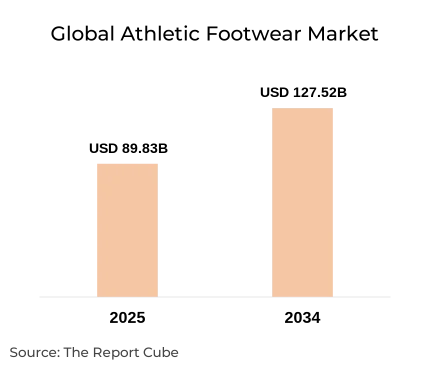
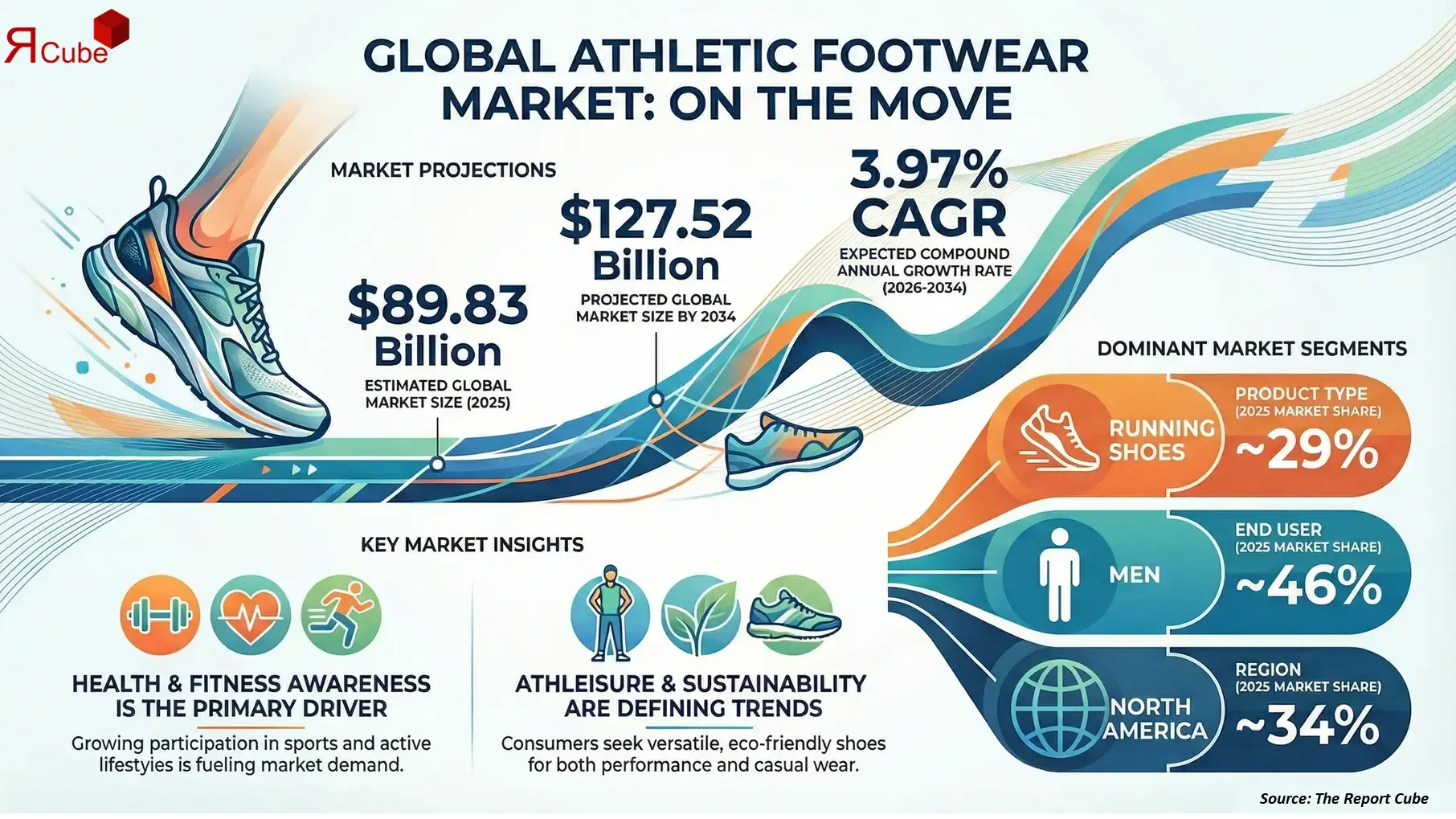
The Global Athletic Footwear Market is anticipated to register a CAGR of 3.97% during the forecast period 2026-2034. The market size was valued at USD 89.83 Billion in 2025 and is projected to reach USD 127.52 Billion by 2034. This steady growth reflects the rising global focus on health, fitness, and active lifestyles, coupled with increasing participation in sports, recreational activities, and everyday athleisure usage. Athletic footwear has evolved beyond performance-centric applications and is now widely adopted as a lifestyle product, driven by fashion trends, brand influence, and comfort-oriented design.
Consumer awareness around physical fitness, obesity prevention, and mental well-being continues to support consistent demand for athletic footwear across age groups. Technological innovation in cushioning, sole materials, breathability, and sustainability is enhancing product value and replacement cycles. Additionally, the rapid expansion of e-commerce, direct-to-consumer channels, and influencer-driven marketing has widened global brand reach. Emerging economies, particularly in Asia Pacific, are contributing incremental demand as disposable incomes rise and sports participation becomes more mainstream.
Global Athletic Footwear Market Recent Developments
- 2025: Nike expanded its sustainable footwear line, increasing the use of recycled and bio-based materials.
- 2025: Adidas introduced advanced running shoe models focused on energy return and injury reduction.
Government Initiatives & Policies
- U.S. Physical Activity Guidelines: Promotes regular physical activity, indirectly supporting demand for sports footwear.
- Fit India Movement: Encourages fitness and sports participation nationwide, boosting athletic apparel and footwear consumption.
Global Athletic Footwear Market Dynamics
Key Driver: Growing Health and Fitness Awareness
The primary driver of the global athletic footwear market is the increasing consumer focus on health, fitness, and active living. Rising awareness of lifestyle-related health issues such as obesity, cardiovascular diseases, and stress has encouraged participation in physical activities including running, walking, gym workouts, and outdoor sports. Athletic footwear plays a critical role in injury prevention, comfort, and performance, making it an essential purchase for both casual and professional users. Government-backed fitness campaigns, corporate wellness programs, and the normalization of athleisure wear further support consistent demand across urban and semi-urban populations.
Major Challenge: Intense Competition and Price Sensitivity
A key challenge impacting the athletic footwear market is intense competition among global brands, regional players, and private labels. The presence of numerous alternatives places pressure on pricing, margins, and brand differentiation. Consumers, particularly in emerging markets, remain price-sensitive and often prioritize affordability over premium features. Additionally, counterfeit products and unorganized local athletic footwear manufacturers pose challenges by offering low-cost alternatives. These factors compel established brands to continuously invest in marketing, innovation, and supply chain efficiency to maintain market share.
Industry Trends: Rise of Athleisure and Sustainable Footwear
An important trend shaping the market is the growing popularity of athleisure footwear that blends performance with casual wear aesthetics. Consumers increasingly seek versatile shoes suitable for workouts, daily wear, and social settings. Sustainability is another defining trend, with brands focusing on eco-friendly materials, recyclable components, and reduced carbon footprints. Environmentally conscious consumers, particularly younger demographics, are influencing purchasing decisions, prompting manufacturers to integrate sustainability into product design and branding strategies.
Opportunity Ahead: Expansion in Emerging Markets and E-Commerce
Emerging economies present significant growth opportunities due to rising disposable incomes, urbanization, and expanding sports culture. Asia Pacific, Latin America, and parts of the Middle East are witnessing growing adoption of athletic footwear driven by younger populations and increased digital connectivity. The rapid growth of e-commerce and omnichannel retail allows brands to reach consumers directly, personalize offerings, and improve margins. Companies that invest in digital engagement, localized designs, and competitive pricing are well positioned to capture untapped demand.
Global Athletic Footwear Market Segment-wise Analysis
By Product Type:
- Running Shoes
- Sports and Training Shoes
- Walking Shoes
- Trekking and Hiking Shoes
- Aerobic and Gym Shoes
- Other Athletic Footwear
Running shoes represent the leading product segment, accounting for approximately 29% of global market revenue in 2025. Their dominance is supported by widespread participation in running and jogging as accessible fitness activities. Sports and training shoes follow closely, driven by gym memberships and functional training trends. Trekking and hiking shoes show steady growth due to rising interest in outdoor and adventure activities.
By End User:
- Men
- Women
- Children
The men segment dominates the market, contributing nearly 46% of total revenue in 2025, supported by higher participation in sports and fitness activities. However, the women segment is growing at a faster pace due to increasing female participation in sports, fitness awareness, and expanding women-specific product lines. Children’s athletic footwear maintains steady demand driven by school sports and recreational activities.
Regional Projection of Global Athletic Footwear Industry
- North America
- Europe
- Asia Pacific
- Middle East and Africa
- South America
North America leads the global athletic footwear market, accounting for approximately 34% of total revenue in 2025. The region benefits from strong sports culture, high consumer spending, and the presence of leading brands such as Nike, Under Armour, and New Balance. Europe follows with stable demand supported by fitness trends and premium brand adoption. Asia Pacific represents the fastest-growing region due to large population base, rising disposable incomes, and increasing sports participation, particularly in China and India.
Why Choose This Report?
- Provides a comprehensive overview of the overall market analysis, encompassing key trends, consumer behavior analysis, and risk assessment to support strategic decision-making.
- Provides accurate, up-to-date insights into market size, segmentation, and emerging opportunities, helping to minimize risk & capitalizing on growth.
- Gives deep understanding of target audience preferences, investment habits, and communication channels for enhanced product development & marketing effectiveness.
- Delivers competitive analysis & benchmarking, uncovering the strengths & weaknesses of market competitors to guide strategies.
- Consolidate comprehensive market intelligence, reducing reasoning & streamlining research efforts.
- Facilitates customized market segmentation & risk mitigation strategies, fine-tuned to the business objectives.
- Aids in identifying both market challenges & untapped opportunities within the industry to drive long-term business growth.
- Provides valuable information based on actual customer data & search trends.
Table of Contents
- Introduction
- Objective of the Study
- Product and Category Definition
- Market Segmentation
- Study Variables
- Research Methodology
- Secondary Data Points
- Breakdown of Secondary Sources
- Primary Data Points
- Breakdown of Primary Interviews
- Secondary Data Points
- Executive Summary
- Market Dynamics
- Drivers
- Challenges
- Opportunity Assessment
- Recent Trends and Developments
- Regulatory and Policy Landscape
- Global Athletic Footwear Market Overview (2020-2034)
- Market Size, By Value (USD Billion)
- Market Share, By Product Type
- Running Shoes
- Sports and Training Shoes
- Walking Shoes
- Trekking and Hiking Shoes
- Aerobic and Gym Shoes
- Other Athletic Footwear
- Market Share, By End User
- Men
- Women
- Children
- Market Share, By Price Range
- Economy and Mass Market
- Mid Range
- Premium and Luxury
- Market Share, By Distribution Channel
- Sports and Athletic Goods Stores
- Brand and Specialty Stores
- Supermarkets and Hypermarkets
- Online Retail and E Commerce
- Other Retail Channels
- Market Share, By Usage
- Professional and Performance Sports
- Recreational and Lifestyle
- Work and Occupational Use
- Market Share, By Region
- North America
- Europe
- Asia Pacific
- Middle East and Africa
- South America
- Market Share, By Company
- Revenue Shares
- Competitive Landscape
- North America Athletic Footwear Market
- Market Size, By Value (USD Billion)
- Market Share, By Product Type
- Market Share, By End User
- Market Share, By Price Range
- Market Share, By Distribution Channel
- Market Share, By Usage
- Market Share, By Country
- United States
- Canada
- Mexico
- Europe Athletic Footwear Market
- Market Size, By Value (USD Billion)
- Market Share, By Product Type
- Market Share, By End User
- Market Share, By Price Range
- Market Share, By Distribution Channel
- Market Share, By Usage
- Market Share, By Country
- Germany
- United Kingdom
- France
- Italy
- Spain
- Northern and Nordic Countries
- Rest of Europe
- Asia Pacific Athletic Footwear Market
- Market Size, By Value (USD Billion)
- Market Share, By Product Type
- Market Share, By End User
- Market Share, By Price Range
- Market Share, By Distribution Channel
- Market Share, By Usage
- Market Share, By Country
- China
- India
- Japan
- South Korea
- Australia and New Zealand
- Rest of Asia Pacific
- Middle East and Africa Athletic Footwear Market
- Market Size, By Value (USD Billion)
- Market Share, By Product Type
- Market Share, By End User
- Market Share, By Price Range
- Market Share, By Distribution Channel
- Market Share, By Usage
- Market Share, By Country
- Saudi Arabia
- United Arab Emirates
- South Africa
- Rest of Middle East and Africa
- South America Athletic Footwear Market
- Market Size, By Value (USD Billion)
- Market Share, By Product Type
- Market Share, By End User
- Market Share, By Price Range
- Market Share, By Distribution Channel
- Market Share, By Usage
- Market Share, By Country
- Brazil
- Argentina
- Rest of South America
- Competitive Outlook and Company Profiles
- Nike
- Company Overview
- Product Portfolio
- Strategic Alliances and Partnerships
- Recent Developments
- Adidas
- Company Overview
- Product Portfolio
- Strategic Alliances and Partnerships
- Recent Developments
- Puma
- Company Overview
- Product Portfolio
- Strategic Alliances and Partnerships
- Recent Developments
- Skechers
- Company Overview
- Product Portfolio
- Strategic Alliances and Partnerships
- Recent Developments
- New Balance
- Company Overview
- Product Portfolio
- Strategic Alliances and Partnerships
- Recent Developments
- ASICS
- Company Overview
- Product Portfolio
- Strategic Alliances and Partnerships
- Recent Developments
- Under Armour
- Company Overview
- Product Portfolio
- Strategic Alliances and Partnerships
- Recent Developments
- Fila
- Company Overview
- Product Portfolio
- Strategic Alliances and Partnerships
- Recent Developments
- Anta Sports
- Company Overview
- Product Portfolio
- Strategic Alliances and Partnerships
- Recent Developments
- Li Ning
- Company Overview
- Product Portfolio
- Strategic Alliances and Partnerships
- Recent Developments
- Others
- Nike
- Contact Us and Disclaimer
Top Key Players & Market Share Outlook
- Nike
- Adidas
- Puma
- Skechers
- New Balance
- ASICS
- Under Armour
- Fila
- Anta Sports
- Li Ning
- Others
Frequently Asked Questions






