



Build Your Custom Market Intelligence Report
Customize Your ReportKey Takeaways
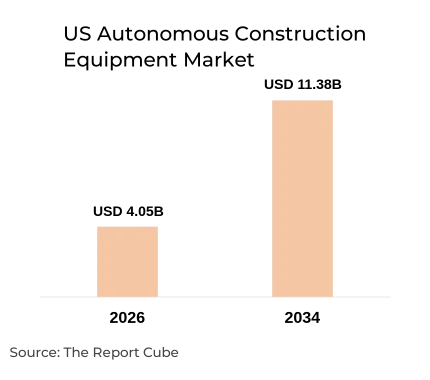
- US Autonomous Construction Equipment Market is valued at USD 4.05 billion in 2026.
- The market is projected to reach USD 11.38 billion by 2034, expanding at a CAGR of 13.78%.
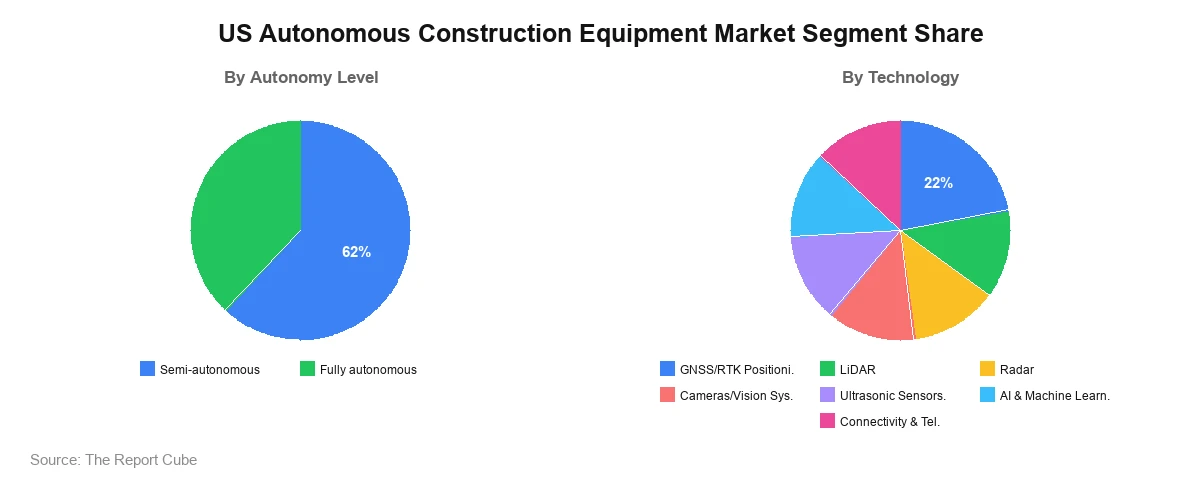
- Semi-autonomous equipment leads the autonomy level segment with an estimated 62% share in 2026.
- GNSS/RTK positioning leads the technology segment with an estimated 22% share in 2026.
- The North region leads geographically with an estimated 32% share in 2026.
- End-user shares were not supplied; contractors, mining companies, public agencies and rental firms form the demand base.
- Caterpillar, Komatsu, Bobcat, Volvo CE and Built Robotics are among the key players.
- Integration of AI software, positioning, sensors and telematics is a defining technology theme.
Market Overview
Autonomous construction equipment refers to excavators, dozers, loaders, compactors, haul trucks and related machines that perform earthmoving tasks with limited or no operator input. These systems combine positioning, perception, control software and connectivity to execute defined work cycles. Applications include excavation, grading, hauling, paving, trenching and demolition across construction, mining and infrastructure worksites.
The US Autonomous Construction Equipment Market Analysis is shaped by workforce replacement needs, infrastructure maintenance and safety requirements. The Bureau of Labor Statistics projects about 42,500 annual openings for construction equipment operators over 2025–2035, many from retirements and occupational exits. This indicates workforce pressure, although it does not directly measure autonomous equipment demand. The market is valued at USD 4.05 billion in 2026 and is projected to reach USD 11.38 billion by 2034. Semi-autonomous machines hold an estimated 62% share in 2026, while GNSS/RTK positioning, AI software and telematics support wider deployment. The market is projected to grow at a CAGR of 13.78% during 2026–2034.
US Autonomous Construction Equipment Market Dynamics
Demand for autonomous construction equipment is influenced by operator availability, infrastructure activity, safety obligations, technology integration costs and competition among equipment manufacturers and autonomy specialists. Government sources describe workforce and robotics-safety conditions but do not directly quantify autonomous equipment revenue, so the assessments below are qualitative.
|
Factor |
Type |
Specific Impact on Market |
Magnitude |
|---|---|---|---|
|
Operator workforce replacement |
Driver |
About 42,500 projected annual operator openings (2025–2035) create an incentive to evaluate automation |
Medium (qualitative) |
|
Infrastructure construction and maintenance |
Driver |
Road, bridge, water and sewer repair creates applications for guidance and automation in excavation and grading |
Medium (qualitative) |
|
Retrofit and integration services |
Opportunity |
Existing fleets may be upgraded with guidance, sensors, positioning and telematics; the US retrofit market is not officially quantified |
Medium (qualitative) |
|
Robotics and machinery safety |
Challenge |
Hazards during non-routine tasks require risk assessment, procedures and safeguards |
Medium–High (qualitative) |
|
Operator training and integration |
Challenge |
Autonomy changes operator duties, maintenance routines and worksite coordination |
Medium (qualitative) |
|
OEM and AI-specialist partnerships |
Trend |
Caterpillar–FieldAI and Komatsu–AIM collaborations show growing emphasis on AI-based autonomy |
Medium–High (qualitative) |
US Autonomous Construction Equipment Market Growth Drivers
Workforce replacement is a principal driver. The Bureau of Labor Statistics projects about 42,500 annual openings for construction equipment operators during 2025–2035, many from retirements and occupational exits. This supports evaluation of automation for repetitive tasks, and US Autonomous Construction Equipment Market Growth depends on whether contractors convert that interest into purchases, which official data do not yet quantify.
Infrastructure activity adds application demand. The Bureau of Labor Statistics identifies repair needs for roads, bridges, water systems and sewer systems alongside new infrastructure construction. These tasks include excavation, grading and site preparation, where machine guidance and automation can be applied. The evidence establishes construction context rather than measured autonomous equipment sales.
US Autonomous Construction Equipment Market Opportunities
Controlled and repetitive workflows offer the clearest entry point. Grading, excavation, hauling and material handling can suit automation where site conditions and tasks are sufficiently predictable. Contractors and equipment providers would need to assess task suitability and safeguards first, consistent with OSHA robotics guidance. This commercial opportunity is an analytical inference, not a government forecast.
Retrofit and integration services present a second opportunity. Existing fleets may be upgraded with machine-guidance kits, sensors, positioning systems and telematics where compatible with the equipment and worksite. Integration, maintenance, training and safety requirements would need evaluation. This is a strategic hypothesis, as official sources do not quantify the US retrofit market.
US Autonomous Construction Equipment Industry Challenges
Robotics safety is a central constraint. The Occupational Safety and Health Administration identifies risks during non-routine activities such as programming, testing, maintenance, setup and adjustment. Autonomous construction systems therefore require risk assessment, operating procedures and safeguards. OSHA’s guidance addresses robotics generally and is not an autonomous-construction market study, so sector-specific compliance requirements need confirmation.
Operational integration adds complexity. The Bureau of Labor Statistics describes equipment operation as controlling, maneuvering, maintaining and monitoring heavy machinery. Autonomous systems can change operator responsibilities, maintenance routines and worksite coordination. This is an operational implication of those duties rather than a quantified estimate of adoption costs, which remain unverified.
Need Specific Data, Let’s Customize the Report for You
Request CustomizationUS Autonomous Construction Equipment Market Trends
A defining direction in US Autonomous Construction Equipment Market Trends is the move from mining-proven autonomy into construction. Caterpillar previewed five autonomous construction machines at CES 2026, including excavators, dozers and compactors, and later showed its Cat CS12 autonomous soil compactor at CONEXPO-CON/AGG 2026, extending autonomy beyond mining fleets into earthmoving workflows.
A second direction is partnership between equipment manufacturers and AI specialists. Komatsu and AIM Intelligent Machines announced a partnership in July 2026 for autonomous bulldozers and excavators, while Caterpillar announced a collaboration with FieldAI in September 2026. These announcements indicate growing emphasis on AI-based autonomy, though they do not establish adoption rates.
US Autonomous Construction Equipment Market Segment Analysis
The US Autonomous Construction Equipment Market Share is distributed across autonomy levels, enabling technologies, distribution channels, applications and end users. Estimated 2026 shares were supplied only for the leading autonomy level and technology segments, so the other categories are described qualitatively.
By Autonomy Level
- Semi-autonomous
- Fully autonomous
Semi-autonomous equipment leads the autonomy level segment with an estimated 62% share in 2026, reflecting operation models in which machines perform defined tasks such as grading, trenching or hauling while operators or site supervisors retain oversight. This configuration aligns with the safeguards and risk assessment expected under robotics safety guidance and with existing fleets that can be upgraded through guidance and sensor systems. It also allows incremental adoption within existing workflows. Fully autonomous equipment follows, supported by commercial introductions such as Caterpillar’s Cat CS12 autonomous compactor and Built Robotics’ autonomous earthmoving systems, although supplied data do not quantify its share or growth rate.
By Technology
- GNSS/RTK Positioning
- LiDAR
- Radar
- Cameras/Vision Systems
- Ultrasonic Sensors
- AI & Machine Learning Software
- Connectivity & Telematics (IoT/5G/V2X)
GNSS/RTK positioning leads the technology segment with an estimated 22% share in 2026, as high-precision location data underpins machine guidance for excavation, grading and site preparation. LiDAR, radar, cameras and vision systems and ultrasonic sensors provide perception for obstacle detection and surroundings awareness, while AI and machine learning software processes sensor data to plan and execute tasks. Connectivity and telematics, including IoT, 5G and V2X, link machines to fleet management and site coordination systems. Caterpillar describes its autonomy as built on AI, machine learning, computer vision and edge computing, and Komatsu offers Smart Construction through EARTHBRAIN. Technology-level growth rates were not supplied, so no fastest-growing segment is identified.
Regional Analysis
|
Region |
Estimated Market Share |
Key Growth Factors |
Industry Trends |
|---|---|---|---|
|
West |
- |
Construction and infrastructure activity (qualitative; regional data not supplied) |
Evaluation of autonomy for earthwork and site preparation |
|
Southwest |
- |
Construction and infrastructure activity (qualitative; regional data not supplied) |
Interest in productivity and workforce-related automation |
|
North |
32% |
Largest supplied regional share in 2026 |
Adoption of guidance, sensing and autonomy systems |
|
Midwest |
- |
Earthmoving and clean-energy site work (qualitative) |
Early autonomous earthmoving deployments reported in Kansas and Missouri |
North is the leading region with an estimated 32% share in 2026, according to the supplied segmentation. Regional shares for West, Southwest and Midwest were not supplied and are not estimated here. The leading position of the North indicates a comparatively larger revenue base, although the supplied data do not identify the underlying drivers.
The remaining 68% is distributed across the West, Southwest and Midwest. Regional demand patterns are expected to reflect differences in construction activity, infrastructure maintenance needs, mining presence and equipment fleet composition, with the Bureau of Labor Statistics identifying road, bridge, water and sewer repair as national activity. State-level regulations governing autonomous equipment require confirmation before regional comparisons are finalized.
Market Share & Competitive Landscape
The US Autonomous Construction Equipment Market includes global construction and mining equipment manufacturers alongside autonomy and retrofit specialists. The table summarizes supplied companies by general capability and segment. It does not represent numerical market share, and US-specific autonomy offerings should be validated where noted.
|
Company |
Competitive Strength |
Primary Segment Served |
|---|---|---|
|
Caterpillar Inc. |
More than 30 years of autonomous mining experience; five autonomous construction machines previewed in 2026 |
Excavators, dozers, compactors and loaders |
|
Komatsu Ltd. |
Construction and mining equipment with Smart Construction digital solutions through EARTHBRAIN |
Autonomous dozers and hydraulic excavators |
|
Bobcat Company |
Compact construction equipment portfolio; autonomy activity not verified in this report |
Compact equipment |
|
Volvo Construction Equipment |
Construction equipment portfolio; autonomy activity not verified in this report |
Construction equipment |
|
Built Robotics |
Autonomous systems for excavators, dozers and skid steers, including retrofit-style kits |
Earthmoving and clean-energy site work |
|
XCMG |
Construction machinery manufacturer; US autonomy activity not verified |
Construction equipment |
|
Hitachi Construction Machinery Co. Ltd. |
Construction and mining machinery manufacturer; US autonomy activity not verified |
Construction and mining equipment |
|
Doosan Infracore |
Construction equipment manufacturer; US autonomy activity not verified |
Construction equipment |
|
JCB |
Construction equipment manufacturer; US autonomy activity not verified |
Construction equipment |
|
SafeAI |
Autonomy and retrofit technology for heavy vehicles across manufacturers; reported as acquired by Pronto in July 2025 |
Construction and mining retrofit |
Key Companies in the US Autonomous Construction Equipment Market
Caterpillar Inc.: Caterpillar, headquartered in Irving, Texas, has deployed autonomous machines in mining for more than 30 years. Its autonomous mining fleet has moved over 11 billion tonnes of material. In 2026 it previewed five autonomous construction machines, positioning its mining autonomy experience as a competitive strength.
Komatsu Ltd.: Komatsu Ltd., headquartered in Tokyo, Japan, supplies construction and mining equipment and has more than a century of engineering history. Its Smart Construction platform is delivered with EARTHBRAIN, and a July 2026 partnership with AIM Intelligent Machines targets autonomous dozers and excavators, with machines already operating at US customer jobsites.
Recent Developments
|
Year / Month |
Company |
Development |
|---|---|---|
|
July 2025 |
SafeAI / Pronto |
SafeAI was reported as acquired by Pronto. |
|
January 2026 |
Caterpillar |
Previewed five autonomous construction machines and the Cat AI Assistant at CES 2026. |
|
March 2026 |
Caterpillar |
Showcased the Cat CS12 autonomous soil compactor at CONEXPO-CON/AGG 2026. |
|
July 2026 |
Komatsu |
Announced a strategic partnership with AIM Intelligent Machines for autonomous bulldozers and hydraulic excavators (31 July). |
|
September 2026 |
Caterpillar |
Announced a collaboration with FieldAI on physical AI and autonomous systems for construction sites. |
US Autonomous Construction Equipment Market Future Outlook
The US Autonomous Construction Equipment Market Forecast indicates growth from USD 4.05 billion in 2026 to USD 11.38 billion by 2034 at a CAGR of 13.78%, based on supplied estimates. Growth is expected to depend on operator availability, infrastructure activity, the maturity of GNSS/RTK, sensing and AI software, and the pace at which semi-autonomous machines transition toward higher autonomy during the forecast period.
Competition is likely to involve established manufacturers, autonomy specialists and software partners, as shown by recent collaborations involving Caterpillar, Komatsu, FieldAI and AIM Intelligent Machines. Risks include robotics safety requirements, operator training, integration costs and uncertain adoption across varied jobsites. The projections remain supplied assumptions rather than guaranteed outcomes, and actual results will depend on regulation, supplier execution and contractor capital spending.
US Autonomous Construction Equipment Market Report Coverage
This US Autonomous Construction Equipment Market Report summarizes the supplied valuation, forecast assumptions, segmentation, regional framework and competitive ecosystem.
|
Parameter |
Details |
|---|---|
|
Market Name |
US Autonomous Construction Equipment Market |
|
Market Size 2026 |
USD 4.05 billion |
|
Market Size 2034 |
USD 11.38 billion |
|
Forecast Period |
2026–2034 |
|
CAGR |
13.78% |
|
Base Year |
2026 |
|
Historical Years |
2021-2025 |
|
Forecast Years |
2026–2034 |
|
Segments Covered |
By Autonomy Level; By Technology; By Distribution Channel; By Application; By End User |
|
Regions Covered |
West, Southwest, North, Midwest |
|
Key Companies |
Caterpillar Inc., Komatsu Ltd., Bobcat Company, Volvo Construction Equipment, Built Robotics, XCMG, Hitachi Construction Machinery Co. Ltd., Doosan Infracore, JCB, SafeAI |
|
Customization |
Available as per client requirements |
Why Choose This US Autonomous Construction Equipment Market Report?
- Market coverage of autonomous construction equipment across construction, mining, infrastructure and rental channels.
- Clear presentation of the supplied 2026 valuation, 2034 forecast and 13.78% CAGR.
- Segmentation across five categories, with leading shares disclosed where supplied.
- Regional framework covering West, Southwest, North and Midwest, including the North’s 32% share.
- Competitive profiling of ten manufacturers, technology providers and autonomy specialists.
- Trend and forecast insights to support product planning, partnership evaluation and market-entry assessment.
- Context from workforce and robotics-safety evidence relevant to adoption planning.
Table of Contents
- Introduction
- Objective of the Study
- Product Definition
- Market Segmentation
- Study Variables
- Research Methodology
- Secondary Data Points
- Companies Interviewed
- Primary Data Points
- Breakdown of Primary Interviews
- Secondary Data Points
- Executive Summary
- Market Dynamics
- Drivers
- Challenges
- Opportunity Assessment
- Recent Trends and Developments
- Policy and Regulatory Landscape
- US Autonomous Construction Equipment Market Overview and Forecast Analysis (2021-2034)
- Market Size, By Value, By Growth Rate (CAGR/USD Billions)
- Demand – Supply Trends
- Market Share, By Autonomy Level
- Semi-autonomous
- Fully autonomous
- Market Share, By Technology
- GNSS/RTK Positioning
- LiDAR
- Radar
- Cameras/Vision Systems
- Ultrasonic Sensors
- AI & Machine Learning Software
- Connectivity & Telematics (IoT/5G/V2X)
- Market Share, By Distribution Channel
- OEM Direct Sales
- Dealer/Distributor Network
- Equipment Rental/Leasing Companies
- Aftermarket Retrofit/Integrator Channels
- Market Share, By Application
- Earthmoving & Excavation
- Grading & Site Preparation
- Hauling & Material Transport
- Paving & Road Construction
- Trenching & Utility Installation
- Demolition
- Market Share, By End User
- Construction Contractors
- Mining Companies
- Infrastructure & Public Works Agencies
- Equipment Rental Companies
- Market Share, By Region
- West
- Southwest
- North
- Midwest
- Market Share, By Competitors
- Competition Characteristics
- Revenue Shares
- Semi-autonomous US Autonomous Construction Equipment Market Overview, 2021-2034F
- By Value (USD Million)
- By Technology – Market Size & Forecast 2021-2034, USD Million
- GNSS/RTK Positioning
- LiDAR
- Radar
- Cameras/Vision Systems
- Ultrasonic Sensors
- AI & Machine Learning Software
- Connectivity & Telematics (IoT/5G/V2X)
- Fully autonomous US Autonomous Construction Equipment Market Overview, 2021-2034F
- By Value (USD Million)
- By Technology – Market Size & Forecast 2021-2034, USD Million
- GNSS/RTK Positioning
- LiDAR
- Radar
- Cameras/Vision Systems
- Ultrasonic Sensors
- AI & Machine Learning Software
- Connectivity & Telematics (IoT/5G/V2X)
- Competitive Outlook (Company Profile – Partial List)
- Caterpillar Inc.
- Company Overview
- Business Segments
- Strategic Alliances/Partnerships
- Recent Developments
- Komatsu Ltd.
- Company Overview
- Business Segments
- Strategic Alliances/Partnerships
- Recent Developments
- Bobcat Company
- Company Overview
- Business Segments
- Strategic Alliances/Partnerships
- Recent Developments
- Volvo Construction Equipment
- Company Overview
- Business Segments
- Strategic Alliances/Partnerships
- Recent Developments
- Built Robotics
- Company Overview
- Business Segments
- Strategic Alliances/Partnerships
- Recent Developments
- XCMG
- Company Overview
- Business Segments
- Strategic Alliances/Partnerships
- Recent Developments
- Hitachi Construction Machinery Co. Ltd.
- Company Overview
- Business Segments
- Strategic Alliances/Partnerships
- Recent Developments
- Doosan Infracore
- Company Overview
- Business Segments
- Strategic Alliances/Partnerships
- Recent Developments
- JCB
- Company Overview
- Business Segments
- Strategic Alliances/Partnerships
- Recent Developments
- SafeAI
- Company Overview
- Business Segments
- Strategic Alliances/Partnerships
- Recent Developments
- Caterpillar Inc.
- Contact Us & Disclaimer
Top Key Players & Market Share Outlook
- Caterpillar Inc.
- Komatsu Ltd.
- Bobcat Company
- Volvo Construction Equipment
- Built Robotics
- XCMG
- Hitachi Construction Machinery Co. Ltd.
- Doosan Infracore
- JCB
- SafeAI
Frequently Asked Questions