



Build Your Custom Market Intelligence Report
Customize Your ReportAustralia Autonomous Trucks Market Key Takeaways
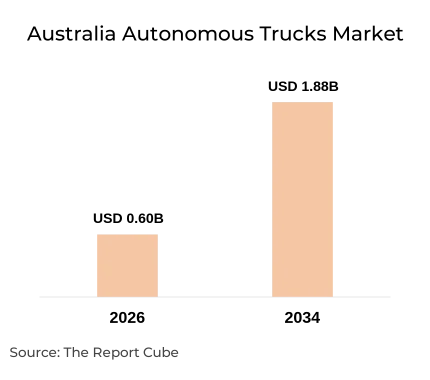
- A comprehensive Australia Autonomous Trucks Market Analysis reveals the market was valued at USD 0.60 billion in 2026, reflecting strong early-stage adoption momentum.
- Industry projected to reach USD 1.88 billion by 2034 at a 15.34% CAGR, among the fastest growth rates in regional freight technology.
- Market expanding at a consistent 15.34% CAGR through the 2034 forecast period driven by mining sector automation and long-haul freight demand.
- Lidar leads the sensor type segment driven by precision mapping requirements across Australia's complex freight corridors.
- Adaptive Cruise Control dominates the ADAS feature segment as the foundational autonomous capability adopted across commercial fleets.
- Automatic Emergency Braking is the fastest-growing ADAS feature as road safety regulators accelerate mandatory fleet compliance timelines.
- Daimler Truck Holding AG, Volvo AB, and Aurora Innovation lead autonomous truck technology deployment across Australian freight networks.
- Platooning technology adoption and driver-assist mandates are reshaping fleet procurement priorities among Australian logistics operators.
Australia Autonomous Trucks Market Overview
The Australia Autonomous Trucks Market is anticipated to register a 15.34% CAGR during 2026–2034. The market size was valued at USD 0.60 billion in 2026 and is projected to reach USD 1.88 billion by 2034. Australia's vast freight distances, critical mining logistics requirements, and acute commercial driver shortages are collectively accelerating adoption of advanced driver-assistance systems and autonomous trucking platforms. Federal and state-level government investment in intelligent transport infrastructure, alongside reforms under the National Heavy Vehicle Regulator (NHVR) framework, is progressively creating a permissive operating environment for Level 3 and Level 4 autonomous trucks across designated freight corridors connecting major ports, mining regions, and distribution hubs.
Growing deployment activity in the Pilbara mining region and Port Botany freight precinct is generating consistent demand for high-grade Lidar, radar, and camera sensor systems. Australia's strategic positioning as an Asia-Pacific logistics hub further supports technology transfer from North American and European autonomous truck programs. Increasing commercial operator awareness of total cost of ownership savings from fuel optimization, accident reduction, and driver productivity improvements is reinforcing investment decisions. Waymo, Aurora Innovation, and TuSimple have intensified Australian market engagement through pilot programs and logistics partnerships targeting interstate highway corridors between Sydney, Melbourne, and Brisbane.
Australia Autonomous Trucks Market Size & Forecast
|
Metric |
Details |
|---|---|
|
Market Size (2026) |
USD 0.60 Billion |
|
Market Size (2034) |
USD 1.88 Billion |
|
CAGR (2026–2034) |
15.34% |
|
Base Year |
2026 |
|
Historical Years |
2021–2025 |
|
Forecast Years |
2026–2034 |
This Australia Autonomous Trucks Market Size study values the industry at USD 0.60 billion in 2026, with projections reaching USD 1.88 billion by 2034 at a 15.34% CAGR - outpacing the global autonomous commercial vehicle average, driven by mining automation scale-up, accelerating ADAS regulatory mandates, and growing logistics operator investment in Level 3 and Level 4 autonomous freight platforms across interstate corridors.
Australia Autonomous Trucks Market Dynamics
Australia's autonomous trucks sector is advancing rapidly as freight operators address structural driver shortages, escalating road safety compliance requirements, and growing pressure to reduce operational costs across long-haul and mine-site logistics networks. Expanding government infrastructure commitments, improving sensor hardware economics, and international technology partnerships are collectively enabling commercial-scale autonomous truck deployment across Australia's high-priority freight corridors through 2034.
|
Factor |
Type |
Specific Impact on Market |
Magnitude |
|---|---|---|---|
|
Commercial driver shortage across freight corridors |
Driver |
Accelerates fleet operator investment in autonomous and driver-assist technologies |
High |
|
Mining sector automation expansion in Western Australia |
Driver |
Generates consistent demand for fully autonomous Level 4 truck platforms in controlled environments |
High |
|
High upfront autonomous system integration costs |
Restraint |
Limits adoption speed among small and mid-scale freight operators with constrained capital budgets |
Medium |
|
Long-haul fuel efficiency optimization via autonomous platooning |
Opportunity |
Reduces operating costs significantly, improving ROI case for fleet-wide autonomous adoption |
High |
|
NHVR regulatory framework evolution |
Challenge |
Compliance complexity creates deployment timeline uncertainty across interstate and urban freight corridors |
Medium |
- Growth Drivers - Mining Automation and Driver Shortage Acceleration: The Australia Autonomous Trucks Market Growth is primarily driven by the convergence of Pilbara mining expansion and persistent freight driver shortages across interstate networks. Rio Tinto and BHP operate extensive autonomous haulage fleets integrating Komatsu and Caterpillar autonomous systems across Western Australian mine sites, creating a proven commercial blueprint that fleet operators and technology developers are adapting for highway freight applications.
- Market Opportunities - Platooning and Long-Haul Freight Efficiency: Autonomous truck platooning across Australia's major freight corridors - including the Sydney-Melbourne Hume Highway and the coastal Queensland freight network - represents a high-value commercial opportunity. Fuel savings of 7–15% per trailing vehicle in platoon configurations, combined with reduced driver fatigue incidents, strengthen the financial case for large logistics operators pursuing staged autonomous fleet transformation.
- Industry Challenges - Regulatory Complexity and Public Acceptance: Evolving NHVR frameworks governing conditional and high automation levels create compliance uncertainty for commercial deployments. Public and union stakeholder concerns regarding driver displacement and road safety accountability standards continue generating policy-level resistance, requiring sustained industry engagement and transparent safety data disclosure from technology developers and fleet operators pursuing commercial autonomous truck certification.
Need Specific Data, Let’s Customize the Report for You
Request CustomizationAustralia Autonomous Trucks Market Trends
- Emerging Trends: Among the most significant Australia Autonomous Trucks Market Trends is the accelerating transition from mine-site-only autonomous deployments toward interstate highway pilot corridors. Queensland and New South Wales are emerging as the primary proving grounds for Level 3 highway automation, with state-level transport authorities working alongside NHVR to develop approved autonomous freight routes connecting major ports and distribution centers.
- Technology Trends: Sensor fusion architectures combining Lidar, radar, and high-resolution camera arrays are becoming the industry standard for Australian autonomous truck deployments. Applied Intuition's simulation platforms and AI-driven validation environments are compressing safety testing timelines. Over-the-air software update capabilities are enabling continuous autonomous system refinement post-deployment, reducing the operational gap between early-adopter fleet performance and new-entrant vehicle configurations.
- Consumer / Buyer Trends: Fleet procurement managers at major Australian logistics groups - including Linfox, Toll Group, and Qube Holdings - increasingly evaluate autonomous truck platforms on total cost of ownership metrics rather than upfront acquisition costs. Buyers are prioritizing suppliers offering integrated technical support, local service networks, and regulatory compliance documentation. Demand for modular ADAS feature packages - enabling staged adoption from ACC through to full highway automation - is rising among mid-scale regional freight operators.
Australia Autonomous Trucks Market Segment Analysis
Australia's autonomous trucks market serves distinct sensor technology requirements and ADAS feature adoption patterns, each shaped by fleet size, operational environment, regulatory compliance stage, and total cost of ownership considerations across mining, long-haul, and urban freight logistics segments.
By Sensor Type
|
Sensor Type |
Estimated Share (2026) |
Key Characteristics |
|---|---|---|
|
Lidar |
34% |
High-precision 3D mapping; essential for Level 3+ highway and mine-site autonomy |
|
Radar |
28% |
All-weather reliability; dominant in adaptive cruise control and emergency braking applications |
|
Camera |
22% |
Lane detection, sign recognition; cost-effective for ADAS feature integration |
|
Ultrasonic |
10% |
Short-range obstacle detection; applied in low-speed port and depot maneuvering |
|
Others |
6% |
GPS/GNSS fusion, thermal imaging, and V2X communication systems |
The Australia Autonomous Trucks Market Share across sensor types is led by Lidar at an estimated 34% in 2026, driven by its superiority in generating high-resolution three-dimensional environmental maps required for Level 3 and Level 4 autonomous operations across Australia's variable freight corridor conditions. Luminar Technologies and Velodyne Lidar supply precision Lidar units integrated into Daimler Truck and Volvo autonomous platforms deployed in Australian mining and highway pilot programs. Radar holds approximately 28% share, supplied by Bosch and Continental AG, providing all-weather sensing reliability for adaptive cruise control and automatic emergency braking systems across interstate freight fleets. Camera systems, representing 22%, are integrated by Mobileye and NVIDIA across entry-level ADAS packages adopted by regional Australian logistics operators prioritizing cost-effective compliance with emerging lane-departure and forward-collision warning regulations.
By ADAS Feature
|
ADAS Feature |
Estimated Share (2026) |
Growth Outlook |
|---|---|---|
|
Adaptive Cruise Control (ACC) |
30% |
Steady; foundational feature across fleet-wide ADAS adoption programs |
|
Automatic Emergency Braking (AEB) |
24% |
Fastest-growing; driven by NHVR mandatory fitment regulatory pathway |
|
Lane Keep Assist (LKA) |
18% |
Growing; increasingly standard across new heavy vehicle platform specifications |
|
Blind Spot Detection (BSD) |
15% |
Moderate; urban freight and multi-lane highway application adoption rising |
|
Intelligent Park Assist (IPA) |
7% |
Niche; depot and port logistics automation driving targeted adoption |
|
Others |
6% |
V2X communication, platooning control, and geofenced automation systems |
Adaptive Cruise Control leads the ADAS feature segment at an estimated 30% share in 2026, serving as the primary entry-point autonomous capability adopted across Australian long-haul freight fleets. PACCAR Inc and Volvo AB integrate ACC systems as standard across their Australian commercial heavy vehicle configurations, with Bosch and Bendix Commercial Vehicle Systems supplying core ACC hardware. Automatic Emergency Braking, the fastest-growing ADAS feature at 24%, is gaining adoption momentum as NHVR advances mandatory fitment frameworks for heavy vehicles above 12 tonnes. Lane Keep Assist, representing approximately 18%, is supplied by Mobileye and Knorr-Bremse across Daimler Truck and Volvo platforms, with fleet uptake accelerating among New South Wales and Queensland transport operators prioritizing safety compliance and insurance premium reduction through demonstrable driver-assist technology deployment.
Australia Autonomous Trucks Market Regional Analysis
|
Region |
Estimated Market Share |
Key Growth Factors |
Consumer Trends |
|---|---|---|---|
|
New South Wales |
30% |
Major freight hub status, port logistics automation, Sydney-Melbourne corridor pilot programs |
ACC and AEB adoption, urban freight automation, Lidar integration |
|
Western Australia |
27% |
Pilbara mining automation, BHP and Rio Tinto autonomous haulage expansion |
Level 4 autonomous platforms, sensor fusion demand, fleet-scale deployment |
|
Queensland |
20% |
Coastal freight network growth, port of Brisbane automation, state-level road trial expansion |
Platooning technology, radar and camera-based ADAS, regional fleet adoption |
|
Victoria |
14% |
Melbourne distribution hub activity, interstate freight corridor investment, industry cluster growth |
LKA and BSD integration, mid-scale fleet ADAS upgrades, OEM partnership activity |
|
Rest of Australia |
9% |
South Australian mining logistics, Northern Territory remote freight automation, Tasmania port activity |
Compound ADAS adoption, entry-level ACC integration, emerging pilot corridor testing |
- New South Wales - Accounting for approximately 30% of total market demand, New South Wales represents Australia's largest autonomous trucks market driven by Port Botany container freight operations, the high-density Sydney–Melbourne Hume Highway corridor, and the state's proactive autonomous vehicle regulatory trial program. Linfox and Qube Holdings are operating early ADAS-equipped heavy vehicle fleets across NSW freight precincts, with Aurora Innovation conducting advanced highway autonomy trials across approved interstate routes.
- Western Australia - Commanding approximately 27% market share, Western Australia leads in Level 4 autonomous truck deployments concentrated in the Pilbara mining region. Rio Tinto's AutoHaul program - the world's largest autonomous rail and truck haulage operation - alongside BHP's autonomous fleet expansion, positions WA as the primary commercial validation environment for fully driverless freight systems supplying Daimler Truck and Komatsu autonomous platforms.
- Queensland - Representing approximately 20% of market demand, Queensland's expanding coastal freight network, Port of Brisbane logistics growth, and state government support for autonomous vehicle corridor trials are generating increasing ADAS technology adoption among regional trucking fleets. Platooning pilot programs along the Bruce Highway are attracting participation from PACCAR and Volvo fleet operators pursuing fuel efficiency and safety improvements across long-distance north Queensland freight routes.
- Victoria - Holding approximately 14% market share, Victoria's role as a major interstate distribution hub drives consistent demand for Blind Spot Detection, Lane Keep Assist, and advanced ACC systems across mid-scale freight operator fleets. Melbourne's expanding logistics precincts and proximity to Geelong and Dandenong industrial zones are supporting OEM partnership activity between Daimler Truck AG and Victorian freight operators pursuing staged autonomous capability upgrades.
- Rest of Australia - Representing approximately 9% of market demand, South Australia, the Northern Territory, and Tasmania collectively present emerging adoption opportunities driven by remote freight automation needs, South Australian mining logistics requirements, and port facility automation programs. Entry-level ADAS integration is the primary technology adoption pathway across these markets as infrastructure and regulatory frameworks progressively develop.
Australia Autonomous Trucks Market Share & Competitive Landscape
The Australia Autonomous Trucks Market's competitive landscape is shaped by global OEM commercial vehicle manufacturers, dedicated autonomous technology developers, and AI-driven software platform providers competing across hardware integration, software development, regulatory engagement, and fleet partnership programs. Key players differentiate through autonomous system maturity level, sensor integration depth, Australian regulatory compliance capability, and the strength of local logistics operator partnerships.
|
Company |
Competitive Strength |
Primary Segment Served |
|---|---|---|
|
Daimler Truck Holding AG ADR |
Global autonomous truck leadership, advanced sensor integration, strong Australia OEM presence |
Long-haul freight, highway autonomy |
|
Volvo AB ADR |
Integrated ADAS platforms, platooning technology, established Australian commercial fleet relationships |
Interstate freight, ACC and AEB |
|
PACCAR Inc |
Kenworth and DAF brand strength, ADAS integration across Australian commercial fleets |
Regional and interstate trucking |
|
Tesla Inc |
Semi platform development, energy efficiency, autonomous technology roadmap |
Emerging long-haul electrified autonomy |
|
Waymo |
Level 4 autonomous software stack, highway pilot program capability |
Highway autonomy, freight corridors |
|
Aurora Innovation Inc Class A |
Aurora Driver platform, commercial freight partnerships, US-to-Australia expansion |
Long-haul highway autonomy |
|
TuSimple |
Autonomous freight network development, sensor fusion, route-specific deployment |
Interstate and corridor freight |
|
Applied Intuition |
Simulation and validation software, ADAS development toolchain |
Technology development, OEM support |
Key Companies in the Australia Autonomous Trucks Market
Daimler Truck Holding AG ADR
Daimler Truck Holding AG, headquartered in Stuttgart, Germany, is the world's largest commercial vehicle manufacturer by revenue, producing Mercedes-Benz, Freightliner, and Fuso truck brands across six continents. In 2025, Daimler Truck expanded its Australian autonomous truck pilot program in partnership with Toll Group, deploying Lidar-equipped highway-capable platforms across the Sydney–Melbourne freight corridor. Its Torc Robotics subsidiary provides the core autonomous driving software stack integrated across Australian commercial heavy vehicle configurations, positioning Daimler as the leading OEM autonomous platform supplier in the market.
Aurora Innovation Inc Class A
Aurora Innovation, headquartered in Pittsburgh, USA, develops the Aurora Driver autonomous trucking platform targeting Level 4 commercial freight deployment. In 2025, Aurora expanded its international program framework to include Asia-Pacific logistics markets, with Australian logistics operators evaluating Aurora Driver integration for interstate highway deployment across approved New South Wales and Queensland freight corridors. Aurora's partnerships with PACCAR and Volvo for hardware integration - combined with its commercial launch timeline and safety validation framework - position the company as a primary autonomous software platform contender in Australia's rapidly maturing autonomous truck technology ecosystem.
Australia Autonomous Trucks Market Recent Developments
|
Year |
Company |
Development |
|---|---|---|
|
2025 |
Daimler Truck Holding AG |
Expanded Australian autonomous truck pilot program with Toll Group across Sydney–Melbourne freight corridor |
|
2025 |
Aurora Innovation |
Announced Asia-Pacific program expansion with Australian interstate freight operator evaluation framework |
|
2025 |
Volvo AB |
Deployed platooning-capable autonomous truck configuration across Queensland coastal freight trial program |
|
Jan 2025 |
Applied Intuition |
Launched Asia-Pacific simulation environment expansion supporting Australian OEM autonomous validation programs |
Australia Autonomous Trucks Market Future Outlook
The Australia Autonomous Trucks Market Forecast projects a 15.34% CAGR through 2034, with market value expanding from USD 0.60 billion in 2026 to USD 1.88 billion. Sustained growth across Western Australian mining logistics, accelerating ADAS regulatory mandates under NHVR frameworks, and increasing fleet operator confidence in Level 3 highway autonomy will collectively drive procurement volumes. Daimler Truck, Volvo AB, and Aurora Innovation are expected to deepen Australian market penetration through logistics operator partnerships, expanded pilot corridor approvals, and competitively priced ADAS integration packages targeting mid-scale regional freight fleets through 2034.
Technological advancement in autonomous truck systems - including next-generation solid-state Lidar, AI-driven predictive route optimization, and V2X communication integration - will progressively reduce per-unit autonomous system costs, expanding commercial viability beyond large fleet operators to independent and regional trucking businesses. Sustainable freight mandates, including federal government emissions reduction targets for the heavy vehicle sector, will further accelerate electric-autonomous truck convergence. UTZ and safety certification standards for autonomous commercial vehicles are expected to mature through 2034, providing the regulatory clarity required for fleet-wide autonomous truck deployment across Australia's interstate and last-mile logistics networks.
Australia Autonomous Trucks Market Report Coverage
This Australia Autonomous Trucks Market Report covers the complete forecast period 2026–2034 across sensor type, ADAS feature, and regional dimensions.
|
Report Attribute |
Details |
|---|---|
|
Market Name |
Australia Autonomous Trucks Market |
|
Market Size (2026) |
USD 0.60 Billion |
|
Market Size (2034) |
USD 1.88 Billion |
|
Forecast Period |
2026–2034 |
|
CAGR |
15.34% |
|
Base Year |
2026 |
|
Historical Years |
2021–2025 |
|
Forecast Years |
2026–2034 |
|
Segments Covered |
By Level of Autonomy, By Propulsion, By Vehicle Type, By Application, By Sensor Type, By ADAS Feature |
|
Regions Covered |
New South Wales, Western Australia, Queensland, Victoria, Rest of Australia |
|
Key Companies |
Daimler Truck Holding AG ADR, Volvo AB ADR, PACCAR Inc, Tesla Inc, Waymo, Aurora Innovation Inc Class A, TuSimple, Applied Intuition, Others |
|
Report Format |
PDF, Excel, PPT |
|
Customization |
Available as per client requirements |
Why Choose This Australia Autonomous Trucks Market Report?
- Comprehensive coverage of Australia's rapidly expanding autonomous commercial truck technology and ADAS adoption market.
- Accurate market sizing from USD 0.60 billion in 2026 through the full 2034 forecast horizon.
- Detailed segmentation by sensor type (Lidar, Radar, Camera, Ultrasonic) and ADAS feature category with share estimates.
- State-level regional insights covering New South Wales, Western Australia, Queensland, Victoria, and Rest of Australia with demand share breakdowns.
- Competitive profiling of 8 leading autonomous truck OEMs and technology platform developers active in the Australian market.
- Analysis of mining sector automation and long-haul platooning trends reshaping fleet procurement and technology investment decisions.
- Forecast data aligned with NHVR regulatory evolution, supporting strategic investment and fleet technology partnership planning.
- Research aligned with Australia's federal freight efficiency and heavy vehicle road safety modernization objectives through 2034.
Table of Contents
- Introduction
- Objective of the Study
- Product Definition
- Market Segmentation
- Study Variables
- Research Methodology
- Secondary Data Points
- Companies Interviewed
- Primary Data Points
- Breakdown of Primary Interviews
- Secondary Data Points
- Executive Summary
- Market Dynamics
- Drivers
- Challenges
- Opportunity Assessment
- Recent Trends and Developments
- Policy and Regulatory Landscape
- Australia Autonomous Trucks Market Overview and Forecast Analysis (2021-2034)
- Market Size, By Value, By Growth Rate (CAGR/USD Billions)
- Demand – Supply Trends
- Market Share, By Level of Autonomy
- L1
- L2 & L3
- L4
- L5
- Market Share, By Propulsion
- Diesel
- Electric
- Hybrid
- Market Share, By Vehicle Type
- Light Duty Trucks
- Medium Duty Trucks
- Heavy Duty Trucks
- Market Share, By Application
- Last Mile Delivery Trucks
- Mining Trucks
- Shuttles
- Market Share, By Sensor Type
- Camera
- Radar
- Lidar
- Ultrasonic
- Others
- Market Share, By ADAS Feature
- Adaptive Cruise Control (ACC)
- Automatic Emergency Braking (AEB)
- Blind Spot Detection (BSD)
- Intelligent Park Assist (IPA)
- Lane Keep Assist (LKA)
- Others
- Market Share, By Region
- New South Wales
- Victoria
- Queensland
- Western Australia
- Rest of Australia
- Market Share, By Competitors
- Competition Characteristics
- Revenue Shares
- L1 Australia Autonomous Trucks Market Overview, 2021-2034F
- By Value (USD Million)
- By Propulsion – Market Size & Forecast 2021-2034, USD Million
- Diesel
- Electric
- Hybrid
- L2 & L3 Australia Autonomous Trucks Market Overview, 2021-2034F
- By Value (USD Million)
- By Propulsion – Market Size & Forecast 2021-2034, USD Million
- Diesel
- Electric
- Hybrid
- L4 Australia Autonomous Trucks Market Overview, 2021-2034F
- By Value (USD Million)
- By Propulsion – Market Size & Forecast 2021-2034, USD Million
- Diesel
- Electric
- Hybrid
- L5 Australia Autonomous Trucks Market Overview, 2021-2034F
- By Value (USD Million)
- By Propulsion – Market Size & Forecast 2021-2034, USD Million
- Diesel
- Electric
- Hybrid
- Competitive Outlook (Company Profile - Partial List)
- Daimler Truck Holding AG ADR
- Company Overview
- Business Segments
- Strategic Alliances/Partnerships
- Recent Developments
- Volvo AB ADR
- Company Overview
- Business Segments
- Strategic Alliances/Partnerships
- Recent Developments
- PACCAR Inc
- Company Overview
- Business Segments
- Strategic Alliances/Partnerships
- Recent Developments
- Tesla Inc
- Company Overview
- Business Segments
- Strategic Alliances/Partnerships
- Recent Developments
- Waymo
- Company Overview
- Business Segments
- Strategic Alliances/Partnerships
- Recent Developments
- Aurora Innovation Inc Class A
- Company Overview
- Business Segments
- Strategic Alliances/Partnerships
- Recent Developments
- TuSimple
- Company Overview
- Business Segments
- Strategic Alliances/Partnerships
- Recent Developments
- Applied Intuition
- Company Overview
- Business Segments
- Strategic Alliances/Partnerships
- Recent Developments
- Others
- Daimler Truck Holding AG ADR
- Contact Us & Disclaimer
Top Key Players & Market Share Outlook
- Daimler Truck Holding AG ADR
- Volvo AB ADR
- PACCAR Inc
- Tesla Inc
- Waymo
- Aurora Innovation Inc Class A
- TuSimple
- Applied Intuition
- Others
Frequently Asked Questions






