



Build Your Custom Market Intelligence Report
Customize Your ReportUAE Electric Commercial Vehicles Market Insights & Analysis
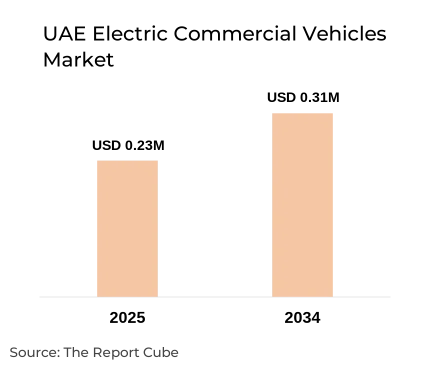
The UAE Electric Commercial Vehicles Market is anticipated to register a CAGR of 3.34% during the forecast period 2026-2034. The market size was valued at USD 0.23 million in 2025 and is projected to reach USD 0.31 million by 2034. Although the market is still at a nascent stage, it is gradually gaining traction as the UAE accelerates its transition toward sustainable transportation and low-emission mobility solutions.
The adoption of electric commercial vehicles (ECVs) in the UAE is being driven by government-led decarbonization targets, rising fuel efficiency awareness, and increasing operational cost pressures on fleet operators. Logistics companies, public transport authorities, and municipal service providers are exploring electric alternatives to reduce long-term fuel expenses and carbon footprints. At the same time, advancements in battery technology and improving charging infrastructure are enhancing the feasibility of electric trucks and buses across urban and intercity routes.
Furthermore, the UAE’s strategic position as a logistics and trade hub has intensified focus on clean mobility for last-mile delivery and public transportation. While upfront costs remain relatively high, total cost of ownership benefits and regulatory support are expected to improve adoption rates. These interconnected factors collectively support steady growth in the UAE Electric Commercial Vehicles Market through 2034.
UAE Electric Commercial Vehicles Market Recent Developments
- 2025: Dubai’s Roads and Transport Authority expanded pilot deployment of electric buses for urban public transport routes.
- 2025: BYD strengthened partnerships with regional fleet operators to supply electric commercial vehicles in the UAE.
Government Initiatives & Policies
- UAE Net Zero by 2050 Initiative: National strategy promoting adoption of electric mobility across public and commercial transport.
- Dubai Green Mobility Strategy: Encourages electric vehicle adoption and charging infrastructure expansion.
UAE Electric Commercial Vehicles Market Dynamics
Key Driver: Government Push Toward Sustainable and Low-Emission Transport
The primary driver of the UAE Electric Commercial Vehicles Market is strong government support for sustainable transportation. Federal and emirate-level initiatives aim to reduce carbon emissions from the transport sector, which currently accounts for a significant share of total emissions. Policies promoting electric mobility, coupled with incentives for fleet electrification, are encouraging logistics operators, public transport agencies, and municipal fleets to transition toward electric commercial vehicles. Additionally, rising fuel costs and long-term operational savings associated with electric vehicles are influencing fleet replacement decisions. As sustainability targets become more stringent, the demand for electric buses, trucks, and delivery vans is expected to rise steadily, reinforcing market growth throughout the forecast period.
Book your FREE 30-minute expert consultation today
Contact UsIndustry Trends: Growing Adoption of Electric Buses and Last-Mile Delivery Vehicles
A key trend shaping the market is the increasing adoption of electric buses and light commercial vehicles for urban operations. Public transport authorities in Dubai and Abu Dhabi are integrating electric buses into city routes to reduce emissions and noise pollution. Similarly, e-commerce growth has fueled demand for electric vans in last-mile delivery applications, where shorter routes and predictable charging schedules improve operational efficiency. Manufacturers are responding by offering region-specific models designed for high temperatures and heavy-duty usage. This trend highlights a gradual shift from pilot projects toward commercial-scale deployment, signaling a more mature phase of adoption over the coming decade.
Major Challenge: High Upfront Costs and Limited Charging Infrastructure
Despite positive momentum, high upfront costs remain a significant challenge for the UAE Electric Commercial Vehicles Market. Electric trucks and buses typically cost 30-50% more than conventional diesel counterparts, creating budget constraints for fleet operators. In addition, limited availability of fast-charging infrastructure for heavy commercial vehicles restricts operational flexibility, particularly for long-haul applications. While urban charging networks are expanding, inter-emirate charging remains underdeveloped. These challenges slow adoption rates, especially among small and mid-sized operators, and may restrain short-term market expansion.
Opportunity: Expansion of Fleet Electrification in Logistics and Public Transport
The growing emphasis on fleet electrification presents a strong opportunity for market participants. Large logistics providers and public transport agencies are increasingly committing to electric vehicle targets as part of broader sustainability goals. Bulk procurement of electric commercial vehicles can significantly reduce per-unit costs, improving affordability. Moreover, advancements in battery energy density and declining battery prices are expected to enhance vehicle range and performance. As charging infrastructure expands and financing models such as leasing and battery-as-a-service gain traction, the market is poised to unlock new growth opportunities across multiple commercial segments.
UAE Electric Commercial Vehicles Market Segment-wise Analysis
By Vehicle Type:
- Light Commercial Vehicles
- Medium Trucks
- Heavy Trucks
- Buses & Coaches
Light Commercial Vehicles currently represent the leading sub-segment, accounting for approximately 38% of the market share in 2025. This dominance is driven by rising adoption in last-mile delivery, municipal services, and urban logistics. Electric buses and coaches follow closely, supported by public transport electrification programs in major cities. Medium and heavy electric trucks remain at an early adoption stage due to higher costs and range limitations, but they are expected to gain momentum as technology improves. The segmental growth reflects a gradual progression from light-duty to heavy-duty electrification.
By Propulsion Type:
- Battery Electric Vehicles
- Plug-in Hybrid EVs
- Fuel-Cell EVs
Battery Electric Vehicles (BEVs) dominate the propulsion segment, holding nearly 62% of the total market share. BEVs benefit from simpler powertrains, lower maintenance costs, and growing charging infrastructure. Plug-in Hybrid EVs serve as a transitional solution, particularly for operators seeking extended range flexibility, while Fuel-Cell EVs remain in the pilot phase due to high infrastructure and hydrogen production costs. Over the forecast period, BEVs are expected to maintain leadership as battery efficiency improves and charging networks expand across the UAE.
Regional Projection of UAE Electric Commercial Vehicles Industry
- Dubai
- Abu Dhabi
- Sharjah
- Northern Emirates
Dubai leads the UAE Electric Commercial Vehicles Market, accounting for nearly 41% of total demand. The emirate benefits from advanced infrastructure, proactive sustainability policies, and early adoption of electric buses and delivery vehicles. Abu Dhabi follows, supported by government-backed pilot programs and investments in clean mobility. Sharjah and the Northern Emirates are gradually adopting electric commercial vehicles, primarily for municipal and logistics applications. Dubai’s leadership is expected to continue throughout the forecast period due to its strong regulatory support and higher concentration of commercial fleets.
Need insights for a specific region within this market?
Request Regional DataWhy Choose This Report?
- Provides a comprehensive overview of the overall market analysis, encompassing key trends, consumer behavior analysis, and risk assessment to support strategic decision-making.
- Provides accurate, up-to-date insights into market size, segmentation, and emerging opportunities, helping to minimize risk & capitalizing on growth.
- Gives deep understanding of target audience preferences, investment habits, and communication channels for enhanced product development & marketing effectiveness.
- Delivers competitive analysis & benchmarking, uncovering the strengths & weaknesses of market competitors to guide strategies.
- Consolidate comprehensive market intelligence, reducing reasoning & streamlining research efforts.
- Facilitates customized market segmentation & risk mitigation strategies, fine-tuned to the business objectives.
- Aids in identifying both market challenges & untapped opportunities within the industry to drive long-term business growth.
- Provides valuable information based on actual customer data & search trends.
Table of Contents
- Introduction
- Objective of the Study
- Product and Category Definition
- Market Segmentation
- Study Variables
- Research Methodology
- Secondary Data Points
- Breakdown of Secondary Sources
- Primary Data Points
- Breakdown of Primary Interviews
- Secondary Data Points
- Executive Summary
- Market Dynamics
- Drivers
- Challenges
- Opportunity Assessment
- Recent Trends and Developments
- Regulatory and Policy Landscape
- UAE Electric Commercial Vehicles Market Overview (2020-2034)
- Market Size, By Value (USD Billion)
- Market Share, By Vehicle Type
- Light Commercial Vehicles
- Medium Trucks
- Heavy Trucks
- Buses & Coaches
- Market Share, By Propulsion Type
- Battery Electric Vehicles
- Plug-in Hybrid EVs
- Fuel-Cell EVs
- Market Share, By Drive Type
- Front-Wheel Drive
- Rear-Wheel Drive
- All-Wheel Drive
- Market Share, By Battery Capacity
- Below 100 kWh
- 100–200 kWh
- Above 200 kWh
- Market Share, By End-Use
- Urban Transit
- Logistics & Delivery
- Construction Fleets
- Mining Fleets
- Municipal Services
- Market Share, By Region
- Dubai
- Abu Dhabi
- Sharjah
- Northern Emirates
- Market Share, By Company
- Competition Characteristics
- Revenue Shares & Analysis
- Dubai Electric Commercial Vehicles Market
- Market Size, By Value (USD Billion)
- Market Share, By Vehicle Type
- Market Share, By Propulsion Type
- Market Share, By Drive Type
- Market Share, By Battery Capacity
- Market Share, By End-Use
- Abu Dhabi Electric Commercial Vehicles Market
- Market Size, By Value (USD Billion)
- Market Share, By Vehicle Type
- Market Share, By Propulsion Type
- Market Share, By Drive Type
- Market Share, By Battery Capacity
- Market Share, By End-Use
- Sharjah Electric Commercial Vehicles Market
- Market Size, By Value (USD Billion)
- Market Share, By Vehicle Type
- Market Share, By Propulsion Type
- Market Share, By Drive Type
- Market Share, By Battery Capacity
- Market Share, By End-Use
- Northern Emirates Electric Commercial Vehicles Market
- Market Size, By Value (USD Billion)
- Market Share, By Vehicle Type
- Market Share, By Propulsion Type
- Market Share, By Drive Type
- Market Share, By Battery Capacity
- Market Share, By End-Use
- Competitive Outlook and Company Profiles
- Daimler Truck AG
- Company Overview
- Product Portfolio
- Strategic Alliances/Partnerships
- Recent Developments
- BYD Company Ltd.
- Company Overview
- Product Portfolio
- Strategic Alliances/Partnerships
- Recent Developments
- Volvo Group
- Company Overview
- Product Portfolio
- Strategic Alliances/Partnerships
- Recent Developments
- Scania AB
- Company Overview
- Product Portfolio
- Strategic Alliances/Partnerships
- Recent Developments
- Yutong Bus Co. Ltd.
- Company Overview
- Product Portfolio
- Strategic Alliances/Partnerships
- Recent Developments
- Tesla Inc.
- Company Overview
- Product Portfolio
- Strategic Alliances/Partnerships
- Recent Developments
- MAN Truck & Bus
- Company Overview
- Product Portfolio
- Strategic Alliances/Partnerships
- Recent Developments
- Hyundai Motor Company
- Company Overview
- Product Portfolio
- Strategic Alliances/Partnerships
- Recent Developments
- Ashok Leyland
- Company Overview
- Product Portfolio
- Strategic Alliances/Partnerships
- Recent Developments
- Emirates Global Motor Electric
- Company Overview
- Product Portfolio
- Strategic Alliances/Partnerships
- Recent Developments
- Others
- Daimler Truck AG
- Contact Us and Disclaimer
Top Key Players & Market Share Outlook
- Daimler Truck AG
- BYD Company Ltd.
- Volvo Group
- Scania AB
- Yutong Bus Co. Ltd.
- Tesla Inc.
- MAN Truck & Bus
- Hyundai Motor Company
- Ashok Leyland
- Emirates Global Motor Electric
- Others
Frequently Asked Questions






