




Build Your Custom Market Intelligence Report
Customize Your ReportWhat Is the UAE Fuel Cell Electric Vehicle (FCEV) Market Size & Value?
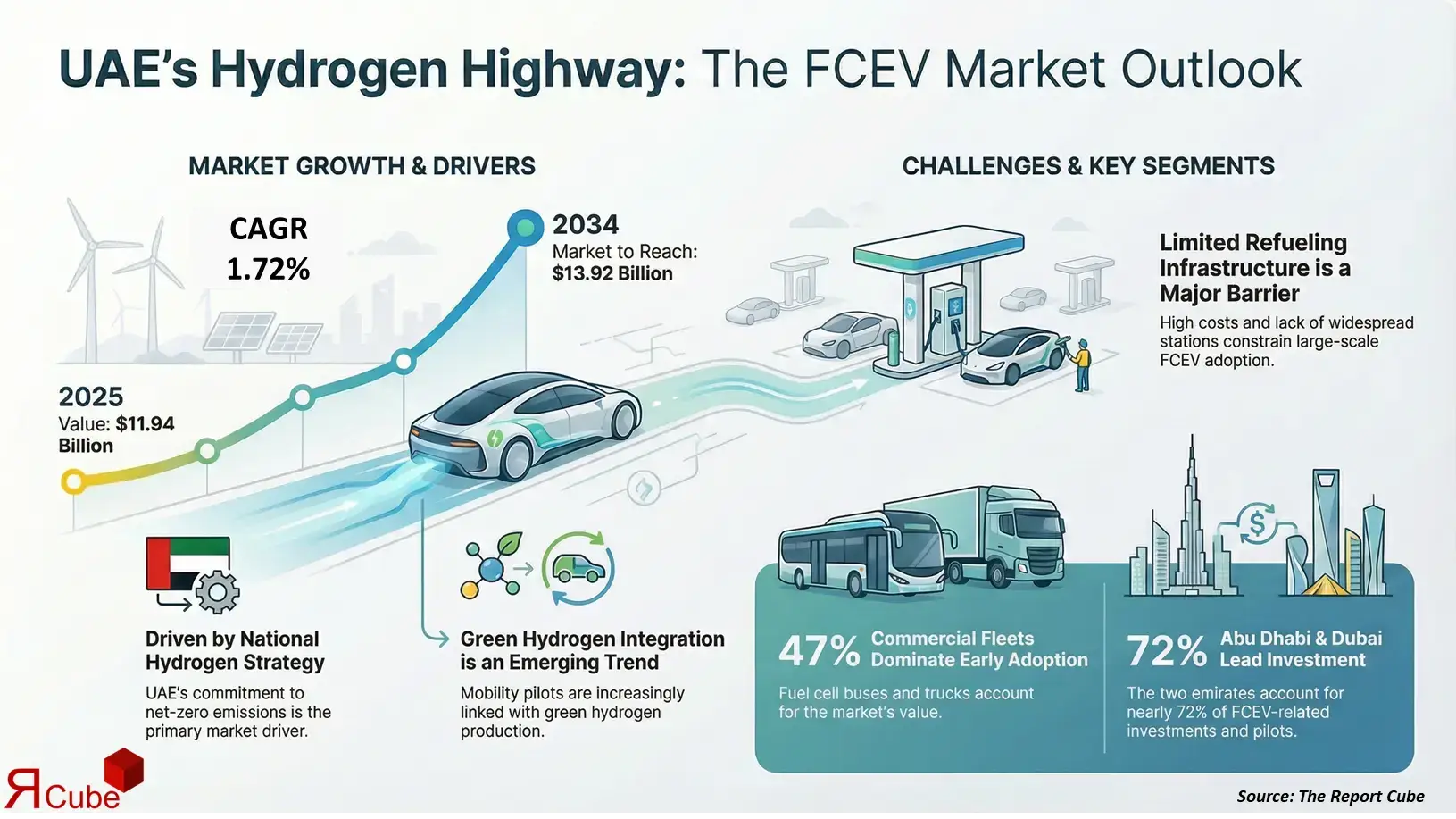
The UAE Fuel Cell Electric Vehicle (FCEV) Market is anticipated to register a 1.72% CAGR during 2026–2034. The market size was valued at USD 11.94 Billion in 2025 and is projected to reach USD 13.92 Billion by 2034. The market is driven by the UAE’s long-term decarbonization goals, hydrogen economy investments, and strategic focus on clean mobility solutions. While adoption remains at a nascent stage compared to battery electric vehicles, government-backed hydrogen initiatives and pilot deployments in commercial fleets, logistics, and public transport are supporting gradual market expansion.
UAE Fuel Cell Electric Vehicle (FCEV) Market Key Highlights
-
National hydrogen strategy supports gradual adoption of fuel cell mobility solutions
-
Commercial fleets and public transport dominate early FCEV deployment
-
Opportunity emerges from green hydrogen production and infrastructure development
-
Leading segments include passenger vehicles, buses, trucks, and material-handling vehicles
-
Abu Dhabi and Dubai lead pilot projects due to policy support and infrastructure readiness
-
Government of the United Arab Emirates promotes hydrogen-based clean energy transition
UAE Fuel Cell Electric Vehicle (FCEV) Market Dynamics
Key Market Driver
Hydrogen Economy Development and Net-Zero Targets
The UAE’s commitment to net-zero emissions and hydrogen economy development is the primary driver of the FCEV market. Strategic investments in green hydrogen production, export infrastructure, and clean mobility pilots are encouraging adoption of fuel cell technologies. FCEVs offer long driving ranges, fast refueling, and suitability for heavy-duty applications, making them attractive for logistics fleets, municipal transport, and industrial mobility use cases where battery-electric solutions face limitations.
Major Industry Challenge
Limited Hydrogen Refueling Infrastructure
The lack of widespread hydrogen refueling stations remains a major barrier to large-scale FCEV adoption in the UAE. High infrastructure costs, limited vehicle availability, and early-stage ecosystem development constrain market growth. Additionally, higher upfront vehicle costs and the absence of large-scale consumer incentives slow penetration beyond pilot and fleet-based deployments.
Emerging Trend Shaping Outlook
Green Hydrogen Integration and Fleet Pilots
The market is witnessing increased integration of green hydrogen production with mobility pilots. Government entities and industrial players are testing hydrogen-powered buses, trucks, and material-handling equipment. Partnerships between ene
Book your FREE 30-minute expert consultation today
Contact UsUAE Fuel Cell Electric Vehicle (FCEV) Industry Analysis 2026–2034
The UAE FCEV industry encompasses hydrogen fuel cell passenger vehicles, buses, commercial trucks, forklifts, and industrial transport solutions. Growth is primarily policy-driven, supported by clean energy investments and pilot mobility programs. Profitability remains limited at this stage, with most deployments occurring under government-backed or corporate sustainability initiatives. The industry is closely linked to hydrogen production, renewable energy, automotive manufacturing, logistics, and infrastructure development sectors. Sales channels include direct government procurement, fleet contracts, and strategic partnerships. During 2024–2025, hydrogen mobility pilots expanded across transport and logistics segments, reinforcing long-term market potential.
How Are the UAE Fuel Cell Electric Vehicle (FCEV) Market Segments Defined?
Market segmentation highlights vehicle categories and application areas, enabling stakeholders to assess adoption pathways and investment priorities.
By Vehicle Type
-
Passenger Fuel Cell Vehicles
-
Fuel Cell Buses and Trucks
-
Industrial and Material-Handling Vehicles
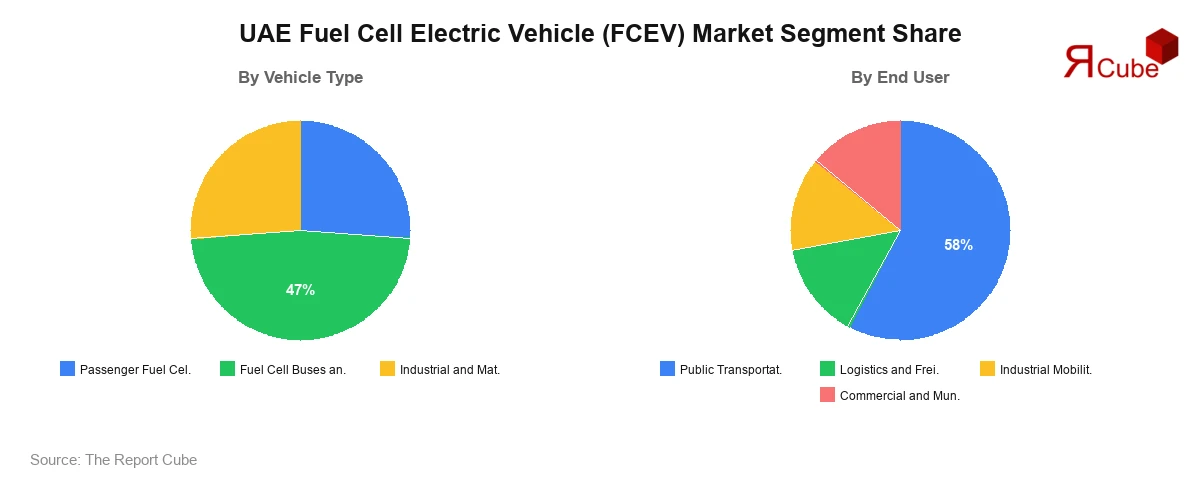
Fuel cell buses and trucks account for approximately 47% of market value due to early adoption in public transport and logistics fleets. Passenger FCEVs remain limited, primarily restricted to demonstration and pilot projects.
By End User
-
Public Transportation
-
Logistics and Freight
-
Industrial Mobility
-
Commercial and Municipal Fleets
Public transportation and logistics applications collectively represent nearly 58% of total market deployment, driven by centralized refueling feasibility and government-led sustainability programs.
UAE Fuel Cell Electric Vehicle (FCEV) Industry: Country Insights
The United Arab Emirates is emerging as a regional leader in hydrogen mobility, with Abu Dhabi and Dubai accounting for nearly 72 percent of FCEV-related investments and pilot projects. Abu Dhabi’s focus on green hydrogen production and industrial applications complements Dubai’s clean mobility and smart transport initiatives, supporting early-stage market development.
UAE Fuel Cell Electric Vehicle (FCEV) Market: Recent Innovations (2025)
-
Amazon.com, Inc. expanded hydrogen-powered material-handling and logistics fleet pilots supporting zero-emission operations
-
Walmart Inc. advanced fuel cell-powered warehouse and fleet sustainability initiatives aligned with global decarbonization goals
Government Initiatives and Programs (2025)
-
Government of the United Arab Emirates advanced the National Hydrogen Strategy supporting clean mobility applications
-
UAE authorities expanded hydrogen pilot programs across transportation and industrial sectors
UAE Fuel Cell Electric Vehicle (FCEV) Market Future Outlook (2034)
By 2034, the UAE Fuel Cell Electric Vehicle (FCEV) Market is expected to reach USD 13.92 Billion, growing at a 1.72% CAGR. Market expansion will remain gradual, driven by hydrogen infrastructure rollout, fleet electrification goals, and industrial decarbonization initiatives. Technology advancement in fuel cell efficiency, green hydrogen production, and cost reduction will support broader adoption. Future growth will favor stakeholders offering integrated hydrogen mobility solutions aligned with the UAE’s long-term clean energy and sustainability vision.
Top Companies in UAE Fuel Cell Electric Vehicle (FCEV) Market
Ask Our Lead Analyst a Question About This Report
Contact UsWhy Choose This Report?
-
Provides a comprehensive overview of the overall market analysis, encompassing key trends, consumer behavior analysis, and risk assessment
-
Provides accurate, up-to-date insights into market size, segmentation, and emerging opportunities
-
Gives deep understanding of target audience preferences and communication channels
-
Delivers competitive analysis and benchmarking to guide strategy development
-
Consolidates comprehensive market intelligence, reducing research effort
-
Facilitates customized market segmentation and risk mitigation strategies
-
Identifies market challenges and untapped opportunities
-
Provides insights based on actual customer data and search trends
Table of Contents
- Introduction
- Objective of the Study
- Product/Technology Definition
- Market Segmentation
- Study Variables
- Research Methodology
- Secondary Data Points
- Breakdown of Secondary Sources
- Primary Data Points
- Breakdown of Primary Interviews
- Secondary Data Points
- Executive Summary
- Market Dynamics
- Drivers
- Challenges
- Opportunities
- Recent Trends and Developments
- Policy and Regulatory Landscape
- UAE FCEV Market Overview (2020–2034)
- Market Size, By Value (AED/USD Million)
- Market Size, By Volume (Units)
- Market Share, By Vehicle Type
- Passenger Cars
- Light Commercial Vehicles (LCVs)
- Buses & Coaches
- Heavy Commercial Vehicles (Trucks)
- Other Vehicle Types (Fleet/Taxi, Municipal Vehicles)
- Market Share, By Range
- Below 300 km
- 300–500 km
- Above 500 km
- Market Share, By End User
- Private/Individual Users
- Fleet Operators (Taxi, Logistics, Last-Mile Delivery)
- Government & Municipalities
- Corporate & Industrial Users
- Market Share, By Fuel Cell Power Output
- Below 100 kW
- 100–200 kW
- Above 200 kW
- Market Share, By Region
- Dubai
- Abu Dhabi
- Sharjah
- Northern Emirates
- Other Regions
- Integration with Hydrogen Value Chain
- Green Hydrogen Production & Hubs
- Hydrogen Refueling Infrastructure
- Storage & Distribution Logistics
- Market Share, By Company
- Revenue Shares
- Fleet Shares
- Competition Characteristics
- Segment-wise & Application-wise Market Overview & Forecast (2026–2034)
- By Vehicle Type
- By Range
- By End User
- By Fuel Cell Power Output
- By Region
- By Hydrogen Refueling Corridor
- Hydrogen Ecosystem & Infrastructure Readiness
- Hydrogen Production Projects (Blue & Green)
- Refueling Stations & Corridors (Port, Airport, Highway, Urban)
- Regulatory Standards & Safety Framework
- Public–Private Partnerships & International Alliances
- Competitive Outlook & Company Profiles
- Hyundai Motor Company (XCIENT Fuel Cell, NEXO)
- Company Overview
- FCEV Product Portfolio
- Partnerships in UAE (e.g., BEEAH Group, logistics fleets)
- Recent Developments & Pilot Projects
- Toyota Motor Corporation (Mirai, FCEV Buses)
- Company Overview
- FCEV Product Portfolio
- Partnerships in UAE (e.g., ENOC, RTA taxi trials)
- Recent Developments & Demonstration Fleets
- Honda Motor Co., Ltd.
- Company Overview
- FCEV Models & Platforms
- Strategic Alliances/Partnerships
- Recent Developments
- Hyundai-BEEAH Hydrogen Mobility Initiative
- Project Overview
- Scope (Refuse Trucks, Logistics, Municipal Fleets)
- Hydrogen Supply & Refueling Collaboration
- Planned Scale-Up
- ENOC Hydrogen Mobility Program
- Program Overview
- Hydrogen Refueling Stations
- FCEV Trials with Taxi & Fleet Operators
- Future Expansion Plans
- ADNOC Distribution Hydrogen Projects
- Company Overview
- Hydrogen Refueling Pilots
- Integration with Service Stations
- Strategic Alliances
- Plug Power Inc. / Ballard Power Systems (Fuel Cell Technology Providers)
- Company Overview
- Fuel Cell Systems for Mobility
- Partnerships & Projects in GCC/UAE
- Recent Developments
- Local and Regional FCEV Solution Providers
- Company Overview
- Retrofit & Conversion Solutions
- Fleet-as-a-Service / Hydrogen-as-a-Service Models
- Recent Developments
- Others
- Hyundai Motor Company (XCIENT Fuel Cell, NEXO)
- Contact Us / Disclaimer
Top Key Players & Market Share Outlook
- The Home Depot, Inc.
- Lowe’s Companies, Inc.
- Gardena GmbH
- Stanley Black & Decker, Inc.
- Deere & Company
- STIHL Group
- Ball Corporation
- Ace Hardware Corporation
- Amazon.com, Inc.
- Walmart Inc.
- Kingfisher plc
- OBI Group Holding SE & Co. KGaA
- Bayer AG
- The Scotts Company LLC
- Ames Companies
- Tui Group
- Syngenta Group
Frequently Asked Questions






