



Build Your Custom Market Intelligence Report
Customize Your ReportUAE Electric Two-Wheeler Market Insights & Analysis
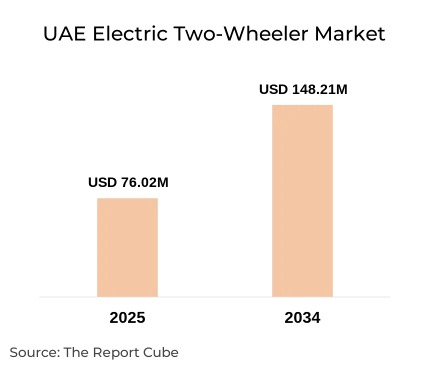
The UAE Electric Two-Wheeler Market is anticipated to register a CAGR of 7.70% during the forecast period. The market size was valued at USD 76.02 million in 2025 and is projected to reach USD 148.21 million by 2034. This growth trajectory reflects the UAE’s accelerating transition toward sustainable urban mobility, supported by government-led decarbonization goals and rising consumer preference for cost-efficient personal transportation.
The market’s expansion is closely linked to increasing urban congestion, rising fuel costs, and a strong push for last-mile mobility solutions across major emirates. Electric two-wheelers, including e-scooters and e-mopeds, are gaining traction among daily commuters, delivery service providers, and tourists seeking convenient mobility alternatives. Shared mobility operators have further amplified adoption by deploying electric fleets across high-density urban corridors.
Moreover, favorable regulatory frameworks, expanding charging infrastructure, and pilot programs supporting micro-mobility are strengthening market confidence. The integration of electric two-wheelers into smart city initiatives and tourism-focused transport planning positions the UAE Electric Two-Wheeler Market as a high-growth niche within the broader electric mobility ecosystem over the coming decade.
UAE Electric Two-Wheeler Market Recent Developments
- 2025: Yadea expanded its electric scooter retail footprint in Dubai to support rising urban commuter demand.
- 2025: Careem Bike increased electric two-wheeler fleet deployment across key residential and commercial zones.
Government Initiatives & Policies
- UAE Net Zero 2050 Strategy: National framework promoting electric mobility adoption across transport segments.
- Dubai Green Mobility Initiative: Supports electric micro-mobility and charging infrastructure expansion.
UAE Electric Two-Wheeler Market Dynamics
Key Driver: Rising Demand for Sustainable Urban Mobility
The primary driver of the UAE Electric Two-Wheeler Market is the growing demand for sustainable and efficient urban mobility solutions. Rapid urbanization and increased population density in cities such as Dubai and Abu Dhabi have intensified traffic congestion, prompting commuters to seek flexible alternatives. Electric two-wheelers offer lower operating costs, zero tailpipe emissions, and ease of parking, making them attractive for short-distance travel. In 2024, micro-mobility usage in urban UAE corridors increased by over 30%, highlighting a structural shift in commuter behavior. Government encouragement through pilot zones and dedicated lanes further supports adoption. As sustainability becomes a core pillar of national transport planning, electric two-wheelers are emerging as a practical solution for reducing carbon emissions while improving urban mobility efficiency.
Book your FREE 30-minute expert consultation today
Contact UsIndustry Trends: Growth of Shared and Subscription-Based Mobility Models
A notable trend shaping the market is the expansion of shared and subscription-based electric two-wheeler services. Operators such as Tier Mobility, Lime, and FENIX are scaling shared e-scooter and e-bike fleets to cater to tourists and first-mile/last-mile commuters. These models lower entry barriers for users by eliminating ownership costs while maximizing vehicle utilization. Subscription plans offered by local manufacturers and dealers are also gaining popularity, particularly among delivery riders and young professionals. Additionally, technology integration through mobile apps, GPS tracking, and digital payments is enhancing user convenience and fleet management efficiency. This shift toward service-oriented mobility is transforming electric two-wheelers from niche products into mainstream transport solutions.
Major Challenge: Limited Charging Infrastructure and Range Anxiety
Despite strong momentum, limited charging infrastructure remains a key challenge for the UAE Electric Two-Wheeler Market. While major cities have made progress in deploying charging points, coverage remains uneven across secondary emirates. Range anxiety continues to influence consumer purchasing decisions, particularly for high-usage segments such as delivery services. Additionally, variations in battery standards and charging compatibility can complicate infrastructure planning. High ambient temperatures also impact battery performance and longevity, raising maintenance concerns among users. Addressing these challenges through standardized charging solutions and battery innovation will be critical to sustaining long-term market growth.
Opportunity: Adoption of Swappable Battery Technology
The emergence of swappable battery technology presents a significant opportunity for the market. Battery swapping reduces downtime, eliminates charging wait times, and enhances operational efficiency for commercial users. Several UAE-based mobility startups are piloting swap stations in logistics hubs and residential communities. This model is particularly attractive for fleet operators and shared mobility providers seeking high vehicle utilization rates. As partnerships between battery providers, vehicle manufacturers, and real estate developers expand, swappable batteries could address infrastructure gaps while accelerating adoption. This innovation aligns well with the UAE’s smart city ambitions and positions electric two-wheelers as a scalable mobility solution.
UAE Electric Two-Wheeler Market Segment-wise Analysis
By Vehicle Type:
- Kick E-Scooters
- E-Mopeds
- E-Motorcycles
- E-Bikes
Kick E-Scooters dominate the market, accounting for approximately 41% of total market share in 2025. Their popularity stems from widespread use in shared mobility programs and short-distance commuting. E-Bikes follow with around 27% share, driven by recreational usage and fitness-conscious consumers. E-Mopeds are gaining momentum among delivery services due to higher load capacity and longer range, while E-Motorcycles remain a niche segment catering to premium users. The dominance of e-scooters highlights the market’s strong orientation toward urban micro-mobility solutions.
By Battery Type:
- Lead Acid
- Li-ion
- Swappable Packs
Li-ion batteries lead the segment with nearly 58% market share, supported by their higher energy density, longer lifespan, and lower maintenance requirements. Swappable battery packs are emerging rapidly, capturing close to 18% share as fleet operators prioritize operational efficiency. Lead acid batteries, while cost-effective, are gradually losing relevance due to weight and performance limitations. The transition toward advanced battery technologies underscores the market’s focus on durability, efficiency, and user convenience.
Regional Projection of UAE Electric Two-Wheeler Industry
- Abu Dhabi
- Dubai
- Sharjah
- Ajman
- Umm Al-Quwain
- Fujairah
- Ras Al Khaimah
Dubai leads the UAE Electric Two-Wheeler Market, holding approximately 36% market share due to advanced infrastructure, high tourist inflow, and early adoption of shared mobility services. Abu Dhabi follows, supported by government-led sustainability initiatives and smart mobility pilots. Sharjah is witnessing steady growth driven by affordability-focused commuters and delivery services. While northern emirates currently represent smaller shares, infrastructure investments and policy alignment are expected to unlock future growth. Dubai’s leadership is expected to continue throughout the forecast period, reinforcing its role as the epicenter of electric micro-mobility adoption.
Need insights for a specific region within this market?
Request Regional DataWhy Choose This Report?
- Provides a comprehensive overview of the overall market analysis, encompassing key trends, consumer behavior analysis, and risk assessment to support strategic decision-making.
- Provides accurate, up-to-date insights into market size, segmentation, and emerging opportunities, helping to minimize risk & capitalizing on growth.
- Gives deep understanding of target audience preferences, investment habits, and communication channels for enhanced product development & marketing effectiveness.
- Delivers competitive analysis & benchmarking, uncovering the strengths & weaknesses of market competitors to guide strategies.
- Consolidate comprehensive market intelligence, reducing reasoning & streamlining research efforts.
- Facilitates customized market segmentation & risk mitigation strategies, fine-tuned to the business objectives.
- Aids in identifying both market challenges & untapped opportunities within the industry to drive long-term business growth.
- Provides valuable information based on actual customer data & search trends.
Table of Contents
- Introduction
- Objective of the Study
- Product and Category Definition
- Market Segmentation
- Study Variables
- Research Methodology
- Secondary Data Points
- Breakdown of Secondary Sources
- Primary Data Points
- Breakdown of Primary Interviews
- Secondary Data Points
- Executive Summary
- Market Dynamics
- Drivers
- Challenges
- Opportunity Assessment
- Recent Trends and Developments
- Regulatory and Policy Landscape
- UAE Electric Two-Wheeler Market Overview (2020-2034)
- Market Size, By Value (USD Million)
- Market Share, By Vehicle Type
- Kick E‑Scooters
- E‑Mopeds
- E‑Motorcycles
- E‑Bikes
- Market Share, By Battery Type
- Lead Acid
- Li‑ion
- Swappable Packs
- Market Share, By Voltage Band
- < 48V
- 48–72V
- > 72V
- Market Share, By Application
- Personal Mobility
- Last‑Mile Delivery
- Tourism Sharing
- Corporate Fleets
- Market Share, By Distribution Channel
- Online
- Multi‑Brand Dealers
- Brand Stores
- Fleet Sales
- Market Share, By Region
- Abu Dhabi
- Dubai
- Sharjah
- Ajman
- Umm Al‑Quwain
- Fujairah
- Ras Al Khaimah
- Market Share, By Company
- Competition Characteristics
- Revenue Shares & Analysis
- Abu Dhabi Electric Two-Wheeler Market
- Market Size, By Value (USD Million)
- Market Share, By Vehicle Type
- Market Share, By Battery Type
- Market Share, By Application
- Market Share, By Distribution Channel
- Dubai Electric Two-Wheeler Market
- Market Size, By Value (USD Million)
- Market Share, By Vehicle Type
- Market Share, By Battery Type
- Market Share, By Application
- Market Share, By Distribution Channel
- Other Emirates Electric Two-Wheeler Market
- Market Size, By Value (USD Million)
- Market Share, By Vehicle Type
- Market Share, By Battery Type
- Market Share, By Application
- Market Share, By Distribution Channel
- Competitive Outlook and Company Profiles
- ONE MOTO Technologies
- Company Overview
- Product Portfolio
- Strategic Alliances/Partnerships
- Recent Developments
- EMX Motors
- Company Overview
- Product Portfolio
- Strategic Alliances/Partnerships
- Recent Developments
- Xoom Volt Motors
- Company Overview
- Product Portfolio
- Strategic Alliances/Partnerships
- Recent Developments
- Terra Tech
- Company Overview
- Product Portfolio
- Strategic Alliances/Partnerships
- Recent Developments
- Blitz Motors
- Company Overview
- Product Portfolio
- Strategic Alliances/Partnerships
- Recent Developments
- Eveons Mobility
- Company Overview
- Product Portfolio
- Strategic Alliances/Partnerships
- Recent Developments
- Energica (Wheels of Arabia)
- Company Overview
- Product Portfolio
- Strategic Alliances/Partnerships
- Recent Developments
- NIU Technologies
- Company Overview
- Product Portfolio
- Strategic Alliances/Partnerships
- Recent Developments
- Yadea (Bikeera UAE)
- Company Overview
- Product Portfolio
- Strategic Alliances/Partnerships
- Recent Developments
- Segway‑Ninebot UAE
- Company Overview
- Product Portfolio
- Strategic Alliances/Partnerships
- Recent Developments
- Others (Tier Mobility, Lime, FENIX, Careem Bike)
- ONE MOTO Technologies
- Contact Us and Disclaimer
Top Key Players & Market Share Outlook
- ONE MOTO Technologies
- EMX Motors
- Xoom Volt Motors
- Terra Tech
- Blitz Motors
- Eveons Mobility
- Energica (Wheels of Arabia)
- NIU Technologies
- Yadea (Bikeera UAE)
- Segway‑Ninebot UAE
- Others (Tier Mobility, Lime, FENIX, Careem Bike)
Frequently Asked Questions






