



Build Your Custom Market Intelligence Report
Customize Your ReportSouth Korea Autonomous Vehicle Maintenance Solutions Market Key Highlights
By Service Type:
Predictive Analytics segment leads the market, accounting for nearly 29% of total revenue.
By Vehicle Type:
Commercial Fleets segment dominate the market with around 34% share.
Regional Outlook:
Sudogwon region holds approximately 38% market share.
Government Initiatives & Policies
- K-Mobility Innovation Strategy: South Korean government roadmap promoting autonomous driving commercialization and smart infrastructure.
- Autonomous Vehicle Pilot Zones Act: Regulatory sandbox enabling large-scale AV testing and maintenance infrastructure deployment.
South Korea Autonomous Vehicle Maintenance Solutions Market Insights & Analysis
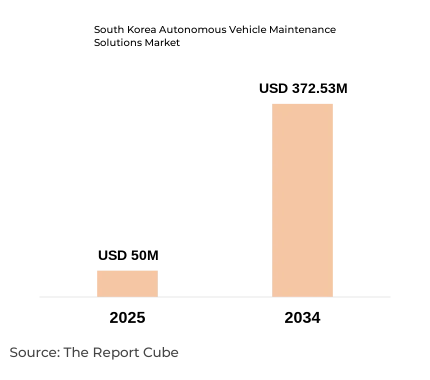
The South Korea Autonomous Vehicle Maintenance Solutions Market is anticipated to register a CAGR of 25.0% during 2026-2034. The market size was valued at USD 50 million in 2025 and is projected to reach USD 372.53 million by 2034. As South Korea accelerates autonomous vehicle deployment across passenger cars, robotaxis, and commercial logistics fleets, maintenance ecosystems are evolving from traditional mechanical servicing toward software-centric, data-driven lifecycle management.
Autonomous vehicles generate terabytes of operational data daily through LiDAR, radar, cameras, and onboard AI processors. This data surge necessitates predictive diagnostics, continuous over-the-air (OTA) updates, cybersecurity monitoring, and sensor recalibration services. More than 60% of AV pilot fleets in Sudogwon now rely on cloud-based maintenance platforms integrated with OEM back-end systems. Strategic investments from Hyundai Group affiliates and mobility startups are strengthening the domestic ecosystem, positioning South Korea as a leading Asian hub for AV lifecycle management technologies.
South Korea Autonomous Vehicle Maintenance Solutions Market Dynamics
Key Driver: Rapid Commercialization of Autonomous Mobility and Fleet Operations
Expanding autonomous vehicle pilot programs and commercial fleet trials are fueling demand for structured maintenance solutions. South Korea has deployed more than 400 autonomous test vehicles across urban corridors, with logistics companies integrating Level 3 and Level 4 trucks for freight operations. Commercial fleets prioritize uptime optimization, as a single hour of downtime can cost logistics operators nearly USD 150-200 per vehicle. Predictive analytics platforms reduce unplanned breakdowns by up to 28%, strengthening operational reliability. As AV deployment scales, OEMs and mobility operators increasingly adopt centralized maintenance dashboards to monitor hardware health, firmware status, and sensor alignment in real time.
Book your FREE 30-minute expert consultation today
Contact UsIndustry Trends: Cloud-Based Diagnostics and AI-Driven Sensor Calibration
The market is witnessing a decisive shift toward cloud-native maintenance platforms integrated with vehicle telemetry. Over 55% of new AV fleets in 2025 operate on hybrid or cloud-based deployment models, enabling real-time diagnostics and OTA patching. Sensor calibration services are also becoming more sophisticated, leveraging AI algorithms to detect micro-misalignment in LiDAR and radar modules. Autonomous vehicles require recalibration cycles every 6-12 months to maintain safety compliance, creating recurring revenue opportunities. Integration of cybersecurity monitoring into maintenance frameworks further strengthens resilience against software vulnerabilities, aligning with national digital security mandates.
Major Challenge: High Technical Complexity and Standardization Gaps
Autonomous maintenance solutions must integrate hardware diagnostics, AI model updates, cybersecurity layers, and regulatory compliance within a unified platform. However, the absence of universal data standards across OEMs creates interoperability challenges. Fleet operators managing multi-brand vehicles face integration costs that can increase maintenance expenditure by nearly 18%. Additionally, sensor calibration requires specialized facilities and certified technicians, limiting scalability outside major urban regions. These complexities slow broader adoption among smaller fleet operators and service providers.
Opportunity: Expansion of Robotaxi Networks and Software-Defined Vehicles
Robotaxi pilots and software-defined vehicle architectures represent significant growth avenues. Autonomous ride-hailing services in Sudogwon and Yeongnam are expanding rapidly, with projected fleet growth exceeding 35% annually through 2030. Software-defined vehicles enable continuous feature upgrades, making OTA maintenance essential rather than optional. As AV hardware becomes standardized, service differentiation will shift toward predictive AI analytics and cybersecurity subscription models. Partnerships between OEMs and cloud providers are expected to unlock scalable, region-wide maintenance ecosystems.
South Korea Autonomous Vehicle Maintenance Solutions Market Segment-wise Analysis
By Service Type:
- Remote Diagnostics
- Over-the-Air Updates
- Predictive Analytics
- Sensor Calibration
- Cybersecurity Services
- Others
Predictive analytics holds approximately 29% market share in 2025, driven by fleet operators seeking proactive maintenance strategies. AI models analyze driving behavior, environmental conditions, and component performance to forecast failures before they occur. Companies integrating predictive platforms report up to 22% reduction in maintenance costs and 30% improvement in vehicle uptime. As autonomous fleets expand, predictive analytics is expected to become the core revenue engine for service providers.
By Vehicle Type:
- Passenger Vehicles
- Commercial Fleets
- Robotaxis & Shuttles
- Logistics Vehicles
- Others
Commercial fleets dominate with around 34% share due to structured deployment models and centralized fleet management systems. Logistics companies deploying autonomous trucks prioritize maintenance reliability to meet delivery schedules. Data-driven monitoring systems enable fleet-wide visibility, reducing downtime and optimizing routing efficiency. As freight automation accelerates, maintenance platforms tailored for heavy-duty vehicles are gaining traction.
Regional Projection of South Korea Autonomous Vehicle Maintenance Solutions Industry
- Sudogwon
- Gwandong
- Hoseo
- Honam
- Yeongnam
- Jeju
Sudogwon leads the market with approximately 38% share, driven by concentration of technology companies, regulatory sandboxes, and smart mobility corridors in Seoul and surrounding metropolitan areas. Yeongnam follows with growing industrial and logistics adoption, while Jeju focuses on eco-friendly autonomous shuttle pilots. Regional growth patterns reflect infrastructure maturity and density of AV testbeds.
South Korea Autonomous Vehicle Maintenance Solutions Market Recent Developments
- 2025: Mars Auto announced that its vision-based End-to-End AI autonomous trucks and MarsBox data collection devices surpassed 10 million kilometers of real-world driving data in South Korea, strengthening commercial freight automation and maintenance analytics capabilities.
- 2025: Seoul Robotics partnered with Agia to deploy its SENSR-I infrastructure-based 3D perception software across South America, expanding its LiDAR and radar-based perception stack for global smart mobility operations.
- 2025: STRADVISION expanded deployment of its SVNet AI perception software across additional OEM models, reinforcing its role in ADAS and autonomous vehicle software stacks.
- 2025: Hyundai Mobis unveiled an integrated software-defined vehicle solution at IAA Mobility 2025, combining autonomous control units, cybersecurity, connectivity, and OTA maintenance features targeting Level 2+ platforms.
Need insights for a specific region within this market?
Request Regional DataWhy Choose This Report?
- Provides a comprehensive overview of the overall market analysis, encompassing key trends, consumer behavior analysis, and risk assessment to support strategic decision-making.
- Provides accurate, up-to-date insights into market size, segmentation, and emerging opportunities, helping to minimize risk & capitalizing on growth.
- Gives deep understanding of target audience preferences, investment habits, and communication channels for enhanced product development & marketing effectiveness.
- Delivers competitive analysis & benchmarking, uncovering the strengths & weaknesses of market competitors to guide strategies.
- Consolidate comprehensive market intelligence, reducing reasoning & streamlining research efforts.
- Facilitates customized market segmentation & risk mitigation strategies, fine-tuned to the business objectives.
- Aids in identifying both market challenges & untapped opportunities within the industry to drive long-term business growth.
- Provides valuable information based on actual customer data & search trends.
Table of Contents
- Introduction
- Objective of the Study
- Product and Category Definition
- Market Segmentation
- Study Variables
- Research Methodology
- Secondary Data Points
- Breakdown of Secondary Sources
- Primary Data Points
- Breakdown of Primary Interviews
- Secondary Data Points
- Executive Summary
- Market Dynamics
- Drivers
- Challenges
- Opportunity Assessment
- Recent Trends and Developments
- Regulatory and Policy Landscape
- South Korea Autonomous Vehicle Maintenance Solutions Market Overview (2021-2034)
- Market Size, By Value (USD Million)
- Market Share, By Service Type
- Remote Diagnostics
- Over-the-Air Updates
- Predictive Analytics
- Sensor Calibration
- Cybersecurity Services
- Others
- Market Share, By Vehicle Type
- Passenger Vehicles
- Commercial Fleets
- Robotaxis & Shuttles
- Logistics Vehicles
- Others
- Market Share, By Autonomy Level
- Level 2+
- Level 3
- Level 4
- Level 5
- Market Share, By Deployment Model
- On-Premises
- Cloud-Based
- Hybrid Model
- Market Share, By End User
- OEMs
- Mobility Operators
- Fleet Owners
- Service Providers
- Others
- Market Share, By Region
- Sudogwon
- Gwandong
- Hoseo
- Honam
- Yeongnam
- Jeju
- Market Share, By Company
- Revenue Shares & Analysis
- Competitive Landscape
- Sudogwon Market
- Market Size, By Value (USD Million)
- Market Share, By Service Type
- Market Share, By Vehicle Type
- Market Share, By Autonomy Level
- Market Share, By Deployment Model
- Market Share, By End User
- Gwandong Market
- Market Size, By Value (USD Million)
- Market Share, By Service Type
- Market Share, By Vehicle Type
- Market Share, By Autonomy Level
- Market Share, By Deployment Model
- Market Share, By End User
- Hoseo Market
- Market Size, By Value (USD Million)
- Market Share, By Service Type
- Market Share, By Vehicle Type
- Market Share, By Autonomy Level
- Market Share, By Deployment Model
- Market Share, By End User
- Honam Market
- Market Size, By Value (USD Million)
- Market Share, By Service Type
- Market Share, By Vehicle Type
- Market Share, By Autonomy Level
- Market Share, By Deployment Model
- Market Share, By End User
- Yeongnam Market
- Market Size, By Value (USD Million)
- Market Share, By Service Type
- Market Share, By Vehicle Type
- Market Share, By Autonomy Level
- Market Share, By Deployment Model
- Market Share, By End User
- Jeju Market
- Market Size, By Value (USD Million)
- Market Share, By Service Type
- Market Share, By Vehicle Type
- Market Share, By Autonomy Level
- Market Share, By Deployment Model
- Market Share, By End User
- Competitive Outlook and Company Profiles
- Hyundai Mobis
- Company Overview
- Product Portfolio
- Strategic Alliances/Partnerships
- Recent Developments
- HL Mando
- Company Overview
- Product Portfolio
- Strategic Alliances/Partnerships
- Recent Developments
- 42dot (Hyundai Group)
- Company Overview
- Product Portfolio
- Strategic Alliances/Partnerships
- Recent Developments
- Hyundai AutoEver
- Company Overview
- Product Portfolio
- Strategic Alliances/Partnerships
- Recent Developments
- Autonomous a2z
- Company Overview
- Product Portfolio
- Strategic Alliances/Partnerships
- Recent Developments
- StradVision
- Company Overview
- Product Portfolio
- Strategic Alliances/Partnerships
- Recent Developments
- Seoul Robotics
- Company Overview
- Product Portfolio
- Strategic Alliances/Partnerships
- Recent Developments
- MORAI
- Company Overview
- Product Portfolio
- Strategic Alliances/Partnerships
- Recent Developments
- SWM (Smart Wellness Mobility)
- Company Overview
- Product Portfolio
- Strategic Alliances/Partnerships
- Recent Developments
- SOS LAB
- Company Overview
- Product Portfolio
- Strategic Alliances/Partnerships
- Recent Developments
- Mars Auto
- Company Overview
- Product Portfolio
- Strategic Alliances/Partnerships
- Recent Developments
- SpringCloud
- Company Overview
- Product Portfolio
- Strategic Alliances/Partnerships
- Recent Developments
- Bitsensing
- Company Overview
- Product Portfolio
- Strategic Alliances/Partnerships
- Recent Developments
- ControlWorks
- Company Overview
- Product Portfolio
- Strategic Alliances/Partnerships
- Recent Developments
- Phantom AI
- Company Overview
- Product Portfolio
- Strategic Alliances/Partnerships
- Recent Developments
- ThorDrive
- Company Overview
- Product Portfolio
- Strategic Alliances/Partnerships
- Recent Developments
- AVL Korea
- Company Overview
- Product Portfolio
- Strategic Alliances/Partnerships
- Recent Developments
- Others
- Hyundai Mobis
- Contact Us and Disclaimer
Top Key Players & Market Share Outlook
- Hyundai Mobis
- HL Mando
- 42dot (Hyundai Group)
- Hyundai AutoEver
- Autonomous a2z
- StradVision
- Seoul Robotics
- MORAI
- SWM (Smart Wellness Mobility)
- SOS LAB
- Mars Auto
- SpringCloud
- Bitsensing
- ControlWorks
- Phantom AI
- ThorDrive
- AVL Korea
- Others
Frequently Asked Questions






