



Build Your Custom Market Intelligence Report
Customize Your ReportMalaysia Logistics Market Insights & Analysis
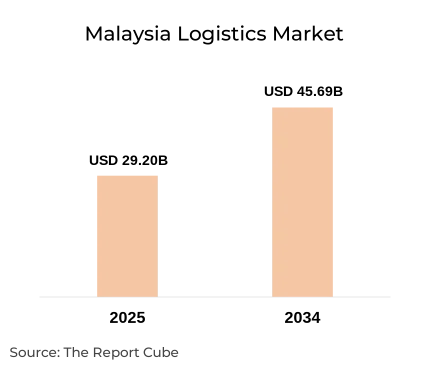
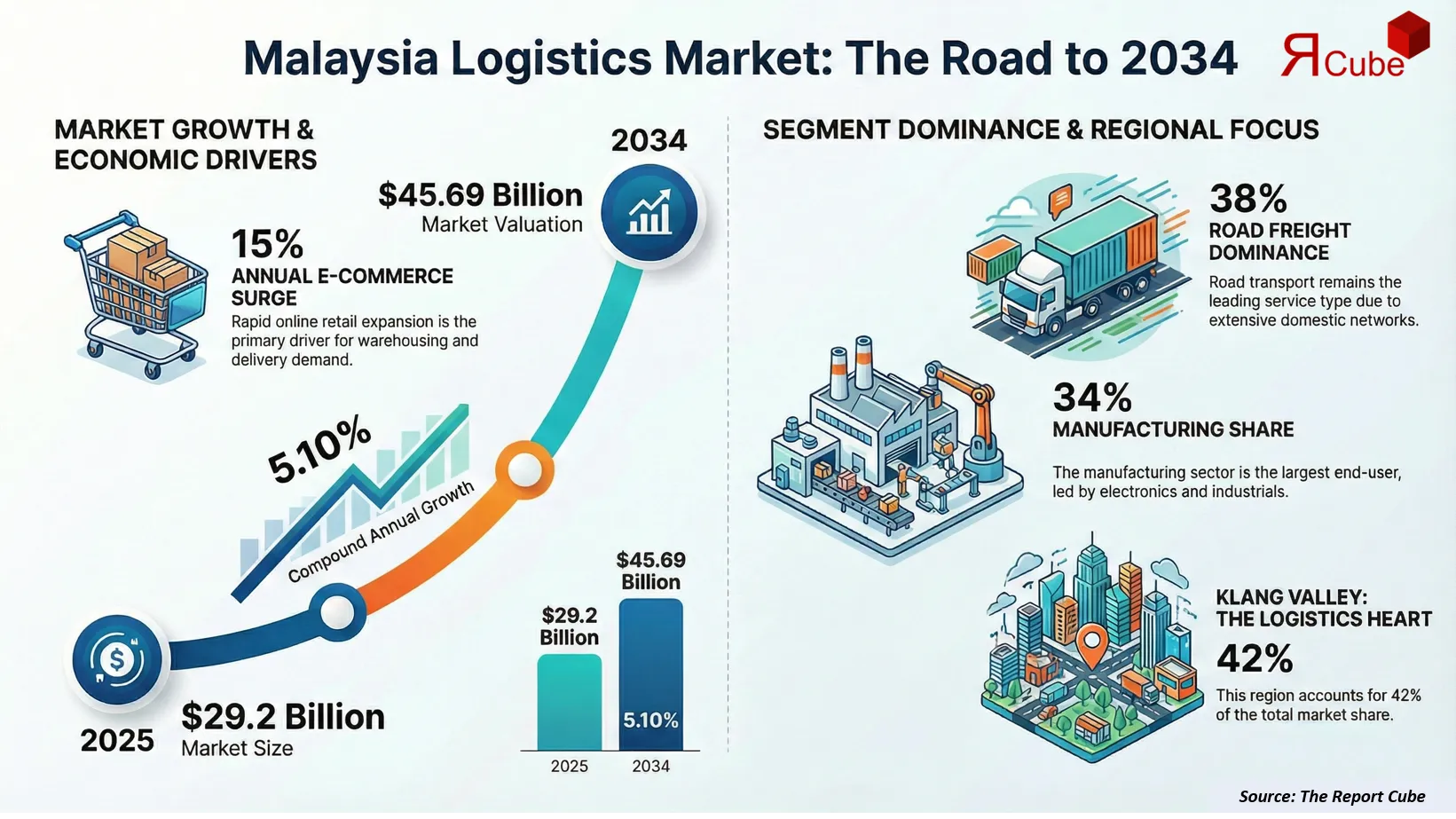
The Malaysia Logistics Market is anticipated to register a CAGR of 5.10% during the forecast period 2026-2034. The market size was valued at USD 29.2 billion in 2025 and is projected to reach USD 45.69 billion by 2034. This growth is driven by Malaysia’s strategic geographic location in Southeast Asia, expanding trade volumes, and rising demand for integrated logistics services across manufacturing, retail, and e-commerce sectors.
Malaysia continues to strengthen its position as a regional logistics and transshipment hub, supported by well-developed ports, airports, and road connectivity. The rapid digitalization of supply chains, combined with growing cross-border trade under ASEAN frameworks, has accelerated demand for efficient freight forwarding, warehousing, and third-party logistics services. Logistics providers are increasingly investing in automation, warehouse management systems, and last-mile delivery capabilities to improve service reliability and turnaround times.
Furthermore, the expansion of e-commerce and omnichannel retailing has reshaped logistics demand patterns, particularly for courier, express, and parcel services. Government-backed infrastructure investments and public-private partnerships are enhancing logistics efficiency nationwide. As a result, the Malaysia Logistics Market is evolving from traditional transportation services toward integrated, technology-driven logistics solutions, supporting sustainable long-term growth through 2034.
Malaysia Logistics Market Recent Developments
- 2025: DHL Group Malaysia expanded automated warehousing capacity to support rising e-commerce and cross-border fulfillment demand.
- 2025: Pos Malaysia Berhad upgraded last-mile delivery networks to improve parcel delivery speed nationwide.
Government Initiatives & Policies
- National Transport Policy 2019-2030: Focuses on improving logistics efficiency, multimodal connectivity, and supply chain resilience.
- Twelfth Malaysia Plan (12MP): Supports logistics digitalization, infrastructure upgrades, and trade facilitation initiatives.
Malaysia Logistics Market Dynamics
Key Driver: Rapid Growth of E-Commerce and Trade Activities
The primary driver of the Malaysia Logistics Market is the rapid expansion of e-commerce and international trade activities. Online retail penetration has increased significantly, with e-commerce transactions growing at over 15% annually in recent years. This surge has intensified demand for warehousing, CEP services, and efficient last-mile delivery solutions. Simultaneously, Malaysia’s strong manufacturing base and export-oriented economy continue to generate high freight volumes, particularly across electronics, automotive, and consumer goods sectors. Logistics providers are responding by expanding capacity, enhancing route optimization, and offering end-to-end supply chain solutions. These interconnected developments are strengthening the role of logistics as a critical enabler of economic growth.
Book your FREE 30-minute expert consultation today
Contact UsIndustry Trends: Shift Toward Integrated and Digital Logistics Solutions
A key trend shaping the market is the shift toward integrated logistics and digital platforms. Companies are increasingly adopting transport management systems, warehouse automation, and data analytics to improve visibility and cost efficiency. Third-party logistics providers are expanding value-added services such as inventory management, cold chain logistics, and reverse logistics. Additionally, sustainability initiatives, including route optimization and alternative fuel vehicles, are gaining traction as companies aim to reduce carbon footprints. These trends highlight the market’s transition from fragmented services to integrated, technology-enabled logistics ecosystems.
Major Challenge: Infrastructure Gaps and Rising Operating Costs
Despite positive growth prospects, infrastructure disparities and rising operating costs pose challenges to the Malaysia Logistics Market. Congestion at key ports, limited rail freight utilization, and uneven connectivity in rural regions can affect delivery timelines and service reliability. Moreover, increasing fuel prices, labor shortages, and compliance costs place pressure on logistics margins. Small and mid-sized operators are particularly vulnerable to these challenges, which may constrain capacity expansion and profitability if not addressed through policy support and operational efficiency improvements.
Opportunity: Expansion of Third-Party Logistics and Cold Chain Services
The growing demand for outsourced logistics presents a significant opportunity for the market. Manufacturers and retailers are increasingly relying on third-party logistics providers to manage complex supply chains and reduce capital expenditure. Cold chain logistics is also expanding rapidly, driven by healthcare, pharmaceuticals, and food and beverage sectors. Investments in temperature-controlled warehousing and specialized transportation are expected to generate new revenue streams. As businesses seek scalable and flexible logistics solutions, third-party providers are well-positioned to capture long-term growth opportunities.
Malaysia Logistics Market Segment-wise Analysis
By Service Type:
- Road Freight
- Rail Freight
- Air Freight
- Sea Freight
- Warehousing
- CEP Services
- Third-Party Logistics
Road Freight dominates the service type segment, accounting for approximately 38% of the market share in 2025 due to extensive road networks and high domestic freight movement. Sea Freight follows closely, supported by Malaysia’s major ports and strong international trade flows. CEP Services are the fastest-growing segment, driven by e-commerce expansion and rising consumer expectations for fast deliveries. Warehousing and third-party logistics services are also gaining prominence as companies seek integrated supply chain solutions. This diversified service mix reflects the evolving needs of Malaysia’s logistics ecosystem.
By End User:
- Manufacturing
- Retail & E-Commerce
- Automotive
- Oil & Gas
- Healthcare
- Food & Beverages
- Others
The Manufacturing sector leads end-user demand, contributing nearly 34% of the market share, driven by Malaysia’s strong electronics and industrial base. Retail & E-Commerce follows, reflecting growing online consumption and omnichannel distribution. Healthcare and food & beverages are emerging as high-growth segments due to increased demand for cold chain and compliant logistics services. These end-user trends underline the market’s increasing complexity and the need for specialized logistics capabilities.
Regional Projection of Malaysia Logistics Industry
- Klang Valley
- Northern Region
- Southern Region
- East Coast Region
- East Malaysia
Klang Valley leads the Malaysia Logistics Market, accounting for around 42% of total market share. The region benefits from dense industrial clusters, major ports, airports, and advanced infrastructure. Its central role in manufacturing, trade, and consumption makes it the primary logistics hub in the country. Northern and Southern regions follow, supported by cross-border trade with Thailand and Singapore. East Malaysia and the East Coast Region are gradually expanding, driven by infrastructure investments and regional development initiatives. Klang Valley is expected to maintain its dominance throughout the forecast period.
Need insights for a specific region within this market?
Request Regional DataWhy Choose This Report?
- Provides a comprehensive overview of the overall market analysis, encompassing key trends, consumer behavior analysis, and risk assessment to support strategic decision-making.
- Provides accurate, up-to-date insights into market size, segmentation, and emerging opportunities, helping to minimize risk & capitalizing on growth.
- Gives deep understanding of target audience preferences, investment habits, and communication channels for enhanced product development & marketing effectiveness.
- Delivers competitive analysis & benchmarking, uncovering the strengths & weaknesses of market competitors to guide strategies.
- Consolidate comprehensive market intelligence, reducing reasoning & streamlining research efforts.
- Facilitates customized market segmentation & risk mitigation strategies, fine-tuned to the business objectives.
- Aids in identifying both market challenges & untapped opportunities within the industry to drive long-term business growth.
- Provides valuable information based on actual customer data & search trends.
Table of Contents
- Introduction
- Objective of the Study
- Product and Category Definition
- Market Segmentation
- Study Variables
- Research Methodology
- Secondary Data Points
- Breakdown of Secondary Sources
- Primary Data Points
- Breakdown of Primary Interviews
- Secondary Data Points
- Executive Summary
- Market Dynamics
- Drivers
- Challenges
- Opportunity Assessment
- Recent Trends and Developments
- Regulatory and Policy Landscape
- Malaysia Logistics Market Overview (2021-2034)
- Market Size, By Value (USD Billion)
- Market Share, By Service Type
- Road Freight
- Rail Freight
- Air Freight
- Sea Freight
- Warehousing
- CEP Services
- Third‑Party Logistics
- Market Share, By End User
- Manufacturing
- Retail & E‑Commerce
- Automotive
- Oil & Gas
- Healthcare
- Food & Beverages
- Others
- Market Share, By Mode
- Domestic Logistics
- International Logistics
- Market Share, By Region
- Klang Valley
- Northern Region
- Southern Region
- East Coast Region
- East Malaysia
- Market Share, By Company
- Market Share, By Company
- Competition Characteristics
- Revenue Shares & Analysis
- Regional Logistics Overview
- Klang Valley Logistics Market
- Market Size, By Value (USD Billion)
- Service Type Mix
- End User Mix
- Northern Region Logistics Market
- Market Size, By Value (USD Billion)
- Service Type Mix
- End User Mix
- Southern Region Logistics Market
- Market Size, By Value (USD Billion)
- Service Type Mix
- End User Mix
- East Coast Region Logistics Market
- Market Size, By Value (USD Billion)
- Service Type Mix
- End User Mix
- East Malaysia Logistics Market
- Market Size, By Value (USD Billion)
- Service Type Mix
- End User Mix
- Klang Valley Logistics Market
- Modal and Service Deep‑Dive
- Road Freight and Distribution
- Rail Freight and Intermodal
- Air Cargo and Express
- Sea Freight and Ports
- Warehousing and Storage
- Courier, Express and Parcel
- Third‑Party Logistics (3PL)
- End‑User Industry Analysis
- Manufacturing Logistics
- Retail and E‑Commerce Logistics
- Automotive Logistics
- Oil & Gas Logistics
- Healthcare and Pharma Logistics
- Food & Beverage Logistics
- Competitive Outlook and Company Profiles
- DHL Group Malaysia
- Company Overview
- Service Portfolio
- Strategic Alliances/Partnerships
- Recent Developments
- GD Express (GDEX)
- Company Overview
- Service Portfolio
- Strategic Alliances/Partnerships
- Recent Developments
- Pos Malaysia Berhad
- Company Overview
- Service Portfolio
- Strategic Alliances/Partnerships
- Recent Developments
- MMC Corporation Berhad
- Company Overview
- Service Portfolio
- Strategic Alliances/Partnerships
- Recent Developments
- J&T Express Malaysia
- Company Overview
- Service Portfolio
- Strategic Alliances/Partnerships
- Recent Developments
- Kerry Logistics Network
- Company Overview
- Service Portfolio
- Strategic Alliances/Partnerships
- Recent Developments
- Nippon Express Malaysia
- Company Overview
- Service Portfolio
- Strategic Alliances/Partnerships
- Recent Developments
- FedEx Express Malaysia
- Company Overview
- Service Portfolio
- Strategic Alliances/Partnerships
- Recent Developments
- UPS Malaysia
- Company Overview
- Service Portfolio
- Strategic Alliances/Partnerships
- Recent Developments
- FM Global Logistics
- Company Overview
- Service Portfolio
- Strategic Alliances/Partnerships
- Recent Developments
- Others
- DHL Group Malaysia
- Contact Us and Disclaimer
Top Key Players & Market Share Outlook
- DHL Group Malaysia
- GD Express (GDEX)
- Pos Malaysia Berhad
- MMC Corporation Berhad
- J&T Express Malaysia
- Kerry Logistics Network
- Nippon Express Malaysia
- FedEx Express Malaysia
- UPS Malaysia
- FM Global Logistics
- Others
Frequently Asked Questions






