



Build Your Custom Market Intelligence Report
Customize Your ReportAustralia E-Commerce Logistics Market Insights & Analysis
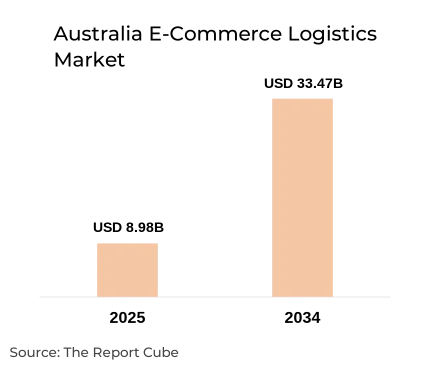
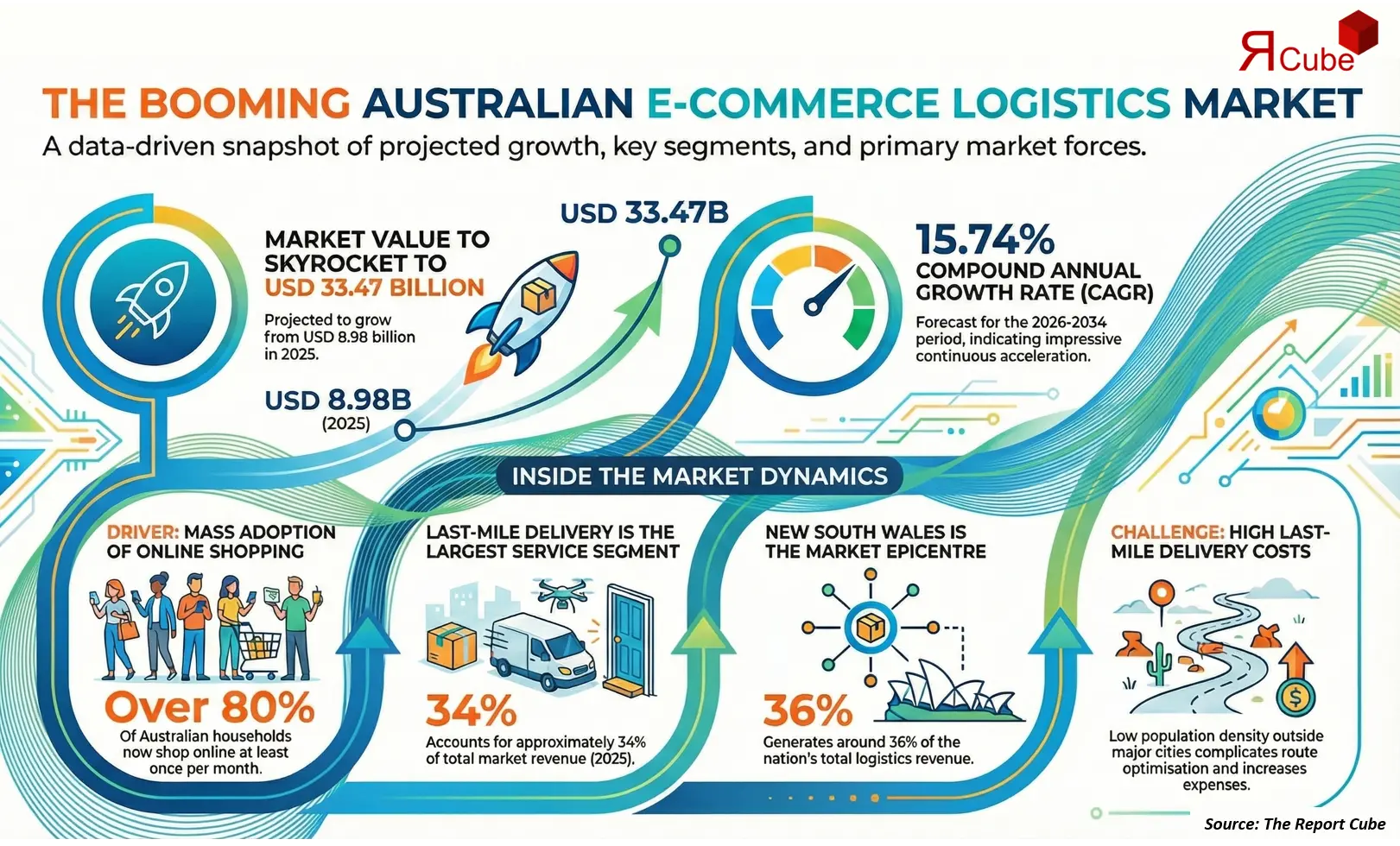
The Australia E-Commerce Logistics Market is anticipated to register a CAGR of 15.74% during 2026-2034. The market size was valued at USD 8.98 billion in 2025 and is projected to reach USD 33.47 billion by 2034. This exceptional growth reflects the rapid expansion of online retail penetration across Australia, supported by strong consumer adoption of digital shopping, increasing smartphone usage, and widespread availability of high-speed internet. As e-commerce volumes rise, logistics providers are scaling operations to manage higher parcel flows, faster delivery expectations, and greater geographic coverage.
The market is further strengthened by Australia’s unique geographic dynamics, where long distances between urban centers demand highly efficient line-haul and last-mile delivery networks. Retailers are increasingly outsourcing logistics to specialized service providers to optimize costs, enhance delivery reliability, and improve customer satisfaction. Fulfilment automation, real-time shipment tracking, and integrated warehouse management systems are becoming core competitive differentiators across the logistics value chain.
Moreover, cross-border e-commerce is accelerating inbound and outbound shipments, driving demand for customs clearance, international freight coordination, and reverse logistics. As consumers expect flexible delivery options and easy returns, logistics providers are shifting toward customer-centric models. Collectively, these factors are positioning the Australia E-Commerce Logistics Market as one of the fastest-growing segments within the country’s broader logistics and supply chain industry.
Australia E-Commerce Logistics Market Recent Developments
- 2025: Australia Post expanded automated parcel sorting capacity to support rising same-day and next-day delivery volumes.
- 2025: DHL Express enhanced its cross-border e-commerce solutions for Asia-Pacific online retailers operating in Australia.
Government Initiatives & Policies
- National Freight and Supply Chain Strategy: Federal initiative improving logistics efficiency, digital freight systems, and infrastructure resilience.
- Modern Manufacturing Strategy - Supply Chain Resilience: Program supporting advanced logistics capabilities and domestic distribution networks.
Australia E-Commerce Logistics Market Dynamics
Key Driver: Rapid Growth of Online Retail and Consumer Delivery Expectations
The accelerating shift toward online shopping is the primary driver of the Australia E-Commerce Logistics Market. Over 80% of Australian households now shop online at least once per month, with parcel volumes growing at double-digit rates annually. Consumers increasingly expect fast, flexible, and low-cost delivery options, including same-day and next-day services. This has forced retailers to rely heavily on third-party logistics providers capable of managing scalable last-mile delivery networks. Additionally, the growth of mobile commerce and subscription-based retail models is increasing shipment frequency, directly boosting demand for advanced e-commerce logistics services across Australia.
Book your FREE 30-minute expert consultation today
Contact UsIndustry Trends: Automation, Data Analytics, and Sustainable Logistics
Automation and data-driven logistics operations are emerging as defining trends within the market. Fulfilment centers are increasingly adopting robotics, automated picking systems, and AI-enabled route optimization to handle rising order volumes efficiently. Nearly 40% of large e-commerce warehouses in Australia implemented some form of automation by 2025. Alongside this, sustainability is becoming a strategic priority, with logistics providers investing in electric delivery vehicles, carbon-neutral shipping options, and optimized packaging. These trends not only improve operational efficiency but also align with growing consumer and regulatory expectations around environmental responsibility.
Major Challenge: High Operational Costs and Last-Mile Complexity
Despite strong growth, high operational costs remain a significant challenge for the Australia E-Commerce Logistics Market. Fuel price volatility, labor shortages, and rising wages are increasing cost pressures, particularly for last-mile delivery. Australia’s low population density outside major cities further complicates route optimization and increases per-parcel delivery costs in regional and remote areas. Additionally, managing failed deliveries and returns adds complexity and erodes margins. Smaller logistics providers often struggle to maintain profitability while meeting service-level expectations set by larger, well-capitalized competitors.
Opportunity: Expansion of Reverse Logistics and Cross-Border Fulfilment
The rapid rise in product returns and international online purchases presents a major growth opportunity for logistics providers. Reverse logistics services, including returns processing, refurbishment, and redistribution, are expanding as return rates in fashion and electronics exceed 25%. At the same time, Australian sellers are increasingly targeting overseas customers, driving demand for cross-border fulfilment, customs brokerage, and international last-mile partnerships. Providers that offer integrated, end-to-end solutions stand to capture significant value over the forecast period.
Australia E-Commerce Logistics Market Segment-wise Analysis
By Service:
- Line-haul Transport
- Last-Mile Delivery
- Fulfilment Warehousing
- Cross-Border Logistics
Last-Mile Delivery leads the service segment, accounting for approximately 34% of total market revenue in 2025. Its dominance reflects the growing emphasis on delivery speed, flexibility, and customer experience. Urban same-day and next-day delivery options are becoming standard among leading e-commerce platforms, driving sustained investment in courier fleets and route optimization technologies. Fulfilment warehousing follows closely, supported by demand for inventory proximity to end consumers.
By Delivery Type:
- Standard Delivery
- Express Delivery
Standard delivery remains the dominant delivery type, holding nearly 62% market share in 2025 due to its cost efficiency for non-urgent shipments. However, express delivery is the fastest-growing segment, driven by premium consumers and time-sensitive product categories. Retailers increasingly use express delivery as a competitive differentiator, particularly in metropolitan regions.
Regional Projection of Australia E-Commerce Logistics Industry
- New South Wales
- Victoria
- Queensland
- Western Australia
New South Wales leads the Australia E-Commerce Logistics Market, contributing approximately 36% of total market revenue in 2025. The region benefits from high population density, strong e-commerce penetration, and the presence of major fulfilment hubs around Sydney. Victoria follows closely, driven by Melbourne’s role as a national distribution center. Together, these regions account for over two-thirds of national e-commerce logistics demand, while Queensland is emerging as a high-growth market supported by population inflows and infrastructure investment.
Need insights for a specific region within this market?
Request Regional DataWhy Choose This Report?
- Provides a comprehensive overview of the overall market analysis, encompassing key trends, consumer behavior analysis, and risk assessment to support strategic decision-making.
- Provides accurate, up-to-date insights into market size, segmentation, and emerging opportunities, helping to minimize risk & capitalizing on growth.
- Gives deep understanding of target audience preferences, investment habits, and communication channels for enhanced product development & marketing effectiveness.
- Delivers competitive analysis & benchmarking, uncovering the strengths & weaknesses of market competitors to guide strategies.
- Consolidate comprehensive market intelligence, reducing reasoning & streamlining research efforts.
- Facilitates customized market segmentation & risk mitigation strategies, fine-tuned to the business objectives.
- Aids in identifying both market challenges & untapped opportunities within the industry to drive long-term business growth.
- Provides valuable information based on actual customer data & search trends.
Table of Contents
- Introduction
- Objective of the Study
- Product and Category Definition
- Market Segmentation
- Study Variables
- Research Methodology
- Secondary Data Points
- Breakdown of Secondary Sources
- Primary Data Points
- Breakdown of Primary Interviews
- Secondary Data Points
- Executive Summary
- Market Dynamics
- Drivers
- Challenges
- Opportunity Assessment
- Recent Trends and Developments
- Regulatory and Policy Landscape
- Australia E‑Commerce Logistics Market Overview (2020‑2034)
- Market Size, By Value (USD Billion)
- Market Share, By Service
- Line‑haul Transport
- Last‑Mile Delivery
- Fulfilment Warehousing
- Cross‑Border Logistics
- Reverse Logistics
- Market Share, By Delivery Type
- Standard Delivery
- Express Delivery
- Market Share, By Shipment Weight
- Lightweight Parcels
- Heavyweight Parcels
- Market Share, By End‑User
- B2C E‑Retailers
- B2B Merchants
- Online Marketplaces
- Cross‑Border Sellers
- Market Share, By Region
- New South Wales
- Victoria
- Queensland
- Western Australia
- South Australia
- Tasmania
- Northern Territory
- Australian Capital Territory
- Market Share, By Company
- Competition Characteristics
- Revenue Shares & Analysis
- New South Wales E‑Commerce Logistics
- Market Size, By Value (USD Billion)
- Market Share, By Service
- Market Share, By Delivery Type
- Market Share, By Shipment Weight
- Market Share, By End‑User
- Victoria E‑Commerce Logistics
- Market Size, By Value (USD Billion)
- Market Share, By Service
- Market Share, By Delivery Type
- Market Share, By Shipment Weight
- Market Share, By End‑User
- Queensland E‑Commerce Logistics
- Market Size, By Value (USD Billion)
- Market Share, By Service
- Market Share, By Delivery Type
- Market Share, By Shipment Weight
- Market Share, By End‑User
- Western Australia E‑Commerce Logistics
- Market Size, By Value (USD Billion)
- Market Share, By Service
- Market Share, By Delivery Type
- Market Share, By Shipment Weight
- Market Share, By End‑User
- South Australia E‑Commerce Logistics
- Market Size, By Value (USD Billion)
- Market Share, By Service
- Market Share, By Delivery Type
- Market Share, By Shipment Weight
- Market Share, By End‑User
- Tasmania E‑Commerce Logistics
- Market Size, By Value (USD Billion)
- Market Share, By Service
- Market Share, By Delivery Type
- Market Share, By Shipment Weight
- Market Share, By End‑User
- Northern Territory E‑Commerce Logistics
- Market Size, By Value (USD Billion)
- Market Share, By Service
- Market Share, By Delivery Type
- Market Share, By Shipment Weight
- Market Share, By End‑User
- Australian Capital Territory E‑Commerce Logistics
- Market Size, By Value (USD Billion)
- Market Share, By Service
- Market Share, By Delivery Type
- Market Share, By Shipment Weight
- Market Share, By End‑User
- Competitive Outlook and Company Profiles
- Australia Post
- Company Overview
- Service Portfolio
- Strategic Alliances/Partnerships
- Recent Developments
- Toll Group
- Company Overview
- Service Portfolio
- Strategic Alliances/Partnerships
- Recent Developments
- Aramex Australia
- Company Overview
- Service Portfolio
- Strategic Alliances/Partnerships
- Recent Developments
- DHL Express
- Company Overview
- Service Portfolio
- Strategic Alliances/Partnerships
- Recent Developments
- FedEx Express
- Company Overview
- Service Portfolio
- Strategic Alliances/Partnerships
- Recent Developments
- UPS Australia
- Company Overview
- Service Portfolio
- Strategic Alliances/Partnerships
- Recent Developments
- CouriersPlease
- Company Overview
- Service Portfolio
- Strategic Alliances/Partnerships
- Recent Developments
- SEKO Logistics
- Company Overview
- Service Portfolio
- Strategic Alliances/Partnerships
- Recent Developments
- Mainfreight Australia
- Company Overview
- Service Portfolio
- Strategic Alliances/Partnerships
- Recent Developments
- CEVA Logistics
- Company Overview
- Service Portfolio
- Strategic Alliances/Partnerships
- Recent Developments
- Others
- Australia Post
- Contact Us and Disclaimer
Top Key Players & Market Share Outlook
- Australia Post
- Toll Group
- Aramex Australia
- DHL Express
- FedEx Express
- UPS Australia
- CouriersPlease
- SEKO Logistics
- Mainfreight Australia
- CEVA Logistics
- Others
Frequently Asked Questions






