



Build Your Custom Market Intelligence Report
Customize Your ReportJapan Third-Party Logistics (3PL) Market Insights & Analysis
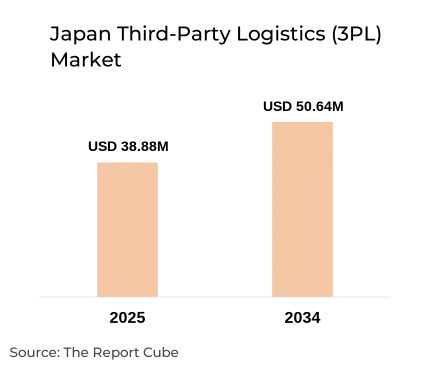
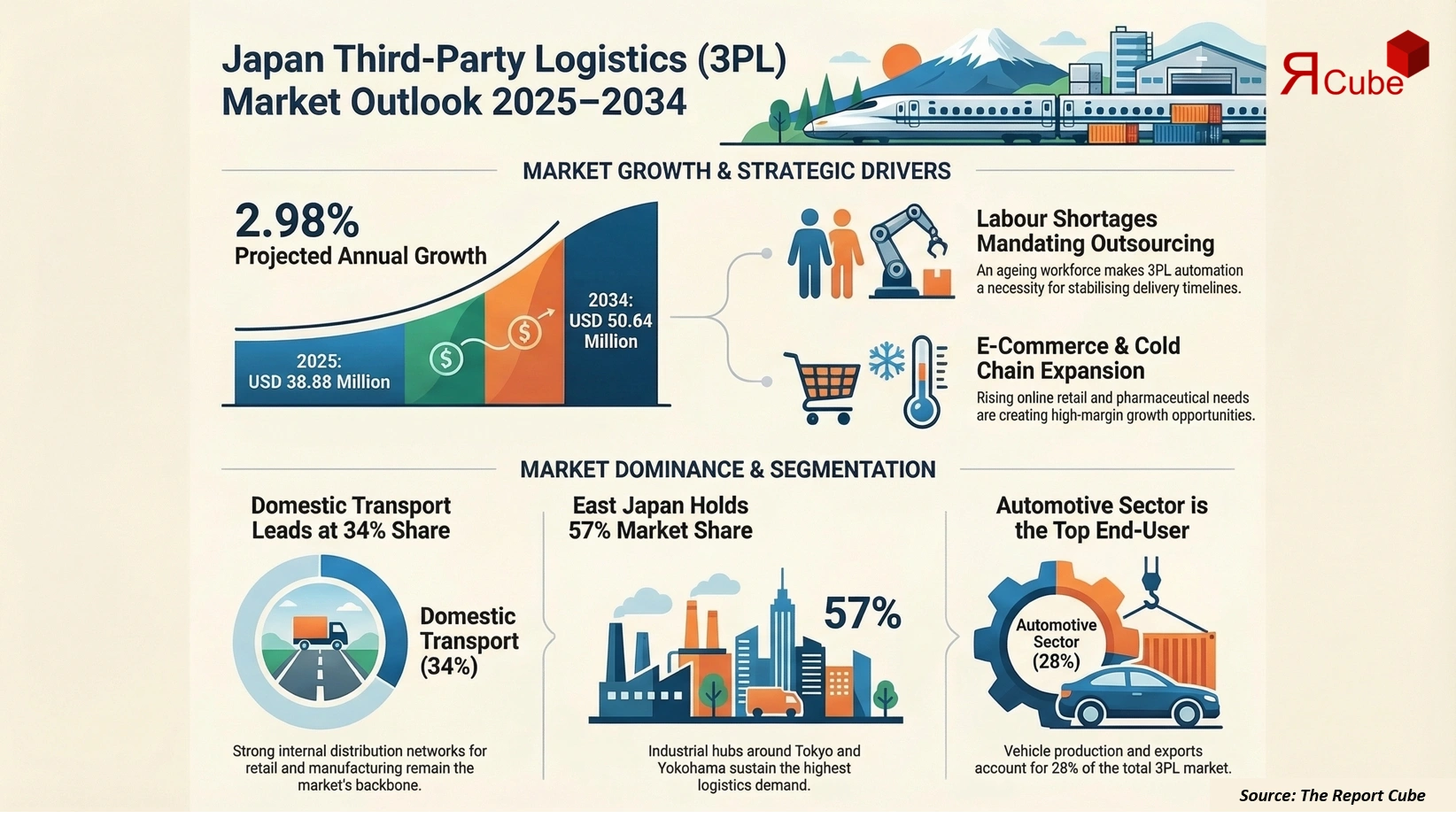
The Japan Third-Party Logistics (3PL) Market is anticipated to register a CAGR of 2.98% during the forecast period 2026-2034. The market size was valued at USD 38.88 million in 2025 and is projected to reach USD 50.64 million by 2034. Japan’s highly structured supply chain ecosystem, combined with its strong manufacturing and export-driven economy, continues to underpin steady demand for outsourced logistics services across industries.
The increasing complexity of domestic and cross-border supply chains has encouraged Japanese enterprises to rely on specialized logistics providers for cost optimization, service reliability, and scalability. Third-party logistics companies play a critical role in managing transportation networks, warehousing, and value-added services for sectors such as automotive, electronics, food, and life sciences. As labor shortages persist in Japan’s logistics sector, automation and outsourcing have become strategic necessities rather than optional efficiencies.
Furthermore, the growth of e-commerce, aging population dynamics, and rising demand for temperature-controlled and just-in-time delivery services are reshaping the 3PL landscape. Companies are increasingly focusing on technology-enabled logistics solutions, including warehouse automation and data-driven route optimization. These interconnected factors collectively support moderate yet resilient growth in the Japan Third-Party Logistics Market throughout the forecast period.
Japan Third-Party Logistics (3PL) Market Recent Developments
- 2025: Nippon Express expanded automated warehouse capacity to improve efficiency in domestic distribution networks.
- 2025: Yamato Holdings strengthened cold-chain logistics services for food and pharmaceutical customers.
Government Initiatives & Policies
- Logistics DX Promotion Policy: Supports digital transformation and automation across Japan’s logistics sector.
- Green Logistics Partnership Program: Encourages energy-efficient transport and emission reduction initiatives.
Japan Third-Party Logistics (3PL) Market Dynamics
Key Driver: Rising Outsourcing Demand Amid Labor Shortages
One of the primary drivers of the Japan Third-Party Logistics Market is the growing reliance on outsourcing due to chronic labor shortages. Japan’s aging workforce has significantly reduced the availability of logistics personnel, increasing operational risks for in-house logistics models. As a result, manufacturers, retailers, and distributors are increasingly partnering with 3PL providers that can offer scalable workforce solutions and advanced automation. Outsourcing allows businesses to stabilize delivery timelines while controlling labor costs. In addition, 3PL companies are investing heavily in robotics, automated storage, and AI-driven scheduling systems, further enhancing their value proposition. This structural labor challenge ensures sustained demand for third-party logistics services across both domestic and international supply chains.
Book your FREE 30-minute expert consultation today
Contact UsIndustry Trends: Growth of Value-Added and Contract Logistics
A notable trend in the market is the increasing adoption of value-added logistics and dedicated contract logistics services. Clients are no longer seeking basic transportation alone but require integrated solutions such as packaging, labeling, kitting, and inventory management. Dedicated contract logistics arrangements provide long-term stability for both service providers and customers, particularly in sectors with predictable volumes such as automotive and consumer goods. Additionally, technology integration, including warehouse management systems and real-time tracking, is becoming a standard offering. These trends are transforming the role of 3PL providers from service vendors to strategic supply chain partners, strengthening customer retention and revenue stability.
Major Challenge: High Operating Costs and Infrastructure Constraints
Despite steady demand, high operating costs remain a major challenge for the Japan Third-Party Logistics Market. Urban congestion, limited warehouse space, and rising energy costs place pressure on profit margins. Japan’s dense urban environments restrict large-scale logistics facility development, particularly near major consumption centers. Furthermore, compliance with strict safety, labor, and environmental regulations increases administrative complexity. Smaller logistics providers often struggle to invest in advanced technologies needed to remain competitive. These constraints limit rapid expansion and require continuous efficiency improvements to sustain profitability.
Opportunity: Expansion of E-Commerce and Cold Chain Logistics
The expansion of e-commerce and cold chain logistics presents a strong growth opportunity for the market. Online retail penetration in Japan continues to rise, driving demand for last-mile delivery, fulfillment centers, and returns management. Simultaneously, increasing consumption of fresh food, pharmaceuticals, and biologics has elevated the importance of temperature-controlled logistics. 3PL providers that invest in cold storage facilities and specialized transport capabilities are well-positioned to capture high-margin segments. This diversification into specialized logistics services enhances long-term growth potential despite moderate overall market expansion.
Japan Third-Party Logistics (3PL) Market Segment-wise Analysis
By Service:
- Domestic Transport
- International Transport
- Warehousing & VAWD
- Dedicated Contract
- Value-Added Logistics
Domestic Transport dominates the market, accounting for approximately 34% of total market share in 2025. This dominance reflects Japan’s strong internal distribution networks supporting retail, food, and manufacturing sectors. Warehousing & VAWD follows closely, driven by rising demand for inventory optimization and packaging services. Dedicated contract logistics is gaining momentum as large enterprises seek long-term partnerships to stabilize supply chains. Value-added logistics, while smaller in share, is growing steadily due to increasing customization requirements across industries.
By End User:
- Automotive
- Retail & E-Commerce
- Manufacturing
- Life Sciences
- Food & Beverage
- Consumer Goods
The Automotive segment leads the end-user landscape with an estimated 28% market share, supported by Japan’s strong vehicle production and export activities. Retail & E-Commerce follows, benefiting from rising online shopping and omnichannel distribution models. Manufacturing and Consumer Goods maintain stable demand for inbound and outbound logistics. Meanwhile, Life Sciences and Food & Beverage segments are expanding due to increased cold chain and compliance-driven logistics needs, contributing to service diversification.
Regional Projection of Japan Third-Party Logistics Industry
- East Japan
- West Japan
East Japan leads the Japan Third-Party Logistics Market, holding approximately 57% of total market share. The region benefits from major industrial hubs, dense population centers, and extensive port and airport infrastructure around Tokyo and Yokohama. High concentration of manufacturing, retail, and import-export activities sustains strong demand for integrated logistics services. West Japan follows, driven by Kansai’s manufacturing base and port connectivity. East Japan is expected to maintain its dominance throughout the forecast period, supported by continued investment in logistics automation and infrastructure modernization.
Need insights for a specific region within this market?
Request Regional DataWhy Choose This Report?
- Provides a comprehensive overview of the overall market analysis, encompassing key trends, consumer behavior analysis, and risk assessment to support strategic decision-making.
- Provides accurate, up-to-date insights into market size, segmentation, and emerging opportunities, helping to minimize risk & capitalizing on growth.
- Gives deep understanding of target audience preferences, investment habits, and communication channels for enhanced product development & marketing effectiveness.
- Delivers competitive analysis & benchmarking, uncovering the strengths & weaknesses of market competitors to guide strategies.
- Consolidate comprehensive market intelligence, reducing reasoning & streamlining research efforts.
- Facilitates customized market segmentation & risk mitigation strategies, fine-tuned to the business objectives.
- Aids in identifying both market challenges & untapped opportunities within the industry to drive long-term business growth.
- Provides valuable information based on actual customer data & search trends.
Table of Contents
- Introduction
- Objective of the Study
- Product and Category Definition
- Market Segmentation
- Study Variables
- Research Methodology
- Secondary Data Points
- Breakdown of Secondary Sources
- Primary Data Points
- Breakdown of Primary Interviews
- Secondary Data Points
- Executive Summary
- Market Dynamics
- Drivers
- Challenges
- Opportunity Assessment
- Recent Trends and Developments
- Regulatory and Policy Landscape
- Japan 3PL Market Overview (2020-2034)
- Market Size, By Value (USD Million)
- Market Share, By Service
- Domestic Transport
- International Transport
- Warehousing & VAWD
- Dedicated Contract
- Value-Added Logistics
- Market Share, By End User
- Automotive
- Retail & E‑Commerce
- Manufacturing
- Life Sciences
- Food & Beverage
- Consumer Goods
- Market Share, By Logistics Model
- Asset-Light
- Asset-Heavy
- Hybrid Model
- Market Share, By Customer Type
- Large Enterprise
- Mid Enterprise
- Small Enterprise
- Market Share, By Region
- East
- West
- Market Share, By Company
- Competition Characteristics
- Revenue Shares & Analysis
- East Japan 3PL Market
- Market Size, By Value (USD Million)
- Market Share, By Service
- Market Share, By End User
- Market Share, By Logistics Model
- Market Share, By Customer Type
- Market Share, By Prefecture Group
- Market Share, By Key Prefectures
- Kanto (Tokyo Area)
- Tohoku
- Hokkaido
- Others in East
- West Japan 3PL Market
- Market Size, By Value (USD Million)
- Market Share, By Service
- Market Share, By End User
- Market Share, By Logistics Model
- Market Share, By Customer Type
- Market Share, By Prefecture Group
- Market Share, By Key Prefectures
- Kansai (Osaka Area)
- Chubu
- Chugoku & Shikoku
- Kyushu & Okinawa
- Competitive Outlook and Company Profiles
- Nippon Express Holdings
- Company Overview
- Service Portfolio
- Strategic Alliances/Partnerships
- Recent Developments
- Yamato Holdings
- Company Overview
- Service Portfolio
- Strategic Alliances/Partnerships
- Recent Developments
- Sagawa Express (SG Holdings)
- Company Overview
- Service Portfolio
- Strategic Alliances/Partnerships
- Recent Developments
- Kintetsu World Express
- Company Overview
- Service Portfolio
- Strategic Alliances/Partnerships
- Recent Developments
- LOGISTEED (Hitachi Transport)
- Company Overview
- Service Portfolio
- Strategic Alliances/Partnerships
- Recent Developments
- Mitsui‑Soko Holdings
- Company Overview
- Service Portfolio
- Strategic Alliances/Partnerships
- Recent Developments
- Nichirei Logistics Group
- Company Overview
- Service Portfolio
- Strategic Alliances/Partnerships
- Recent Developments
- Yusen Logistics
- Company Overview
- Service Portfolio
- Strategic Alliances/Partnerships
- Recent Developments
- Sankyu Inc.
- Company Overview
- Service Portfolio
- Strategic Alliances/Partnerships
- Recent Developments
- DHL Supply Chain Japan
- Company Overview
- Service Portfolio
- Strategic Alliances/Partnerships
- Recent Developments
- Others
- Nippon Express Holdings
- Contact Us and Disclaimer
Top Key Players & Market Share Outlook
- Nippon Express Holdings
- Yamato Holdings
- Sagawa Express (SG Holdings)
- Kintetsu World Express
- LOGISTEED (Hitachi Transport)
- Mitsui‑Soko Holdings
- Nichirei Logistics Group
- Yusen Logistics
- Sankyu Inc.
- DHL Supply Chain Japan
- Others
Frequently Asked Questions






