




Build Your Custom Market Intelligence Report
Customize Your ReportAsia Pacific Logistics Market Insights & Analysis
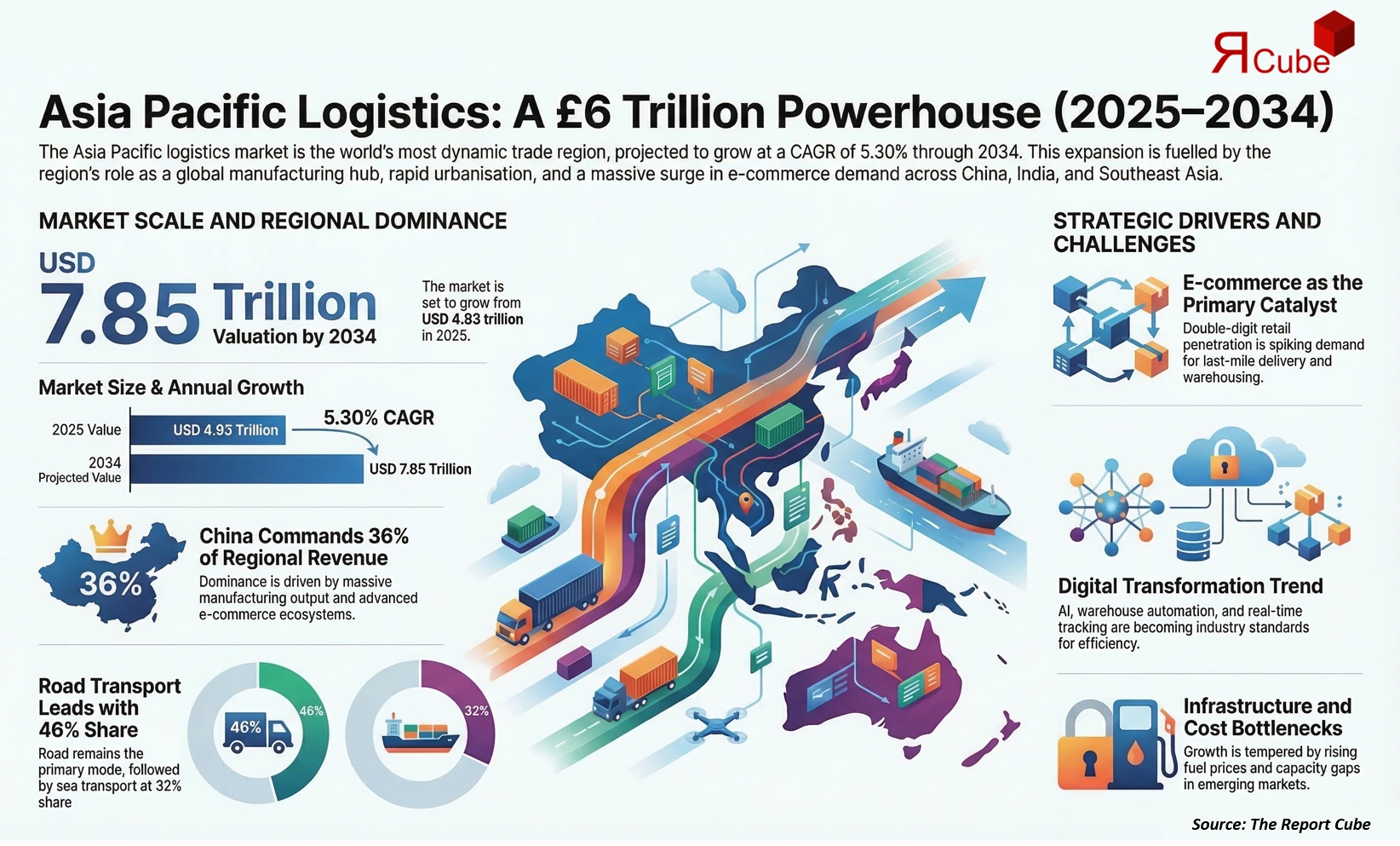
The Asia Pacific Logistics Market is anticipated to register a CAGR of 5.30% during the forecast period 2026-2034. The market size was valued at USD 4,930 billion in 2025 and is projected to reach USD 7,850 billion by 2034. This robust expansion reflects the region’s growing role as a global manufacturing hub, rapid urbanization, and rising intra-regional trade supported by expanding consumer markets.
The logistics ecosystem in Asia Pacific is evolving rapidly as governments and private players invest heavily in transportation infrastructure, digital supply chains, and cross-border connectivity. Strong growth in e-commerce, automotive production, electronics manufacturing, and pharmaceuticals continues to fuel demand for efficient logistics services. Countries such as China, India, and Southeast Asian nations are witnessing sustained increases in freight volumes, driven by rising disposable incomes and changing consumption patterns.
Moreover, supply chain diversification strategies adopted by multinational corporations are strengthening logistics demand across multiple Asia Pacific economies. Companies are increasingly focusing on resilience, faster delivery cycles, and integrated logistics solutions. As a result, service providers are expanding multimodal capabilities and value-added offerings, positioning the Asia Pacific Logistics Market as one of the most dynamic and strategically important regions globally.
Asia Pacific Logistics Market Recent Developments
- 2025: SF Express expanded cross-border logistics hubs across Southeast Asia to support rising e-commerce exports.
- 2025: Nippon Express enhanced integrated logistics solutions for automotive and electronics supply chains in Asia.
Government Initiatives & Policies
- China Belt and Road Initiative: Strengthens regional trade corridors and logistics infrastructure.
- India National Logistics Policy: Aims to reduce logistics costs and improve multimodal connectivity.
Asia Pacific Logistics Market Dynamics
Key Driver: Expansion of E-commerce and Regional Trade
The primary driver of the Asia Pacific Logistics Market is the rapid expansion of e-commerce and regional trade flows. Online retail penetration has grown at double-digit rates across major economies, particularly in China, India, and Southeast Asia. This surge has increased demand for transportation, warehousing, and last-mile delivery services. Additionally, regional trade agreements and manufacturing relocation within Asia have boosted cross-border freight movement. As companies prioritize faster order fulfillment and inventory optimization, logistics providers are scaling operations and investing in advanced distribution networks. These interconnected trends are significantly enhancing freight volumes and driving sustained market growth.
Book your FREE 30-minute expert consultation today
Contact UsIndustry Trends: Digitalization and Integrated Logistics Solutions
Digital transformation is a defining trend in the Asia Pacific logistics sector. Companies are adopting warehouse automation, real-time tracking, and data analytics to improve efficiency and transparency. Integrated logistics solutions combining transportation, warehousing, and value-added services are gaining popularity among manufacturers and retailers seeking end-to-end supply chain visibility. Additionally, the use of digital freight platforms and smart ports is improving asset utilization and reducing turnaround times. These trends are enabling logistics providers to offer more reliable, scalable, and customer-centric services across the region.
Major Challenge: Infrastructure Gaps and Cost Pressures
Despite strong growth prospects, infrastructure gaps and rising operational costs remain major challenges for the Asia Pacific Logistics Market. While developed economies such as Japan and South Korea benefit from advanced infrastructure, several emerging markets face bottlenecks in road, rail, and port capacity. Congestion, regulatory complexity, and fuel price volatility add to cost pressures for logistics providers. These challenges can impact service reliability and profitability, particularly for small and mid-sized operators. Addressing infrastructure disparities and improving policy coordination remain critical for sustaining long-term market growth.
Opportunity: Multimodal Logistics and Value-added Services
The growing emphasis on multimodal logistics presents a significant opportunity for market players. Combining road, rail, air, and sea transport enables cost optimization and faster transit times for long-distance shipments. Additionally, demand for value-added services such as packaging, labeling, cold chain logistics, and inventory management is increasing across industries. Logistics providers that invest in integrated service portfolios and regional distribution hubs are well-positioned to capture higher margins and strengthen customer relationships. This shift toward comprehensive solutions is expected to unlock new revenue streams throughout the forecast period.
Asia Pacific Logistics Market Segment-wise Analysis
By Service Type:
- Transportation
- Warehousing
- Freight Forwarding
- Inventory Management
- Value-added Services
- Integration & Consulting
Transportation dominates the service type segment, accounting for nearly 44% of the market share in 2025. This leadership is driven by high freight volumes across road, rail, air, and sea networks. Freight forwarding follows, supported by rising cross-border trade and complex customs requirements. Warehousing and inventory management are experiencing accelerated growth as e-commerce and omnichannel retail expand. Value-added services are gaining traction, contributing approximately 12% market share, as customers seek customized logistics solutions. The integration of consulting services further enhances supply chain efficiency and customer retention.
By Mode:
- Road
- Rail
- Air
- Sea
Road transport leads the mode segment with an estimated 46% market share, supported by extensive regional road networks and last-mile delivery demand. Sea transport remains critical for international trade, holding around 32% share due to cost efficiency for bulk shipments. Rail transport is gaining momentum, particularly in China and India, as governments invest in dedicated freight corridors. Air logistics, while smaller in share, is essential for high-value and time-sensitive goods. The balanced growth across modes highlights the importance of multimodal strategies in the region.
Regional Projection of Asia Pacific Logistics Industry
- China
- India
- Japan
- South Korea
- Australia
- Southeast Asia
China leads the Asia Pacific Logistics Market, accounting for approximately 36% of total regional revenue. Its dominance is supported by massive manufacturing output, advanced e-commerce ecosystems, and extensive transportation infrastructure. India follows as a high-growth market, driven by infrastructure development and rising domestic consumption. Japan and South Korea contribute steady demand through technologically advanced and efficient logistics networks. Southeast Asian countries are emerging as key growth centers due to manufacturing relocation and expanding consumer markets. China is expected to maintain its leadership position throughout the forecast period, while Southeast Asia records the fastest growth.
Need insights for a specific region within this market?
Request Regional DataWhy Choose This Report?
- Provides a comprehensive overview of the overall market analysis, encompassing key trends, consumer behavior analysis, and risk assessment to support strategic decision-making.
- Provides accurate, up-to-date insights into market size, segmentation, and emerging opportunities, helping to minimize risk & capitalizing on growth.
- Gives deep understanding of target audience preferences, investment habits, and communication channels for enhanced product development & marketing effectiveness.
- Delivers competitive analysis & benchmarking, uncovering the strengths & weaknesses of market competitors to guide strategies.
- Consolidate comprehensive market intelligence, reducing reasoning & streamlining research efforts.
- Facilitates customized market segmentation & risk mitigation strategies, fine-tuned to the business objectives.
- Aids in identifying both market challenges & untapped opportunities within the industry to drive long-term business growth.
- Provides valuable information based on actual customer data & search trends.
Table of Contents
- Introduction
- Objective of the Study
- Product and Category Definition
- Market Segmentation
- Study Variables
- Research Methodology
- Secondary Data Points
- Breakdown of Secondary Sources
- Primary Data Points
- Breakdown of Primary Interviews
- Secondary Data Points
- Executive Summary
- Market Dynamics
- Drivers
- Challenges
- Opportunity Assessment
- Recent Trends and Developments
- Regulatory and Policy Landscape
- Asia Pacific Logistics Market Overview (2020-2034)
- Market Size, By Value (USD Billion)
- Market Share, By Service Type
- Transportation
- Warehousing
- Freight Forwarding
- Inventory Management
- Value-added Services
- Integration & Consulting
- Market Share, By Mode
- Road
- Rail
- Air
- Sea
- Market Share, By End-user
- Manufacturing
- Retail & E‑commerce
- FMCG
- Automotive
- Healthcare
- Others
- Market Share, By Logistics Type
- First-party (1PL)
- Second-party (2PL)
- Third-party (3PL)
- Fourth-party (4PL)
- Market Share, By Country
- China
- India
- Japan
- South Korea
- Australia
- Indonesia
- Vietnam
- Thailand
- Malaysia
- Rest of Asia Pacific
- Market Share, By Company
- Revenue Shares
- Competition Characteristics
- Revenue Shares & Analysis
- China Logistics Market
- Market Size, By Value (USD Billion)
- Market Share, By Service Type
- Market Share, By Mode
- Market Share, By End-user
- Market Share, By Logistics Type
- India Logistics Market
- Market Size, By Value (USD Billion)
- Market Share, By Service Type
- Market Share, By Mode
- Market Share, By End-user
- Market Share, By Logistics Type
- Japan Logistics Market
- Market Size, By Value (USD Billion)
- Market Share, By Service Type
- Market Share, By Mode
- Market Share, By End-user
- Market Share, By Logistics Type
- South Korea Logistics Market
- Market Size, By Value (USD Billion)
- Market Share, By Service Type
- Market Share, By Mode
- Market Share, By End-user
- Market Share, By Logistics Type
- Australia Logistics Market
- Market Size, By Value (USD Billion)
- Market Share, By Service Type
- Market Share, By Mode
- Market Share, By End-user
- Market Share, By Logistics Type
- ASEAN Logistics Markets
- Market Size, By Value (USD Billion)
- Market Share, By Service Type
- Market Share, By Mode
- Market Share, By End-user
- Market Share, By Logistics Type
- Market Share, By Country
- Indonesia Logistics Market
- Vietnam Logistics Market
- Thailand Logistics Market
- Malaysia Logistics Market
- Philippines Logistics Market
- Rest of ASEAN
- Competitive Outlook and Company Profiles
- DHL Supply Chain & Global Forwarding
- Company Overview
- Service Portfolio
- Strategic Alliances/Partnerships
- Recent Developments
- Kuehne + Nagel
- Company Overview
- Service Portfolio
- Strategic Alliances/Partnerships
- Recent Developments
- DB Schenker
- Company Overview
- Service Portfolio
- Strategic Alliances/Partnerships
- Recent Developments
- Nippon Express Holdings
- Company Overview
- Service Portfolio
- Strategic Alliances/Partnerships
- Recent Developments
- SF Express
- Company Overview
- Service Portfolio
- Strategic Alliances/Partnerships
- Recent Developments
- Yusen Logistics
- Company Overview
- Service Portfolio
- Strategic Alliances/Partnerships
- Recent Developments
- CEVA Logistics
- Company Overview
- Service Portfolio
- Strategic Alliances/Partnerships
- Recent Developments
- Agility Logistics
- Company Overview
- Service Portfolio
- Strategic Alliances/Partnerships
- Recent Developments
- FedEx Corporation
- Company Overview
- Service Portfolio
- Strategic Alliances/Partnerships
- Recent Developments
- United Parcel Service (UPS)
- Company Overview
- Service Portfolio
- Strategic Alliances/Partnerships
- Recent Developments
- Others
- DHL Supply Chain & Global Forwarding
- Contact Us and Disclaimer
Top Key Players & Market Share Outlook
- DHL Supply Chain
- DB Schenker
- FedEx Corporation
- United Parcel Service, Inc.
- Schenker AG
- C.H. Robinson Worldwide Inc.
- Deutsche Post AG
- DSV A/S
- CMA CGM Group (CEVA Logistics SA)
- Kuehne + Nagel International AG
- Nippon Express Co., Ltd.
- Expeditors International of Washington, Inc.
- Kintetsu World Express Inc.
- GXO Logistics, Inc.
- A.P. Møller – Mærsk A/S
- Others
Frequently Asked Questions






