



Build Your Custom Market Intelligence Report
Customize Your ReportJapan Smart Warehousing Market Insights & Analysis
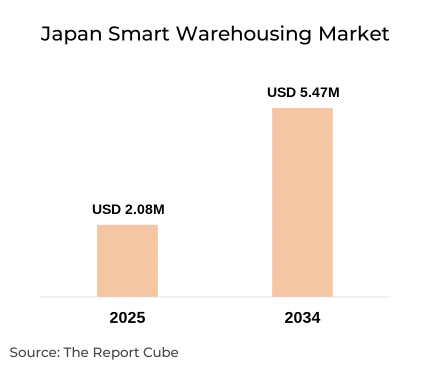
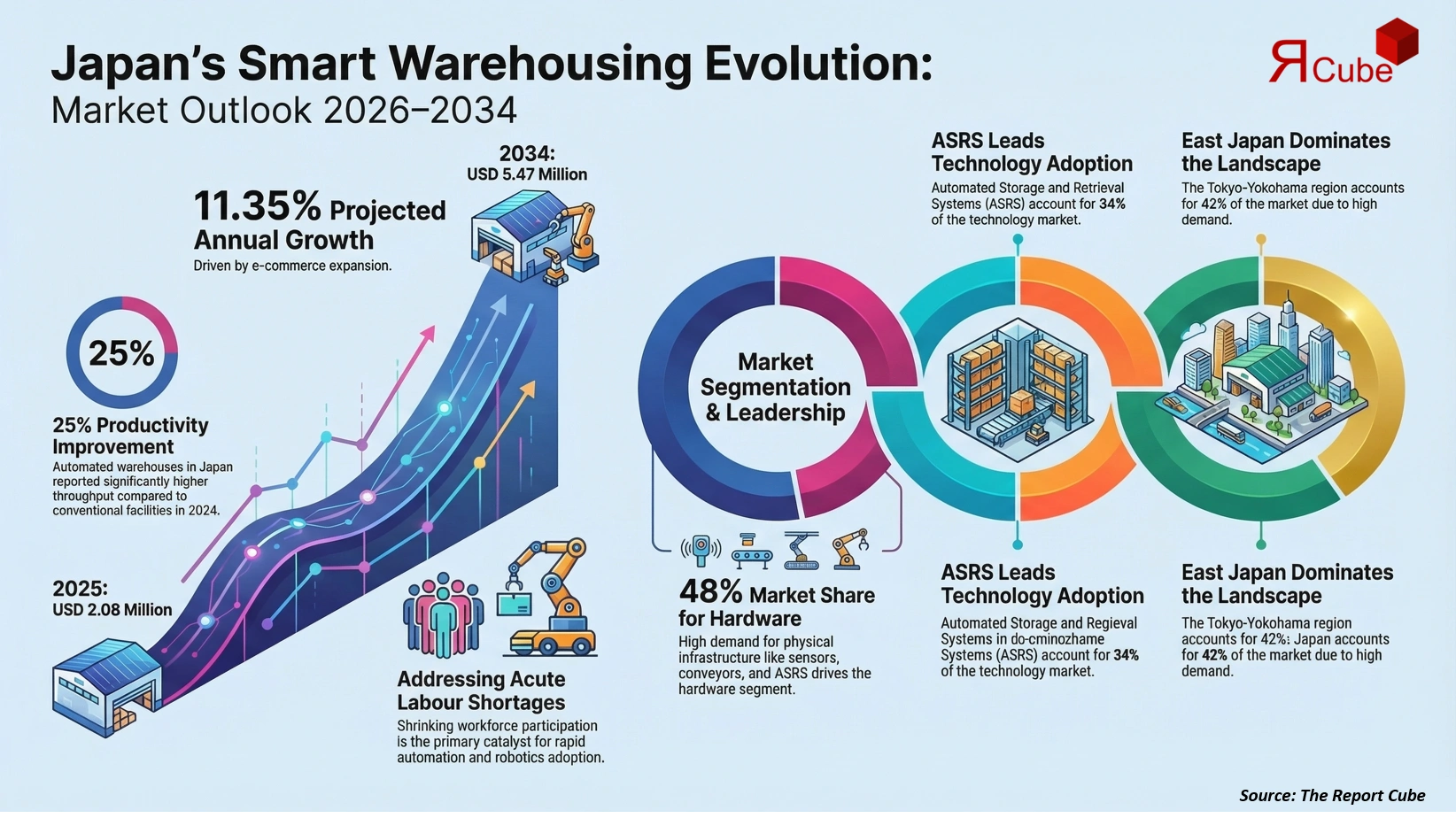
The Japan Smart Warehousing Market is anticipated to register a CAGR of 11.35% during the forecast period 2026-2034. The market size was valued at USD 2.08 million in 2025 and is projected to reach USD 5.47 million by 2034. This strong growth trajectory reflects Japan’s accelerated adoption of automation, digital logistics platforms, and advanced material-handling technologies to address labor shortages and rising e-commerce volumes.
Japan’s warehousing landscape is undergoing a fundamental shift as logistics operators, manufacturers, and retailers increasingly deploy smart technologies to enhance efficiency, accuracy, and scalability. Aging demographics and a shrinking workforce have intensified the need for automated solutions such as automated storage and retrieval systems, robotics, and intelligent warehouse management software. As a result, investments are rising across both greenfield and retrofit warehouse projects, particularly in urban and port-centric regions.
Moreover, the rapid growth of omnichannel retailing and just-in-time manufacturing is pushing warehouse operators to adopt real-time data analytics, IoT-enabled monitoring, and AI-driven inventory optimization. These interconnected systems enable faster order fulfillment, reduced error rates, and improved space utilization. Collectively, these factors position the Japan Smart Warehousing Market as a critical enabler of supply chain resilience and operational excellence over the forecast period.
Japan Smart Warehousing Market Recent Developments
- 2025: Daifuku Co., Ltd. expanded advanced ASRS installations for large-scale e-commerce fulfillment centers in Japan.
- 2025: Toyota Industries Corporation introduced next-generation AGV solutions optimized for high-density warehouse operations.
Government Initiatives & Policies
- Society 5.0 Initiative: Promotes digital transformation and automation across logistics and industrial infrastructure.
- Logistics DX Policy: Supports smart logistics, warehouse automation, and data-driven supply chains.
Japan Smart Warehousing Market Dynamics
Key Driver: Rising Labor Shortages Accelerating Warehouse Automation
The most significant driver of the Japan Smart Warehousing Market is the acute shortage of warehouse labor caused by the country’s aging population and declining workforce participation. Logistics operators face increasing difficulty in recruiting and retaining manual labor, particularly in physically demanding warehouse roles. As a result, companies are rapidly adopting automated systems such as robotics, AGVs, and ASRS to maintain operational continuity. These technologies reduce reliance on human labor while improving throughput and accuracy. In 2024, automated warehouses in Japan reported productivity improvements of over 25% compared to conventional facilities. This strong economic and operational incentive continues to drive widespread adoption of smart warehousing solutions across industries.
Book your FREE 30-minute expert consultation today
Contact UsIndustry Trends: Integration of Robotics, IoT, and Advanced Analytics
An important trend shaping the market is the deep integration of robotics with IoT platforms and analytics-driven warehouse management systems. Modern smart warehouses increasingly rely on interconnected technologies that provide real-time visibility into inventory levels, equipment health, and order flows. Robotics systems are now equipped with sensors and AI algorithms that enable adaptive routing, predictive maintenance, and collision avoidance. Simultaneously, analytics platforms process large volumes of operational data to optimize layout planning and inventory placement. This convergence of technologies is transforming warehouses into intelligent, self-optimizing environments, supporting faster decision-making and improved service levels across Japan’s logistics ecosystem.
Major Challenge: High Initial Capital Investment
Despite strong growth prospects, high upfront capital investment remains a major challenge for the Japan Smart Warehousing Market. Advanced automation systems, robotics, and software platforms require significant financial commitment, which can be prohibitive for small and mid-sized warehouse operators. In addition to equipment costs, integration, customization, and employee training further increase total project expenditure. While long-term operational savings are substantial, the payback period can extend over several years, creating hesitation among budget-constrained enterprises. This challenge may slow adoption in certain segments, particularly in regional warehouses with lower throughput volumes.
Opportunity: Expansion of E-commerce and Omnichannel Logistics
The continued expansion of e-commerce and omnichannel retailing presents a major opportunity for the Japan Smart Warehousing Market. Online retail sales in Japan are growing steadily, increasing demand for fast, accurate, and flexible order fulfillment. Smart warehousing solutions enable same-day and next-day delivery by streamlining picking, packing, and dispatch operations. Retailers and third-party logistics providers are increasingly investing in modular automation systems that can scale with fluctuating demand. This shift toward technology-driven fulfillment models creates significant long-term growth opportunities for smart warehouse solution providers across Japan.
Japan Smart Warehousing Market Segment-wise Analysis
By Component:
- Hardware
- Software
- Services
The Hardware segment dominates the Japan Smart Warehousing Market, accounting for approximately 48% of the total market share in 2025. This leadership is driven by high demand for robotics, conveyors, sensors, and ASRS installations. However, the Software segment is gaining momentum, supported by increasing adoption of WMS and analytics platforms to orchestrate automated operations. Services, including integration, maintenance, and consulting, represent a growing share as companies seek long-term system reliability and optimization. The balanced growth across components highlights the interconnected nature of smart warehousing ecosystems.
By Technology:
- Warehouse Management Systems (WMS)
- AGV/AMR
- ASRS
- IoT/Analytics
- Robotics
ASRS technology leads this segment, contributing nearly 34% of the market share, due to its ability to maximize space utilization in Japan’s high-cost urban areas. AGV and AMR solutions follow closely, driven by their flexibility and scalability in dynamic warehouse environments. WMS adoption remains strong as it serves as the central control layer for smart operations. IoT and analytics solutions are rapidly emerging, enabling predictive insights and real-time decision-making. Robotics continues to expand across picking and sorting applications, reinforcing overall system efficiency.
Regional Projection of Japan Smart Warehousing Industry
- East Japan
- West Japan
- Central Japan
East Japan leads the Japan Smart Warehousing Market, accounting for nearly 42% of total market share. The region benefits from a dense concentration of manufacturing hubs, ports, and large consumer markets, particularly around Tokyo and Yokohama. High land costs and strong logistics demand have accelerated the adoption of automated, high-density warehouse solutions. West Japan follows, supported by growing e-commerce activity and regional distribution centers. Central Japan is steadily emerging as an important growth area, driven by automotive and electronics manufacturing supply chains. East Japan is expected to retain its leadership position throughout the forecast period.
Need insights for a specific region within this market?
Request Regional DataWhy Choose This Report?
- Provides a comprehensive overview of the overall market analysis, encompassing key trends, consumer behavior analysis, and risk assessment to support strategic decision-making.
- Provides accurate, up-to-date insights into market size, segmentation, and emerging opportunities, helping to minimize risk & capitalizing on growth.
- Gives deep understanding of target audience preferences, investment habits, and communication channels for enhanced product development & marketing effectiveness.
- Delivers competitive analysis & benchmarking, uncovering the strengths & weaknesses of market competitors to guide strategies.
- Consolidate comprehensive market intelligence, reducing reasoning & streamlining research efforts.
- Facilitates customized market segmentation & risk mitigation strategies, fine-tuned to the business objectives.
- Aids in identifying both market challenges & untapped opportunities within the industry to drive long-term business growth.
- Provides valuable information based on actual customer data & search trends.
Table of Contents
- Introduction
- Objective of the Study
- Product and Category Definition
- Market Segmentation
- Study Variables
- Research Methodology
- Secondary Data Points
- Breakdown of Secondary Sources
- Primary Data Points
- Breakdown of Primary Interviews
- Secondary Data Points
- Executive Summary
- Market Dynamics
- Drivers
- Challenges
- Opportunity Assessment
- Recent Trends and Developments
- Regulatory and Policy Landscape
- Japan Smart Warehousing Market Overview (2020-2034)
- Market Size, By Value (USD Million)
- Market Share, By Component
- Hardware
- Software
- Services
- Market Share, By Technology
- WMS
- AGV/AMR
- ASRS
- IoT/Analytics
- Robotics
- Market Share, By Warehouse Size
- Small
- Medium
- Large
- Market Share, By Industry Vertical
- Retail/E‑Commerce
- Manufacturing
- Transport/Logistics
- Food/Beverage
- Healthcare
- Market Share, By Region
- East
- West
- Central Japan
- Market Share, By Company
- Competition Characteristics
- Revenue Shares & Analysis
- East Japan Smart Warehousing Market
- Market Size, By Value (USD Million)
- Market Share, By Component
- Market Share, By Technology
- Market Share, By Warehouse Size
- Market Share, By Industry Vertical
- West Japan Smart Warehousing Market
- Market Size, By Value (USD Million)
- Market Share, By Component
- Market Share, By Technology
- Market Share, By Warehouse Size
- Market Share, By Industry Vertical
- Central Japan Smart Warehousing Market
- Market Size, By Value (USD Million)
- Market Share, By Component
- Market Share, By Technology
- Market Share, By Warehouse Size
- Market Share, By Industry Vertical
- Competitive Outlook and Company Profiles
- Daifuku Co., Ltd.
- Company Overview
- Smart Warehouse Offerings
- Strategic Alliances/Partnerships
- Recent Developments
- Murata Machinery, Ltd.
- Company Overview
- Smart Warehouse Offerings
- Strategic Alliances/Partnerships
- Recent Developments
- Toyota Industries Corporation
- Company Overview
- Smart Warehouse Offerings
- Strategic Alliances/Partnerships
- Recent Developments
- Hitachi, Ltd.
- Company Overview
- Smart Warehouse Offerings
- Strategic Alliances/Partnerships
- Recent Developments
- Fujitsu Limited
- Company Overview
- Smart Warehouse Offerings
- Strategic Alliances/Partnerships
- Recent Developments
- YE DIGITAL Corporation
- Company Overview
- Smart Warehouse Offerings
- Strategic Alliances/Partnerships
- Recent Developments
- Mitsubishi Electric Corporation
- Company Overview
- Smart Warehouse Offerings
- Strategic Alliances/Partnerships
- Recent Developments
- SSI Schaefer Group
- Company Overview
- Smart Warehouse Offerings
- Strategic Alliances/Partnerships
- Recent Developments
- Körber Supply Chain
- Company Overview
- Smart Warehouse Offerings
- Strategic Alliances/Partnerships
- Recent Developments
- Dematic (KION Group)
- Company Overview
- Smart Warehouse Offerings
- Strategic Alliances/Partnerships
- Recent Developments
- Others
- Daifuku Co., Ltd.
- Contact Us and Disclaimer
Top Key Players & Market Share Outlook
- Daifuku Co., Ltd. Smart Warehouse Offerings
- Murata Machinery, Ltd. Smart Warehouse Offerings
- Toyota Industries Corporation Smart Warehouse Offerings
- Hitachi, Ltd. Smart Warehouse Offerings
- Fujitsu Limited Smart Warehouse Offerings
- YE DIGITAL Corporation Smart Warehouse Offerings
- Mitsubishi Electric Corporation Smart Warehouse Offerings
- SSI Schaefer Group Smart Warehouse Offerings
- Körber Supply Chain Smart Warehouse Offerings
- Dematic (KION Group) Smart Warehouse Offerings
- Others
Frequently Asked Questions






