



Build Your Custom Market Intelligence Report
Customize Your ReportBelgium Pharmaceutical Logistics Market Insights & Analysis
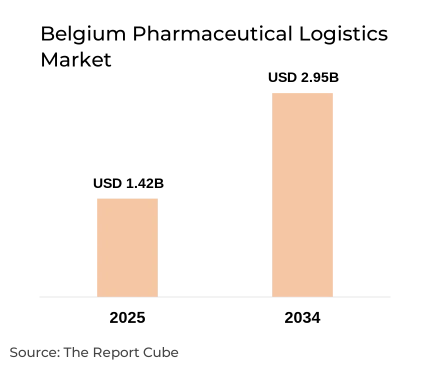
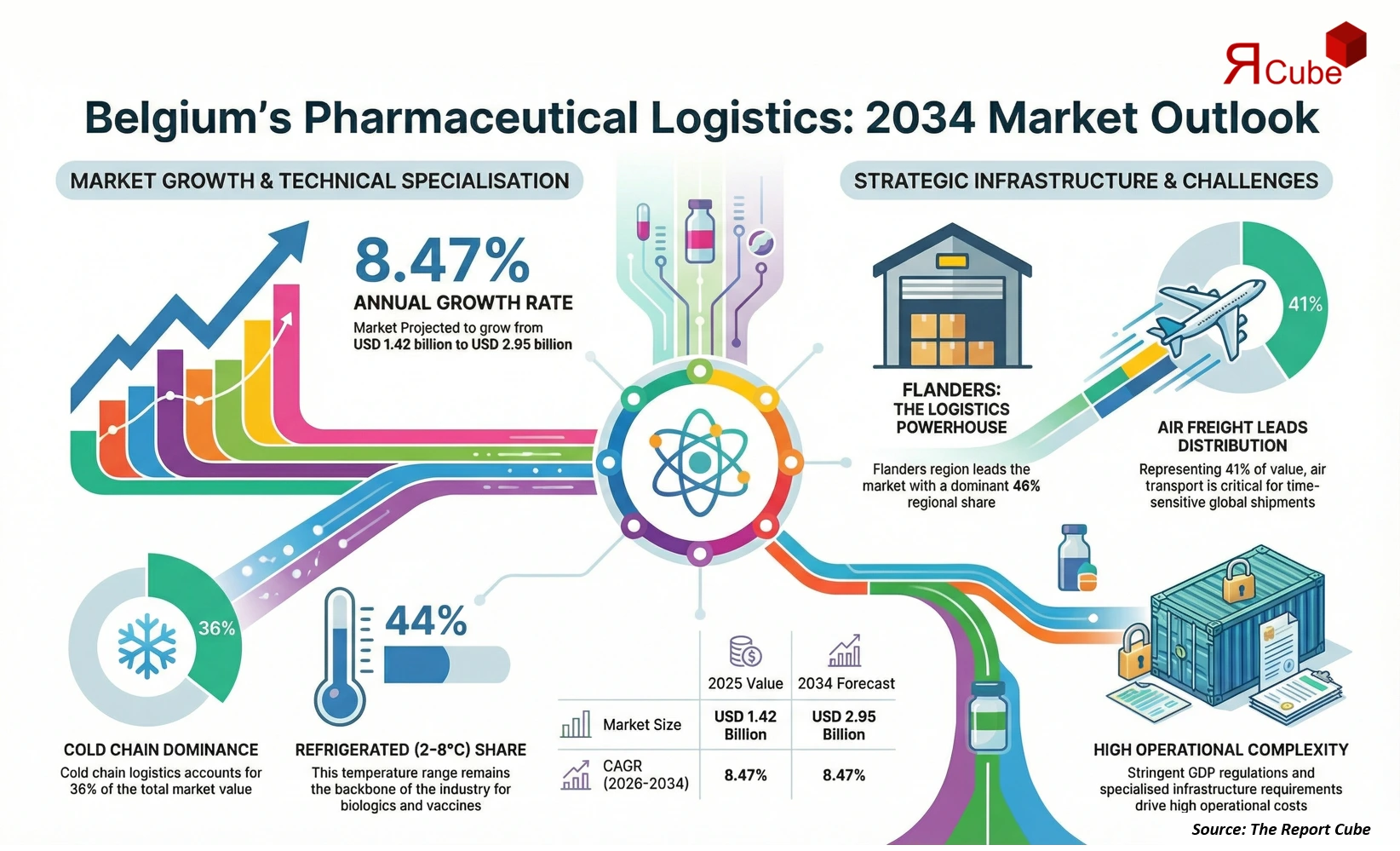
The Belgium Pharmaceutical Logistics Market is anticipated to register a CAGR of 8.47% during the forecast period from 2026 to 2034. The market size was valued at USD 1.42 Billion in 2025 and is projected to reach USD 2.95 Billion by 2034. Belgium has established itself as one of Europe’s most strategic pharmaceutical logistics hubs, supported by advanced infrastructure, strong regulatory compliance, and proximity to major European healthcare markets.
Belgium’s central geographic location, world-class airports such as Brussels Airport, and access to major seaports enable efficient pan-European pharmaceutical distribution. The country plays a critical role in vaccine distribution, biologics transport, and clinical trial logistics. High concentration of pharmaceutical manufacturing and biotechnology companies further strengthens logistics demand.
Additionally, rising demand for temperature-sensitive drugs, personalized medicines, and biopharmaceuticals is reshaping logistics requirements. Investments in cold chain infrastructure, digital tracking, and value-added services are positioning Belgium as a preferred destination for high-value pharmaceutical logistics operations.
Belgium Pharmaceutical Logistics Market Recent Developments
- 2025: Major logistics providers expanded temperature-controlled warehouse capacity near Brussels Airport.
- 2025: Increased deployment of real-time shipment monitoring systems for biologics and vaccines.
Government Initiatives & Policies
- Belgium Life Sciences Strategy: Supports pharmaceutical manufacturing and logistics investments.
- EU Good Distribution Practice (GDP): Ensures quality and safety in pharmaceutical logistics.
Belgium Pharmaceutical Logistics Market Dynamics
Key Driver: Growing Demand for Temperature-Controlled and Biopharma Logistics
The primary driver of the Belgium pharmaceutical logistics market is the increasing demand for temperature-controlled transportation and storage solutions. The rapid growth of biologics, vaccines, cell and gene therapies, and specialty drugs requires highly controlled logistics environments. Belgium’s advanced cold chain infrastructure and compliance with EU GDP standards make it a preferred hub for high-value pharmaceutical shipments across Europe.
Book your FREE 30-minute expert consultation today
Contact UsIndustry Trends: Digitalization and End-to-End Supply Chain Visibility
The market is witnessing a strong shift toward digital logistics platforms offering real-time monitoring, predictive analytics, and automated compliance reporting. Blockchain-enabled traceability, IoT sensors, and AI-driven route optimization are increasingly adopted to ensure product integrity and reduce shipment risks. These technologies are becoming standard requirements for pharmaceutical manufacturers and research organizations.
Major Challenge: High Operational Costs and Regulatory Complexity
Pharmaceutical logistics involves stringent regulatory requirements, specialized infrastructure, and skilled personnel, resulting in high operational costs. Compliance with GDP, temperature validation, and documentation standards increases cost pressure, particularly for smaller logistics providers. Additionally, evolving regulations across different EU markets add complexity to cross-border operations.
Opportunity: Expansion of Clinical Trial and Personalized Medicine Logistics
The growing number of clinical trials and personalized therapies presents a significant growth opportunity. Belgium’s strong research ecosystem and hospital network support rising demand for small- batch, high-value logistics services. Specialized handling of investigational drugs and patient-specific therapies is expected to drive premium logistics demand over the forecast period.
Belgium Pharmaceutical Logistics Market Segment-wise Analysis
By Service Type:
- Transportation Services
- Warehousing Services
- Cold Chain Logistics
- Packaging Services
- Value-Added Services
Cold Chain Logistics is the most dominant service segment in the Belgium Pharmaceutical Logistics Market, accounting for approximately 36% of total market value in 2025. This leadership is primarily driven by Belgium’s critical role in the storage and distribution of temperature-sensitive pharmaceutical products, including vaccines, biologics, insulin, oncology drugs, and advanced therapies. The country has invested heavily in GDP-compliant cold storage infrastructure, temperature-controlled vehicles, and validated handling processes, enabling it to serve as a reliable distribution hub for Europe and global markets.
Belgium’s cold chain capabilities are particularly strong around Brussels Airport and major logistics corridors, where specialized pharma zones support active (powered) and passive (packaging-based) temperature control solutions. Pharmaceutical manufacturers increasingly rely on logistics providers offering end-to-end cold chain services, including monitoring, documentation, and risk mitigation. As biopharmaceutical pipelines expand and regulatory scrutiny increases, demand for premium cold chain logistics services is expected to remain strong throughout the forecast period.
Transportation Services represent another significant segment, supported by Belgium’s multimodal logistics network. However, transportation increasingly operates as an integrated component of cold chain and value-added service offerings rather than a standalone function.
By Temperature Type:
- Ambient
- Refrigerated (2–8°C)
- Frozen
- Ultra-Cold / Cryogenic
Refrigerated logistics (2–8°C) dominate the temperature-type segment, holding an estimated 44% market share. This temperature range is essential for the majority of biologics, vaccines, and injectable drugs, making it the backbone of pharmaceutical distribution. Belgium’s leadership in vaccine exports and biologics manufacturing strongly supports this segment’s dominance.
The ultra-cold and cryogenic segment, while smaller in absolute share, is the fastest-growing due to increasing adoption of cell and gene therapies. These therapies require temperatures as low as –70°C or lower, necessitating highly specialized logistics solutions, which Belgium is increasingly equipped to provide. s.
By Mode of Transport:
- Air Freight
- Road Transport
- Sea Freight
- Rail Transport
Air freight is the leading transport mode, accounting for approximately 41% of total pharmaceutical logistics value. Belgium’s position as a global air cargo hub—anchored by Brussels Airport—enables rapid, compliant, and secure international distribution of high-value and time-sensitive pharmaceutical products. Air transport is particularly critical for vaccines, clinical trial materials, and specialty drugs with limited shelf life.
Road transport plays a complementary role, supporting intra-European distribution and last-mile delivery, especially for regional hospital networks and manufacturing facilities.
Regional Projection of Belgium Pharmaceutical Logistics Market
- Flanders
- Wallonia
- Brussels Capital Region
Flanders leads the Belgium Pharmaceutical Logistics Market with an estimated 46% regional market share. The region’s dominance is driven by its dense concentration of pharmaceutical manufacturing plants, major seaports such as Antwerp, and extensive logistics parks. Flanders serves as a critical gateway for both inbound raw materials and outbound finished pharmaceutical products destined for global markets.
The region also benefits from strong road and rail connectivity, enabling efficient distribution across Western Europe. Many global logistics providers have established large-scale, GDP-certified warehousing and cold storage facilities in Flanders, reinforcing its leadership position.
The Brussels Capital Region represents the second-largest regional market, supported primarily by Brussels Airport’s role as a global pharmaceutical air freight hub. The region specializes in high-value, time-critical shipments such as vaccines, biologics, and clinical trial materials. Advanced temperature-controlled infrastructure and real-time monitoring capabilities make Brussels a preferred location for premium pharmaceutical logistics operations.
Wallonia, while smaller in market share, is gaining importance due to growing biotechnology clusters and increasing investment in research and clinical trial activity. The region’s cost advantages and expanding healthcare infrastructure are expected to support steady logistics demand growth over the forecast period.
Need insights for a specific region within this market?
Request Regional DataWhy Choose This Report?
- Provides a comprehensive overview of Belgium’s pharmaceutical logistics ecosystem.
- Delivers accurate market sizing, segmentation, and long-term forecasts.
- Analyzes cold chain, biopharma, and clinical trial logistics trends.
- Offers competitive benchmarking of global and regional logistics providers.
- Supports strategic planning with regulatory and regional insights.
- Identifies operational challenges and high-growth opportunities.
- Reduces research complexity through consolidated intelligence.
- Reflects real pharmaceutical supply chain demand patterns.
Table of Contents
- Introduction
- Objective of the Study
- Pharmaceutical Logistics Definition
- Market Segmentation
- Study Variables
- Research Methodology
- Secondary Data Points
- Breakdown of Secondary Sources
- Primary Data Points
- Breakdown of Primary Interviews
- Secondary Data Points
- Executive Summary
- Market Dynamics
- Drivers
- Challenges
- Opportunity Assessment
- Recent Trends and Developments
- Regulatory and Policy Landscape
- Belgium Pharmaceutical Logistics Market Overview (2026–2034)
- Market Size, By Value (USD Billion)
- Market Share, By Service Type
- Transportation Services
- Warehousing Services
- Cold Chain Logistics
- Packaging Services
- Value-Added Services
- Market Share, By Temperature Type
- Ambient
- Refrigerated (2–8°C)
- Frozen
- Ultra-Cold / Cryogenic
- Market Share, By Product Type
- Vaccines
- Biopharmaceuticals
- Generic Drugs
- Branded Pharmaceuticals
- Clinical Trial Materials
- Market Share, By Mode of Transport
- Air Freight
- Road Transport
- Sea Freight
- Rail Transport
- Market Share, By End User
- Pharmaceutical Manufacturers
- Biotechnology Companies
- Hospitals and Clinics
- Research Organizations
- Market Share, By Company
- Competition Characteristics
- Revenue Shares & Analysis
- Market Share, By Region
- Flanders Pharmaceutical Logistics Market
- Market Size, By Value
- Market Share, By Service Type
- Market Share, By Temperature Type
- Wallonia Pharmaceutical Logistics Market
- Market Size, By Value
- Market Share, By Service Type
- Market Share, By Temperature Type
- Brussels Capital Region Pharmaceutical Logistics Market
- Market Size, By Value
- Market Share, By Service Type
- Market Share, By Temperature Type
- Flanders Pharmaceutical Logistics Market
- Competitive Outlook and Company Profiles
- DHL Supply Chain
- Company Overview
- Pharmaceutical Logistics Portfolio
- Strategic Alliances/Partnerships
- Recent Developments
- UPS Healthcare
- Company Overview
- Pharmaceutical Logistics Portfolio
- Strategic Alliances/Partnerships
- Recent Developments
- Kuehne + Nagel
- Company Overview
- Pharmaceutical Logistics Portfolio
- Strategic Alliances/Partnerships
- Recent Developments
- DB Schenker
- Company Overview
- Pharmaceutical Logistics Portfolio
- Strategic Alliances/Partnerships
- Recent Developments
- FedEx
- Company Overview
- Pharmaceutical Logistics Portfolio
- Strategic Alliances/Partnerships
- Recent Developments
- Others
- Company Overview
- Business Segments
- Strategic Alliances/Partnerships
- Recent Developments
- DHL Supply Chain
- Contact Us / Disclaimer
Top Key Players & Market Share Outlook
-
DHL Supply Chain
-
UPS Healthcare
-
Kuehne + Nagel
-
DB Schenker
-
FedEx
-
Others
Frequently Asked Questions






