



Build Your Custom Market Intelligence Report
Customize Your ReportKey Highlights
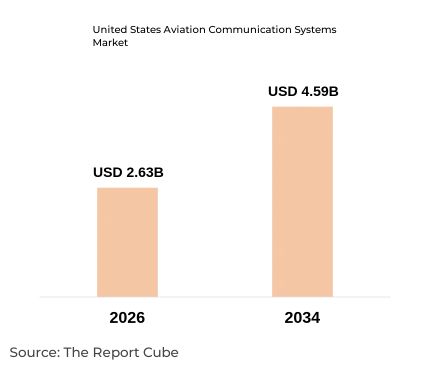
- The U.S. Aviation Communication Systems Market was valued at USD 2.63 billion in 2026.
- The market is projected to reach USD 4.59 billion by 2034.
- It is expected to expand at a CAGR of 7.20% during 2026–2034.
- Commercial aviation led the application segment, and hardware led the component segment.
- Fleet modernization, aircraft connectivity and the FAA’s Data Comm expansion are the major growth drivers.
- The competitive landscape includes Collins Aerospace, Honeywell Aerospace, L3Harris Technologies, Viasat, Garmin, Thales and Rohde & Schwarz.
Market Outlook
The U.S. Aviation Communication Systems Market covers the radios, satellite terminals, data-link equipment and software that connect aircraft with air traffic controllers, airline operators and ground networks. These systems support flight operations, safety-related messaging and aircraft connectivity, making them essential across commercial, military and general aviation.
Demand is shaped by the replacement of legacy equipment, rising connectivity requirements and the shift from voice-based to digital communication. Core technologies include SATCOM, VHF and HF radio, data-link communication and emergency equipment. Controller-Pilot Data Link Communications (CPDLC) is moving routine messaging toward digital exchange, and the Federal Aviation Administration (FAA) has extended Data Comm across all 20 en-route centers.
The U.S. Aviation Communication Systems Market was valued at USD 2.63 billion in 2026 and is projected to reach USD 4.59 billion by 2034, growing at a CAGR of 7.20%. Growth is supported by SATCOM adoption, fleet modernization, digital communication deployment and the need for reliable communication infrastructure across aircraft operators.
Established avionics manufacturers, satellite service providers and defense technology firms compete on certification capability, integration depth and aftermarket support. Opportunities lie in retrofit programs, integrated hardware and software offerings, and resilient connectivity. Future direction favors digital, interoperable and cyber-secure communication architectures across commercial and defense fleets.
Government Regulations
The U.S. Aviation Communication Systems Market operates under the oversight of the Federal Aviation Administration, which governs aviation safety, equipment approval and communication modernization. Its NextGen program and Data Comm service drive the transition toward digital pilot-controller communication, with en-route services active at all 20 Air Route Traffic Control Centers and tower services at 65 airports by 2025. The Federal Communications Commission regulates radio frequency spectrum use and equipment authorization. RTCA publishes technical standards for aviation electronic systems, and the International Civil Aviation Organization sets global standards for communication interoperability. Manufacturers must meet certification, electromagnetic compatibility and reliability requirements before equipment can be deployed on aircraft. These obligations raise development and certification costs, favor established suppliers with proven compliance records, and encourage replacement of legacy equipment as communication standards evolve.
U.S. Aviation Communication Systems Market Dynamics
The market is shaped by rising demand for aircraft connectivity, modernization of air traffic communication and adoption of digital technologies. The shift from voice-based communication to integrated data-link and satellite systems creates opportunities for equipment and technology providers. High certification costs, complex integration, cybersecurity requirements and dependence on aircraft production cycles may moderate the pace of expansion.
|
Factor |
Type |
Specific Impact on Market |
Magnitude |
|---|---|---|---|
|
Satellite communication adoption |
Driver |
Supports demand for terminals, antennas and connectivity equipment across aircraft categories |
High |
|
Digital air traffic communication |
Driver |
CPDLC and Data Comm expansion increase demand for data-link-enabled equipment |
Medium–High |
|
Retrofit and modernization demand |
Opportunity |
Ageing radios and avionics in the installed fleet require upgrades |
Medium–High |
|
Certification and integration costs |
Challenge |
Extensive testing raises development costs and slows deployment |
Medium–High |
|
Digital data-link transition |
Trend |
Reduces reliance on voice communication for supported operational messages |
Medium |
|
Legacy interoperability |
Challenge |
Coexisting radio, data-link and satellite standards increase complexity |
Medium |
Growth Drivers: Increasing Adoption of Satellite Communication Systems
Reliable aircraft connectivity is driving satellite communication adoption across commercial, military and business aviation. SATCOM allows aircraft to maintain contact over long distances and in regions where ground-based infrastructure offers limited coverage. Airlines and operators are investing in satellite terminals, antennas and associated equipment to support operational data transmission, flight communications and passenger connectivity. This continuing requirement for uninterrupted connectivity is expected to sustain demand for advanced satellite communication equipment through the forecast period.
Market Opportunities: Aircraft Communication System Retrofit and Modernization
The large installed U.S. aircraft base creates opportunities for suppliers of communication equipment upgrades. Airlines, business aircraft operators and defense organizations need to replace ageing radios, integrate digital communication systems and upgrade satellite equipment. Retrofit programs let operators modernize existing fleets without buying new aircraft, supporting demand for replacement hardware, installation services and maintenance. Suppliers offering combined hardware, software and lifecycle support are well placed to capture this demand.
Industry Challenges: High Equipment, Certification and Integration Costs
Aviation communication systems require extensive testing, certification and integration to meet strict safety and reliability requirements. Manufacturers must ensure equipment works with existing avionics, navigation systems and ground-based infrastructure, which raises development and deployment costs. Smaller operators may face financial constraints when replacing legacy equipment or adopting advanced technologies, potentially slowing modernization. Longer certification timelines can also delay product launches and limit how quickly new communication technologies reach aircraft.
Need Specific Data, Let’s Customize the Report for You
Request CustomizationMarket Trends: Transition Towards Digital Data-Link Communication
The aviation sector is steadily adopting digital communication to improve information exchange between aircraft and air traffic control. CPDLC enables digital transmission of supported operational messages, reducing reliance on traditional voice communication and improving efficiency. The FAA’s continued Data Comm deployment, including en-route coverage across all 20 Air Route Traffic Control Centers, reflects the growing importance of digital systems in U.S. operations. This trend favors manufacturers offering data-link-capable avionics and communication management software.
U.S. Aviation Communication Systems Market Segment Analysis
The U.S. Aviation Communication Systems Market is segmented by system type, component, application and installation type. These categories reflect the technology mix, product composition, end-use platforms and fitment channels that shape purchasing decisions across aircraft operators and manufacturers.
By Application
- Commercial Aviation
- Military Aviation
- Business & General Aviation
- Others
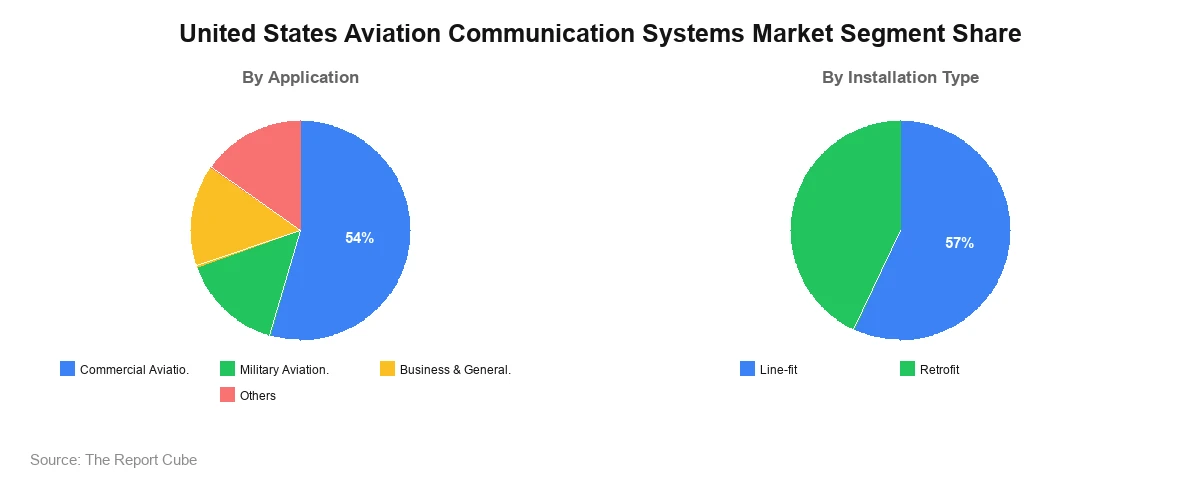
Commercial aviation leads the application segment with approximately 54% share in 2026, reflecting the large U.S. airline fleet and its need for dependable flight operations, air traffic coordination and connectivity. Military aviation is the second segment, supported by requirements for secure, resilient, mission-critical communication. Business and general aviation and other applications follow, with demand tied to cockpit communication upgrades, satellite connectivity and avionics modernization in smaller aircraft.
By Installation Type
- Line-fit
- Retrofit
Line-fit leads the installation segment with approximately 57% share in 2026, supported by new aircraft deliveries and factory-installed advanced avionics. Retrofit is the second segment, covering upgrades and replacement of communication equipment on existing aircraft. Demand for digital communication, SATCOM terminals and updated radios sustains retrofit activity, giving it commercial importance as operators extend the service life of current fleets.
Competitive Landscape
The U.S. Aviation Communication Systems Market includes established aerospace manufacturers, avionics suppliers, satellite communication providers and specialized communication technology firms. Companies compete on product innovation, certification capability, reliability, integration with aircraft platforms and aftermarket support. The table summarizes capabilities and does not represent numerical market share or ranking.
|
Company |
Competitive Strength |
Primary Segment Served |
|---|---|---|
|
Collins Aerospace |
Aircraft radios, SATCOM and data-link systems with integrated avionics |
Commercial and government aviation |
|
Honeywell Aerospace |
VHF/HF radios, avionics and cockpit systems |
Commercial, business and defense aviation |
|
L3Harris Technologies |
Secure communication and aviation electronics |
Defense and government aviation |
|
Viasat |
SATCOM and in-flight connectivity |
Satellite-based aviation communication |
|
Garmin |
Aviation radios and integrated avionics |
General and business aviation |
|
Thales |
Avionics, communication and air traffic management systems |
Commercial and defense aviation |
|
Rohde & Schwarz |
VHF/UHF radios and digital voice communication systems |
Ground-based aviation communication |
Collins Aerospace: Collins Aerospace, part of RTX, provides aircraft communication systems, satellite communication solutions, data-link technologies and integrated flight-deck equipment. Its portfolio serves commercial aviation and government aerospace applications. Established relationships with aircraft manufacturers and broad integrated avionics capabilities support its competitive position across both line-fit and retrofit installations.
Honeywell Aerospace: Honeywell Aerospace supplies aircraft communication radios, avionics and integrated cockpit technologies for commercial aircraft, business aviation and defense platforms. Its competitive position rests on established aerospace engineering capabilities and a broad aftermarket support network, which helps it serve operators seeking equipment upgrades and long-term maintenance across diverse fleets.
Recent Developments and Updates
- 2025, FAA Data Comm Expansion: The Federal Aviation Administration expanded Data Comm so that en-route services operate across all 20 Air Route Traffic Control Centers, with tower services at 65 airports. The expansion supports wider adoption of digital pilot-controller communication and data-link-capable equipment.
- December 2025, FAA Air Traffic Control Modernization: The FAA announced Peraton as prime integrator for its air traffic control modernization initiative, covering replacement of ageing systems and upgrades to communications, surveillance, facilities and automation. It creates procurement opportunities for communication equipment and infrastructure providers.
U.S. Aviation Communication Systems Market Future Outlook
The U.S. Aviation Communication Systems Market is expected to grow from USD 2.63 billion in 2026 to USD 4.59 billion by 2034 at a CAGR of 7.20%. SATCOM is expected to remain the leading and fastest-growing system category, while software and retrofit installations should grow faster as communication systems become more digital. Hardware is expected to keep the largest component share.
Competition is likely to center on integrated hardware, software and lifecycle support, while government-led air traffic modernization adds demand for adjacent communication infrastructure. Long-term expansion will depend on aircraft production volumes, certification timelines, cybersecurity requirements and infrastructure investment. Production delays and integration risks may influence annual growth, but sustained fleet modernization supports the outlook.
U.S. Aviation Communication Systems Market Report Coverage
This report covers market size, forecast, segmentation, competitive landscape and regulatory context for aviation communication systems used across commercial, military and general aviation in the United States.
|
Parameter |
Details |
|---|---|
|
Market Name |
U.S. Aviation Communication Systems Market |
|
Market Size (Base Year) |
USD 2.63 billion (2026) |
|
Market Size (Forecast Year) |
USD 4.59 billion (2034) |
|
CAGR |
7.20% |
|
Base Year |
2026 |
|
Historical Period |
2021–2025 |
|
Forecast Period |
2026–2034 |
|
Geographic Scope |
United States |
|
Segmentation |
By System Type; By Component; By Application; By Installation Type |
|
Regions Covered |
Northeast, Midwest, South, West, Central |
|
Key Companies |
Collins Aerospace; Honeywell Aerospace; L3Harris Technologies; Viasat; Garmin; Thales; Rohde & Schwarz |
|
Customization |
Available as per requirement |
Why Choose This U.S. Aviation Communication Systems Market Report?
- Presents the 2026 valuation, 2034 forecast and 7.20% CAGR in a consistent USD framework.
- Segments the market by system type, component, application and installation type.
- Analyzes market dynamics, including drivers, opportunities, challenges and trends.
- Provides national-level context, with unsupplied regional shares clearly identified.
- Profiles key companies by capability and primary segment served.
- Highlights emerging opportunities in SATCOM, digital data-link, software and retrofit programs.
- Summarizes FAA, FCC, RTCA and ICAO frameworks to support strategic planning and investment decisions.
Table of Contents
- Introduction
- Objective of the Study
- Product Definition
- Market Segmentation
- Study Variables
- Research Methodology
- Secondary Data Points
- Companies Interviewed
- Primary Data Points
- Breakdown of Primary Interviews
- Secondary Data Points
- Executive Summary
- Market Dynamics
- Drivers
- Challenges
- Opportunity Assessment
- Recent Trends and Developments
- Policy and Regulatory Landscape
- U.S. Aviation Communication Systems Market Overview and Forecast Analysis (2021-2034)
- Market Size, By Value, By Growth Rate (CAGR/USD Billions)
- Demand – Supply Trends
- Market Share, By System Type
- Satellite Communication (SATCOM)
- VHF & HF Radio
- Data-Link Communication
- Emergency & Distress Communication
- Others
- Market Share, By Component
- Hardware
- Software
- Market Share, By Application
- Commercial Aviation
- Military Aviation
- Business & General Aviation
- Others
- Market Share, By Installation Type
- Line-fit
- Retrofit
- Market Share, By Region
- Northeast
- Midwest
- South
- West
- Central
- Market Share, By Competitors
- Competition Characteristics
- Revenue Shares
- Satellite Communication (SATCOM) U.S. Aviation Communication Systems Market Overview, 2021-2034F
- By Value (USD Million)
- By Component – Market Size & Forecast 2021-2034, USD Million
- Hardware
- Software
- VHF & HF Radio U.S. Aviation Communication Systems Market Overview, 2021-2034F
- By Value (USD Million)
- By Component – Market Size & Forecast 2021-2034, USD Million
- Hardware
- Software
- Data-Link Communication U.S. Aviation Communication Systems Market Overview, 2021-2034F
- By Value (USD Million)
- By Component – Market Size & Forecast 2021-2034, USD Million
- Hardware
- Software
- Emergency & Distress Communication U.S. Aviation Communication Systems Market Overview, 2021-2034F
- By Value (USD Million)
- By Component – Market Size & Forecast 2021-2034, USD Million
- Hardware
- Software
- Others U.S. Aviation Communication Systems Market Overview, 2021-2034F
- By Value (USD Million)
- By Component – Market Size & Forecast 2021-2034, USD Million
- Hardware
- Software
- Competitive Outlook (Company Profile – Partial List)
- Collins Aerospace
- Company Overview
- Business Segments
- Strategic Alliances/Partnerships
- Recent Developments
- Honeywell Aerospace
- Company Overview
- Business Segments
- Strategic Alliances/Partnerships
- Recent Developments
- L3Harris Technologies
- Company Overview
- Business Segments
- Strategic Alliances/Partnerships
- Recent Developments
- Viasat
- Company Overview
- Business Segments
- Strategic Alliances/Partnerships
- Recent Developments
- Garmin
- Company Overview
- Business Segments
- Strategic Alliances/Partnerships
- Recent Developments
- Thales
- Company Overview
- Business Segments
- Strategic Alliances/Partnerships
- Recent Developments
- Rohde & Schwarz
- Company Overview
- Business Segments
- Strategic Alliances/Partnerships
- Recent Developments
- Collins Aerospace
- Contact Us & Disclaimer
Top Key Players & Market Share Outlook
- Collins Aerospace
- Honeywell Aerospace
- L3Harris Technologies
- Viasat
- Garmin
- Thales
- Rohde & Schwarz
Frequently Asked Questions