




Build Your Custom Market Intelligence Report
Customize Your ReportIndonesia Baby Food Market Insights & Analysis
The Indonesia Baby Food Market is anticipated to register a CAGR of 5.24% during 2026-2034. The market size was valued at USD 2.77 billion in 2025 and is projected to reach USD 4.39 billion by 2034. This growth reflects Indonesia’s large infant population base, improving maternal awareness, and rising focus on early-life nutrition across both urban and semi-urban households.
The market is strongly influenced by changing parental preferences toward nutritionally fortified, safe, and scientifically formulated baby food products. Increasing female workforce participation and busier lifestyles have accelerated reliance on packaged baby food, particularly milk formula and processed baby food products. These factors are supported by expanding retail penetration, growing e-commerce adoption, and consistent marketing efforts by multinational and domestic brands.
Furthermore, Indonesia’s improving healthcare access and government-led nutrition awareness programs have encouraged parents to adopt age-appropriate baby food products. As disposable incomes rise and consumers shift from traditional homemade feeding practices to branded alternatives, the Indonesia Baby Food Market is expected to maintain robust momentum throughout the forecast period.
Indonesia Baby Food Market Recent Developments
- 2025: Danone Indonesia expanded fortified growing-up milk production to support rising domestic demand.
- 2025: Nestlé Indonesia launched localized infant cereal variants tailored to Indonesian nutritional needs.
Government Initiatives & Policies
- National Strategy for Stunting Reduction: Government program focusing on early-life nutrition improvement.
- Food Safety and Nutrition Regulation: Strengthens quality standards for infant and baby food products.
Indonesia Baby Food Market Dynamics
Key Driver: Rising Awareness of Infant Nutrition and Stunting Prevention
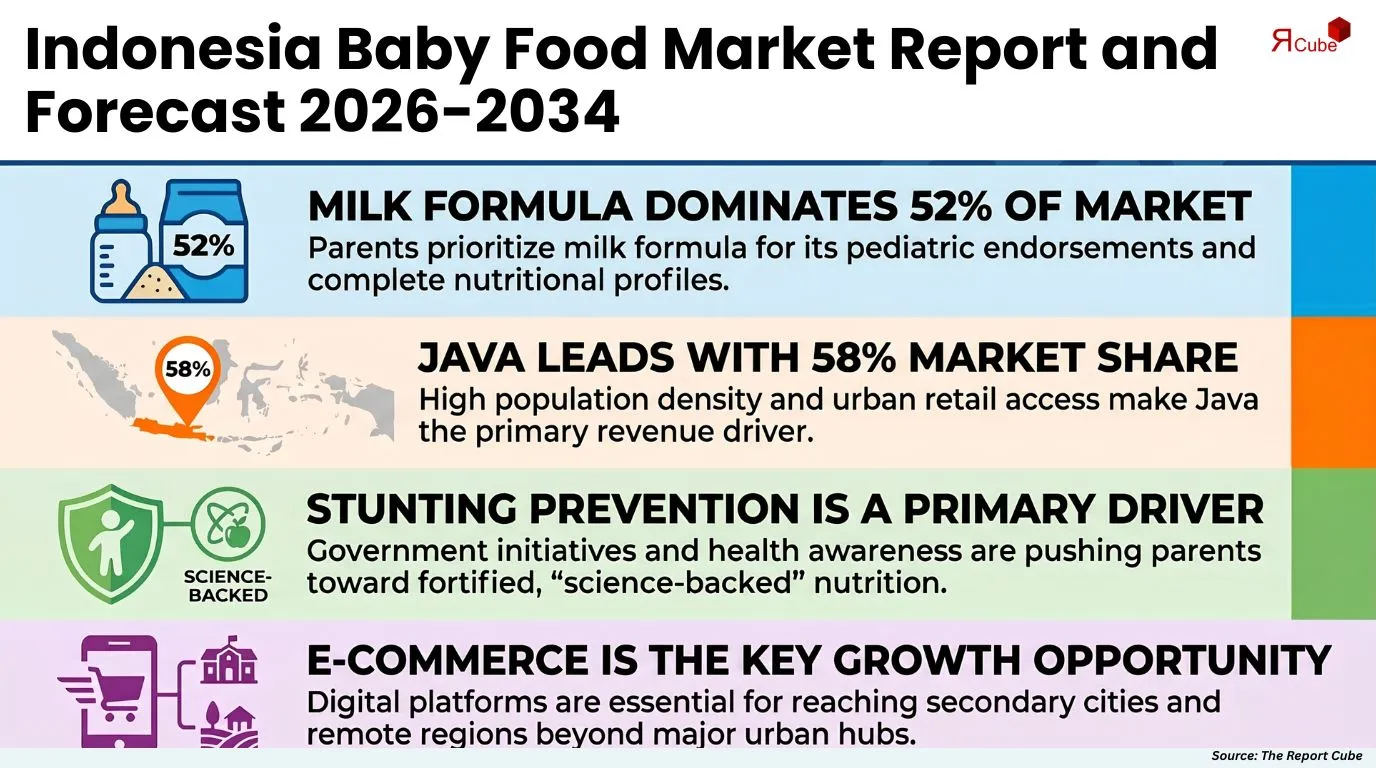
Growing awareness regarding infant nutrition and the long-term impact of early dietary habits is a primary driver of the Indonesia Baby Food Market. Indonesia has faced persistent challenges related to child malnutrition and stunting, prompting both government and private stakeholders to emphasize balanced infant diets. Parents are increasingly prioritizing fortified baby foods that support cognitive development, immunity, and physical growth. This awareness, combined with pediatric recommendations and widespread educational campaigns, has encouraged higher adoption of milk formulas and processed baby foods. As families seek reliable nutritional solutions, branded baby food products are increasingly viewed as essential rather than optional.
Book your FREE 30-minute expert consultation today
Contact UsIndustry Trends: Premiumization and Functional Baby Food Products
An important trend shaping the Indonesia Baby Food Market is the shift toward premium and functional baby food offerings. Consumers are showing increased interest in products enriched with DHA, probiotics, iron, and vitamins, aligning with global infant nutrition standards. Organic baby food options are also gaining gradual acceptance among higher-income urban households. This premiumization trend is closely linked with rising disposable incomes and improved access to information through digital platforms. As a result, manufacturers are focusing on product differentiation, clean labeling, and science-backed formulations to strengthen brand trust and long-term consumer loyalty.
Major Challenge: Price Sensitivity and Income Disparities
Despite strong growth potential, price sensitivity remains a significant challenge for the Indonesia Baby Food Market. A large portion of the population continues to rely on traditional feeding practices due to cost concerns associated with branded baby food products. Income disparities across regions further limit penetration in rural and lower-income households. Additionally, fluctuations in raw material prices and import dependencies can impact product affordability. These factors compel manufacturers to balance quality, pricing, and accessibility to sustain growth across diverse consumer segments.
Opportunity: Expansion of Digital and E-Commerce Distribution Channels
The rapid expansion of digital commerce presents a strong opportunity for the Indonesia Baby Food Market. E-commerce platforms allow brands to reach a wider consumer base, including secondary cities and remote regions. Online channels also enable targeted marketing, subscription-based purchasing, and better consumer education regarding product benefits. As internet penetration and mobile usage continue to rise, e-commerce is expected to play a critical role in improving accessibility, enhancing brand visibility, and supporting long-term market expansion.
Indonesia Baby Food Market Segment-wise Analysis
By Product Type:
- Processed Baby Food
- Milk Formula
- Dried Baby Food
- Other Baby Food
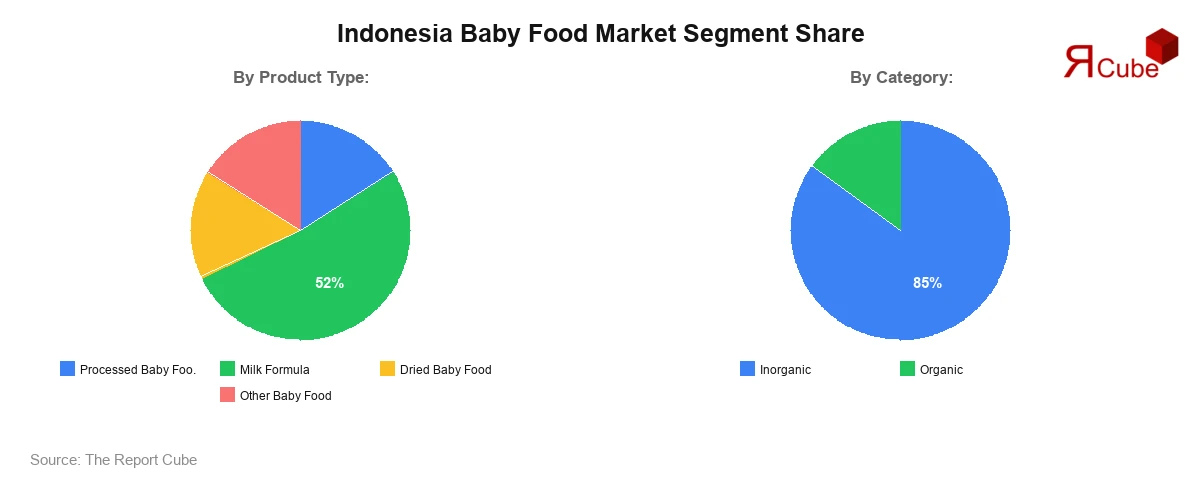
Milk formula dominates the Indonesia Baby Food Market, accounting for approximately 52% of total market share in 2025. Standard and follow-on milk formulas are widely adopted due to strong pediatric endorsement and parental trust. The segment’s leadership is reinforced by continuous product innovation and aggressive marketing by leading multinational brands. As parents increasingly seek complete nutritional solutions, milk formula remains central to early-stage infant feeding practices.
By Category:
- Inorganic
- Organic
The inorganic category leads the Indonesia Baby Food Market with over 85% market share, driven by wider availability and affordability. However, the organic segment is gradually gaining traction, particularly among health-conscious urban consumers. This shift is supported by rising awareness of clean ingredients and chemical-free nutrition, positioning organic baby food as a high-growth niche within the market.
Regional Projection of Indonesia Baby Food Industry
- Java
- Sumatra
- Bali and Nusa Tenggara
- Sulawesi
- Kalimantan
- Papua
Java leads the Indonesia Baby Food Market, contributing nearly 58% of total market revenue. This dominance is supported by high population density, better healthcare infrastructure, and stronger purchasing power. Urban centers such as Jakarta and Surabaya exhibit higher adoption of premium baby food products due to improved awareness and retail access. Java’s advanced distribution networks and concentration of key manufacturers further strengthen its leading position, while other regions are expected to witness gradual growth as infrastructure and awareness improve.
Need insights for a specific region within this market?
Request Regional DataWhy Choose This Report?
- Provides a comprehensive overview of the overall market analysis, encompassing key trends, consumer behavior analysis, and risk assessment to support strategic decision-making.
- Provides accurate, up-to-date insights into market size, segmentation, and emerging opportunities, helping to minimize risk & capitalizing on growth.
- Gives deep understanding of target audience preferences, investment habits, and communication channels for enhanced product development & marketing effectiveness.
- Delivers competitive analysis & benchmarking, uncovering the strengths & weaknesses of market competitors to guide strategies.
- Consolidate comprehensive market intelligence, reducing reasoning & streamlining research efforts.
- Facilitates customized market segmentation & risk mitigation strategies, fine-tuned to the business objectives.
- Aids in identifying both market challenges & untapped opportunities within the industry to drive long-term business growth.
- Provides valuable information based on actual customer data & search trends.
Table of Contents
- Introduction
- Objective of the Study
- Product and Category Definition
- Market Segmentation
- Study Variables
- Research Methodology
- Secondary Data Points
- Breakdown of Secondary Sources
- Primary Data Points
- Breakdown of Primary Interviews
- Secondary Data Points
- Executive Summary
- Market Dynamics
- Drivers
- Challenges
- Opportunity Assessment
- Recent Trends and Developments
- Regulatory and Policy Landscape
- Indonesia Baby Food Market Overview (2021-2034)
- Market Size, By Value (USD Billion)
- Market Share, By Product Type
- Processed Baby Food
- Milk Formula
- Standard Milk Formula
- Follow-on Milk Formula
- Growing-Up Milk Formula
- Special Baby Milk Formula
- Dried Baby Food
- Other Baby Food
- Liquid Standard Milk Formula
- Powder Standard Milk Formula
- Liquid Follow-on Milk Formula
- Powder Follow-on Milk Formula
- Market Share, By Category
- Inorganic
- Organic
- Market Share, By Age Group
- 0-6 Months
- 6-12 Months
- 12-24 Months
- 24-36 Months
- Above 36 Months
- Market Share, By Distribution Channel
- Retail Offline
- Grocery Retailers
- Convenience Retail
- Convenience Stores
- Forecourt Retailers
- Supermarkets
- Hypermarkets
- Discounts
- Warehouse Clubs
- Food/drink/tobacco/specialist
- Convenience Retail
- Non-Grocery Retailers
- General Merchandise Store
- Vending
- Direct Selling
- Grocery Retailers
- Retail E-Commerce
- Retail Offline
- Market Share, By Region
- Java
- Sumatra
- Bali and Nusa Tenggara
- Sulawesi
- Kalimantan
- Papua
- Market Share, By Company
- Revenue Shares and Analysis
- Competitive Landscape
- Java Baby Food Products Market
- Market Size, By Value (USD Billion)
- Market Share, By Product Type
- Market Share, By Category
- Market Share, By Age Group
- Market Share, By Distribution Channel
- Sumatra Baby Food Products Market
- Market Size, By Value (USD Billion)
- Market Share, By Product Type
- Market Share, By Category
- Market Share, By Age Group
- Market Share, By Distribution Channel
- Bali and Nusa Tenggara Baby Food Products Market
- Market Size, By Value (USD Billion)
- Market Share, By Product Type
- Market Share, By Category
- Market Share, By Age Group
- Market Share, By Distribution Channel
- Sulawesi Baby Food Products Market
- Market Size, By Value (USD Billion)
- Market Share, By Product Type
- Market Share, By Category
- Market Share, By Age Group
- Market Share, By Distribution Channel
- Kalimantan Baby Food Products Market
- Market Size, By Value (USD Billion)
- Market Share, By Product Type
- Market Share, By Category
- Market Share, By Age Group
- Market Share, By Distribution Channel
- Papua Baby Food Products Market
- Market Size, By Value (USD Billion)
- Market Share, By Product Type
- Market Share, By Category
- Market Share, By Age Group
- Market Share, By Distribution Channel
- Competitive Outlook and Company Profiles
- Nestlé Indonesia
- Company Overview
- Product Portfolio
- Strategic Alliances/Partnerships
- Recent Developments
- Danone Indonesia
- Company Overview
- Product Portfolio
- Strategic Alliances/Partnerships
- Recent Developments
- Abbott Indonesia
- Company Overview
- Product Portfolio
- Strategic Alliances/Partnerships
- Recent Developments
- FrieslandCampina Indonesia
- Company Overview
- Product Portfolio
- Strategic Alliances/Partnerships
- Recent Developments
- Reckitt Indonesia
- Company Overview
- Product Portfolio
- Strategic Alliances/Partnerships
- Recent Developments
- Heinz ABC Indonesia
- Company Overview
- Product Portfolio
- Strategic Alliances/Partnerships
- Recent Developments
- Mead Johnson Indonesia
- Company Overview
- Product Portfolio
- Strategic Alliances/Partnerships
- Recent Developments
- Kalbe Nutritionals
- Company Overview
- Product Portfolio
- Strategic Alliances/Partnerships
- Recent Developments
- PT Sarihusada Generasi Mahardhika
- Company Overview
- Product Portfolio
- Strategic Alliances/Partnerships
- Recent Developments
- PT Indofood CBP Sukses Makmur Tbk
- Company Overview
- Product Portfolio
- Strategic Alliances/Partnerships
- Recent Developments
- Others
- Nestlé Indonesia
- Contact Us and Disclaimer
Top Key Players & Market Share Outlook
- Nestlé Indonesia
- Danone Indonesia
- Abbott Indonesia
- FrieslandCampina Indonesia
- Reckitt Indonesia
- Heinz ABC Indonesia
- Mead Johnson Indonesia
- Kalbe Nutritionals
- PT Sarihusada Generasi Mahardhika
- PT Indofood CBP Sukses Makmur Tbk
- Others
Frequently Asked Questions






