




Build Your Custom Market Intelligence Report
Customize Your ReportIndonesia Frozen Processed Foods Market Insights & Analysis
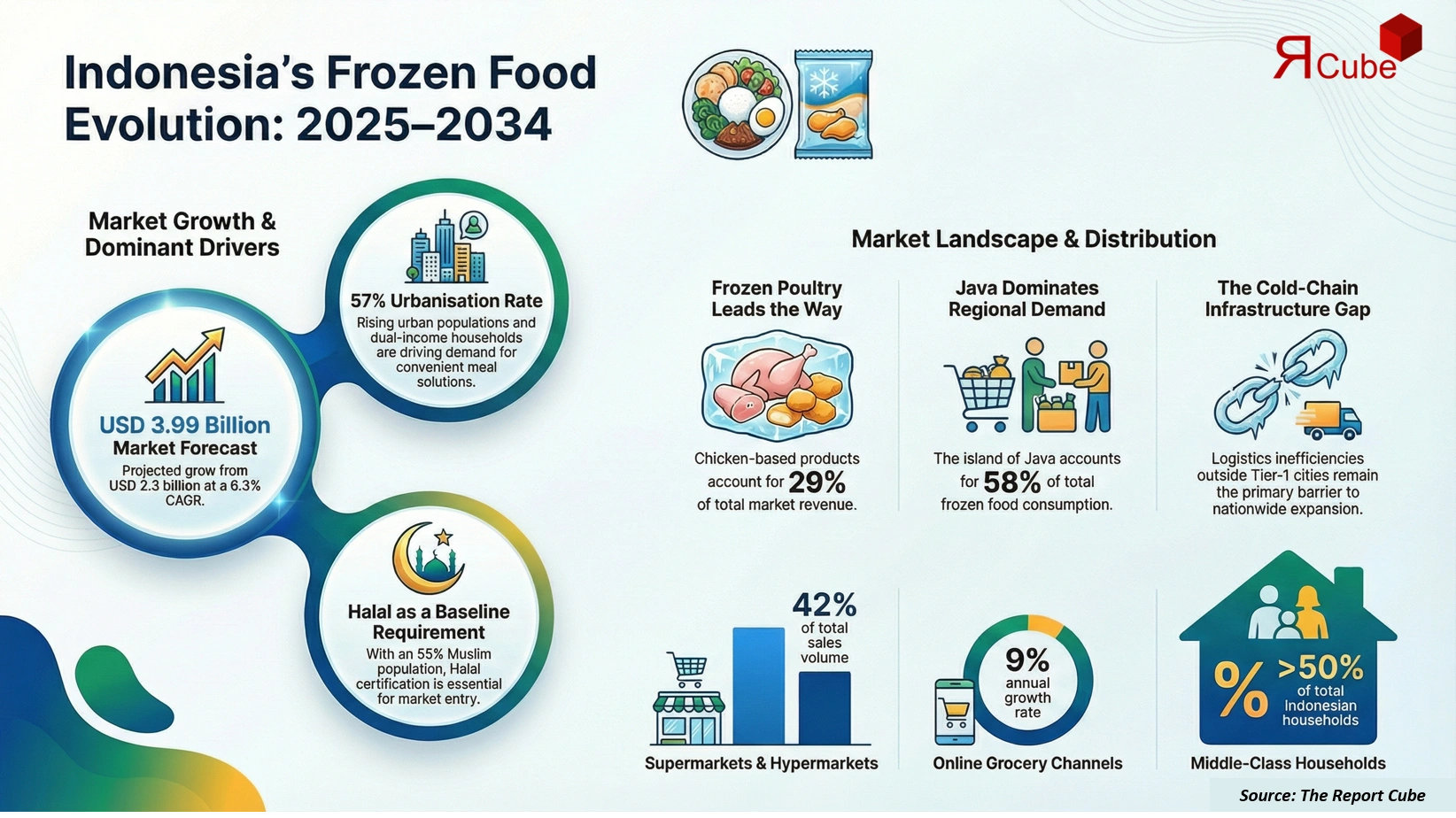
The Indonesia Frozen Processed Foods Market is anticipated to register a CAGR of 6.3% during 2026-2034. The market size was valued at USD 2.3 billion in 2025 and is projected to reach USD 3.99 billion by 2034. The market has evolved rapidly as changing lifestyles, rising urbanization, and increasing female workforce participation reshape food consumption patterns across Indonesia. Frozen processed foods are increasingly viewed as reliable solutions that balance convenience, nutrition, and affordability.
Indonesia’s expanding middle-class population, estimated to represent over 50% of total households, has driven demand for time-saving meal options. Improved cold-chain logistics, wider freezer penetration, and modern retail expansion have further strengthened market accessibility. Urban consumers, particularly in Jakarta, Surabaya, and Bandung, are adopting frozen poultry, seafood, and ready meals as part of weekly grocery purchases rather than occasional substitutes.
In addition, food safety awareness and preference for hygienically processed foods have grown significantly post-pandemic. Multinational and domestic manufacturers are investing in product localization, halal certification, and portion-size optimization to address diverse consumer needs. These combined factors position the Indonesia Frozen Processed Foods Market for sustained and resilient growth through 2034.
Indonesia Frozen Processed Foods Market Recent Developments
- 2025: PT Charoen Pokphand Indonesia expanded frozen poultry processing capacity to support rising domestic retail demand.
- 2025: Indofood CBP launched affordable frozen ready-to-cook meals tailored for urban households.
Government Initiatives & Policies
- National Food Security Program: Supports cold-chain infrastructure and processed food resilience across Indonesia.
- Halal Product Assurance Law: Strengthens consumer trust in frozen processed food safety and certification.
Indonesia Frozen Processed Foods Market Dynamics
Key Driver: Rapid Urbanization and Growing Demand for Convenient Protein Sources
Rapid urbanization remains the most influential driver of the Indonesia Frozen Processed Foods Market. More than 57% of Indonesia’s population now resides in urban areas, creating sustained demand for convenient, long-shelf-life food products. Frozen poultry, seafood, and processed meat provide reliable protein sources that align with busy lifestyles. Rising dual-income households have reduced daily cooking time, accelerating reliance on ready-to-cook and ready-to-heat frozen foods. Additionally, affordability compared to fresh imports and consistent quality across batches further supports consumer trust. As freezer ownership continues to expand beyond major cities, frozen processed foods are becoming a staple across middle-income households nationwide.
Book your FREE 30-minute expert consultation today
Contact UsIndustry Trends: Expansion of Halal-Certified and Value-Added Frozen Products
One of the most notable trends shaping the Indonesia Frozen Processed Foods Market is the expansion of halal-certified, value-added offerings. With over 85% of the population identifying as Muslim, halal compliance has become a baseline requirement rather than a differentiator. Manufacturers are enhancing product portfolios with seasoned, marinated, and pre-cooked frozen options to deliver superior taste and preparation ease. Frozen ready meals and processed poultry now represent nearly 34% of total frozen food sales. Innovation in packaging, portion control, and nutrition fortification is further strengthening brand loyalty among urban consumers.
Major Challenge: Cold-Chain Infrastructure Gaps Outside Tier-1 Cities
Despite strong demand, cold-chain limitations remain a critical challenge for the Indonesia Frozen Processed Foods Market. Distribution inefficiencies, particularly in eastern Indonesia and remote islands, increase logistics costs and product spoilage risks. Smaller retailers often lack adequate freezer capacity, restricting market penetration beyond major metropolitan areas. Additionally, fluctuating electricity reliability in rural regions discourages widespread freezer adoption. These infrastructure constraints elevate operational costs for manufacturers and limit product availability, slowing uniform nationwide growth.
Opportunity: Growth of Online Grocery and Direct-to-Consumer Channels
The rapid growth of online grocery platforms presents a compelling opportunity for the Indonesia Frozen Processed Foods Market. Digital grocery adoption has grown at over 20% annually, driven by mobile penetration and urban convenience preferences. Frozen foods are well-suited for scheduled delivery and bulk purchasing models. Brands leveraging direct-to-consumer channels benefit from better margin control, consumer data insights, and targeted promotions. Expansion of last-mile cold delivery services is expected to significantly improve frozen food accessibility across secondary cities.
Indonesia Frozen Processed Foods Market Segment-wise Analysis
By Product Type:
- Frozen Red Meat
- Frozen Poultry
- Frozen Seafood
- Frozen Meals
- Frozen Potatoes
- Frozen Vegetables
- Frozen Fruits
- Frozen Dairy
- Others
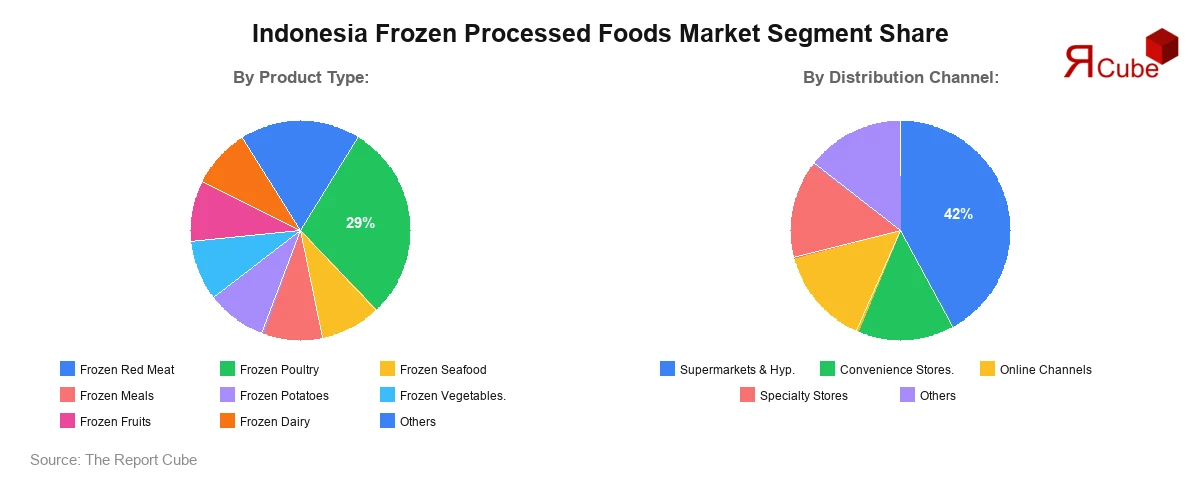
Frozen Poultry dominates the Indonesia Frozen Processed Foods Market by product type, accounting for approximately 29% of total market revenue in 2025. Chicken-based frozen products benefit from cultural dietary preferences, affordability, and versatility across cuisines. Strong vertical integration by leading producers ensures stable pricing and supply consistency. Frozen seafood follows closely, supported by Indonesia’s robust fisheries sector and growing domestic demand for protein-rich diets.
By Distribution Channel:
- Supermarkets & Hypermarkets
- Convenience Stores
- Online Channels
- Specialty Stores
- Others
Supermarkets and hypermarkets remain the leading distribution channel, contributing nearly 42% of Indonesia Frozen Processed Foods Market sales. These outlets offer extensive freezer infrastructure, promotional visibility, and consumer trust. However, online channels are the fastest-growing segment, expanding at over 9% annually, driven by urban millennials and subscription-based grocery models.
Regional Projection of Indonesia Frozen Processed Foods Industry
- Java
- Sumatra
- Kalimantan
- Sulawesi
Java leads the Indonesia Frozen Processed Foods Market, accounting for approximately 58% of total demand. High population density, advanced retail infrastructure, and higher disposable income support strong consumption levels. Jakarta and surrounding metropolitan regions act as innovation hubs for frozen ready meals and premium offerings. Sumatra follows as a growing market, supported by retail expansion and improving cold-chain investments.
Need insights for a specific region within this market?
Request Regional DataWhy Choose This Report?
- Provides a comprehensive overview of the Indonesia Frozen Processed Foods Market, covering trends, risks, and consumer behavior.
- Provides accurate, up-to-date insights into Indonesia Frozen Processed Foods Market size and segmentation.
- Gives deep understanding of Indonesia Frozen Processed Foods Market consumer preferences and purchasing patterns.
- Delivers competitive analysis of Indonesia Frozen Processed Foods Market players for strategic planning.
- Consolidates Indonesia Frozen Processed Foods Market intelligence to streamline decision-making.
- Facilitates customized Indonesia Frozen Processed Foods Market strategies aligned with business goals.
- Aids in identifying Indonesia Frozen Processed Foods Market challenges and untapped opportunities.
- Provides Indonesia Frozen Processed Foods Market insights based on real consumer and retail data.
Table of Contents
- Introduction
- Objective of the Study
- Product and Category Definition
- Market Segmentation
- Study Variables
- Research Methodology
- Secondary Data Points
- Breakdown of Secondary Sources
- Primary Data Points
- Breakdown of Primary Interviews
- Secondary Data Points
- Executive Summary
- Market Dynamics
- Drivers
- Challenges
- Opportunity Assessment
- Recent Trends and Developments
- Regulatory and Policy Landscape
- Indonesia Frozen Processed Foods Market Overview (2021-2034)
- Market Size, By Value (USD Million)
- Market Share, By Product Type
- Frozen Red Meat
- Frozen Poultry
- Frozen Seafood
- Frozen Meals
- Frozen Potatoes
- Frozen Vegetables
- Frozen Fruits
- Frozen Dairy
- Other Products
- Market Share, By Meal Format
- Ready to Eat
- Ready to Cook
- Ready to Heat
- Other Formats
- Market Share, By End Use
- Retail Consumers
- Foodservice
- Institutional
- Industrial
- Market Share, By Distribution Channel
- Supermarkets Hypermarkets
- Convenience Stores
- Online Channels
- Specialty Stores
- Other Channels
- Market Share, By Price Range
- Budget
- Mid Range
- Premium
- Market Share, By Region
- Java
- Sumatra
- Kalimantan
- Sulawesi
- Market Share, By Company
- Competition Characteristics
- Revenue Shares & Analysis
- Java Frozen Processed Foods Market
- Market Size, By Value (USD Million)
- Market Share, By Product Type
- Market Share, By Meal Format
- Market Share, By End Use
- Market Share, By Distribution Channel
- Market Share, By Price Range
- Sumatra Frozen Processed Foods Market
- Market Size, By Value (USD Million)
- Market Share, By Product Type
- Market Share, By Meal Format
- Market Share, By End Use
- Market Share, By Distribution Channel
- Market Share, By Price Range
- Kalimantan Frozen Processed Foods Market
- Market Size, By Value (USD Million)
- Market Share, By Product Type
- Market Share, By Meal Format
- Market Share, By End Use
- Market Share, By Distribution Channel
- Market Share, By Price Range
- Sulawesi Frozen Processed Foods Market
- Market Size, By Value (USD Million)
- Market Share, By Product Type
- Market Share, By Meal Format
- Market Share, By End Use
- Market Share, By Distribution Channel
- Market Share, By Price Range
- Competitive Outlook and Company Profiles
- PT Charoen Pokphand Indonesia Tbk
- Company Overview
- Product Portfolio
- Strategic Alliances Partnerships
- Recent Developments
- JAPFA Ltd (PT So Good Food)
- Company Overview
- Product Portfolio
- Strategic Alliances Partnerships
- Recent Developments
- PT Sekar Bumi Tbk
- Company Overview
- Product Portfolio
- Strategic Alliances Partnerships
- Recent Developments
- PT Indofood CBP Sukses Makmur Tbk
- Company Overview
- Product Portfolio
- Strategic Alliances Partnerships
- Recent Developments
- Unilever Indonesia Tbk
- Company Overview
- Product Portfolio
- Strategic Alliances Partnerships
- Recent Developments
- Nestlé Indonesia
- Company Overview
- Product Portfolio
- Strategic Alliances Partnerships
- Recent Developments
- General Mills Indonesia
- Company Overview
- Product Portfolio
- Strategic Alliances Partnerships
- Recent Developments
- McCain Foods Indonesia
- Company Overview
- Product Portfolio
- Strategic Alliances Partnerships
- Recent Developments
- PT Ultra Prima Abadi (Wings Group)
- Company Overview
- Product Portfolio
- Strategic Alliances Partnerships
- Recent Developments
- Pronas Indonesia
- Company Overview
- Product Portfolio
- Strategic Alliances Partnerships
- Recent Developments
- Others
- PT Charoen Pokphand Indonesia Tbk
- Contact Us and Disclaimer
Top Key Players & Market Share Outlook
- PT Charoen Pokphand Indonesia Tbk
- JAPFA Ltd (PT So Good Food)
- PT Sekar Bumi Tbk
- PT Indofood CBP Sukses Makmur Tbk
- Unilever Indonesia Tbk
- Nestlé Indonesia
- General Mills Indonesia
- McCain Foods Indonesia
- PT Ultra Prima Abadi (Wings Group)
- Pronas Indonesia
- Others
Frequently Asked Questions






