



Build Your Custom Market Intelligence Report
Customize Your ReportChina Baby Skincare Products Market Insights & Analysis
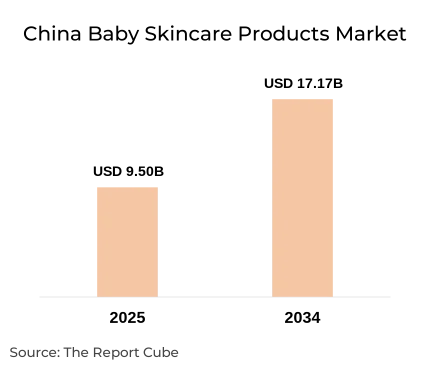
The China Baby Skincare Products Market is anticipated to register a CAGR of 6.80% during 2026-2034. The market size was valued at USD 9.5 billion in 2025 and is projected to reach USD 17.17 billion by 2034. This robust growth trajectory reflects rising parental awareness regarding infant skin health, increasing birth rates under supportive family policies, and growing expenditure on premium childcare products across urban China.
The market’s expansion is closely linked to changing consumer behavior, where parents are prioritizing product safety, dermatological testing, and natural formulations. Baby skincare has shifted from basic hygiene to preventive and protective care, addressing concerns such as eczema, dryness, and pollution-related skin sensitivity. This evolution is further supported by the growing penetration of international brands alongside strong domestic players that understand local preferences.
Additionally, the rapid expansion of e-commerce platforms and digital parenting communities has enhanced product accessibility and awareness. Online reviews, influencer recommendations, and pediatric endorsements play a significant role in shaping purchase decisions, positioning the China Baby Skincare Products Market for sustained growth throughout the forecast period.
China Baby Skincare Products Market Recent Developments
- 2025: Johnson & Johnson expanded its hypoallergenic baby skincare portfolio to address sensitive skin conditions.
- 2025: Shanghai Jahwa strengthened Baby Elephant’s organic product line across major online retail platforms.
Government Initiatives & Policies
- Healthy China 2030 Plan: National initiative promoting maternal and child health awareness and product safety standards.
- Cosmetics Supervision and Administration Regulation: Strengthened regulatory framework ensuring safety and quality of baby skincare products.
China Baby Skincare Products Market Dynamics
Key Driver: Rising Awareness of Infant Skin Health and Safety
Increasing parental awareness regarding infant skin sensitivity is a key driver of the China Baby Skincare Products Market. Parents are becoming more informed about conditions such as diaper rash, atopic dermatitis, and allergic reactions, leading to higher demand for specialized baby skincare solutions. This awareness is reinforced by pediatric consultations, social media education, and healthcare campaigns, which collectively encourage early adoption of preventive skincare routines. As disposable incomes rise, especially in Tier 1 and Tier 2 cities, parents are more willing to invest in trusted and clinically tested baby skincare brands.
Book your FREE 30-minute expert consultation today
Contact UsIndustry Trends: Shift Toward Premium, Organic, and Hypoallergenic Products
A notable trend shaping the China Baby Skincare Products Market is the growing preference for premium, organic, and hypoallergenic formulations. Parents increasingly scrutinize ingredient lists, avoiding parabens, sulfates, and artificial fragrances. This trend has encouraged manufacturers to emphasize plant-based ingredients, dermatological testing, and international safety certifications. Premiumization is also evident in packaging, branding, and targeted marketing, which position baby skincare products as essential wellness investments rather than discretionary purchases.
Major Challenge: Intense Competition and Brand Trust Barriers
Despite strong demand, intense competition poses a challenge to the China Baby Skincare Products Market. The presence of numerous domestic and international brands has led to market saturation in urban areas. New entrants often struggle to establish brand trust, as parents tend to remain loyal to proven and reputable brands. Additionally, concerns over counterfeit products and inconsistent quality across online channels further complicate market expansion, requiring companies to invest heavily in quality assurance and brand communication.
Opportunity: Expansion Through Digital and Specialty Baby Retail Channels
The continued growth of online retail and specialty baby stores presents a significant opportunity for the China Baby Skincare Products Market. Digital platforms enable brands to reach younger parents directly, offering personalized recommendations and subscription-based purchasing models. Specialty baby stores, on the other hand, provide expert guidance and curated product selections, reinforcing consumer trust. Together, these channels create a strong foundation for long-term market growth.
China Baby Skincare Products Market Segment-wise Analysis
By Product Type:
- Baby Lotions
- Baby Creams
- Baby Oils
- Baby Wipes
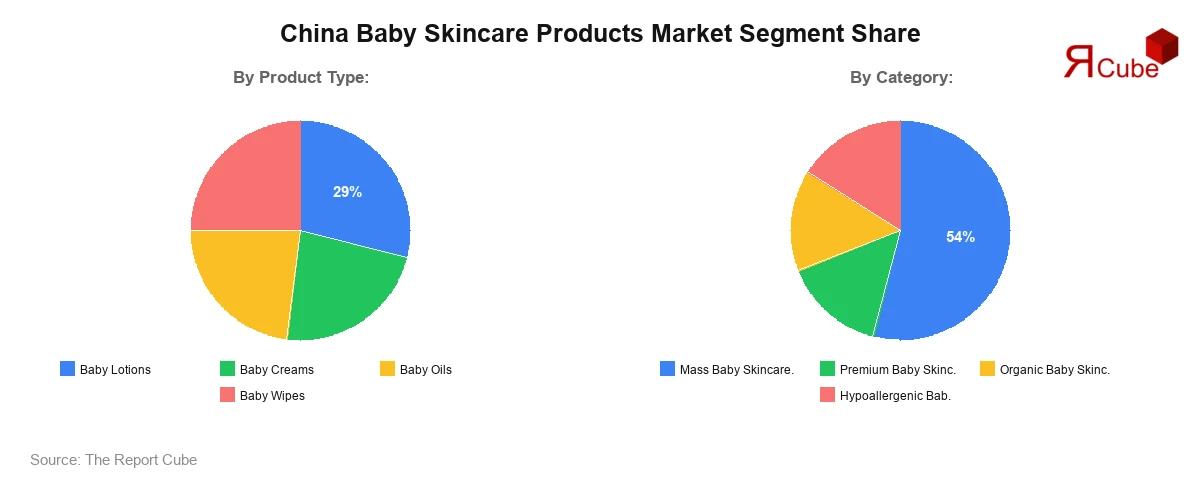
Baby lotions dominate the China Baby Skincare Products Market, accounting for approximately 29% of total revenue in 2025. Their widespread use for daily moisturizing and skin protection makes them a staple across households. Baby creams follow closely, particularly in colder regions where skin dryness is more prevalent. The consistent demand across product types highlights the essential nature of baby skincare in everyday infant care routines.
By Category:
- Mass Baby Skincare
- Premium Baby Skincare
- Organic Baby Skincare
- Hypoallergenic Baby Skincare
Mass baby skincare products currently hold the largest market share at nearly 54%, driven by affordability and broad availability. However, premium and organic baby skincare categories are growing at a faster pace, supported by rising income levels and increasing trust in natural formulations. This shift underscores a gradual transition toward value-driven rather than price-driven purchasing behavior.
Regional Projection of China Baby Skincare Products Industry
- East China
- North China
- South China
- Central China
East China leads the China Baby Skincare Products Market, contributing approximately 38% of total market revenue. The region benefits from higher urbanization rates, strong retail infrastructure, and greater consumer awareness regarding premium baby care products. Cities such as Shanghai and Hangzhou act as innovation hubs, where new products are often launched first. Strong online retail penetration further enhances regional dominance, positioning East China as the primary growth engine for the market through 2034.
Need insights for a specific region within this market?
Request Regional DataWhy Choose This Report?
- Provides a comprehensive overview of the overall market analysis, encompassing key trends, consumer behavior analysis, and risk assessment to support strategic decision-making.
- Provides accurate, up-to-date insights into market size, segmentation, and emerging opportunities, helping to minimize risk & capitalizing on growth.
- Gives deep understanding of target audience preferences, investment habits, and communication channels for enhanced product development & marketing effectiveness.
- Delivers competitive analysis & benchmarking, uncovering the strengths & weaknesses of market competitors to guide strategies.
- Consolidate comprehensive market intelligence, reducing reasoning & streamlining research efforts.
- Facilitates customized market segmentation & risk mitigation strategies, fine-tuned to the business objectives.
- Aids in identifying both market challenges & untapped opportunities within the industry to drive long-term business growth.
- Provides valuable information based on actual customer data & search trends.
Table of Contents
- Introduction
- Objective of the Study
- Product and Category Definition
- Market Segmentation
- Study Variables
- Research Methodology
- Secondary Data Points
- Breakdown of Secondary Sources
- Primary Data Points
- Breakdown of Primary Interviews
- Secondary Data Points
- Executive Summary
- Market Dynamics
- Drivers
- Challenges
- Opportunity Assessment
- Recent Trends and Developments
- Regulatory and Policy Landscape
- China Baby Skincare Products Market Overview (2021-2034)
- Market Size, By Value (USD Billion)
- Market Share, By Product Type
- Baby Lotions
- Baby Creams
- Baby Oils
- Baby Powders
- Baby Wipes
- Baby Bath Products
- Baby Sun Care
- Market Share, By Category
- Mass Baby Skincare
- Premium Baby Skincare
- Organic Baby Skincare
- Hypoallergenic Baby Skincare
- Market Share, By Formulation
- Cream-Based
- Lotion-Based
- Oil-Based
- Gel-Based
- Market Share, By Distribution Channel
- Supermarkets and Hypermarkets
- Convenience Stores
- Specialty Baby Stores
- Pharmacies and Drugstores
- Online Retail
- Market Share, By Region
- East China
- North China
- Northeast China
- Central China
- South China
- Southwest China
- Northwest China
- Market Share, By Company
- Revenue Shares and Analysis
- Competitive Landscape
- East China Baby Skincare Products Market
- Market Size, By Value (USD Billion)
- Market Share, By Product Type
- Market Share, By Category
- Market Share, By Formulation
- Market Share, By Distribution Channel
- North China Baby Skincare Products Market
- Market Size, By Value (USD Billion)
- Market Share, By Product Type
- Market Share, By Category
- Market Share, By Formulation
- Market Share, By Distribution Channel
- Northeast China Baby Skincare Products Market
- Market Size, By Value (USD Billion)
- Market Share, By Product Type
- Market Share, By Category
- Market Share, By Formulation
- Market Share, By Distribution Channel
- Central China Baby Skincare Products Market
- Market Size, By Value (USD Billion)
- Market Share, By Product Type
- Market Share, By Category
- Market Share, By Formulation
- Market Share, By Distribution Channel
- South China Baby Skincare Products Market
- Market Size, By Value (USD Billion)
- Market Share, By Product Type
- Market Share, By Category
- Market Share, By Formulation
- Market Share, By Distribution Channel
- Southwest China Baby Skincare Products Market
- Market Size, By Value (USD Billion)
- Market Share, By Product Type
- Market Share, By Category
- Market Share, By Formulation
- Market Share, By Distribution Channel
- Northwest China Baby Skincare Products Market
- Market Share, By Product Type
- Market Share, By Category
- Market Share, By Formulation
- Market Share, By Distribution Channel
- Competitive Outlook and Company Profiles
- Johnson & Johnson
- Company Overview
- Product Portfolio
- Strategic Alliances/Partnerships
- Recent Developments
- Procter & Gamble (Pampers, Pampers Baby Care)
- Company Overview
- Product Portfolio
- Strategic Alliances/Partnerships
- Recent Developments
- Nestlé (Wyeth Nutrition and Gerber Baby Care)
- Company Overview
- Product Portfolio
- Strategic Alliances/Partnerships
- Recent Developments
- Unilever (Dove Baby and Local Baby Brands)
- Company Overview
- Product Portfolio
- Strategic Alliances/Partnerships
- Recent Developments
- Beiersdorf (Nivea Baby)
- Company Overview
- Product Portfolio
- Strategic Alliances/Partnerships
- Recent Developments
- Pigeon Corporation
- Company Overview
- Product Portfolio
- Strategic Alliances/Partnerships
- Recent Developments
- Frog Prince Daily Chemical
- Company Overview
- Product Portfolio
- Strategic Alliances/Partnerships
- Recent Developments
- YingZhiSheng (Yeehoo Baby Care)
- Company Overview
- Product Portfolio
- Strategic Alliances/Partnerships
- Recent Developments
- Baby Elephant (Shanghai Jahwa Brand)
- Company Overview
- Product Portfolio
- Strategic Alliances/Partnerships
- Recent Developments
- Goodbaby Group (Baby Skincare Lines)
- Company Overview
- Product Portfolio
- Strategic Alliances/Partnerships
- Recent Developments
- Others
- Johnson & Johnson
- Contact Us and Disclaimer
Top Key Players & Market Share Outlook
- Johnson & Johnson
- Procter & Gamble (Pampers, Pampers Baby Care)
- Nestlé (Wyeth Nutrition and Gerber Baby Care)
- Unilever (Dove Baby and Local Baby Brands)
- Beiersdorf (Nivea Baby)
- Pigeon Corporation
- Frog Prince Daily Chemical
- YingZhiSheng (Yeehoo Baby Care)
- Baby Elephant (Shanghai Jahwa Brand)
- Goodbaby Group (Baby Skincare Lines)
- Others
Frequently Asked Questions






