



Build Your Custom Market Intelligence Report
Customize Your ReportChina Perfume Market Insights & Analysis
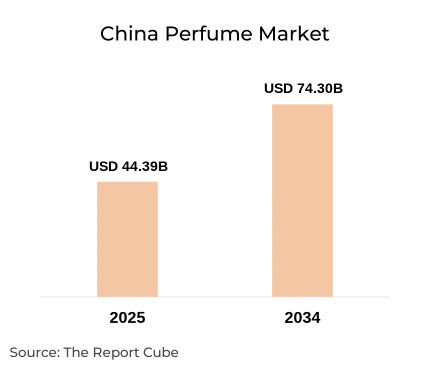
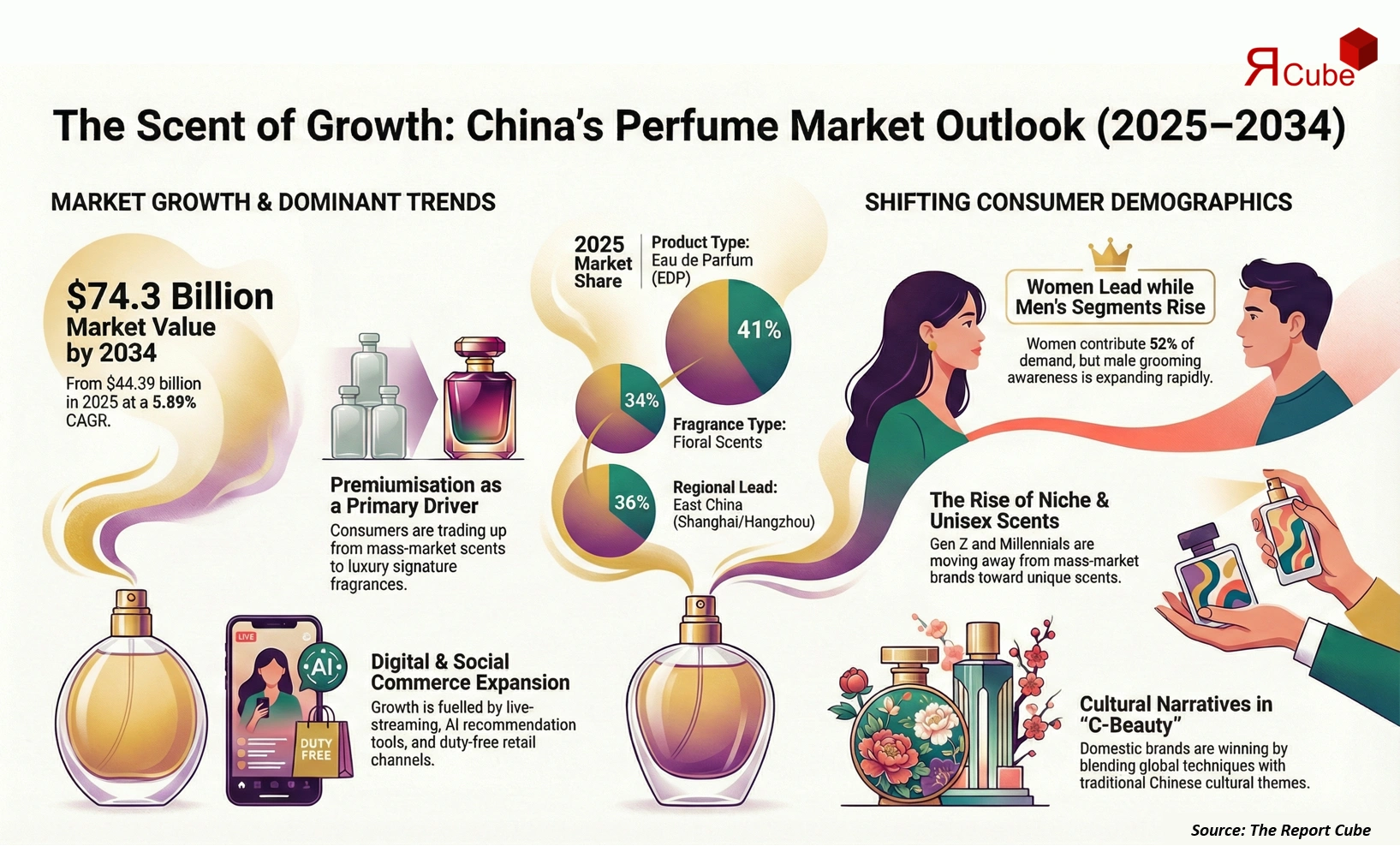
The China Perfume Market is anticipated to register a CAGR of 5.89% during the forecast period 2026-2034. The market size was valued at USD 44.39 billion in 2025 and is projected to reach USD 74.30 billion by 2034. This growth reflects China’s rapid evolution from a traditionally low-fragrance-usage market into one of the world’s most dynamic and high-potential perfume markets. Rising disposable incomes, expanding urban middle-class populations, and growing exposure to global luxury and lifestyle trends are reshaping consumer preferences toward premium and personalized fragrance products. Perfume consumption in China is increasingly linked to self-expression, social identity, and lifestyle aspiration rather than purely functional use.
Market expansion is further supported by strong growth in e-commerce, social commerce, and duty-free retail channels, which have significantly improved access to both international luxury brands and emerging domestic fragrance labels. Younger consumers, particularly Gen Z and millennials, are driving demand through experimentation with niche scents, unisex fragrances, and limited-edition launches. Additionally, rising interest in grooming, personal wellness, and premium beauty products among male consumers is broadening the addressable market. The combination of global brand penetration, fast-growing domestic players, and strong digital engagement positions China as one of the most strategically important perfume markets worldwide.
China Perfume Market Recent Developments
- 2025: CHANEL and Dior expanded exclusive fragrance launches through China’s duty-free and online luxury platforms.
- 2025: Noble Vogue Parfum strengthened domestic niche fragrance distribution across major Chinese cities.
Government Initiatives & Policies
- China Cosmetics Supervision and Administration Regulation (CSAR): Regulatory framework improving safety, transparency, and market standardization.
- Cross-Border E-commerce Policy: Policy supporting import of premium beauty and fragrance products through bonded zones.
China Perfume Market Dynamics
Key Driver: Premiumization and lifestyle-driven fragrance adoption
The primary driver of the China perfume market is the accelerating premiumization of personal care and beauty consumption. Chinese consumers increasingly associate fragrances with personal identity, confidence, and lifestyle status rather than occasional luxury use. Exposure to global fashion trends, celebrity endorsements, and social media-driven beauty culture has normalized perfume usage, especially among younger urban consumers. Rising disposable incomes and growing demand for premium and niche products are encouraging consumers to trade up from mass-market scents to luxury eau de parfum and signature fragrances. Additionally, gifting culture, seasonal promotions, and travel retail sales further stimulate demand, making perfume a fast-growing category within China’s broader beauty market.
Major Challenge: Brand education and fragrance penetration gaps
A key challenge facing the China perfume market is uneven fragrance awareness and penetration outside major metropolitan areas. While tier-one cities exhibit strong adoption of luxury and niche fragrances, lower-tier cities remain more price-sensitive and less familiar with perfume usage occasions. Educating consumers about fragrance layering, scent families, and usage remains a gradual process. Additionally, regulatory compliance under China’s cosmetics framework can increase time-to-market and costs for new launches. Counterfeit products and grey-market distribution also pose brand protection challenges, particularly for high-end international labels. Overcoming these barriers requires sustained brand investment, localized marketing, and controlled distribution strategies.
Industry Trends: Rise of niche, unisex, and local fragrance brands
A defining trend in the China perfume market is the rapid rise of niche fragrances, unisex scents, and domestically developed perfume brands. Younger consumers increasingly seek unique, story-driven fragrances that differentiate them from mass-market offerings. Oriental, woody, and customized blends inspired by Chinese culture and local ingredients are gaining popularity. Unisex perfumes are also expanding as gender-neutral beauty trends gain traction. Meanwhile, digital-first domestic brands are leveraging social commerce, influencer marketing, and data-driven product development to compete with global luxury houses. This diversification of offerings is reshaping competitive dynamics and expanding consumer choice.
Opportunity Ahead: Digital engagement and premium domestic innovation
Significant opportunities exist in leveraging digital platforms and localized product innovation to deepen market penetration. Live-streaming commerce, AI-driven scent recommendation tools, and virtual sampling experiences are transforming how consumers discover and purchase fragrances. Domestic brands have opportunities to blend global perfumery techniques with Chinese cultural narratives to create distinctive premium offerings. Additionally, growing demand for sustainable packaging, cruelty-free formulations, and clean-label products opens new premium segments. Brands that successfully combine storytelling, technology, and authenticity are well positioned to capture long-term growth in China’s evolving perfume landscape.
China Perfume Market Segment-wise Analysis
By Product Type:
- Eau de Parfum (EDP)
- Eau de Toilette (EDT)
- Eau de Cologne (EDC)
- Perfume Oils
- Others (Body Sprays, Solid Perfumes, etc.)
Eau de Parfum (EDP) dominates the China perfume market, accounting for approximately 41% of total market revenue in 2025. Chinese consumers increasingly prefer EDP formulations due to their longer-lasting scent profiles and premium positioning. EDT remains popular for everyday use, particularly among younger consumers, while perfume oils and solid perfumes are gaining traction within niche and luxury segments. The preference for concentrated, long-wear fragrances aligns with premiumization trends across urban markets.
By Consumer Group:
- Women
- Men
- Unisex
Women remain the largest consumer group, contributing approximately 52% of total perfume demand in 2025. However, men’s and unisex fragrances are expanding rapidly as grooming awareness and gender-neutral beauty trends gain momentum. Men’s fragrance adoption is rising strongly in professional urban populations, while unisex scents appeal to younger consumers seeking individuality and versatility. This shift is broadening the overall consumer base and driving category diversification.
By Fragrance Type:
- Floral
- Fruity
- Oriental
- Woody
- Fresh / Citrus
- Others
Floral fragrances lead the market with an estimated 34% share, reflecting traditional preferences for light, elegant, and feminine scent profiles. Oriental and woody fragrances are gaining popularity among niche and premium consumers, particularly in colder regions and evening-use segments. Fresh and citrus fragrances maintain strong demand for daily wear, especially during warmer seasons, supporting balanced growth across fragrance families.
Regional Projection of China Perfume Industry
- North China
- East China
- South Central China
- Southwest China
- Northwest China
- Northeast China
East China leads the China perfume market, accounting for approximately 36% of total market value in 2025. The region benefits from high urbanization, strong luxury retail presence, and concentration of affluent consumers in cities such as Shanghai and Hangzhou. South Central China follows, driven by Guangzhou and Shenzhen’s strong beauty retail ecosystems. North China contributes significantly through Beijing’s premium consumption base, while other regions are gradually increasing adoption as e-commerce penetration expands nationwide.
Why Choose This Report?
- Provides a comprehensive overview of the overall market analysis, encompassing key trends, consumer behavior analysis, and risk assessment to support strategic decision-making.
- Provides accurate, up-to-date insights into market size, segmentation, and emerging opportunities, helping to minimize risk & capitalizing on growth.
- Gives deep understanding of target audience preferences, investment habits, and communication channels for enhanced product development & marketing effectiveness.
- Delivers competitive analysis & benchmarking, uncovering the strengths & weaknesses of market competitors to guide strategies.
- Consolidate comprehensive market intelligence, reducing reasoning & streamlining research efforts.
- Facilitates customized market segmentation & risk mitigation strategies, fine-tuned to the business objectives.
- Aids in identifying both market challenges & untapped opportunities within the industry to drive long-term business growth.
- Provides valuable information based on actual customer data & search trends.
Table of Contents
- Introduction
- Objective of the Study
- Product/Category Definition
- Market Segmentation
- Study Variables
- Research Methodology
- Secondary Data Points
- Breakdown of Secondary Sources
- Primary Data Points
- Breakdown of Primary Interviews
- Secondary Data Points
- Executive Summary
- Market Dynamics
- Drivers
- Challenges
- Opportunity Assessment
- Recent Trends and Developments
- Policy and Regulatory Landscape
- China Perfume Market Overview (2020-2034)
- Market Size, By Volume & Value (Million Units / USD Billion)
- Market Share, By Product Type
- Eau de Parfum (EDP)
- Eau de Toilette (EDT)
- Eau de Cologne (EDC)
- Perfume Oils
- Others (Body Sprays, Solid Perfumes, etc.)
- Market Share, By Category
- Mass Market Perfumes
- Premium Perfumes
- Luxury / Niche Perfumes
- Market Share, By Consumer Group
- Women
- Men
- Unisex
- Market Share, By Fragrance Type
- Floral
- Fruity
- Oriental
- Woody
- Fresh / Citrus
- Others
- Market Share, By Price Range
- Economy
- Mid-Range
- Premium & Luxury
- Market Share, By Distribution Channel
- Offline Retail
- Specialty Stores
- Department Stores
- Supermarkets & Hypermarkets
- Others
- Online Retail
- Brand Websites
- Third-Party E-commerce Platforms
- Offline Retail
- Market Share, By Region
- North China
- East China
- South Central China
- Southwest China
- Northwest China
- Northeast China
- Market Share, By Company
- Revenue Shares
- Competitive Landscape
- North China Perfume Market
- Market Size, By Volume & Value (USD Billion)
- Market Share, By Product Type
- Market Share, By Category
- Market Share, By Consumer Group
- Market Share, By Distribution Channel
- East China Perfume Market
- Market Size, By Volume & Value (USD Billion)
- Market Share, By Product Type
- Market Share, By Category
- Market Share, By Consumer Group
- Market Share, By Distribution Channel
- South Central China Perfume Market
- Market Size, By Volume & Value (USD Billion)
- Market Share, By Product Type
- Market Share, By Category
- Market Share, By Consumer Group
- Market Share, By Distribution Channel
- Southwest China Perfume Market
- Market Size, By Volume & Value (USD Billion)
- Market Share, By Product Type
- Market Share, By Category
- Market Share, By Consumer Group
- Market Share, By Distribution Channel
- Northwest China Perfume Market
- Market Size, By Volume & Value (USD Billion)
- Market Share, By Product Type
- Market Share, By Category
- Market Share, By Consumer Group
- Market Share, By Distribution Channel
- Northeast China Perfume Market
- Market Size, By Volume & Value (USD Billion)
- Market Share, By Product Type
- Market Share, By Category
- Market Share, By Consumer Group
- Market Share, By Distribution Channel
- Competitive Outlook & Company Profiles
- Christian Dior (Dior)
- Company Overview
- Product Portfolio
- Strategic Alliances/Partnerships
- Recent Developments
- CHANEL
- Company Overview
- Product Portfolio
- Strategic Alliances/Partnerships
- Recent Developments
- Giorgio Armani
- Company Overview
- Product Portfolio
- Strategic Alliances/Partnerships
- Recent Developments
- Gucci
- Company Overview
- Product Portfolio
- Strategic Alliances/Partnerships
- Recent Developments
- Hermès
- Company Overview
- Product Portfolio
- Strategic Alliances/Partnerships
- Recent Developments
- Jo Malone London
- Company Overview
- Product Portfolio
- Strategic Alliances/Partnerships
- Recent Developments
- Yves Saint Laurent (YSL)
- Company Overview
- Product Portfolio
- Strategic Alliances/Partnerships
- Recent Developments
- Louis Vuitton
- Company Overview
- Product Portfolio
- Strategic Alliances/Partnerships
- Recent Developments
- NOBLE VOGUE PARFUM
- Company Overview
- Product Portfolio
- Strategic Alliances/Partnerships
- Recent Developments
- Guangzhou Zuofun Cosmetics Co., Ltd.
- Company Overview
- Product Portfolio
- Strategic Alliances/Partnerships
- Recent Developments
- Others
- Christian Dior (Dior)
- Contact Us / Disclaimer
Top Key Players & Market Share Outlook
- Christian Dior (Dior)
- CHANEL
- Giorgio Armani
- Gucci
- Hermès
- Jo Malone London
- Yves Saint Laurent (YSL)
- Louis Vuitton
- NOBLE VOGUE PARFUM
- Guangzhou Zuofun Cosmetics Co., Ltd.
- Others
Frequently Asked Questions






