




Build Your Custom Market Intelligence Report
Customize Your ReportChina Skin Toner Market Key Highlights
By Ingredient Type:
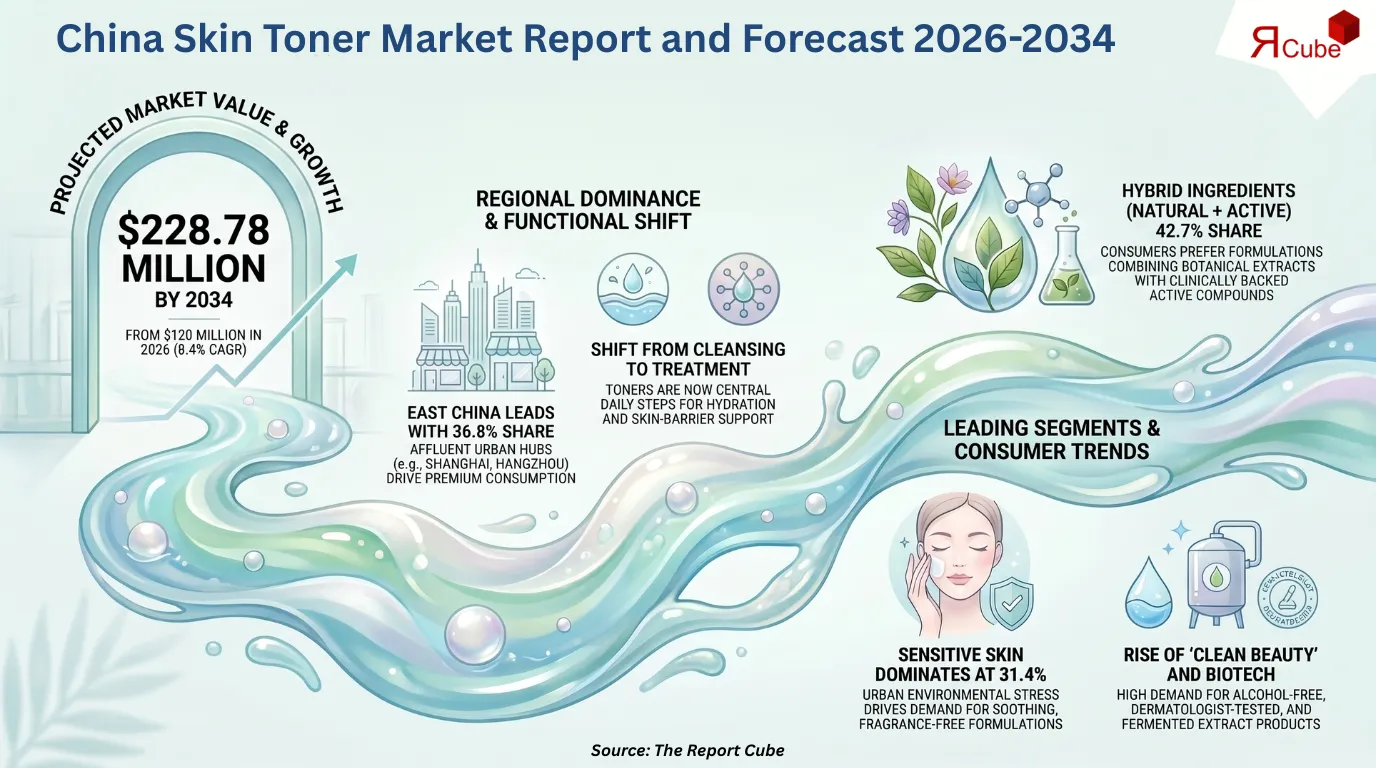
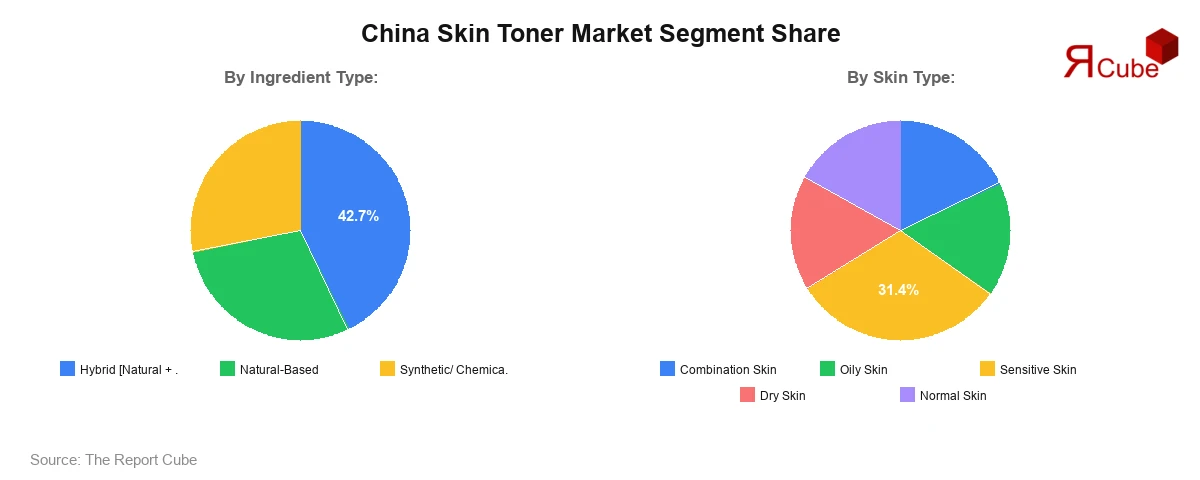
Hybrid [Natural + Active Ingredients] segment leads the market with nearly 42.7% share.
By Skin Type:
Sensitive Skin segment dominates the market with around 31.4% of revenue.
Regional Outlook:
East region dominates the China Skin Toner market with approximately 36.8% share.
China Skin Toner Market Insights & Analysis
The China Skin Toner Market is anticipated to register a CAGR of around 8.4% during the forecast period 2026-2034. The market size is valued at USD 120 million in 2026 and is projected to reach USD 228.78 million by 2034. China’s skincare industry is undergoing a noticeable transition toward hydration-focused and skin-barrier-support solutions as consumers increasingly prioritize long-term skin health over short-term cosmetic enhancement. Toners are no longer viewed as secondary cleansing products. Instead, they are becoming a central step in daily skincare regimens, particularly among younger urban consumers dealing with environmental stress, irregular lifestyles, and heightened skin sensitivity.
Major skincare manufacturers are strengthening investment in biotech ingredients, fermented extracts, peptide complexes, and mineral-rich botanical formulations to improve product differentiation. Domestic cosmetic brands are also gaining stronger market positioning by combining traditional Chinese herbal ingredients with clinically backed active compounds tailored for local skin concerns. Premium retail expansion, dermatology-led skincare education, and rapid growth in social commerce platforms are supporting wider adoption of multifunctional toners across East and South Central China. The market is also benefiting from rising demand for alcohol-free, fragrance-controlled, and dermatologist-tested formulations designed for sensitive and combination skin types.
China Skin Toner Market Impact Analysis
| Factor | Type | Specific Impact on Market | Magnitude | Business Implication |
|---|---|---|---|---|
| Rising Skincare Routine Adoption | Consumer | Daily multi step regimes increase usage frequency of toners | High | Supports volume growth for mass and premium toner formats |
| Demand for Functional Clean Beauty | Market | Preference shifts toward natural and alcohol free formulations | High | Drives innovation in gentle botanical and hypoallergenic lines |
| Influence of Social Commerce Platforms | Market | Short video and live streams accelerate product discovery | High | Requires KOL partnerships and content led campaign scaling |
| Regulation on Cosmetic Safety | Regulatory | Stricter filing and ingredient rules raise compliance costs | Medium | Favors established brands with strong regulatory capabilities |
| Intense Brand Proliferation | Competitive | Global and local labels crowd mid price and entry segments | High | Necessitates clear positioning and differentiated claims focus |
| Shift to Online and O2O Channels | Market | Ecommerce growth redistributes sales from traditional retail | Medium | Encourages omnichannel models and digital first assortments |
| Economic Cycles and Premium Trading | Environmental | Income changes shape trade up or down between price tiers | Medium | Needs tiered portfolios to cushion demand across downturns |
China Skin Toner Market Dynamics
Key Driver: Rising preference for barrier-repair and hydration-based skincare routines
Changing skincare habits across China are significantly influencing demand for advanced skin toner products. Consumers are increasingly choosing formulations that improve hydration retention, support microbiome balance, and reduce irritation caused by pollution exposure and climate variability. The growing popularity of minimalist skincare routines has elevated demand for multifunctional toners capable of delivering hydration, oil regulation, and soothing benefits in a single application. Sensitive skin concerns have also become more common among urban consumers, particularly in densely populated cities with high environmental stress levels.
Leading beauty brands are responding by developing toner solutions enriched with ceramides, centella asiatica, panthenol, and hyaluronic acid to strengthen skin barriers and reduce redness. Clinical testing, ingredient transparency, and dermatological validation are becoming key purchasing considerations among Chinese skincare consumers. This shift toward skin-health-focused skincare is expected to remain one of the strongest growth drivers supporting China skin toner market expansion over the forecast period.
Book your FREE 30-minute expert consultation today
Contact UsIndustry Trends: Premium functional toners reshaping skincare product development
China’s skincare manufacturers are increasingly introducing premium toner formulations that combine active treatment benefits with lightweight hydration properties. Products featuring niacinamide, glycolic acid, probiotics, peptides, and fermented rice extracts are gaining notable traction across both premium and mass-market categories. Consumers are showing stronger interest in toner-essence hybrid systems designed to simplify multi-step skincare routines while maintaining visible skin improvement.
Beauty brands are also emphasizing product safety, clean-label formulations, and sustainable packaging to strengthen consumer trust. Refillable skincare packaging and preservative-controlled formulations are becoming more visible within premium skincare portfolios. Several domestic cosmetic companies are leveraging traditional Chinese medicinal ingredients such as ginseng, mugwort, and snow mushroom extracts to create differentiated toner products tailored to local beauty preferences. These formulation trends continue to strengthen product innovation and elevate premiumization across the China skin toner industry.
Major Challenge: High product saturation and competitive pricing pressure
The China skin toner market faces intense competitive pressure due to the rapid expansion of domestic beauty startups, international skincare brands, and online direct-to-consumer cosmetic companies. Consumers now have access to a broad range of toner products across e-commerce platforms, specialty beauty retailers, and social commerce channels. This highly crowded marketplace has increased promotional competition and reduced long-term brand loyalty among younger consumers seeking value-driven skincare solutions.
Rising compliance requirements related to ingredient disclosure, efficacy substantiation, and cosmetic safety registration are also increasing operational costs for manufacturers. Smaller skincare companies often struggle to maintain premium positioning while balancing research investment and pricing competitiveness. In addition, counterfeit cosmetic products distributed through unauthorized channels continue to affect consumer confidence and brand reputation. These market challenges are encouraging skincare brands to focus more heavily on product authenticity, formulation quality, and clinical credibility.
Opportunity: Expansion of dermatologist-backed and sensitive-skin skincare categories
Growing awareness regarding skin sensitivity and inflammatory skin conditions is creating substantial opportunities for specialized toner products across China. Consumers are increasingly selecting formulations that are fragrance-free, alcohol-controlled, and clinically tested for delicate skin conditions. Demand for barrier-strengthening and microbiome-friendly skincare products is especially strong among younger consumers living in major metropolitan regions.
At the same time, male skincare adoption and rising beauty expenditure in lower-tier cities are opening new revenue opportunities for skincare companies. Brands investing in derma-cosmetic innovation, ingredient traceability, and personalized skincare systems are expected to gain stronger market traction. Functional toners designed for acne management, hydration repair, and post-treatment skincare support are likely to witness accelerated demand as China’s skincare industry continues shifting toward science-backed and treatment-oriented product categories.
China Skin Toner Market Segment-wise Analysis
By Ingredient Type:
- Hybrid [Natural + Active Ingredients]
- Natural-Based
- Synthetic/ Chemical-Based
The Hybrid [Natural + Active Ingredients] segment accounts for the largest share of the China skin toner market, contributing nearly 42.7% of total industry revenue. Consumers are increasingly favoring formulations that combine botanical extracts with clinically recognized active compounds capable of improving hydration, brightening skin tone, and reducing irritation. Toners enriched with niacinamide, peptides, centella asiatica, fermented extracts, and hyaluronic acid are experiencing strong acceptance across premium skincare categories.
Domestic skincare companies are strengthening investment in biotechnology-driven ingredients to improve product efficacy while maintaining gentle formulation profiles. The segment is also benefiting from growing trust in products that merge traditional Chinese herbal skincare principles with modern dermatological science. Hybrid toner systems are particularly popular among consumers seeking multifunctional skincare products that simplify routines without compromising visible skincare performance. This trend is expected to continue supporting segment expansion throughout the forecast timeline.
By Skin Type:
- Combination Skin
- Oily Skin
- Sensitive Skin
- Dry Skin
- Normal Skin
The Sensitive Skin segment holds the dominant position in the China skin toner market with around 31.4% revenue share. Increasing exposure to pollution, changing weather conditions, stress-related skin reactions, and overuse of harsh skincare ingredients has contributed to rising cases of skin sensitivity among Chinese consumers. This shift has accelerated demand for soothing toner products formulated with calming and barrier-support ingredients.
Skincare brands are actively introducing low-irritation toner formulations featuring ceramides, panthenol, thermal water, probiotics, and botanical extracts designed to reduce redness and improve skin resilience. Dermatologist recommendations and pharmacy-led skincare distribution channels are also supporting growth in this category. Sensitive-skin-focused toners are gaining stronger visibility across premium skincare shelves as consumers increasingly prioritize long-term skin health and formulation safety over aggressive cosmetic treatments.
Regional Projection of China Skin Toner Industry
- North
- Northeast
- East
- South Central
- Southwest
- Northwest
East China maintains the leading position in the China skin toner market with approximately 36.8% share, supported by strong premium skincare consumption and highly developed retail infrastructure. Cities such as Shanghai, Hangzhou, and Suzhou continue to witness strong demand for hydration-focused, anti-aging, and sensitive-skin skincare products. Consumers in the region generally demonstrate higher willingness to spend on premium and clinically validated beauty products compared to several inland provinces.
The region also benefits from advanced e-commerce penetration, strong logistics networks, and extensive presence of international cosmetic retailers. Domestic skincare brands are increasingly launching region-specific products designed to address humidity-related skin concerns and urban environmental stress factors common across East China. Continued investment in biotechnology skincare innovation, beauty retail expansion, and digital commerce ecosystems is expected to sustain regional market leadership through 2034.
Need insights for a specific region within this market?
Request Regional DataChina Skin Toner Industry Regional Analysis
The China skin toner industry varies significantly across regions due to diverse consumer preferences, income levels, and digital commerce penetration.
| Region | Demand Level | Key Areas | Product Dominance | Core Demand Logic | Growth Nature |
|---|---|---|---|---|---|
| North (Beijing, Tianjin, Hebei) | High | Beijing, Tianjin metropolitan | Premium & Imported toners | Affluent consumers & brand consciousness | Steady premiumization |
| Northeast (Liaoning, Jilin, Heilongjiang) | Medium | Shenyang, Harbin, Changchun | Hydrating & moisturizing toners | Dry climate & seasonal skincare needs | Value-driven growth |
| East (Shanghai, Jiangsu, Zhejiang, Shandong) | Extremely High | Shanghai, Hangzhou, Nanjing | Multifunctional & K-beauty toners | Beauty hub & manufacturing cluster presence | Innovation-led expansion |
| South Central (Guangdong, Hunan, Hubei) | Very High | Guangzhou, Shenzhen, Wuhan | Herbal & functional toners | Humid climate & e-commerce dominance | Digital commerce boom |
| Southwest (Sichuan, Chongqing, Yunnan) | Medium to High | Chengdu, Chongqing, Kunming | Botanical & organic toners | Natural ingredients preference & humidity | Emerging market surge |
| Northwest (Shaanxi, Gansu, Xinjiang) | Low to Medium | Xi'an, Lanzhou, Urumqi | Moisturizing & repair toners | Dry climate & lower purchasing power | Gradual penetration |
Government Initiatives & Policies
- China National Medical Products Administration Cosmetic Supervision Updates (2025): China strengthened cosmetic ingredient registration and efficacy claim verification requirements to improve product safety transparency and consumer trust across skincare categories including toner products.
- 14th Five-Year Plan for Consumer Goods Industry Development (2025 Implementation Phase): The Chinese government continued supporting domestic beauty and personal care innovation through biotechnology investment, premium manufacturing, and digital retail modernization initiatives.
China Skin Toner Industry Recent Developments
- 2025: Florasis expanded into toner-based skincare by launching a dedicated product line including toners, creams, essences, and lotions focused on hydration and sensitive-skin support. The move reflects increasing demand for multifunctional skincare systems and premium skin barrier-repair solutions among younger Chinese consumers.
- 2025: The Ordinary entered mainland China through Sephora China with glycolic acid-based toning products adapted for local skincare requirements and regulatory standards. The expansion strengthened the trend toward functional, clinical, and ingredient-transparent toner solutions targeting results-focused skincare consumers.
Why Choose This Report?
- Provides a comprehensive overview of the overall market analysis, encompassing key trends, consumer behavior analysis, and risk assessment to support strategic decision-making.
- Provides accurate, up-to-date insights into market size, segmentation, and emerging opportunities, helping to minimize risk & capitalizing on growth.
- Gives deep understanding of target audience preferences, investment habits, and communication channels for enhanced product development & marketing effectiveness.
- Delivers competitive analysis & benchmarking, uncovering the strengths & weaknesses of market competitors to guide strategies.
- Consolidate comprehensive market intelligence, reducing reasoning & streamlining research efforts.
- Facilitates customized market segmentation & risk mitigation strategies, fine-tuned to the business objectives.
- Aids in identifying both market challenges & untapped opportunities within the industry to drive long-term business growth.
- Provides valuable information based on actual customer data & search trends.
Table of Contents
- Introduction
- Objective of the Study
- Product and Category Definition
- Market Segmentation
- Study Variables
- Research Methodology
- Secondary Data Points
- Breakdown of Secondary Sources
- Primary Data Points
- Breakdown of Primary Interviews
- Secondary Data Points
- Executive Summary
- Market Dynamics
- Emerging Opportunities
- Adoption Trends
- Demand Drivers
- Disruption Analysis (Challenges)
- Industry Analysis & Strategic Insights
- Supply/Value Chain Analysis
- Pricing Analysis
- Go-To-Market (GTM) Strategy
- BCG Matrix
- Recent Trends and Developments
- Import and Export Analysis
- Regulatory and Policy Landscape
- Region-wise Policies
- Government Initiatives
- China Skin Toner Market Overview and Forecast Analysis (2021-2034)
- Market Size, By Value, By Growth Rate (CAGR/ USD Million)
- Market Share, By Product Type
- Treatment Toners
- Exfoliating Toners
- Hydrating Toners
- Astringent Toners
- Skin Fresheners/ Bracers
- Market Share, By Format
- Toner Pads
- Gel Toners
- Mist Toners
- Liquid Toners
- Market Share, By Ingredient Type
- Hybrid (Natural + Active Ingredients)
- Natural-Based
- Synthetic/ Chemical-Based
- Market Share, By Skin Type
- Combination Skin
- Oily Skin
- Sensitive Skin
- Dry Skin
- Normal Skin
- Market Share, By Gender
- Unisex
- Women
- Men
- Market Share, By Price Range
- Mid-Range
- Premium
- Mass
- Market Share, By Application
- Brightening
- Skin Soothing/ Calming
- Oil Control
- Anti-Aging Care
- Hydration
- Skin Preparation
- Cleansing & Residue Removal
- Market Share, By Distribution Channel
- Online
- Brand Websites (DTC)
- E-commerce Marketplaces
- Offline
- Department Stores
- Pharmacies/ Drug Stores
- Specialty Stores
- Supermarkets/ Hypermarkets
- Online
- Market Share, By Packaging Type
- Jars/ Pad Containers
- Spray Containers
- Bottles
- Pump Dispensers
- Sachets Packs
- Market Share, By End User
- Professional/ Institutional
- Dermatology Centers
- Salons & Spas
- Makeup Artists
- Beauty Clinics
- Individual Consumers
- Professional/ Institutional
- Market Share, By Region
- North
- Northeast
- East
- South Central
- Southwest
- Northwest
- Market Share, By Company
- Revenue Shares & Analysis
- Competitive Landscape
- North China Skin Toner Market Overview and Forecast Analysis (2021-2034)
- Market Size, By Value, By Growth Rate (CAGR/ USD Million)
- Market Share, By Product Type
- Market Share, By Format
- Market Share, By Ingredient Type
- Market Share, By Skin Type
- Market Share, By Gender
- Market Share, By Price Range
- Market Share, By Application
- Market Share, By Distribution Channel
- Market Share, By Packaging Type
- Market Share, By End User
- Northeast China Skin Toner Market Overview and Forecast Analysis (2021-2034)
- Market Size, By Value, By Growth Rate (CAGR/ USD Million)
- Market Share, By Product Type
- Market Share, By Format
- Market Share, By Ingredient Type
- Market Share, By Skin Type
- Market Share, By Gender
- Market Share, By Price Range
- Market Share, By Application
- Market Share, By Distribution Channel
- Market Share, By Packaging Type
- Market Share, By End User
- East China Skin Toner Market Overview and Forecast Analysis (2021-2034)
- Market Size, By Value, By Growth Rate (CAGR/ USD Million)
- Market Share, By Product Type
- Market Share, By Format
- Market Share, By Ingredient Type
- Market Share, By Skin Type
- Market Share, By Gender
- Market Share, By Price Range
- Market Share, By Application
- Market Share, By Distribution Channel
- Market Share, By Packaging Type
- Market Share, By End User
- South Central China Skin Toner Market Overview and Forecast Analysis (2021-2034)
- Market Size, By Value, By Growth Rate (CAGR/ USD Million)
- Market Share, By Product Type
- Market Share, By Format
- Market Share, By Ingredient Type
- Market Share, By Skin Type
- Market Share, By Gender
- Market Share, By Price Range
- Market Share, By Application
- Market Share, By Distribution Channel
- Market Share, By Packaging Type
- Market Share, By End User
- Southwest China Skin Toner Market Overview and Forecast Analysis (2021-2034)
- Market Size, By Value, By Growth Rate (CAGR/ USD Million)
- Market Share, By Product Type
- Market Share, By Format
- Market Share, By Ingredient Type
- Market Share, By Skin Type
- Market Share, By Gender
- Market Share, By Price Range
- Market Share, By Application
- Market Share, By Distribution Channel
- Market Share, By Packaging Type
- Market Share, By End User
- Northwest China Skin Toner Market Overview and Forecast Analysis (2021-2034)
- Market Size, By Value, By Growth Rate (CAGR/ USD Million)
- Market Share, By Product Type
- Market Share, By Format
- Market Share, By Ingredient Type
- Market Share, By Skin Type
- Market Share, By Gender
- Market Share, By Price Range
- Market Share, By Application
- Market Share, By Distribution Channel
- Market Share, By Packaging Type
- Market Share, By End User
- Competitive Analysis, 2026
- Market Share of Key Players
- Competitive Mapping for Each Segment and Companies Operating by Region
- North China Skin Toner Poultry Feed Companies/Brands Share and Competitive Analysis, 2026
- Northeast China Skin Toner Poultry Feed Companies/Brands Share and Competitive Analysis, 2026
- East Skin China Toner Poultry Feed Companies/Brands Share and Competitive Analysis, 2026
- South Central China Skin Toner Poultry Feed Companies/Brands Share and Competitive Analysis, 2026
- Southwest China Skin Toner Poultry Feed Companies/Brands Share and Competitive Analysis, 2026
- Northwest China Skin Toner Poultry Feed Companies/Brands Share and Competitive Analysis, 2026
- Company Profile (Partial List)
- Shiseido Company, Limited
- Company Overview
- Product Portfolio
- Strategic Alliances/ Partnerships
- Recent Developments
- Shanghai Pehchaolin Daily Chemical Co., Ltd.
- Company Overview
- Product Portfolio
- Strategic Alliances/ Partnerships
- Recent Developments
- Yunnan Botanee Bio-Technology Group Co., Ltd.
- Company Overview
- Product Portfolio
- Strategic Alliances/ Partnerships
- Recent Developments
- Procter & Gamble Company
- Company Overview
- Product Portfolio
- Strategic Alliances/ Partnerships
- Recent Developments
- L'Oréal S.A.
- Company Overview
- Product Portfolio
- Strategic Alliances/ Partnerships
- Recent Developments
- Bloomage Biotechnology Corporation Limited
- Company Overview
- Product Portfolio
- Strategic Alliances/ Partnerships
- Recent Developments
- JALA Group Co., Ltd.
- Company Overview
- Product Portfolio
- Strategic Alliances/ Partnerships
- Recent Developments
- Shanghai Jahwa United Co., Ltd.
- Company Overview
- Product Portfolio
- Strategic Alliances/ Partnerships
- Recent Developments
- The Estée Lauder Companies Inc.
- Company Overview
- Product Portfolio
- Strategic Alliances/ Partnerships
- Recent Developments
- Proya Cosmetics Co., Ltd.
- Company Overview
- Product Portfolio
- Strategic Alliances/ Partnerships
- Recent Developments
- Others (Partial List)
- Shiseido Company, Limited
- Contact Us and Disclaimer
Top Key Players & Market Share Outlook
- Shiseido Company, Limited
- Shanghai Pehchaolin Daily Chemical Co., Ltd.
- Yunnan Botanee Bio-Technology Group Co., Ltd.
- Procter & Gamble Company
- L'Oréal S.A.
- Bloomage Biotechnology Corporation Limited
- JALA Group Co., Ltd.
- Shanghai Jahwa United Co., Ltd.
- The Estée Lauder Companies Inc.
- Proya Cosmetics Co., Ltd.
- Others
Frequently Asked Questions






