




Build Your Custom Market Intelligence Report
Customize Your ReportJapan Bath Soap Manufacturing Market Key Takeaways
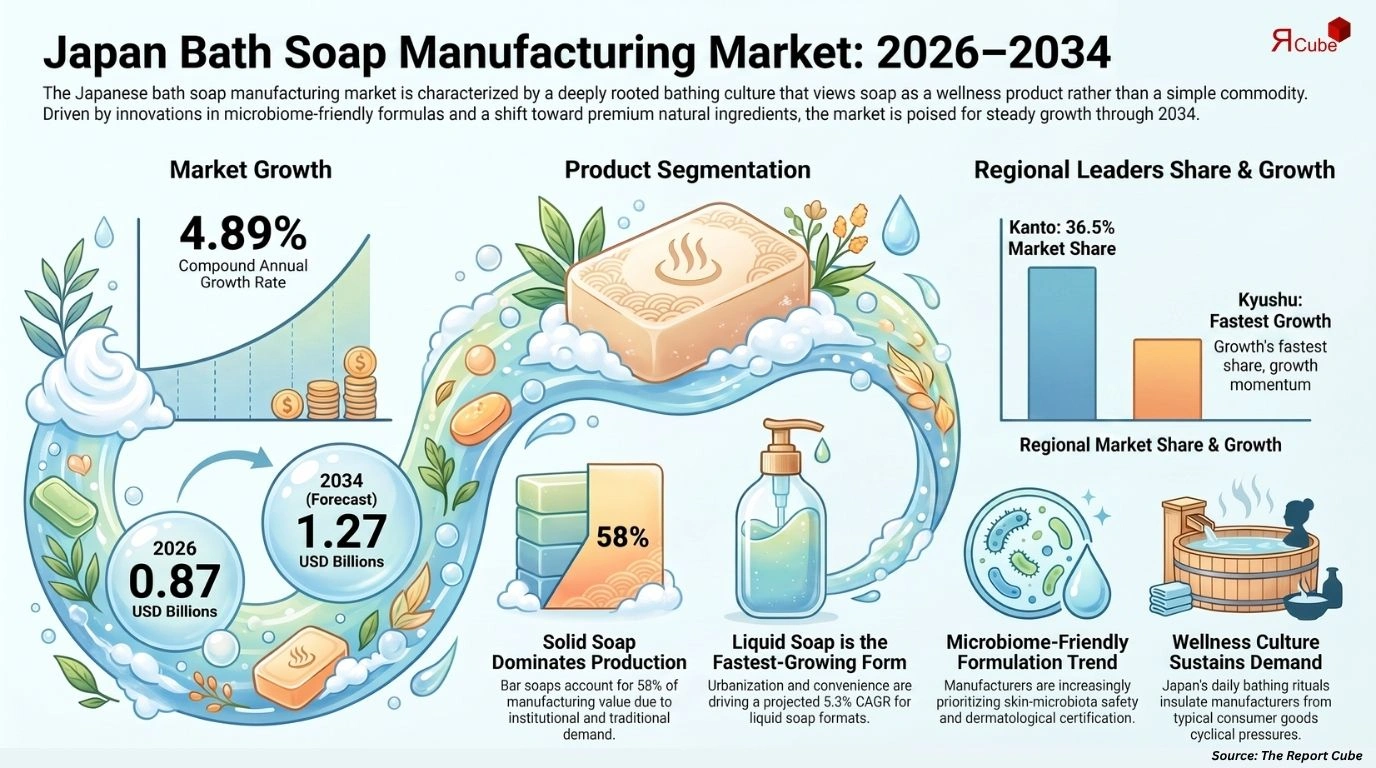
- Market valued at USD 0.87 billion in 2026, reflecting steady manufacturing expansion.
- Industry projected to reach USD 1.27 billion by 2034, growing at 4.89% CAGR.
- Solid bath soaps remain the dominant form segment across Japan's manufacturing base.
- Supermarkets and hypermarkets lead distribution, anchoring mass-market soap accessibility nationwide.
- Kanto region maintains market leadership driven by Tokyo's dense consumer population.
- Kyushu emerges as the fastest-growing region, supported by onsen-linked manufacturing demand.
- Leading companies include Lion Corporation, Cow Brand Soap Co., Ltd., and Shabondama Soap.
- Natural ingredient sourcing, microbiome-friendly formulations, and e-commerce growth drive market momentum.
Japan Bath Soap Manufacturing Market Insights & Analysis
The Japan Bath Soap Manufacturing Market is anticipated to register a 4.89% CAGR during 2026–2034. The market size was valued at USD 0.87 billion in 2026 and is projected to reach USD 1.27 billion by 2034. Japan's deeply embedded bathing culture, where daily soaking rituals extend beyond basic hygiene into wellness and skin-care routines, creates persistent manufacturing demand that insulates producers from the cyclical pressures affecting comparable consumer goods categories. Producers are reinforcing investments in saponification process upgrades and contract manufacturing infrastructure to serve both domestic retail and growing export channels. The Japan personal care manufacturing supply chain continues evolving, with ingredients sourcing shifting toward plant-derived and sustainably certified inputs that command stronger retail pricing across premium tiers.
Government-backed quality frameworks, including the Act on Securing Quality, Efficacy and Safety of Products Including Pharmaceuticals and Medical Devices, impose stringent ingredient disclosure mandates that raise the compliance bar for manufacturers while simultaneously elevating consumer trust. Domestic producers such as Cow Brand Soap Co., Ltd. and Shabondama Soap continue investing in additive-free formulation science and natural saponification methods that differentiate Japanese-manufactured soaps from lower-cost regional alternatives. Institutional buyers - spanning hotels, onsen facilities, and travel accommodations - are also scaling bulk procurement, pushing contract manufacturers to optimize bar formats that balance fragrance stability, cost efficiency, and consistent quality output at scale.
Japan Bath Soap Manufacturing Market Dynamics
Japan's bath soap manufacturing sector operates within a mature but structurally evolving market environment shaped by shifting consumer preferences, rising wellness consciousness, and tightening regulatory oversight. Manufacturers are navigating a transition from volume-led production toward formulation differentiation and premium positioning, with institutional and export demand providing incremental growth vectors alongside domestic retail. Investment in process automation, sustainable packaging, and natural ingredient verification is accelerating across both established producers and artisanal-scale manufacturers.
|
Factor |
Type |
Specific Impact on Market |
Magnitude |
|---|---|---|---|
|
Japan's deep-rooted bathing culture |
Driver |
Sustains consistent baseline demand for bath soap manufacturing |
Very High |
|
Natural and additive-free formulation trends |
Driver |
Pushes producers toward premium manufacturing investments |
High |
|
Rising onsen and hotel accommodation demand |
Opportunity |
Expands institutional bulk manufacturing and bar format optimization |
High |
|
Ingredient regulatory compliance requirements |
Driver |
Raises quality standards, filters underprepared market entrants |
High |
|
Online channel growth for specialty soaps |
Trend |
Accelerates premium and artisanal soap distribution at scale |
High |
Key Market Driver: Japan's Wellness Bathing Culture
Japan's tradition of ofuro and onsen bathing positions bath soap as a daily functional wellness product rather than a routine hygiene commodity. This cultural distinction directly supports elevated per-capita soap consumption and sustained manufacturing investment. Producers are capitalizing on this positioning by developing moisturizing and skin-barrier bath soap formulations that extend beyond cleansing into active dermatological care. With aging demographics increasingly prioritizing low-irritant, moisture-retaining formulations, manufacturers are reconfiguring saponification protocols and ingredient sourcing to deliver clinically substantiated skin-health outcomes across mass and premium product tiers.
Major Industry Challenge: Palm Oil Supply Chain Volatility
Japan's bath soap manufacturers depend significantly on palm oil and palm kernel oil as primary fatty acid inputs for saponification. Global palm oil price volatility, driven by weather events, export policy changes across Indonesia and Malaysia, and sustainability certification compliance costs, directly compresses manufacturer margins. Producers operating without vertically integrated ingredient supply cannot easily absorb input cost shocks, and substituting with alternative oils such as coconut or tallow requires reformulation investment that disrupts production timelines. This supply chain exposure represents a structural vulnerability that disproportionately affects mid-tier and contract manufacturers operating under fixed-price retail agreements.
Emerging Trend Shaping Outlook: Microbiome-Friendly Formulation Science
Japanese manufacturers are increasingly integrating microbiome-compatibility claims and dermatological substantiation into product development workflows. Following frameworks such as the MyMicrobiome Derm Standard introduced in April 2025, producers are investing in clinical validation that demonstrates a soap's neutral-to-positive impact on skin microbiota. This trend is reshaping ingredient selection - reducing synthetic surfactant concentrations, increasing prebiotic additive inclusion, and repositioning traditional additive-free soaps as scientifically validated skin-health products. Manufacturers investing early in microbiome-compliant bath soap certification pathways are expected to command disproportionate margin premiums as consumer demand for substantiated skin-safety claims accelerates through 2034.
Need Specific Data, Let’s Customize the Report for You
Request CustomizationJapan Bath Soap Manufacturing Market Segment-wise Analysis
Japan's bath soap manufacturing landscape is segmented across product form and distribution channel, both of which reveal distinct consumption behaviors, manufacturing priorities, and revenue concentration patterns within the domestic market.
By Form
- Solid Bath Soaps
- Liquid Bath Soaps
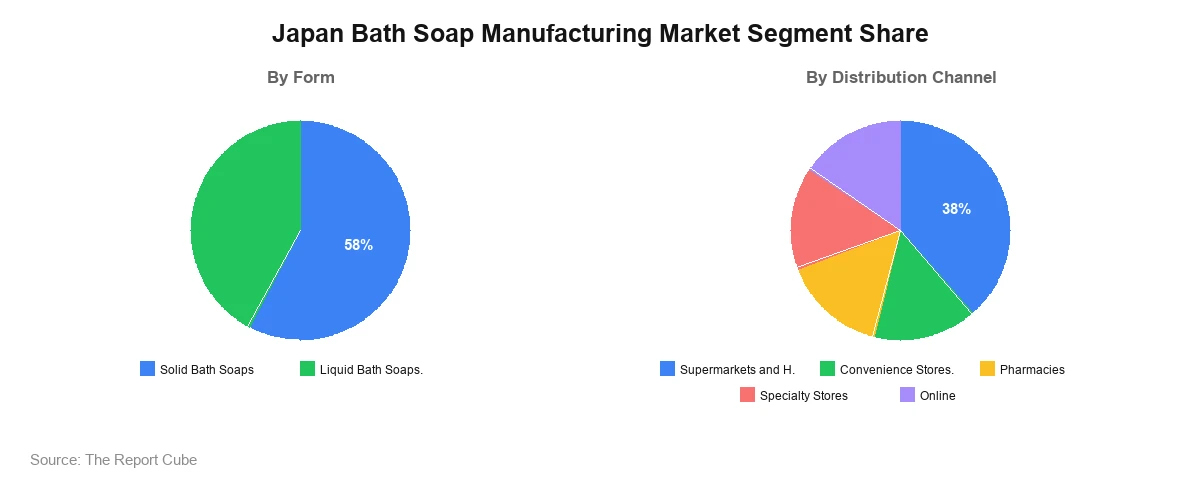
Solid bath soaps dominate Japan's manufacturing output, accounting for approximately 58% of total production value. This dominance reflects both Japan's historical manufacturing legacy in bar soap craftsmanship and continued institutional demand from hotels, onsen facilities, and ryokan accommodations that favor traditional bar formats for their cost efficiency, fragrance stability, and cultural alignment with Japanese bathing customs. Domestic producers including Cow Brand Soap Co., Ltd. and Shabondama Soap have built substantial manufacturing reputations around additive-free solid formulations that carry strong consumer trust and command retail premiums well above mass-market alternatives.
Liquid bath soaps represent the fastest-growing form segment, projected to expand at approximately 5.3% CAGR through 2034, driven by urbanization, dispenser convenience preference among working-age metropolitan consumers, and growing retail shelf space dedicated to pump-format products across pharmacy and specialty channels. Lion Corporation's hadakara Beauty Premium Moist Body Care Soap - launched in liquid and foam pump formats in 2026 - exemplifies the category's upward momentum. Manufacturers are investing in mild surfactant blends, fragrance encapsulation technology, and microbiome-friendly formulation systems to differentiate liquid portfolios and move volume through rapidly growing online retail platforms.
By Distribution Channel
- Supermarkets and Hypermarkets
- Convenience Stores
- Pharmacies
- Specialty Stores
- Online
Supermarkets and hypermarkets remain the dominant distribution channel for Japan's bath soap manufacturing sector, accounting for an estimated 38% of retail-facing output value. Mass-market producers including Lion Corporation and Unilever PLC leverage integrated supply chain capabilities to secure high-volume shelf placements across major retail banners such as AEON and Ito-Yokado, with private-label consolidation further concentrating procurement power among larger banner operators. Pharmacy channels reinforce this dominance by serving aging consumers who prioritize dermatologically positioned soap products with moisture-retention and hypoallergenic credentials verified through pharmacist endorsement.
Specialty stores and online channels together represent the fastest-growing distribution dimensions in the Japan Bath Soap Manufacturing Market. Online retail is projected to deliver approximately 12.2% CAGR through the forecast period, reflecting accelerating consumer adoption of e-commerce platforms for premium, artisanal, and subscription-format soap purchasing. WAWAZA and Beauty Secrets of Japan are capturing significant online traction among gift buyers and wellness consumers seeking authentically crafted Japanese artisanal bath soaps with cultural storytelling and minimalist packaging. Specialty stores concentrated in Tokyo and Osaka metropolitan corridors are similarly driving demand for formulation-differentiated and limited-batch products that supermarket channels cannot accommodate.
Regional Projection of Japan Bath Soap Manufacturing Market
Japan's bath soap manufacturing market demonstrates meaningful regional variation shaped by population density, consumer income levels, tourism infrastructure, and proximity to manufacturing hubs - with Kanto maintaining national leadership while Kyushu emerges as the most dynamically expanding regional market.
|
Region |
Estimated Market Share |
Key Growth Factors |
Consumer Trends |
|---|---|---|---|
|
Kanto |
36.5% |
Tokyo's dense population, premium soap retail concentration |
High adoption of liquid and moisturizing formulations |
|
Kansai |
24.2% |
Osaka-Kyoto urban clusters, growing tourism demand |
Increasing preference for traditional and natural soaps |
|
Chubu |
17.8% |
Nagoya industrial base, expanding personal care retail |
Rising mass-market soap consumption among dual-income households |
|
Kyushu |
13.1% |
Onsen culture, hotel and travel accommodation procurement |
Strong institutional and additive-free soap demand |
|
Others |
8.4% |
Rural distribution expansion, regional manufacturing clusters |
Gradual shift toward natural and wellness-positioned products |
- Kanto: Kanto leads the Japan Bath Soap Manufacturing Market with approximately 36.5% regional share, anchored by Tokyo's dense professional consumer base and premium pharmacy channel concentration driving formulation-differentiated purchasing.
- Kansai: Kansai's Osaka-Kyoto corridor sustains steady soap manufacturing demand, particularly for traditional natural formulations aligned with the region's heritage wellness culture and expanding inbound tourism hospitality infrastructure.
- Chubu: Chubu benefits from Nagoya's industrial economy and growing dual-income household formation rates, supporting consistent mass-market soap consumption and increased personal care retail investment across the region.
- Kyushu: Kyushu is the fastest-growing regional market, where onsen bathing infrastructure and hotel accommodation growth are driving institutional bulk soap procurement and accelerating additive-free bar soap manufacturing at regional producers including Shabondama Soap.
- Others: Remaining regions including Hokkaido, Tohoku, and Shikoku are experiencing gradual demand increases driven by rural distribution network expansion and growing natural product awareness among health-conscious local consumers.
Japan Bath Soap Manufacturing Market: Recent Development (2025)
- Lion Corporation launched hadakara Beauty Premium Moist Body Care Soap, expanding moisture-adsorbing formulation technology for retail.
- Shabondama Soap introduced the Shabond brand with repositioned packaging and accessible pricing targeting younger Japanese consumer demographics.
- Cow Brand Soap Co., Ltd. extended its additive-free soap series with new fragrance variants aligned to wellness-conscious retail and export demand.
- WAWAZA expanded small-batch artisanal soap production, reinforcing export positioning across gift and wellness international retail channels.
Japan Bath Soap Manufacturing Market Future Outlook (2034)
The Japan Bath Soap Manufacturing Market is projected to expand at a 4.89% CAGR, reaching approximately USD 1.27 billion by 2034. Growth will be driven by sustained investment in premium and functional soap formulations, rising institutional procurement from Japan's hotel and onsen accommodation sectors, and accelerating online retail adoption by artisanal and specialty producers. Manufacturers investing in microbiome-compatible ingredient systems, sustainable palm oil sourcing, and clinical substantiation infrastructure will be best positioned to capture disproportionate share of value-added production as the market matures through 2034.
Long-term expansion will also be supported by Japan's deepening export footprint, with domestic producers leveraging cultural authenticity - particularly additive-free manufacturing philosophy and traditional saponification craftsmanship - to access premium retail positions across South Korea, Southeast Asia, North America, and European wellness markets. Automation investments in saponification and drying systems, alongside fragrance encapsulation science and sustainable soap packaging innovation, will further differentiate Japanese manufacturers in an increasingly competitive global personal care landscape. Producers who secure early-mover advantage in dermatological certification and microbiome-compliance positioning are expected to sustain above-market growth trajectories across the forecast period.
Japan Bath Soap Manufacturing Market Report Coverage
|
Report Attribute |
Details |
|---|---|
|
Market Name |
Japan Bath Soap Manufacturing Market |
|
Market Size (2026) |
USD 0.87 Billion |
|
Market Size (2034) |
USD 1.27 Billion |
|
Forecast Period |
2026–2034 |
|
CAGR |
4.89% |
|
Base Year |
2026 |
|
Historical Years |
2021–2025 |
|
Forecast Years |
2026–2034 |
|
Segments Covered |
By Form, By Distribution Channel, By Product |
|
Regions Covered |
Kanto, Kansai, Chubu, Kyushu, Others |
|
Key Companies |
Cow Brand Soap Co., Ltd., Lion Corporation, WAWAZA, Beauty Secrets of Japan, Unilever PLC, Johnson & Johnson, Shabondama Soap, Sanwa WINGS Co., Ltd., Others |
|
Report Format |
PDF, Excel, PPT |
|
Customization |
Available as per client requirements |
Why Choose This Report?
- Comprehensive analysis covering Japan's bath soap manufacturing dynamics and trends.
- Accurate market sizing with a reliable 4.89% CAGR forecast through 2034.
- Detailed segmentation covering form and distribution channel revenue opportunities.
- Regional insights spanning Kanto, Kansai, Chubu, Kyushu, and emerging markets.
- Competitive profiling of leading domestic and international soap manufacturers.
- Analysis of microbiome-friendly formulation and sustainable ingredient trends.
- Institutional procurement and onsen-linked manufacturing demand coverage included.
- Data-driven research aligned with EEAT principles and current industry developments.
Table of Contents
- Introduction
- Objective of the Study
- Product Definition
- Market Segmentation
- Study Variables
- Research Methodology
- Secondary Data Points
- Companies Interviewed
- Primary Data Points
- Breakdown of Primary Interviews
- Secondary Data Points
- Executive Summary
- Market Dynamics
- Drivers
- Challenges
- Opportunity Assessment
- Recent Trends and Developments
- Policy and Regulatory Landscape
- Japan Bath Soap Manufacturing Market Overview and Forecast Analysis (2021-2034)
- Market Size, By Value, By Growth Rate (CAGR/USD Billions)
- Demand – Supply Trends
- Market Share, By Product
- Premium Products
- Mass Products
- Market Share, By Form
- Solid Bath Soaps
- Liquid Bath Soaps
- Market Share, By Distribution Channel
- Supermarkets and Hypermarkets
- Convenience Stores
- Pharmacies
- Specialty Stores
- Online
- Region
- Kanto
- Kansai
- Chubu
- Kyushu
- Others
- Market Share, By Competitors
- Competition Characteristics
- Revenue Shares
- Premium Products Japan Bath Soap Manufacturing Market Overview, 2021-2034F
- By Value (USD Million)
- By Form – Market Size & Forecast 2021-2034, USD Million
- Solid Bath Soaps
- Liquid Bath Soaps
- Mass Products Japan Bath Soap Manufacturing Market Overview, 2021-2034F
- By Value (USD Million)
- By Form – Market Size & Forecast 2021-2034, USD Million
- Solid Bath Soaps
- Liquid Bath Soaps
- Competitive Outlook (Company Profile - Partial List)
- Cow Brand Soap Co. Ltd.
- Company Overview
- Business Segments
- Strategic Alliances/Partnerships
- Recent Developments
- Lion Corporation
- Company Overview
- Business Segments
- Strategic Alliances/Partnerships
- Recent Developments
- WAWAZA
- Company Overview
- Business Segments
- Strategic Alliances/Partnerships
- Recent Developments
- Beauty Secrets of Japan
- Company Overview
- Business Segments
- Strategic Alliances/Partnerships
- Recent Developments
- Unilever PLC
- Company Overview
- Business Segments
- Strategic Alliances/Partnerships
- Recent Developments
- Johnson & Johnson
- Company Overview
- Business Segments
- Strategic Alliances/Partnerships
- Recent Developments
- Shabondama Soap
- Company Overview
- Business Segments
- Strategic Alliances/Partnerships
- Recent Developments
- Sanwa WINGS Co. Ltd
- Company Overview
- Business Segments
- Strategic Alliances/Partnerships
- Recent Developments
- Others
- Cow Brand Soap Co. Ltd.
- Contact Us & Disclaimer
Top Key Players & Market Share Outlook
- Cow Brand Soap Co., Ltd.
- Lion Corporation
- WAWAZA
- Beauty Secrets of Japan
- Unilever PLC
- Johnson & Johnson
- Shabondama Soap
- Sanwa WINGS Co.,Ltd
- Others
Frequently Asked Questions






