



Build Your Custom Market Intelligence Report
Customize Your ReportGlobal E-Commerce Independent Software Vendors Market Key Takeaways
- Market size reached USD 21.16 billion during the 2026 assessment year.
- Industry projected to attain USD 86.24 billion by 2034.
- Market forecast indicates a CAGR of 19.20% during 2026-2034.
- Shopify, Salesforce, BigCommerce, and WooCommerce remain leading market participants.
- Cloud-Based deployment dominates the deployment model segment globally.
- Retail represents the largest industry vertical revenue contribution worldwide.
- North America remains the leading regional E-Commerce ISV market.
- AI-powered commerce platforms continue accelerating global software adoption.
Global E-Commerce Independent Software Vendors Market Insights & Analysis
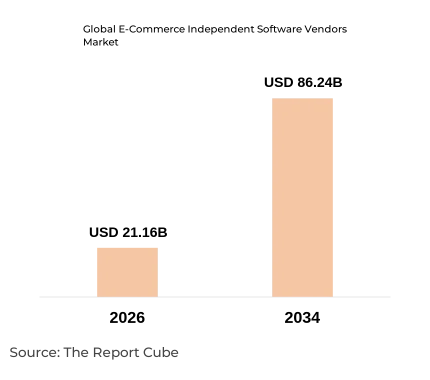
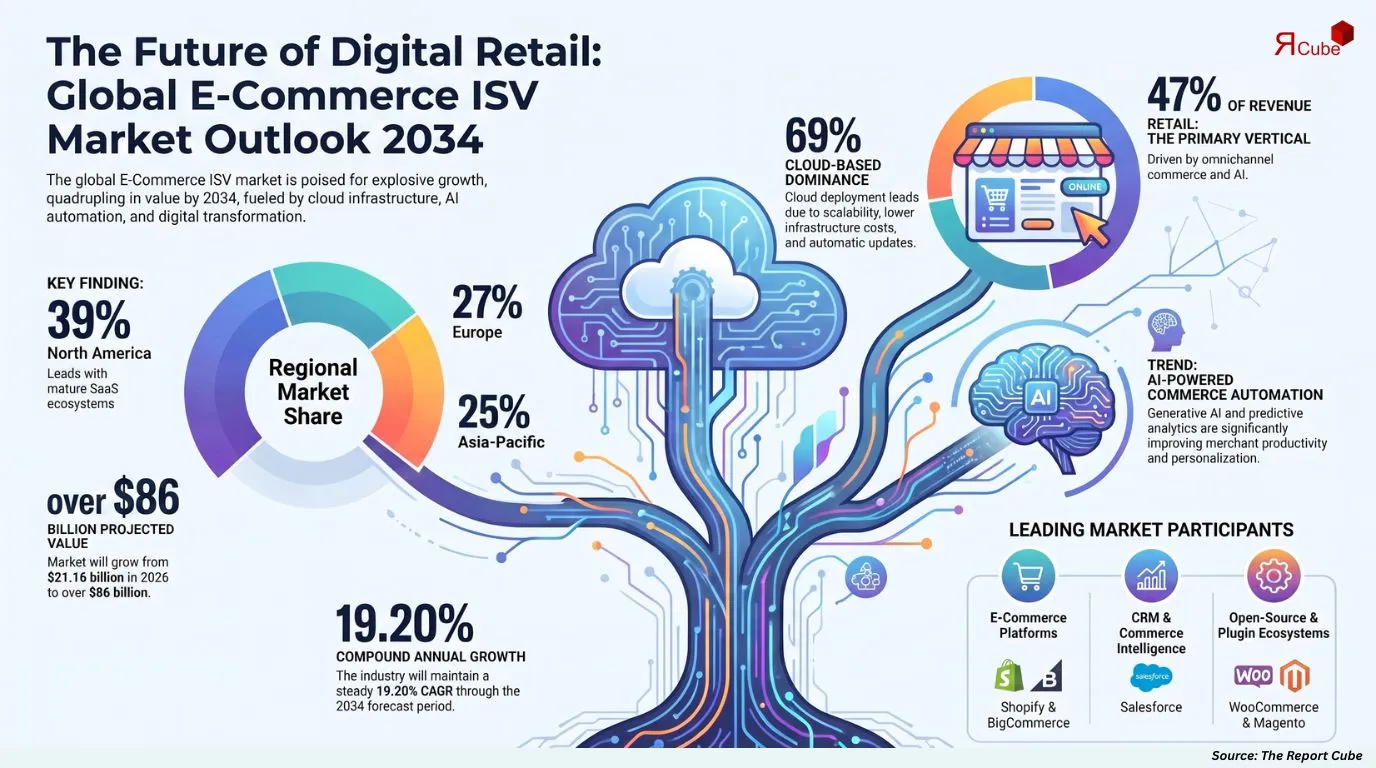
The Global E-Commerce Independent Software Vendors Market is anticipated to register a 19.20% CAGR during 2026-2034. The market size was valued at USD 21.16 billion in 2026 and is projected to reach USD 86.24 billion by 2034. The market is experiencing rapid expansion due to increasing digital commerce adoption, growing demand for scalable online retail platforms, and rising investments in omnichannel commerce solutions. Businesses are increasingly adopting Independent Software Vendor (ISV) platforms to streamline store management, payment processing, inventory control, customer engagement, and digital marketing. Expanding cross-border e-commerce activities continue strengthening global market demand.
Growing investments in cloud infrastructure, digital payment ecosystems, and enterprise software modernization are accelerating ISV platform adoption. Government initiatives promoting digital transformation and SME digitalization, combined with increasing venture funding for commerce technology providers, are encouraging innovation. AI-powered automation, advanced analytics, and intelligent customer engagement technologies are expected to reinforce long-term market expansion throughout the forecast period.
Global E-Commerce Independent Software Vendors Market Dynamics
The global E-Commerce Independent Software Vendors market continues evolving due to rapid cloud adoption, increasing online retail penetration, and growing enterprise demand for integrated commerce solutions. Software vendors are continuously introducing intelligent automation, omnichannel capabilities, and API-driven platforms to improve operational efficiency and customer experiences. These evolving dynamics continue creating substantial growth opportunities across international digital commerce ecosystems.
Growing investments in SaaS infrastructure, payment technologies, cloud-native architectures, and customer analytics are strengthening market development. Technological advancements in artificial intelligence, machine learning, predictive analytics, and low-code development platforms are significantly enhancing software functionality and merchant productivity. These developments are expected to reinforce industry competitiveness and support future market expansion.
|
Factor |
Type |
Specific Impact on Market |
Magnitude |
|---|---|---|---|
|
Digital commerce expansion |
Driver |
Accelerates software platform adoption |
High |
|
SME digital transformation |
Driver |
Increases merchant onboarding |
High |
|
AI-powered commerce automation |
Trend |
Improves operational efficiency |
High |
|
Cybersecurity compliance requirements |
Challenge |
Increases software governance needs |
Medium |
|
Cross-border e-commerce growth |
Opportunity |
Expands global software demand |
High |
Key Market Driver: Expanding Digital Commerce Ecosystem
Rapid expansion of global digital commerce remains the primary driver of the Global E-Commerce Independent Software Vendors Market. Increasing numbers of online merchants, growing mobile commerce adoption, and rising demand for integrated retail management platforms continue accelerating software implementation. ISV solutions simplify store creation, inventory management, order fulfillment, and customer engagement while enabling businesses to scale efficiently across multiple digital channels.
Major Industry Challenge: Managing Data Security Compliance
Managing data privacy, cybersecurity, and regulatory compliance remains a significant challenge for software vendors. E-commerce platforms process sensitive customer information, financial transactions, and business data requiring robust security frameworks. Companies are increasingly investing in advanced encryption, identity management, regulatory compliance tools, and secure cloud architectures to strengthen customer trust and operational resilience.
Emerging Trend Shaping Outlook: AI-Driven Commerce Automation Platforms
AI-driven commerce automation platforms are emerging as a transformative trend shaping the future outlook of the market. Artificial intelligence enables intelligent product recommendations, automated marketing campaigns, predictive inventory management, chatbot support, fraud detection, and dynamic pricing optimization. Integration with generative AI and advanced analytics is significantly improving merchant productivity, customer experiences, and revenue generation across global e-commerce ecosystems.
The market continues benefiting from increasing cloud adoption, enterprise digitalization, and expanding online retail activities. Industry participants are emphasizing innovation, scalability, and platform integration to strengthen competitive positioning. These developments continue supporting long-term market growth. Strategic collaborations among cloud providers, payment companies, software developers, and digital retailers are accelerating platform innovation and commercial adoption. Companies focusing on AI-enabled commerce, API-driven architectures, and omnichannel capabilities are expected to maintain strong competitive advantages throughout the forecast period.
Need Specific Data, Let’s Customize the Report for You
Request CustomizationGlobal E-Commerce Independent Software Vendors Market Segment-wise Analysis
The global E-Commerce Independent Software Vendors market demonstrates diversified segmentation based on deployment models and industry verticals. Rising cloud adoption, enterprise software modernization, and digital commerce expansion continue influencing segment performance. Increasing merchant demand for scalable and intelligent commerce platforms is creating substantial opportunities across multiple software categories.
By Deployment Model
- Cloud-Based
- On-Premises
- Hybrid
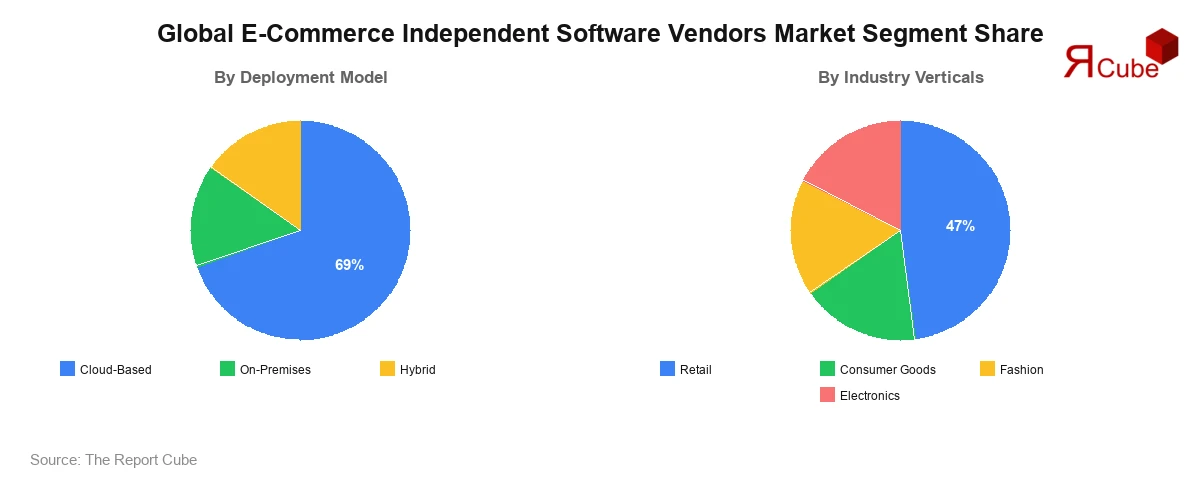
Cloud-Based deployment dominates the market with an estimated market share of approximately 69%. Its leadership is supported by scalability, lower infrastructure requirements, automatic software updates, remote accessibility, and subscription-based pricing. Businesses increasingly prefer cloud-native platforms because they simplify implementation, improve operational flexibility, and enable seamless integration with payment gateways, CRM systems, and third-party applications.
Hybrid deployment continues witnessing steady adoption among large enterprises requiring both cloud flexibility and on-premises control, while On-Premises solutions remain relevant for organizations with specialized compliance and security requirements.
By Industry Verticals
- Retail
- Consumer Goods
- Fashion
- Electronics
The Retail segment accounts for approximately 47% market share, making it the dominant industry vertical within the Global E-Commerce Independent Software Vendors Market. Growth is driven by increasing digital storefront adoption, omnichannel retail expansion, personalized shopping experiences, and integrated inventory management solutions. Retail businesses continue investing heavily in AI-powered commerce platforms to improve operational efficiency and customer engagement. Consumer Goods, Fashion, and Electronics also represent significant industry verticals due to expanding online sales, personalized marketing strategies, and increasing digital transformation across global retail ecosystems.
Regional Projection of Global E-Commerce Independent Software Vendors Market
The regional landscape of the global E-Commerce Independent Software Vendors market reflects differences in digital infrastructure, cloud adoption, enterprise technology investments, and online retail maturity. Demand remains concentrated in technologically advanced economies with strong SaaS ecosystems and high digital commerce penetration. Continued investments in cloud computing and AI technologies are expected to support market growth worldwide.
|
Region |
Estimated Market Share |
Key Growth Factors |
Consumer Trends |
|---|---|---|---|
|
North America |
39% |
Advanced cloud infrastructure and SaaS adoption |
Growing AI-powered commerce platforms |
|
Europe |
27% |
Enterprise digital transformation |
Rising omnichannel retail adoption |
|
Asia-Pacific |
25% |
Expanding e-commerce ecosystem |
Increasing SME digitalization |
|
Rest of the World |
9% |
Improving digital infrastructure |
Growing cloud commerce investments |
- North America
- Europe
- Asia-Pacific
- Rest of the World
North America leads the market with an estimated 39% share due to advanced cloud computing infrastructure, mature SaaS ecosystems, and widespread enterprise digital transformation. The region benefits from strong technology investments, global software vendors, and extensive adoption of AI-powered commerce platforms across retail and consumer industries.
Growing investments in generative AI, cloud-native commerce platforms, and intelligent automation continue reinforcing North America's leadership position. Continuous software innovation and expanding digital commerce ecosystems are expected to sustain regional dominance throughout the forecast period.
Global E-Commerce Independent Software Vendors Market: Recent Development (2025)
- Shopify expanded AI-powered commerce capabilities enhancing merchant automation, customer engagement, and personalized online shopping experiences globally.
- Salesforce introduced advanced commerce intelligence solutions improving omnichannel retail management and predictive customer analytics significantly worldwide.
- BigCommerce strengthened enterprise cloud platform supporting scalable digital commerce infrastructure for multinational retail businesses successfully.
- WooCommerce expanded AI-driven plugin ecosystem improving website customization, payment integration, and merchant productivity across global markets.
Global E-Commerce Independent Software Vendors Market Future Outlook (2034)
The Global E-Commerce Independent Software Vendors Market is expected to reach USD 86.24 billion by 2034 while expanding at a CAGR of 19.20% throughout the forecast period. Rising digital commerce adoption, cloud-based software demand, omnichannel retail strategies, and enterprise digital transformation are expected to create substantial opportunities for software vendors worldwide.
Technological advancements in AI-driven automation, generative AI, predictive analytics, low-code development, cloud-native platforms, and intelligent commerce solutions are expected to significantly improve merchant productivity and customer experiences. Continued investments in SaaS innovation, cybersecurity, and global digital commerce ecosystems will support long-term market expansion through 2034.
Global E-Commerce Independent Software Vendors Market Report Coverage
|
Report Attribute |
Details |
|---|---|
|
Market Name |
Global E-Commerce Independent Software Vendors Market |
|
Market Size (2026) |
USD 21.16 billion |
|
Market Size (2034) |
USD 86.24 billion |
|
Forecast Period |
2026-2034 |
|
CAGR |
19.20% |
|
Customization |
Available Upon Request |
|
Segments Covered |
By Business Size, By Software Type, By Deployment Model, By Industry Verticals |
|
Regions Covered |
North America, Europe, Asia-Pacific, Rest of the World |
|
Key Companies |
Shopify, BigCommerce, Magento, WooCommerce, Salesforce, Square, PrestaShop, OpenCart, Wix, Others |
|
Report Format |
PDF, Excel, PPT |
Why Choose This Report?
- Comprehensive assessment of market size, forecasts, and emerging software opportunities.
- Detailed evaluation of deployment models and industry vertical performance.
- In-depth regional analysis highlighting cloud commerce and SaaS adoption.
- Competitive intelligence covering leading global e-commerce software vendors.
- Insights into AI-powered commerce automation and digital transformation trends.
- Reliable forecasting methodology supporting investment and strategic business planning.
Table of Contents
- Introduction
- Objective of the study
- Product Definition
- Market Segmentation
- Study Variables
- Research Methodology
- Secondary Data Points
- Companies Interviewed
- Primary Data Points
- Breakdown of Primary Interviews
- Secondary Data Points
- Executive Summary
- Market Dynamics
- Drivers
- Challenges
- Opportunity Assessment
- Recent Trends and Developments
- Policy and Regulatory Landscape
- Global E-Commerce Independent Software Vendors Market Overview and Forecast Analysis (2021-2034)
- Market Size, By Value, By growth rate (CAGR/USD Billions)
- Demand - Supply Trends
- Market Share, By Business Size
- Small Enterprises
- Medium Enterprises
- Large Enterprises
- Market Share, By Software Type
- E-Commerce Platforms
- Payment Processing Software
- Inventory Management Software
- Customer Relationship Management Software
- Market Share, By Deployment Model
- Cloud-Based
- On-Premises
- Hybrid
- Market Share, By Industry Verticals
- Retail
- Consumer Goods
- Fashion
- Electronics
- Market Share, By Region
- North America
- Europe
- Asia-Pacific
- Rest of the World
- Market Share, By Competitors
- Competition Characteristics
- Revenue Shares
- Global Small Enterprises E-Commerce Independent Software Vendors Market Overview, 2021-2034F
- By Value (USD Million)
- By Software Type- Market Size & Forecast 2021-2034, USD Million
- By Deployment Model - Market Size & Forecast 2021-2034, USD Million
- By Industry Verticals - Market Size & Forecast 2021-2034, USD Million
- Global Medium Enterprises E-Commerce Independent Software Vendors Market Overview, 2021-2034F
- By Value (USD Million)
- By Software Type- Market Size & Forecast 2021-2034, USD Million
- By Deployment Model - Market Size & Forecast 2021-2034, USD Million
- By Industry Verticals - Market Size & Forecast 2021-2034, USD Million
- Global Large Enterprises E-Commerce Independent Software Vendors Market Overview, 2021-2034F
- By Value (USD Million)
- By Software Type- Market Size & Forecast 2021-2034, USD Million
- By Deployment Model - Market Size & Forecast 2021-2034, USD Million
- By Industry Verticals - Market Size & Forecast 2021-2034, USD Million
- Competitive Outlook (Company Profile - Partial List)
- Shopify
- Company Overview
- Business Segments
- Strategic Alliances/Partnerships
- Recent Developments
- BigCommerce
- Company Overview
- Business Segments
- Strategic Alliances/Partnerships
- Recent Developments
- Magento
- Company Overview
- Business Segments
- Strategic Alliances/Partnerships
- Recent Developments
- WooCommerce
- Company Overview
- Business Segments
- Strategic Alliances/Partnerships
- Recent Developments
- Salesforce
- Company Overview
- Business Segments
- Strategic Alliances/Partnerships
- Recent Developments
- Square
- Company Overview
- Business Segments
- Strategic Alliances/Partnerships
- Recent Developments
- PrestaShop
- Company Overview
- Business Segments
- Strategic Alliances/Partnerships
- Recent Developments
- OpenCart
- Company Overview
- Business Segments
- Strategic Alliances/Partnerships
- Recent Developments
- Wix
- Company Overview
- Business Segments
- Strategic Alliances/Partnerships
- Recent Developments
- Others
- Shopify
- Contact Us & Disclaimer
Top Key Players & Market Share Outlook
- Shopify
- BigCommerce
- Magento
- WooCommerce
- Salesforce
- Square
- PrestaShop
- OpenCart
- Wix
- Others
Frequently Asked Questions






