



Build Your Custom Market Intelligence Report
Customize Your ReportUS Beauty Devices Market Insights & Analysis
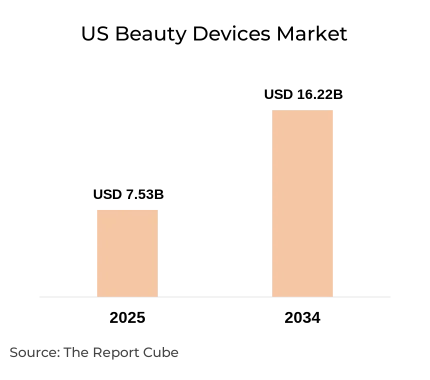
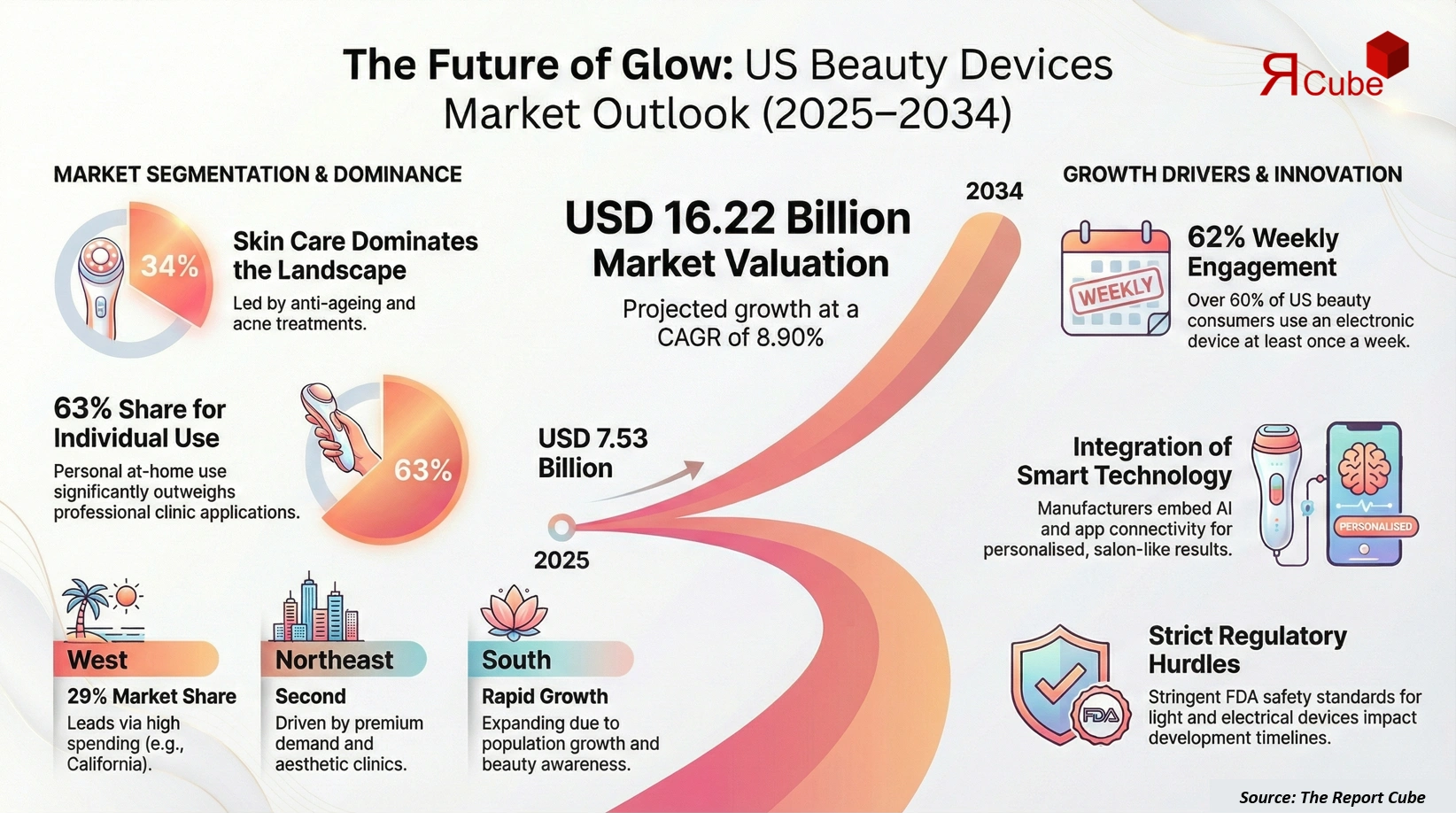
The US Beauty Devices Market is anticipated to register a CAGR of 8.90% during the forecast period 2026-2034. The market size was valued at USD 7.53 billion in 2025 and is projected to reach USD 16.22 billion by 2034. This robust growth reflects the rising consumer focus on personal grooming, skin health, and aesthetic wellness, supported by increasing disposable income and strong beauty consciousness across age groups.
The US market is witnessing a clear shift toward technologically advanced, at-home beauty solutions that offer salon-like results with convenience and cost efficiency. Consumers are increasingly investing in devices that support hair removal, anti-aging, acne treatment, and hair styling, driven by busy lifestyles and the desire for personalized beauty routines. This demand is further reinforced by the influence of social media, beauty influencers, and dermatologist-backed device endorsements.
Moreover, professional beauty clinics and dermatology centers are expanding device adoption to enhance treatment precision and throughput. The convergence of consumer electronics, dermatology, and AI-enabled diagnostics is strengthening product innovation. As a result, manufacturers are focusing on multifunctional devices, ergonomic designs, and safety certifications, positioning the US Beauty Devices Market for sustained expansion throughout the forecast period.
US Beauty Devices Market Recent Developments
- 2025: Dyson Inc. introduced upgraded intelligent hair styling devices with real-time heat control for reduced hair damage.
- 2025: L’Oréal USA expanded its personalized skin diagnostic beauty device portfolio for at-home skincare routines.
Government Initiatives & Policies
- FDA Medical Device Oversight Program: Regulates safety and efficacy standards for cosmetic and dermatology devices.
- FTC Consumer Product Safety Guidelines: Ensures transparent marketing and consumer protection in beauty electronics.
US Beauty Devices Market Dynamics
Key Driver: Rising Consumer Demand for At-Home Beauty and Grooming Solutions
The primary driver of the US Beauty Devices Market is the growing consumer preference for at-home beauty and grooming solutions. Busy lifestyles, rising salon service costs, and increased awareness of personal aesthetics have encouraged consumers to invest in devices that deliver professional-grade results at home. Hair removal and skin care devices, in particular, are experiencing strong demand due to their long-term cost benefits and convenience. In 2024, over 62% of US beauty consumers reported using at least one electronic beauty device weekly. This behavioral shift is further supported by product innovation focused on ease of use, safety features, and compact designs, making beauty devices accessible to a broader demographic.
Book your FREE 30-minute expert consultation today
Contact UsIndustry Trends: Integration of Smart Technology and Multi-Use Functionality
An important trend shaping the market is the integration of smart technology and multi-use functionality within beauty devices. Manufacturers are embedding sensors, AI-driven skin analysis, and app connectivity to offer personalized treatment recommendations. Multi-use devices that combine hair care, skin rejuvenation, and cleansing functions are gaining popularity, as consumers seek value-driven purchases. Additionally, sustainability-focused designs, rechargeable batteries, and dermatologically tested materials are influencing buying decisions. Professional users are also adopting advanced devices that improve treatment accuracy and reduce procedure time. These trends are collectively redefining product differentiation and strengthening brand loyalty in the competitive US market.
Major Challenge: Regulatory Compliance and Product Safety Concerns
Regulatory compliance and safety assurance remain key challenges for the US Beauty Devices Market. Devices that emit light, heat, or electrical impulses must meet stringent FDA and consumer safety standards, which can extend product development timelines and increase costs. Any adverse consumer incidents can quickly damage brand reputation in a highly visible digital marketplace. Additionally, counterfeit and low-quality imports pose safety risks and intensify price competition. Manufacturers must therefore invest heavily in testing, certifications, and consumer education, which can limit profitability for smaller players while creating barriers to entry.
Opportunity: Expansion of Professional Aesthetic and Dermatology Services
The expansion of professional aesthetic and dermatology services presents a significant opportunity for the market. Medical spas, dermatology clinics, and beauty salons are increasingly adopting advanced devices for hair removal, skin tightening, and rejuvenation procedures. The professional use segment benefits from recurring equipment upgrades and service contracts, providing stable revenue streams for manufacturers. As non-invasive cosmetic procedures gain popularity in the US, demand for high-performance beauty devices is expected to rise steadily. This professional expansion complements consumer demand, creating a balanced growth ecosystem across applications.
US Beauty Devices Market Segment-wise Analysis
By Product Segment:
- Hair Removal
- Hair Care
- Skin Care
- Multi-Use Devices
- Other Devices
The Skin Care segment leads the market, accounting for approximately 34% of total market share in 2025. This dominance is driven by high demand for anti-aging, acne treatment, and facial cleansing devices. Consumers increasingly prioritize skin health, fueling repeat purchases and upgrades. Hair Removal follows closely, supported by long-term cost savings compared to salon treatments. Multi-Use Devices are the fastest-growing sub-segment, benefiting from consumer preference for multifunctionality and space-efficient products. Together, these segments reflect a shift toward holistic and technology-enabled beauty routines.
By Application:
- Individual Use
- Professional Use
Individual Use dominates the market with nearly 63% share, driven by strong retail penetration and e-commerce availability. At-home beauty routines have become mainstream, particularly among millennials and Gen Z consumers. Professional Use, while smaller in share, is growing steadily due to increased demand for non-invasive cosmetic procedures in clinics and salons. This segment benefits from higher device prices and long-term service contracts, contributing significantly to overall market value despite lower unit volumes.
Regional Projection of US Beauty Devices Industry
- South
- West
- Midwest
- Northeast
The West region leads the US Beauty Devices Market, holding approximately 29% market share. This leadership is supported by high consumer spending on personal care, strong presence of beauty brands, and widespread adoption of innovative products in states such as California. The Northeast follows, driven by premium skincare demand and professional aesthetic clinics. The South is emerging rapidly due to population growth and increasing beauty awareness, while the Midwest shows steady adoption supported by expanding retail distribution. Regional diversity ensures balanced market expansion across the country.
Need insights for a specific region within this market?
Request Regional DataWhy Choose This Report?
- Provides a comprehensive overview of the overall market analysis, encompassing key trends, consumer behavior analysis, and risk assessment to support strategic decision-making.
- Provides accurate, up-to-date insights into market size, segmentation, and emerging opportunities, helping to minimize risk & capitalizing on growth.
- Gives deep understanding of target audience preferences, investment habits, and communication channels for enhanced product development & marketing effectiveness.
- Delivers competitive analysis & benchmarking, uncovering the strengths & weaknesses of market competitors to guide strategies.
- Consolidate comprehensive market intelligence, reducing reasoning & streamlining research efforts.
- Facilitates customized market segmentation & risk mitigation strategies, fine-tuned to the business objectives.
- Aids in identifying both market challenges & untapped opportunities within the industry to drive long-term business growth.
- Provides valuable information based on actual customer data & search trends.
Table of Contents
- Introduction
- Objective of the Study
- Product and Category Definition
- Market Segmentation
- Study Variables
- Research Methodology
- Secondary Data Points
- Breakdown of Secondary Sources
- Primary Data Points
- Breakdown of Primary Interviews
- Secondary Data Points
- Executive Summary
- Market Dynamics
- Drivers
- Challenges
- Opportunity Assessment
- Recent Trends and Developments
- Regulatory and Policy Landscape
- U.S. Beauty Devices Market Overview (2021-2034)
- Market Size, By Value (USD Billion)
- Market Share, By Product Segment
- Hair Removal
- Hair Care
- Skin Care
- Multi‑Use Devices
- Other Devices
- Market Share, By Application
- Individual Use
- Professional Use
- Market Share, By Price Tier
- High Price
- Mid Price
- Low Price
- Market Share, By Sales Channel
- Exclusive Stores
- Hypermarkets
- Multi‑Brand Stores
- Online Retail
- Other Channels
- Market Share, By Region
- South
- West
- Midwest
- Northeast
- Market Share, By Company
- Revenue Shares & Analysis
- Competition Characteristics
- South U.S. Beauty Devices Market
- Market Size, By Value (USD Billion)
- Market Share, By Product Segment
- Market Share, By Application
- Market Share, By Price Tier
- Market Share, By Sales Channel
- West U.S. Beauty Devices Market
- Market Size, By Value (USD Billion)
- Market Share, By Product Segment
- Market Share, By Application
- Market Share, By Price Tier
- Market Share, By Sales Channel
- Midwest U.S. Beauty Devices Market
- Market Size, By Value (USD Billion)
- Market Share, By Product Segment
- Market Share, By Application
- Market Share, By Price Tier
- Market Share, By Sales Channel
- Northeast U.S. Beauty Devices Market
- Market Size, By Value (USD Billion)
- Market Share, By Product Segment
- Market Share, By Application
- Market Share, By Price Tier
- Market Share, By Sales Channel
- Competitive Outlook and Company Profiles
- Panasonic North America
- Company Overview
- Product Portfolio
- Strategic Alliances/Partnerships
- Recent Developments
- Procter & Gamble
- Company Overview
- Product Portfolio
- Strategic Alliances/Partnerships
- Recent Developments
- Dyson Inc.
- Company Overview
- Product Portfolio
- Strategic Alliances/Partnerships
- Recent Developments
- Spectrum Brands
- Company Overview
- Product Portfolio
- Strategic Alliances/Partnerships
- Recent Developments
- Conair LLC
- Company Overview
- Product Portfolio
- Strategic Alliances/Partnerships
- Recent Developments
- Beurer North America
- Company Overview
- Product Portfolio
- Strategic Alliances/Partnerships
- Recent Developments
- L'Oréal USA
- Company Overview
- Product Portfolio
- Strategic Alliances/Partnerships
- Recent Developments
- Groupe SEB USA
- Company Overview
- Product Portfolio
- Strategic Alliances/Partnerships
- Recent Developments
- Philips North America
- Company Overview
- Product Portfolio
- Strategic Alliances/Partnerships
- Recent Developments
- TRIA Beauty
- Company Overview
- Product Portfolio
- Strategic Alliances/Partnerships
- Recent Developments
- Others
- Panasonic North America
- Contact Us and Disclaimer
Top Key Players & Market Share Outlook
- Panasonic North America
- Procter & Gamble
- Dyson Inc.
- Spectrum Brands
- Conair LLC
- Beurer North America
- L'Oréal USA
- Groupe SEB USA
- Philips North America
- TRIA Beauty
- Others
Frequently Asked Questions






