

Build Your Custom Market Intelligence Report
Customize Your ReportKey Takeaways
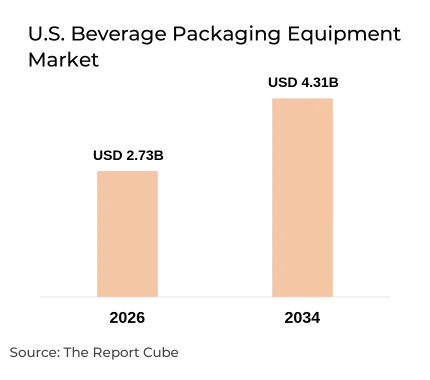
- U.S. Beverage Packaging Equipment Market is valued at USD 2.73 billion in 2026.
- The market is projected to reach USD 4.31 billion by 2034 at a CAGR of 5.88%.
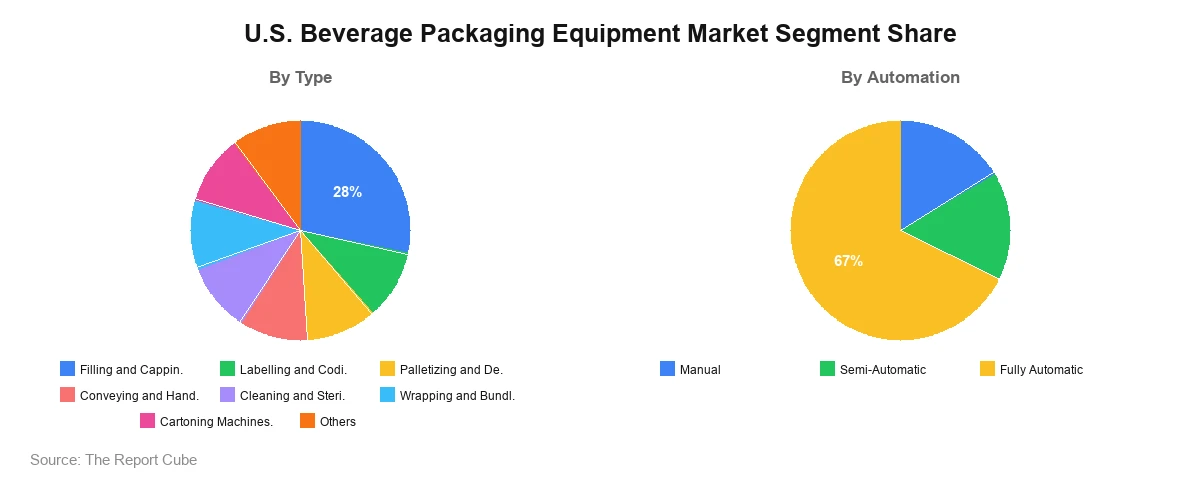
- Filling and capping machines lead the type segment with an estimated 28% share in 2026.
- Fully automatic equipment dominates the automation segment with an estimated 67% share in 2026.
- North leads regional demand with an estimated 30% share in 2026.
- Barry-Wehmiller, Syntegon, KHS Group, GEA Group and Coesia are among the key players.
- Flexible, modular automation and smart manufacturing technologies are shaping equipment investment decisions.
Market Overview
Beverage packaging equipment includes machinery used to fill, cap, label, code, convey, sterilize, wrap, bundle, carton, and palletize beverage containers. Producers of bottled water, dairy beverages, alcoholic beverages, and other drinks use these systems to maintain product quality, packaging consistency, and production speed across bottles, cans, cartons, and multipack formats.
The U.S. Beverage Packaging Equipment Market Analysis reflects demand linked to beverage production, automation, and format variety. The U.S. Bureau of Labor Statistics projects beverage manufacturing employment to rise from 333,000 in 2024 to 370,800 in 2034, an industry indicator rather than a direct measure of equipment sales. PMMI also identifies SKU proliferation and flexibility as investment influences.
Beverage producers purchase packaging equipment to raise throughput, manage frequent changeovers, and support varied container formats. Flexible automation, inspection technologies, and equipment compatible with recyclable materials are shaping investment priorities. The market is projected to grow at a CAGR of 5.88% during 2026–2034, from USD 2.73 billion in 2026 to USD 4.31 billion in 2034.
U.S. Beverage Packaging Equipment Market Dynamics
The U.S. beverage packaging equipment market is influenced by beverage manufacturing output, automation investment, product variety, packaging requirements, and production efficiency. Manufacturers balance high-speed operations with food-contact safety, product quality, and changing packaging formats, while labor availability and technology adoption affect equipment investment decisions across beverage production facilities.
|
Factor |
Type |
Specific Impact on Market |
Magnitude |
|---|---|---|---|
|
Planned machinery investment by beverage producers |
Driver |
Supports demand for filling, capping, labeling, conveying, and palletizing equipment |
High |
|
Automation adoption |
Driver |
Raises demand for automated filling, packing, palletizing, and inspection systems |
High |
|
Recyclable packaging-compatible machinery |
Opportunity |
Creates demand for equipment handling varied materials and container formats |
Medium–High |
|
High capital and integration costs |
Challenge |
Slows upgrades and complicates multi-supplier line integration |
Medium–High |
|
Food-contact compliance |
Challenge |
Requires careful material and component selection |
Medium |
|
Flexible and modular automation |
Trend |
Supports frequent changeovers and SKU variety |
High |
U.S. Beverage Packaging Equipment Market Growth Drivers
The U.S. Beverage Packaging Equipment Market Growth outlook is supported by planned machinery investment among producers. PMMI’s 2025 beverage packaging trends research reports that 68% of beverage companies expect moderate to significant increases in packaging machinery investment over the next two to three years, with nearly 90% planning equipment purchases.
Automation adoption adds a second driver. The U.S. Bureau of Labor Statistics reports that technology adoption is expected to lift food and beverage manufacturing output, including through automated filling, packing, and palletizing equipment. Beverage producers use these systems to improve efficiency and support output growth, which reinforces demand for fully automatic lines.
U.S. Beverage Packaging Equipment Market Opportunities
Equipment manufacturers can expand integrated lines that combine filling, capping, labeling, conveying, and palletizing. The U.S. Bureau of Labor Statistics identifies automated filling, packing, and palletizing as technologies contributing to higher food and beverage manufacturing output, which supports opportunities for high-speed, fully automatic systems among bottled water, dairy, and alcoholic beverage producers.
Sustainable packaging presents a further opening. Manufacturers can develop machinery that handles different materials and formats, including recyclable beverage containers. The U.S. EPA provides guidance on recycling common packaging materials, including plastic bottles and caps, which reinforces the importance of packaging design and material compatibility when beverage producers select filling, capping, and handling equipment.
U.S. Beverage Packaging Equipment Industry Challenges
High capital requirements limit upgrade speed. Advanced packaging lines can require substantial investment in machinery, installation, control systems, maintenance, and workforce training. Integrating equipment from different suppliers adds technical and operational complexity, which can extend project timelines and complicate investment decisions for beverage producers evaluating higher-automation systems and line replacement schedules.
Food-contact safety and regulatory requirements add compliance considerations. The FDA regulates food-contact substances, including materials used in packaging and processing equipment. Manufacturers must evaluate applicable authorizations and compliance requirements when selecting materials and machinery components, and current requirements for specific equipment configurations require confirmation before procurement or final design decisions.
Need Specific Data, Let’s Customize the Report for You
Request CustomizationU.S. Beverage Packaging Equipment Market Trends
Among the U.S. Beverage Packaging Equipment Market Trends, flexible and modular automation is gaining relevance. Beverage manufacturers increasingly need machinery that handles more product variations, package formats, and frequent changeovers. PMMI’s 2026 industry report identifies flexibility, SKU proliferation, automation, and emerging AI applications as important influences on packaging machinery investment.
Smart manufacturing technologies are becoming more relevant to beverage production. The U.S. Bureau of Labor Statistics identifies sensor technology and AI applications as tools that support quality monitoring, process accuracy, and production efficiency in food and beverage manufacturing, pointing toward greater use of automated inspection, production monitoring, and data-driven controls on packaging lines.
U.S. Beverage Packaging Equipment Market Segment Analysis
The U.S. Beverage Packaging Equipment Market is segmented by type, automation level, and application, each reflecting different production scales, container formats, and investment requirements. Shares shown for 2026 are supplied estimates and apply only to the leading segment in each category.
By Type
- Filling and Capping Machines
- Labelling and Coding Machines
- Palletizing and Depalletizing Machines
- Conveying and Handling Machines
- Cleaning and Sterilizing Machines
- Wrapping and Bundling Machines
- Cartoning Machines
- Others
Filling and capping machines hold the leading position in U.S. Beverage Packaging Equipment Market Share by type, with an estimated 28% share in 2026, reflecting their central role in every beverage line and their direct link to production volume, container variety, and product protection. KHS Group supplies filling and packaging systems for beverage producers. Labelling and coding machines support product identification, while palletizing and depalletizing machines and conveying and handling machines connect individual stations into continuous lines. Cleaning and sterilizing machines address hygiene requirements, particularly where food-contact surfaces are involved. Wrapping and bundling machines support multipack formats, and cartoning machines serve secondary packaging needs, with Syntegon Technology and Mpac Group active in cartoning and end-of-line solutions. The others category covers remaining specialized equipment. Demand across these segments is driven by automation investment, SKU variety, and frequent changeovers, while segment-level growth rankings require validation.
By Automation
- Manual
- Semi-Automatic
- Fully Automatic
Fully automatic equipment leads the automation segment with an estimated 67% share in 2026, driven by high-speed beverage production, labor availability constraints, and the need for consistent output across filling, capping, labeling, and palletizing operations. The U.S. Bureau of Labor Statistics links technology adoption with higher food and beverage manufacturing output through automated filling, packing, and palletizing equipment. Semi-automatic systems follow as an intermediate option for producers that require some operator involvement or have lower volume requirements, while manual equipment is generally associated with small-scale operations, specialty production, and limited capital budgets. Integration complexity, upfront costs, and changeover flexibility influence how producers move between these automation levels.
Regional Analysis
|
Region |
Estimated Market Share |
Key Growth Factors |
Industry Trends |
|---|---|---|---|
|
North |
30% |
Leading region in supplied estimate; beverage production activity and line replacement (drivers require validation) |
Emphasis on throughput, reliability, and integrated automated lines |
|
West |
- |
Qualitative: diverse beverage categories and varied package formats |
Demand for flexible equipment and technical support |
|
Southwest |
- |
Qualitative: regional beverage production and distribution needs |
Demand for flexible, dependable equipment |
|
Midwest |
- |
Equipment manufacturing presence, including KHS USA in Wisconsin |
Emphasis on local supply and service access |
North is the leading region with an estimated 30% share in 2026, based on supplied data. Regional demand reflects beverage production activity, automation investment, and replacement of packaging lines, although detailed state-level drivers require validation. Producers in the region typically prioritize throughput, reliability, and integration across filling, labeling, conveying, and palletizing equipment.
West, Southwest, and Midwest account for the remaining 70% of the market, though individual shares have not been supplied. The Midwest hosts equipment manufacturing operations, including KHS USA in Wisconsin, which supports local equipment supply. West and Southwest demand is linked to diverse beverage categories and varied package formats, requiring flexible equipment and responsive technical support.
Market Share & Competitive Landscape
The market includes global packaging machinery groups, processing technology providers, and specialized equipment suppliers. The table summarizes supplied companies by general capability and does not represent numerical market share. Product-level capabilities marked for validation should be confirmed before publication.
|
Company |
Competitive Strength |
Primary Segment Served |
|---|---|---|
|
Barry-Wehmiller Companies |
St. Louis-based capital equipment group with multiple packaging businesses |
Integrated packaging lines |
|
Syntegon Technology GmbH |
Processing and packaging technology, including cartoning and carton closing |
Cartoning machines |
|
Bradman Lake Group Ltd. |
Wrapping, cartoning, and end-of-line packaging machinery (validation required) |
Wrapping and cartoning |
|
Coesia S.p.A. |
Packaging and industrial automation solutions |
Automated packaging systems |
|
Clearpack |
Packaging equipment supply (product-level capabilities require validation) |
Packaging machinery |
|
EconoCorp Inc. |
Packaging equipment supply (product-level capabilities require validation) |
Packaging machinery |
|
GEA Group |
Processing technology for food, dairy, and beverage production |
Dairy beverage processing |
|
Jacob White Packaging Ltd. |
Packaging machinery (product-level capabilities require validation) |
Packaging machinery |
|
KHS Group |
Filling and packaging systems for beverage, food, and non-food industries |
Filling and capping machines |
|
Mpac Group plc |
High-speed packaging and automation, including cartoning and end-of-line solutions |
Cartoning and end-of-line |
Key Companies in the U.S. Beverage Packaging Equipment Market
KHS Group: KHS Group is headquartered in Dortmund, Germany, and supplies filling and packaging systems for beverage, food, and non-food industries. Its U.S. subsidiary, KHS USA, dates to 1971 and operates in Wisconsin and Florida. Ferrum Packaging and KHS announced the acquisition of H.F. Meyer in November 2024, strengthening can-line capabilities.
Syntegon Technology GmbH: Syntegon Technology is headquartered in Waiblingen, Germany, and provides processing and packaging technology, with cartoning among its packaging strengths. Its U.S. operations include a New Richmond, Wisconsin site, and the company launched an advanced carton closer at PACK EXPO Southeast 2025, supporting secondary packaging requirements.
Recent Developments
|
Year / Month |
Company |
Development |
|---|---|---|
|
March 2025 |
PMMI |
Published 2025 Beverage Industry Packaging Trends, reporting that 68% of beverage companies anticipate moderate to significant machinery investment increases |
|
2025 |
Syntegon |
Launched an advanced carton closer at PACK EXPO Southeast 2025 |
|
April 2026 |
PMMI and FPSA |
Published the 2026 Processing State of the Industry Report covering U.S. food and beverage processing machinery |
U.S. Beverage Packaging Equipment Market Future Outlook
The U.S. Beverage Packaging Equipment Market Forecast indicates growth from USD 2.73 billion in 2026 to USD 4.31 billion in 2034 at a CAGR of 5.88%, based on supplied estimates. Expansion is expected to depend on beverage production activity, automation investment, packaging format variety, and replacement of older lines, with fully automatic systems and filling and capping equipment anchoring demand.
Technology investment is likely to center on flexible and modular lines, automated inspection, production monitoring, and machinery compatible with recyclable packaging materials. Risks include high capital and integration costs, food-contact compliance requirements, labor availability, and uncertain demand across beverage categories. The projections remain supplied assumptions rather than guaranteed outcomes, and results will depend on supplier execution, regulation, and producer capital spending.
U.S. Beverage Packaging Equipment Market Report Coverage
This U.S. Beverage Packaging Equipment Market Report summarizes the supplied valuation, forecast assumptions, segmentation, regional framework, and competitive ecosystem.
|
Parameter |
Details |
|---|---|
|
Market Name |
U.S. Beverage Packaging Equipment Market |
|
Market Size 2026 |
USD 2.73 billion |
|
Market Size 2034 |
USD 4.31 billion |
|
Forecast Period |
2026–2034 |
|
CAGR |
5.88% |
|
Base Year |
2026 |
|
Historical Years |
2021-2034 |
|
Forecast Years |
2026–2034 |
|
Segments Covered |
By Type; By Automation; By Application |
|
Regions Covered |
West, Southwest, North, Midwest |
|
Key Companies |
Barry-Wehmiller Companies, Syntegon Technology GmbH, Bradman Lake Group Ltd., Coesia S.p.A., Clearpack, EconoCorp Inc., GEA Group, Jacob White Packaging Ltd., KHS Group, Mpac Group plc |
|
Customization |
Available as per client requirements |
Why Choose This U.S. Beverage Packaging Equipment Market Report?
- Coverage of beverage packaging machinery across filling, labeling, handling, cartoning, and end-of-line equipment.
- Clear presentation of the supplied 2026 valuation, 2034 forecast, and 5.88% CAGR.
- Segmentation across eight equipment types, three automation levels, and four applications.
- Regional framework covering West, Southwest, North, and Midwest.
- Competitive profiling of ten supplied packaging and processing equipment companies.
- Trend insights on flexible automation, smart manufacturing, and recyclable packaging compatibility.
- Context on food-contact compliance and recycling guidance relevant to equipment investment planning.
Table of Contents
- Introduction
- Objective of the Study
- Product Definition
- Market Segmentation
- Study Variables
- Research Methodology
- Secondary Data Points
- Companies Interviewed
- Primary Data Points
- Breakdown of Primary Interviews
- Secondary Data Points
- Executive Summary
- Market Dynamics
- Drivers
- Challenges
- Opportunity Assessment
- Recent Trends and Developments
- Policy and Regulatory Landscape
- U.S. Beverage Packaging Equipment Market Overview and Forecast Analysis (2021-2034)
- Market Size, By Value, By Growth Rate (CAGR/USD Billions)
- Demand – Supply Trends
- Market Share, By Type
- Filling and Capping Machines
- Labelling and Coding Machines
- Palletizing and Depalletizing Machines
- Conveying and Handling Machines
- Cleaning and Sterilizing Machines
- Wrapping and Bundling Machines
- Cartoning Machines
- Others
- Market Share, By Automation
- Manual
- Semi-Automatic
- Fully Automatic
- Market Share, By Application
- Bottled Water
- Dairy Beverage
- Alcoholic Beverages
- Others
- Market Share, By Region
- West
- Southwest
- North
- Midwest
- Market Share, By Competitors
- Competition Characteristics
- Revenue Shares
- Filling and Capping Machines U.S. Beverage Packaging Equipment Market Overview, 2021-2034F
- By Value (USD Million)
- By Automation – Market Size & Forecast 2021-2034, USD Million
- Manual
- Semi-Automatic
- Fully Automatic
- Labelling and Coding Machines U.S. Beverage Packaging Equipment Market Overview, 2021-2034F
- By Value (USD Million)
- By Automation – Market Size & Forecast 2021-2034, USD Million
- Manual
- Semi-Automatic
- Fully Automatic
- Palletizing and Depalletizing Machines U.S. Beverage Packaging Equipment Market Overview, 2021-2034F
- By Value (USD Million)
- By Automation – Market Size & Forecast 2021-2034, USD Million
- Manual
- Semi-Automatic
- Fully Automatic
- Conveying and Handling Machines U.S. Beverage Packaging Equipment Market Overview, 2021-2034F
- By Value (USD Million)
- By Automation – Market Size & Forecast 2021-2034, USD Million
- Manual
- Semi-Automatic
- Fully Automatic
- Cleaning and Sterilizing Machines U.S. Beverage Packaging Equipment Market Overview, 2021-2034F
- By Value (USD Million)
- By Automation – Market Size & Forecast 2021-2034, USD Million
- Manual
- Semi-Automatic
- Fully Automatic
- Wrapping and Bundling Machines U.S. Beverage Packaging Equipment Market Overview, 2021-2034F
- By Value (USD Million)
- By Automation – Market Size & Forecast 2021-2034, USD Million
- Manual
- Semi-Automatic
- Fully Automatic
- Cartoning Machines U.S. Beverage Packaging Equipment Market Overview, 2021-2034F
- By Value (USD Million)
- By Automation – Market Size & Forecast 2021-2034, USD Million
- Manual
- Semi-Automatic
- Fully Automatic
- Others U.S. Beverage Packaging Equipment Market Overview, 2021-2034F
- By Value (USD Million)
- By Automation – Market Size & Forecast 2021-2034, USD Million
- Manual
- Semi-Automatic
- Fully Automatic
- Competitive Outlook (Company Profile – Partial List)
- Barry-Wehmiller Companies
- Company Overview
- Business Segments
- Strategic Alliances/Partnerships
- Recent Developments
- Syntegon Technology GmbH
- Company Overview
- Business Segments
- Strategic Alliances/Partnerships
- Recent Developments
- Bradman Lake Group Ltd.
- Company Overview
- Business Segments
- Strategic Alliances/Partnerships
- Recent Developments
- Coesia S.p.A.
- Company Overview
- Business Segments
- Strategic Alliances/Partnerships
- Recent Developments
- Clearpack
- Company Overview
- Business Segments
- Strategic Alliances/Partnerships
- Recent Developments
- EconoCorp Inc.
- Company Overview
- Business Segments
- Strategic Alliances/Partnerships
- Recent Developments
- GEA Group
- Company Overview
- Business Segments
- Strategic Alliances/Partnerships
- Recent Developments
- Jacob White Packaging Ltd.
- Company Overview
- Business Segments
- Strategic Alliances/Partnerships
- Recent Developments
- KHS Group
- Company Overview
- Business Segments
- Strategic Alliances/Partnerships
- Recent Developments
- Mpac Group plc
- Company Overview
- Business Segments
- Strategic Alliances/Partnerships
- Recent Developments
- Barry-Wehmiller Companies
- Contact Us & Disclaimer
Top Key Players & Market Share Outlook
- Barry-Wehmiller Companies
- Syntegon Technology GmbH
- Bradman Lake Group Ltd.
- Coesia S.p.A.
- Clearpack
- EconoCorp Inc.
- GEA Group
- Jacob White Packaging Ltd.
- KHS Group
- Mpac Group plc
Frequently Asked Questions