



Build Your Custom Market Intelligence Report
Customize Your ReportUnited States Natural Caffeine Market Key Highlights
By Type:
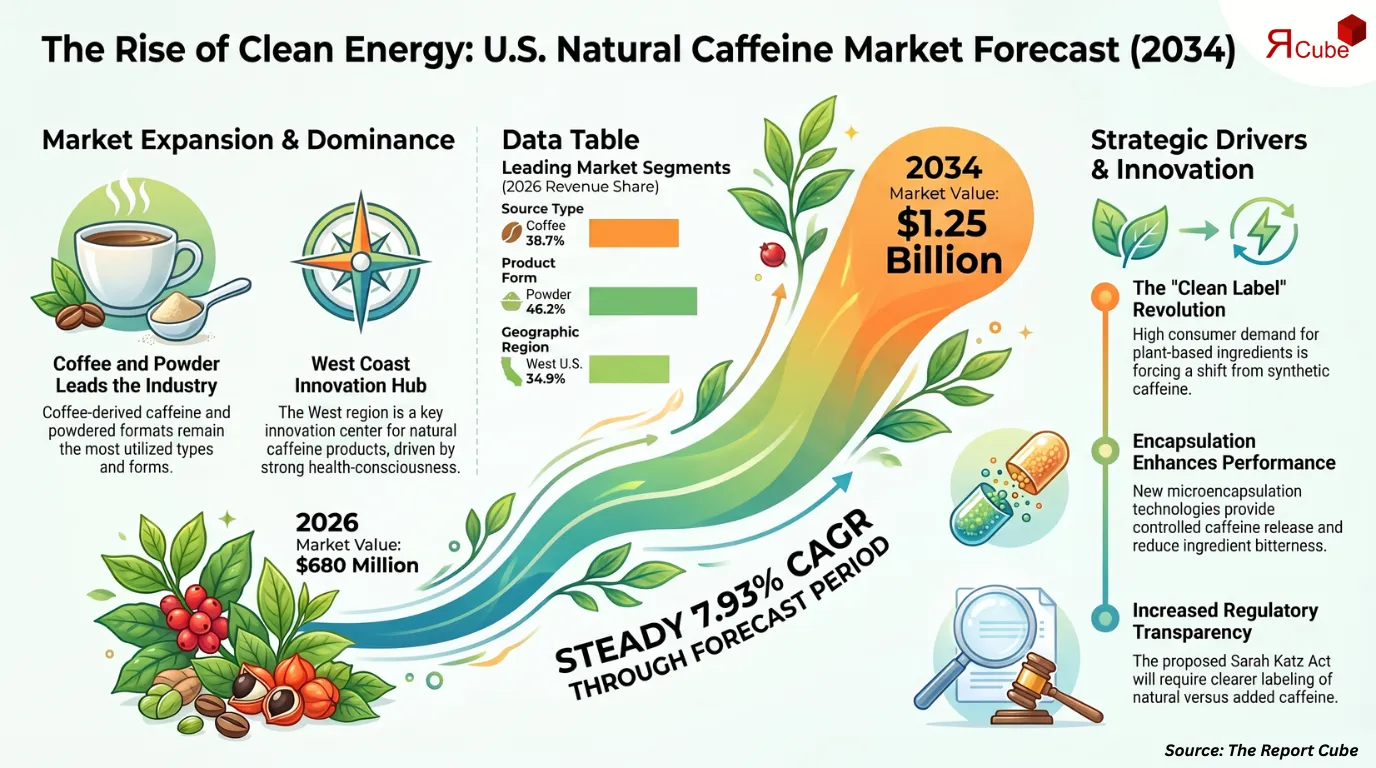
Coffee segment leads the market with approximately 38.7% share.
By Form:
Powder segment dominates the market with nearly 46.2% of total revenue.
Regional Outlook:
The West region dominates the US Natural Caffeine Market with around 34.9% market share.
United States Natural Caffeine Market Insights & Analysis
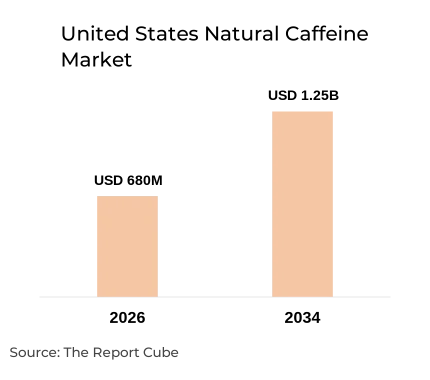
The United States Natural Caffeine Market is anticipated to register a CAGR of around 7.93% during the forecast period 2026-2034. The market size is valued at USD 680 million in 2026 and is projected to reach USD 1,252.12 million by 2034. Market growth is primarily driven by rising consumer preference for naturally sourced ingredients across beverages, dietary supplements, pharmaceutical formulations, and sports nutrition products. Consumers are increasingly shifting toward clean-label products that avoid synthetic additives while offering functional health benefits. This trend has encouraged ingredient manufacturers to expand production capacities for naturally extracted caffeine from coffee beans, tea leaves, guarana, yerba mate, cocoa, and kola nut. Growing investments in premium ready-to-drink beverages, energy drinks, and nutritional supplements continue to strengthen demand for high-quality botanical caffeine ingredients across the United States.
Innovation remains one of the strongest contributors to market expansion as manufacturers introduce microencapsulated caffeine, sustained-release formulations, and organic-certified ingredients designed to improve product stability and consumer experience. Food and beverage companies are increasingly partnering with botanical ingredient suppliers to develop functional beverages that combine natural caffeine with vitamins, adaptogens, and plant extracts. Regulatory attention toward transparent ingredient disclosure is also encouraging manufacturers to improve labeling practices and product traceability. The proposed Sarah Katz Caffeine Safety Act reflects the growing focus on consumer safety through clearer caffeine labeling, including disclosure of natural versus added caffeine sources. These developments are expected to strengthen consumer confidence while supporting long-term growth opportunities throughout the United States natural caffeine industry.
US Natural Caffeine Market Impact Analysis
| Factor | Type | Specific Impact on Market | Magnitude | Business Implication |
|---|---|---|---|---|
| Shift Toward Clean Label Beverages | Consumer | Brands replace synthetic caffeine with natural plant sources | High | Supports premium pricing and brand differentiation by origin |
| Growth in Functional Drinks and Shots | Market | Energy drinks and shots increase demand for natural caffeine | High | Drives higher volumes for powder and extract based suppliers |
| Regulatory Scrutiny on Stimulant Levels | Regulatory | Labeling rules constrain maximum caffeine per serving size | Medium | Requires precise dosing and compliance focused formulation |
| Expansion of Sports and Fitness Nutrition | Market | Pre workout and sports products adopt natural caffeine bases | Medium | Creates cross selling potential into sports supplement brands |
| Health Concern Over Excess Intake | Environmental | Medical guidance encourages moderate and controlled consumption | Medium | Promotes portion controlled formats and balanced formulations |
| Volatile Supply of Botanical Inputs | Environmental | Crop yield swings affect cost of coffee and tea derived inputs | High | Necessitates diversified sourcing and long term supply contracts |
| Competition from Synthetic Caffeine | Competitive | Low cost synthetic options pressure prices in mass products | Medium | Pushes focus toward premium niches and value added formats |
United States Natural Caffeine Market Dynamics
Key Driver: Strong Consumer Preference for Naturally Sourced Functional Ingredients
Purchasing behavior across the United States continues to favor products formulated with recognizable plant-derived ingredients, encouraging manufacturers to increase the use of natural caffeine across multiple product categories. Coffee-derived caffeine remains the preferred source due to its consistent quality, while extracts from green tea, guarana, and yerba mate continue to gain commercial acceptance in premium formulations. Beverage manufacturers are introducing clean-label energy drinks, sparkling beverages, protein shakes, hydration products, and wellness shots that emphasize naturally sourced stimulants. This transition is strengthening demand throughout the natural caffeine value chain while encouraging suppliers to improve extraction efficiency and ingredient traceability.
Demand is also expanding beyond conventional energy beverages. Sports nutrition brands, healthy aging companies, and cognitive wellness manufacturers increasingly combine natural caffeine with amino acids, botanical extracts, electrolytes, vitamins, and adaptogens to develop multifunctional products. These formulations address consumer interest in sustained energy, mental focus, and physical performance while supporting long-term market expansion across retail and commercial channels.
Industry Trends: Sustainable Extraction Technologies and Premium Botanical Ingredients
Manufacturers are investing in environmentally responsible extraction methods that improve ingredient purity while reducing solvent usage and minimizing environmental impact. Advanced purification systems allow producers to deliver standardized caffeine concentrations suitable for demanding food, beverage, and pharmaceutical applications. Sustainable sourcing initiatives are also becoming an important competitive differentiator as large customers increasingly evaluate environmental performance alongside ingredient quality and pricing.
Another significant trend involves the rapid commercialization of encapsulated and microencapsulated natural caffeine. These technologies improve formulation stability, extend product shelf life, reduce bitterness, and enable gradual caffeine release for longer-lasting performance. Such innovations have expanded commercial opportunities across powdered beverages, gummies, capsules, functional confectionery, and premium nutritional supplements, helping manufacturers diversify product offerings while meeting evolving formulation requirements.
Book your FREE 30-minute expert consultation today
Contact UsMajor Challenge: Agricultural Supply Risks and Increasing Compliance Costs
Natural caffeine production depends heavily on agricultural commodities including coffee, tea, cocoa, and guarana, making the market sensitive to climate variability, harvest fluctuations, transportation disruptions, and international commodity pricing. Changes in rainfall patterns, labor availability, and agricultural productivity can directly influence raw material availability and extraction costs. These variables create pricing uncertainty for manufacturers supplying large-scale beverage and nutraceutical producers.
Regulatory expectations continue to evolve alongside growing consumer awareness of stimulant consumption. Companies must maintain strict quality management systems, validate botanical origins, conduct comprehensive laboratory testing, and provide transparent ingredient declarations. Proposed legislation emphasizing caffeine disclosure has encouraged manufacturers to strengthen compliance procedures and invest in advanced analytical capabilities. While these requirements improve consumer confidence, they also increase operating costs, particularly for smaller ingredient suppliers.
Opportunity: Expanding Commercial Applications Across Wellness and Functional Nutrition
Product innovation is opening new revenue opportunities beyond traditional energy drinks. Natural caffeine is increasingly incorporated into hydration powders, healthy snack bars, meal replacement products, functional chocolates, ready-to-drink coffee beverages, beauty supplements, and nootropic formulations. Manufacturers are responding to growing demand for convenient products that deliver sustained energy while maintaining clean-label positioning and botanical authenticity.
Strategic partnerships between ingredient suppliers, beverage companies, and contract manufacturers continue to accelerate commercialization of premium formulations. Investment in personalized nutrition, healthy aging solutions, and active lifestyle products is expected to generate additional demand for high-purity botanical caffeine throughout the forecast period. Companies capable of delivering traceable sourcing, consistent ingredient quality, and innovative delivery technologies are likely to strengthen their competitive position within the United States Natural Caffeine Market.
United States Natural Caffeine Market Segment-wise Analysis
By Type:
- Tea
- Yerba Mate
- Cocoa
- Guarana
- Coffee
- Kola Nut
- Others
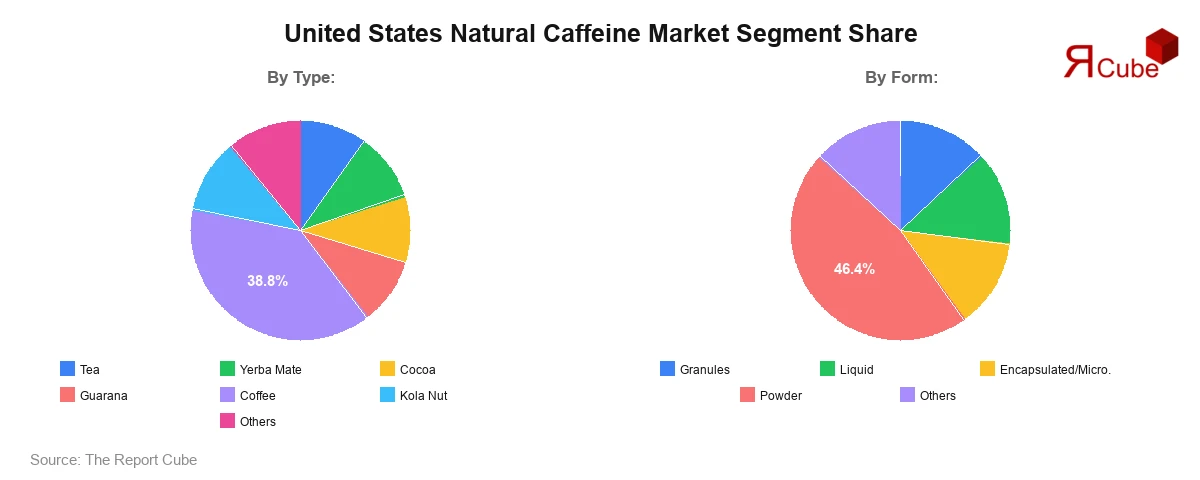
Coffee represented the largest share of the United States Natural Caffeine Market, contributing nearly 38.8% of total revenue in 2026. The segment benefits from a mature supply network, high extraction efficiency, and broad commercial acceptance across food, beverage, pharmaceutical, and nutraceutical industries. Manufacturers continue to favor coffee-derived caffeine because it delivers consistent purity, reliable supply, and strong consumer recognition. The rapid expansion of premium ready-to-drink coffee beverages, clean-label energy drinks, and sports nutrition products has further increased demand for naturally extracted coffee caffeine. Large ingredient processors are also investing in sustainable coffee sourcing programs, traceability systems, and advanced purification technologies to ensure consistent quality while meeting retailer and regulatory expectations. These commercial advantages are expected to preserve coffee's leading position throughout the forecast period as product manufacturers increasingly replace synthetic stimulants with botanical alternatives.
Tea-derived caffeine is steadily gaining traction, particularly within premium wellness beverages and dietary supplements positioned around natural energy and antioxidant support. Guarana continues to attract attention in sports nutrition because of its naturally high caffeine concentration and gradual energy-release profile. Yerba mate is witnessing growing adoption in functional beverages as brands introduce products inspired by South American botanical traditions. Cocoa and kola nut remain niche but valuable sources, primarily serving specialty food formulations and premium confectionery applications. Ongoing diversification of botanical caffeine sources enables manufacturers to strengthen supply resilience while offering differentiated ingredient solutions tailored to evolving product formulations.
By Form:
- Granules
- Liquid
- Encapsulated/Microencapsulated
- Powder
- Others
Powder remained the dominant form in the United States Natural Caffeine Market, accounting for approximately 46.4% of industry revenue in 2026. The format offers superior storage stability, simplified transportation, precise dosing, and excellent compatibility with dry blending processes, making it the preferred choice for manufacturers of dietary supplements, powdered beverages, sports nutrition products, functional foods, and pharmaceutical formulations. High-purity powdered caffeine also enables consistent product performance across large-scale commercial production while supporting clean-label product positioning. Increasing demand for convenient nutrition products and powdered hydration mixes continues to reinforce the segment's market leadership.
Encapsulated and microencapsulated natural caffeine is emerging as one of the fastest-growing categories due to its ability to provide controlled caffeine release, reduce bitterness, and improve formulation stability. Beverage and nutraceutical manufacturers increasingly adopt encapsulation technologies to develop premium products offering sustained energy throughout the day. Liquid caffeine extracts continue to serve beverage manufacturers seeking rapid incorporation into ready-to-drink formulations, while granules remain suitable for selected pharmaceutical and specialty food applications. Continuous advances in ingredient delivery systems are expanding formulation flexibility and enabling manufacturers to address diverse consumer preferences across the United States natural caffeine industry
Regional Projection of United States Natural Caffeine Industry
- West
- East
- South
- Midwest
- Others
The West region held the leading position in the United States Natural Caffeine Market with an estimated 34.9% revenue share in 2026. The region benefits from a well-developed functional food and beverage ecosystem, high consumer awareness regarding natural ingredients, and strong demand for premium organic products. States including California, Washington, and Oregon continue to serve as major centers for innovation in functional beverages, dietary supplements, and plant-based nutrition. Numerous ingredient manufacturers, beverage startups, and established food companies have expanded production capacities across the region to address growing consumer demand for naturally sourced caffeine.
The West also benefits from strong retail penetration through supermarkets, specialty health stores, e-commerce platforms, and direct-to-consumer brands. Increasing investment in sustainable ingredient sourcing, organic certifications, and environmentally responsible manufacturing practices has strengthened the region's competitive position. In addition, partnerships between botanical extract suppliers and functional beverage companies continue to drive product innovation involving coffee-derived caffeine, guarana extracts, green tea extracts, and yerba mate ingredients. These factors are expected to help the West maintain its market leadership throughout the 2026-2034 forecast period.
Need insights for a specific region within this market?
Request Regional DataRegional Analysis of United States Natural Caffeine Market
The U.S. natural caffeine market shows distinct regional patterns driven by lifestyle, health focus, and clean-label beverage adoption.
| Cluster | Demand Level | Key Areas | System Dominance | Core Demand Logic | Growth Nature |
|---|---|---|---|---|---|
| West | Very High | California, Washington | RTD coffee & natural energy drinks | Health-forward, clean-label consumers | Innovation-led premium growth |
| East | High | New York, Massachusetts | Specialty coffee & wellness beverages | Urban café culture, functional focus | Stable, premiumization-driven |
| South | Very High | Texas, Florida, Georgia | Natural energy drinks & teas | Warm climate, on-the-go lifestyles | Volume-led, mainstream expansion |
| Midwest | Medium | Illinois, Ohio, Michigan | Mass coffee brands with natural lines | Price-aware shift to cleaner options | Gradual conversion from legacy |
| Others | Emerging | Mountain & rural states | Natural powders & supplements | Fitness and e-commerce driven | Niche but fast-growing |
Government Initiatives & Policies
- Sarah Katz Caffeine Safety Act (Proposed): Introduced in the U.S. Congress, the proposed legislation seeks enhanced caffeine labeling by requiring manufacturers to disclose caffeine content, identify whether caffeine is naturally occurring or added, and include clearer consumer safety warnings. The proposal supports greater transparency across foods, beverages, and dietary supplements.
- FDA Human Foods Program Food Chemical Safety Modernization (2025-2026): The U.S. Food and Drug Administration continues strengthening oversight of food ingredients through its Human Foods Program, emphasizing ingredient safety evaluations, transparent labeling, risk-based assessments, and consumer protection for products containing functional ingredients such as natural caffeine.
United States Natural Caffeine Industry Recent Developments
- 2026: OmniActive Health Technologies Limited introduced a refreshed global brand strategy focused on Performance & Active Nutrition, Everyday Wellness, and Healthspan. The strategy strengthens the company's natural ingredient portfolio, with natural caffeine continuing to support functional beverage, sports nutrition, and dietary supplement applications.
- 2025: Applied Food Sciences, Inc. expanded distribution of its flagship PurCaf® Organic Caffeine through a strategic partnership with Dempsey Corporation. The collaboration significantly broadened product availability throughout North America while addressing rising demand for organic, clean-label caffeine ingredients across beverage and nutritional product manufacturers.
- 2026: Several U.S. food and beverage manufacturers accelerated reformulation initiatives by replacing synthetic caffeine with naturally extracted coffee and tea caffeine to meet growing consumer demand for clean-label energy products. This transition has strengthened investment in botanical extraction technologies and sustainable ingredient sourcing.
Why Choose This Report?
- Provides a comprehensive overview of the overall market analysis, encompassing key trends, consumer behavior analysis, and risk assessment to support strategic decision-making.
- Provides accurate, up-to-date insights into market size, segmentation, and emerging opportunities, helping to minimize risk while capitalizing on growth.
- Gives deep understanding of target audience preferences, investment habits, and communication channels for enhanced product development and marketing effectiveness.
- Delivers competitive analysis and benchmarking, uncovering the strengths and weaknesses of market competitors to guide business strategies.
- Consolidates comprehensive market intelligence, reducing research efforts while improving decision-making efficiency.
- Facilitates customized market segmentation and risk mitigation strategies, fine-tuned to business objectives.
- Aids in identifying both market challenges and untapped opportunities within the industry to drive long-term business growth.
- Provides valuable information based on actual customer data, industry developments, and search trends.
Table of Contents
- Introduction
- Objective of the Study
- Product and Category Definition
- Market Segmentation
- Study Variables
- Research Methodology
- Secondary Data Points
- Breakdown of Secondary Sources
- Primary Data Points
- Breakdown of Primary Interviews
- Secondary Data Points
- Executive Summary
- Market Dynamics
- Emerging Opportunities
- Adoption Trends
- Demand Drivers
- Disruption Analysis (Challenges)
- Industry Analysis & Strategic Insights
- Supply/Value Chain Analysis
- Pricing Analysis
- Go-To-Market (GTM) Strategy
- BCG Matrix
- Recent Trends and Developments
- Import and Export Analysis
- Regulatory and Policy Landscape
- Region-wise policies
- Government Initiatives
- United States Natural Caffeine Market Overview and Forecast Analysis (2021-2034)
- Market Size, By Value, By Growth Rate (CAGR/USD Billion)
- Market Share, By Type
- Tea
- Yerba Mate
- Cocoa
- Guarana
- Coffee
- Kola Nut
- Others
- Market Share, By Form
- Granules
- Liquid
- Encapsulated / Microencapsulated
- Powder
- Others
- Market Share, By Application
- Pharmaceuticals
- Cosmetics & Personal Care
- Dietary Supplements & Nutraceuticals
- Food and Beverages
- Others
- Market Share, By Distribution Channel
- In-Direct Sales
- Direct Sales
- Market Share, By Region
- West
- East
- South
- Midwest
- Others
- Market Share, By Company
- Revenue Shares & Analysis
- Competitive Landscape
- West United States Natural Caffeine Market Overview and Forecast Analysis (2021-2034)
- Market Size, By Value, By Growth Rate (CAGR/USD Billion/Million)
- Market Share, By Type
- Market Share, By Form
- Market Share, By Application
- Market Share, By Distribution Channel
- East United States Natural Caffeine Market Overview and Forecast Analysis (2021-2034)
- Market Size, By Value, By Growth Rate (CAGR/USD Billion/Million)
- Market Share, By Type
- Market Share, By Form
- Market Share, By Application
- Market Share, By Distribution Channel
- South United States Natural Caffeine Market Overview and Forecast Analysis (2021-2034)
- Market Size, By Value, By Growth Rate (CAGR/USD Billion/Million)
- Market Share, By Type
- Market Share, By Form
- Market Share, By Application
- Market Share, By Distribution Channel
- Midwest United States Natural Caffeine Market Overview and Forecast Analysis (2021-2034)
- Market Size, By Value, By Growth Rate (CAGR/USD Billion/Million)
- Market Share, By Type
- Market Share, By Form
- Market Share, By Application
- Market Share, By Distribution Channel
- Competitive Analysis, 2026
- Market Share of Key Players
- Competitive Mapping for Each Segment and Companies Operating Regionally
- West United States Natural Caffeine Companies Share & Competitive Analysis, 2026
- East United States Natural Caffeine Companies Share & Competitive Analysis, 2026
- South United States Natural Caffeine Companies Share & Competitive Analysis, 2026
- Midwest United States Natural Caffeine Companies Share & Competitive Analysis, 2026
- Company Profile (Partial List)
- CR3-Kaffeeveredelung GmbH
- Company Overview
- Product Portfolio
- Strategic Alliances/Partnerships
- Recent Developments
- Applied Food Sciences, Inc.
- Company Overview
- Product Portfolio
- Strategic Alliances/Partnerships
- Recent Developments
- Botanic Healthcare Pvt. Ltd.
- Company Overview
- Product Portfolio
- Strategic Alliances/Partnerships
- Recent Developments
- Cepham
- Company Overview
- Product Portfolio
- Strategic Alliances/Partnerships
- Recent Developments
- NutriScience Innovations, LLC
- Company Overview
- Product Portfolio
- Strategic Alliances/Partnerships
- Recent Developments
- Herbo Nutra Extract Private Limited
- Company Overview
- Product Portfolio
- Strategic Alliances/Partnerships
- Recent Developments
- OmniActive Health Technologies Limited
- Company Overview
- Product Portfolio
- Strategic Alliances/Partnerships
- Recent Developments
- Plant Lipids
- Company Overview
- Product Portfolio
- Strategic Alliances/Partnerships
- Recent Developments
- Elementa
- Company Overview
- Product Portfolio
- Strategic Alliances/Partnerships
- Recent Developments
- Hangzhou Muhua Bio-Tech Co., Ltd.
- Company Overview
- Product Portfolio
- Strategic Alliances/Partnerships
- Recent Developments
- Anderson Global Group, LLC
- Company Overview
- Product Portfolio
- Strategic Alliances/Partnerships
- Recent Developments
- Shri Ahimsa Naturals Ltd.
- Company Overview
- Product Portfolio
- Strategic Alliances/Partnerships
- Recent Developments
- UNICORN NATURAL PRODUCT LIMITED
- Company Overview
- Product Portfolio
- Strategic Alliances/Partnerships
- Recent Developments
- Descafeinadores Mexicanos S.A.
- Company Overview
- Product Portfolio
- Strategic Alliances/Partnerships
- Recent Developments
- Natura Vitalis Industries Pvt. Ltd.
- Company Overview
- Product Portfolio
- Strategic Alliances/Partnerships
- Recent Developments
- Coffein Compagnie GmbH & Co. KG
- Company Overview
- Product Portfolio
- Strategic Alliances/Partnerships
- Recent Developments
- AVT Natural
- Company Overview
- Product Portfolio
- Strategic Alliances/Partnerships
- Recent Developments
- Sivaroma Naturals Pvt. Ltd.
- Company Overview
- Product Portfolio
- Strategic Alliances/Partnerships
- Recent Developments
- Cymbio Pharma Private Limited
- Company Overview
- Product Portfolio
- Strategic Alliances/Partnerships
- Recent Developments
- Umang Global
- Company Overview
- Product Portfolio
- Strategic Alliances/Partnerships
- Recent Developments
- EPC Natural Products Co., Ltd.
- Company Overview
- Product Portfolio
- Strategic Alliances/Partnerships
- Recent Developments
- Vita Forte Inc.
- Company Overview
- Product Portfolio
- Strategic Alliances/Partnerships
- Recent Developments
- Derivados Industrializados del Café S.A.
- Company Overview
- Product Portfolio
- Strategic Alliances/Partnerships
- Recent Developments
- Others (Partial List)
- CR3-Kaffeeveredelung GmbH
- Contact Us and Disclaimer
Top Key Players & Market Share Outlook
- CR3-Kaffeeveredelung GmbH
- Applied Food Sciences, Inc.
- Botanic Healthcare Pvt. Ltd.
- Cepham
- NutriScience Innovations, LLC
- Herbo Nutra Extract Private Limited
- OmniActive Health Technologies Limited
- Plant Lipids
- Elementa
- Hangzhou Muhua Bio-Tech Co., Ltd.
- Anderson Global Group, LLC
- Shri Ahimsa Naturals Ltd.
- UNICORN NATURAL PRODUCT LIMITED
- Descafeinadores Mexicanos S.A.
- Natura Vitalis Industries Pvt. Ltd.
- Coffein Compagnie GmbH & Co. KG
- AVT Natural
- Sivaroma Naturals Pvt. Ltd.
- Cymbio Pharma Private Limited
- Umang Global
- EPC Natural Products Co., Ltd.
- Vita Forte Inc.
- Derivados Industrializados del Café S.A.
- Others
Frequently Asked Questions






