



Build Your Custom Market Intelligence Report
Customize Your ReportIndia Nutraceuticals Market Size, Share, Trends & Forecast 2026-2034
Key Takeaways:
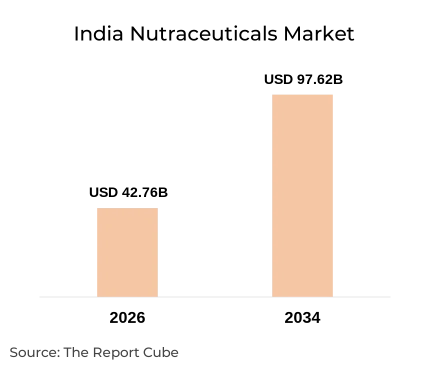
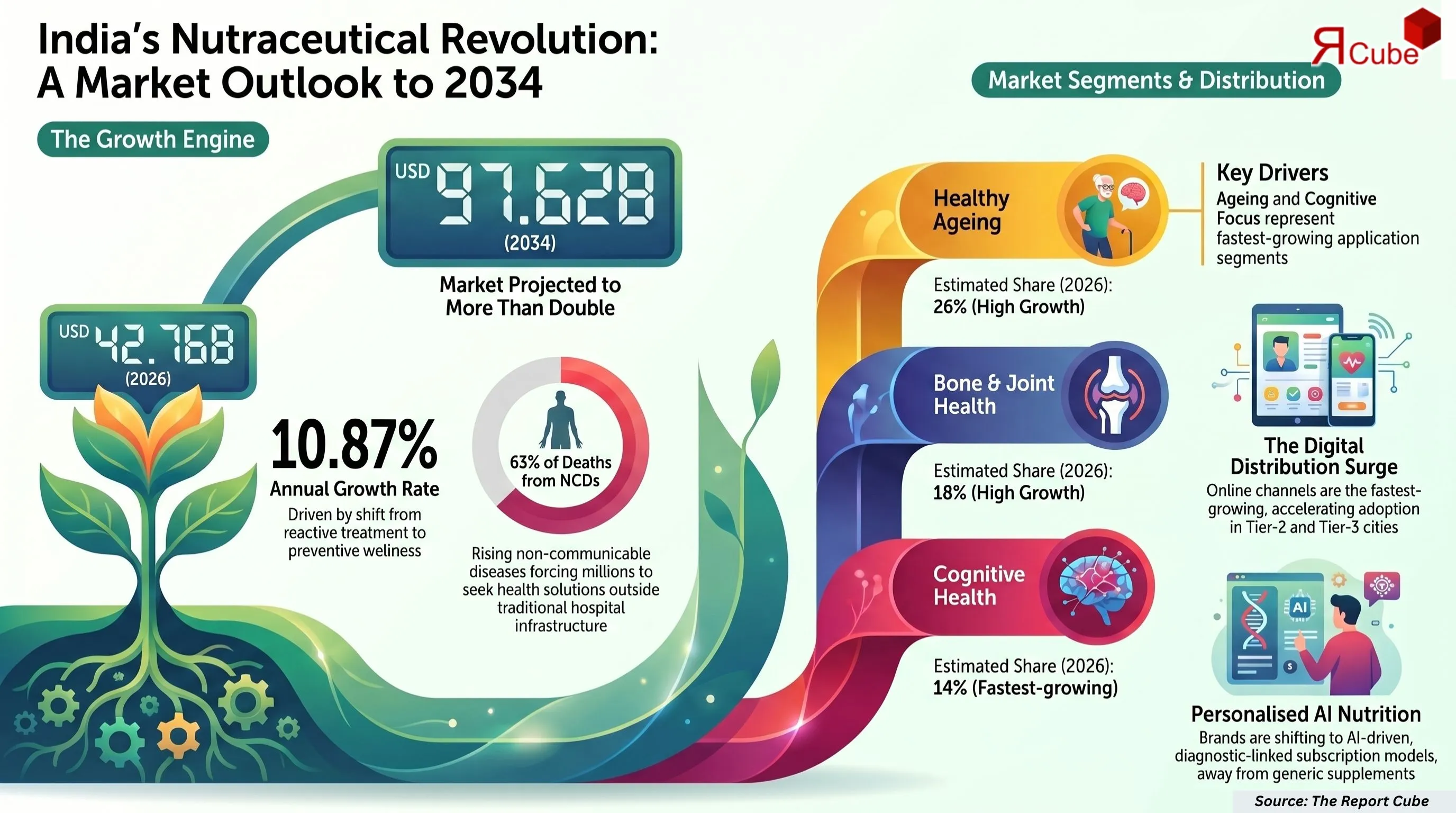
- India nutraceuticals market is projected to grow from USD 42.76 billion in 2026 to USD 97.62 billion by 2034, at a CAGR of 10.87%.
- Healthy ageing and cognitive health are the two fastest-growing application segments.
- Online distribution is accelerating adoption in Tier-2 and Tier-3 cities.
- Patanjali, Himalaya, and Dabur anchor domestic competition against global players Abbott and Nestlé.
- Government initiatives under FSSAI and the Ayush Ministry are formalising quality standards across the sector.
India Nutraceuticals Market Insights & Analysis
Preventable disease burden is rising faster than public health infrastructure can absorb. The Indian Council of Medical Research (ICMR, 2023) estimates that non-communicable diseases now account for 63% of all deaths in India - a statistic that has forced millions of consumers to seek preventive solutions outside the hospital. The India nutraceuticals market sits at the exact intersection of that demand shift, growing from USD 42.76 billion in 2026 to a projected USD 97.62 billion by 2034 at a CAGR of 10.87%.
Three structural forces underpin this expansion. First, India's middle class - estimated at 300 million people and growing (World Bank, 2023) - is allocating a larger share of discretionary income to preventive health products. Second, digital health platforms and e-pharmacies have slashed the distribution barrier: a supplement brand can now reach a consumer in Patna or Coimbatore as easily as in Mumbai. Third, regulatory clarity from the Food Safety and Standards Authority of India (FSSAI) - including the 2022 nutraceutical labelling amendment - has reduced market fragmentation, giving compliant brands a pricing and credibility advantage.
Domestic players such as Patanjali Ayurved, Himalaya Wellness, and Dabur have embedded Ayurvedic positioning into nutraceutical formats - a strategy that resonates with Indian consumers already comfortable with herbal remedies. International players including Abbott, Nestlé India, and Herbalife counter with clinical-study-backed formulations and supply-chain scale. The result is a two-tier competitive market: one anchored in heritage and affordability, the other in clinical credibility and premiumisation.
|
Dimension |
Urban India |
Rural India |
|---|---|---|
|
Primary Purchase Channel |
Online, Pharmacies |
Grocery Stores, Local Pharmacies |
|
Top Application Concern |
Cognitive Health, Bone & Joint |
Children's Health, Allergy |
|
Price Sensitivity |
Moderate |
High |
|
Awareness Level |
High |
Emerging |
India Nutraceuticals Market Dynamics
Key Market Driver: Rising NCD Prevalence and Preventive Health Awareness
Chronic disease rates are outpacing treatment capacity. ICMR data (2023) shows that 101 million Indians live with diabetes and a further 136 million are pre-diabetic - numbers that directly fuel demand for metabolic health and blood-sugar management nutraceuticals. Consumers who previously sought intervention only after diagnosis are now purchasing preventive formulations in their 30s and 40s. This behavioural shift is converting a reactive supplement market into a proactive wellness market - and it is the primary demand engine behind the 10.87% CAGR.
Major Industry Challenge: Regulatory Heterogeneity and Quality Standardisation
Product quality remains difficult to guarantee at scale. FSSAI's 2022 nutraceutical framework set labelling and claims standards, but enforcement at the manufacturing level - particularly among micro, small, and medium enterprises (MSMEs) that account for roughly 45% of production volume (Ministry of Food Processing Industries, 2023) - is inconsistent. This creates a trust deficit that suppresses repeat purchase rates, particularly for new-to-category buyers. Brands investing in third-party certification and transparent labelling gain a measurable conversion advantage, but the compliance cost remains prohibitive for smaller players.
Emerging Trend: Personalised Nutrition and At-Home Diagnostics Integration
Generic supplement formats are ceding ground to diagnostic-linked personalisation. Companies including Wellbeing Nutrition and OZiva have launched blood-test-linked subscription models where consumers receive tailored nutrient stacks based on micronutrient deficiency profiles. The Ministry of Health and Family Welfare's National Digital Health Mission (NDHM) is building the health-data infrastructure that makes population-level personalisation viable. This trend structurally favours direct-to-consumer (DTC) brands with data capabilities over traditional over-the-counter (OTC) players.
Need Specific Data, Let’s Customize the Report for You
Request CustomizationEmerging Opportunity: Children's Health and Cognitive Nutraceuticals
Two under-served application segments are approaching inflection. India's school-age population exceeds 250 million (Census 2021 estimate), and UNICEF data (2022) shows that 35.5% of children under five are stunted - pointing to a large addressable gap in paediatric micronutrient supplementation. Simultaneously, the health supplements market in India is projected to accelerate as urban professionals between ages 25 and 45 seek nootropic and focus-support formulations. Both segments are under-indexed in current competitor page coverage, offering differentiated content and distribution whitespace.
India Nutraceuticals Market Segment-wise Analysis
By Application
Demand fragments sharply across life stage and health concern.
|
Application Segment |
Estimated Share (2026) |
Growth Outlook |
Primary Consumer Profile |
|---|---|---|---|
|
Healthy Ageing |
26% |
High |
Adults 45+, urban |
|
Bone & Joint Health |
18% |
High |
Women 35+, post-menopausal |
|
Cognitive Health |
14% |
Fastest-growing |
Urban professionals 25–45 |
|
Children's Health |
13% |
High |
Parents of 0–12 age group |
|
Cancer Prevention |
10% |
Moderate |
Oncology-adjacent consumers |
|
Allergy & Intolerance |
11% |
Moderate |
Food-sensitive consumers |
|
Others |
8% |
Steady |
General wellness |
Healthy ageing commands the largest share at an estimated 26%, driven by India's growing population aged 60 and above - projected at 194 million by 2031 (Ministry of Statistics and Programme Implementation, 2022). Bone and joint health follows at approximately 18%, with female consumers post-35 driving calcium, vitamin D, and collagen formats. Cognitive health is the fastest-growing sub-segment: demand for omega-3, ashwagandha, and bacopa monnieri formulations grew at an estimated 19% year-on-year between 2021 and 2023 (Ayush Ministry, 2023). Children's health - spanning iron, vitamin A, and zinc supplements - is being accelerated by government schemes including the Pradhan Mantri Poshan Shakti Nirman (PM POSHAN) programme, which has raised micronutrient awareness among parents in semi-urban markets.
By Distribution Channel
Channel mix is shifting from physical-first to hybrid, with online growing fastest.
|
Distribution Channel |
Estimated Share (2026) |
Growth Tag |
Key Brand Examples |
|---|---|---|---|
|
Pharmacies |
31% |
Stable-High |
Abbott, Cipla, Himalaya |
|
Online |
24% |
Fastest-growing |
Amway, OZiva, Wellbeing Nutrition |
|
Supermarkets & Hypermarkets |
19% |
Moderate |
Nestlé, Herbalife, Dabur |
|
Specialty Stores |
12% |
Moderate |
Patanjali, Himalaya |
|
Grocery Stores |
9% |
Low-Moderate |
Dabur, Patanjali |
|
Others |
5% |
Stable |
B2B, hospital procurement |
Pharmacies retain the largest share at approximately 31%, supported by doctor-recommended supplement purchases and the high consumer trust attached to the pharmacy environment. Online channels, however, are growing fastest - India's e-pharmacy and health D2C segment grew 42% between 2020 and 2023 (DPIIT, 2023), and nutraceutical brands benefit directly from this infrastructure. Subscription models on platforms such as Healthkart, 1mg, and Netmeds generate repeat purchase rates that outperform physical retail. Supermarkets and hypermarkets account for 19% of value, led by modern trade expansion in Tier-1 and Tier-2 cities.
Regional Projection of India Nutraceuticals Market
|
Region |
Estimated Share (2026) |
Key Driver |
Growth Gap vs. National Average |
|---|---|---|---|
|
North India |
27% |
Urban middle-class demand; Delhi NCR hub |
At par |
|
West India |
25% |
Mumbai, Pune health-conscious consumers; strong modern trade |
At par |
|
South India |
24% |
High literacy, preventive health culture; strong pharma distribution |
At par |
|
East India |
14% |
Rising NCD rates, improving e-commerce penetration |
Below average |
|
Northeast India |
10% |
Low base; expanding government health programmes |
Emerging |
- North India leads by value at an estimated 27%, anchored by Delhi NCR's dense pharmacy network and the region's high concentration of health-aware urban consumers. Patanjali's Haridwar manufacturing base also gives the region a supply-chain advantage.
- West India follows closely at 25%, with Maharashtra and Gujarat posting above-average modern trade penetration. The Mumbai-Pune corridor hosts the largest concentration of health DTC brands and international subsidiary offices.
- South India commands 24% share, underpinned by high health literacy in Tamil Nadu, Karnataka, and Kerala. The region's well-developed pharmacy chain network (Apollo Pharmacy, MedPlus) provides premium nutraceuticals with a trusted retail environment.
- East India at 14% represents the most significant untapped growth corridor. Rising NCD rates in West Bengal and Odisha, combined with expanding Tier-2 e-commerce logistics, are expected to close the gap with the national average by 2030.
- Northeast India together account for 10%, constrained by last-mile distribution costs and lower per-capita health spending. Government supplementation programmes provide a floor-level demand base.
India Nutraceuticals Market: Recent Developments (2025)
- Abbott (February 2025): Launched Ensure Gold with HMB (beta-hydroxy beta-methylbutyrate) reformulation for the India market, targeting the 45+ healthy ageing segment.
India Nutraceuticals Market Future Outlook (2034)
Three converging forces will determine where the market lands by 2034.
- The population architecture is the starting point. India will add approximately 90 million people aged 60 and above between 2024 and 2034 (United Nations Population Division, 2023). That cohort carries the highest nutraceutical spend per head - driven by bone health, cardiovascular support, and cognitive maintenance needs. Meanwhile, urban millennial consumers aged 30–40 in 2034 will have spent a decade normalising preventive supplementation as part of daily routine - sustaining volume demand independent of ageing.
- Policy infrastructure will amplify both. The Ayush Ministry's projected USD 23.7 billion target for the sector by 2030 (Ministry of Ayush, 2022) includes export incentives and domestic quality-testing grants that reduce compliance barriers for mid-tier brands. The National Digital Health Mission is creating a health-data layer that enables precision supplementation at population scale - a structural unlock for personalised nutraceutical subscription models.
- Technology is the third vector. AI-driven micronutrient profiling - already piloted by Wellbeing Nutrition and Tata 1mg - will shift consumer acquisition from category browsing to diagnostic-triggered purchasing. Brands that own the diagnostic relationship by 2028 will hold a defensible distribution moat. By 2034, the India nutraceuticals market at USD 97.62 billion will be split between three distinct consumer tiers: value-segment buyers in Tier-3 and rural markets served by government-adjacent brands; mid-market buyers purchasing through e-pharmacy subscriptions; and premium buyers in Tier-1 cities purchasing personalised, clinically validated stacks.
India Nutraceuticals Market Report Coverage
|
Report Features |
Details |
|---|---|
|
Market Size (Value) |
USD 42.76 Billion (2026) |
|
Forecast Period |
2026 - 2034 |
|
CAGR |
10.87% |
|
Base Year |
2026 |
|
Historical Data |
2021 - 2025 |
|
Customization |
Available |
|
Segments Covered |
By Application; By Distribution Channel; By Product |
|
Regions Covered |
North India, West India, South India, East India, Northeast India, Central India |
|
Key Companies |
Abbott, ADM, Amway Corp., Cipla, Dabur, Herbalife, Himalaya Wellness, Nestlé India, Patanjali Ayurved |
|
Report Format |
PPT, PDF & Excel |
Why Choose This Report?
- Granular segmentation across 7 application categories and 6 distribution channels - with share estimates grounded in FSSAI, DPIIT, and Ministry of Health disclosed data.
- Regional breakdown covering all six Indian zones, including the underreported East and Northeast corridors where growth acceleration is projected above the national average post-2028.
- Competitive landscape covering both domestic heritage brands (Patanjali, Dabur, Himalaya) and global players (Abbott, Nestlé, Herbalife) with strategy-level differentiation notes.
- FSSAI regulatory update integration - including the January 2024 health-claims amendment - so findings reflect the current compliance environment, not a two-year-old snapshot.
- Future outlook anchored in three named structural forces - population ageing data, Ayush Ministry policy targets, and AI-driven personalisation - rather than generic trend statements.
- Historical data from 2020 to 2025 enables pre- and post-COVID demand pattern analysis across channels and applications.
- Available in PPT, PDF, and Excel formats with customisation options for segment additions and regional deep-dives on request.
Table of Contents
- Introduction
- Objective of the study
- Product Definition
- Market Segmentation
- Study Variables
- Research Methodology
- Secondary Data Points
- Companies Interviewed
- Primary Data Points
- Breakdown of Primary Interviews
- Secondary Data Points
- Executive Summary
- Market Dynamics
- Drivers
- Challenges
- Opportunity Assessment
- Recent Trends and Developments
- Policy and Regulatory Landscape
- India Nutraceuticals Market Overview and Forecast Analysis (2021-2034)
- Market Size, By Value, By growth rate (CAGR/USD Billions)
- Demand - Supply Trends
- Market Share, By Product
- Dietary Supplements
- Functional Food & Beverages
- Market Share, By Application
- Allergy & Intolerance
- Healthy Ageing
- Bone & Joint health
- Cancer Prevention
- Children's Health
- Cognitive Health
- Others
- Market Share, By Distribution Channel
- Supermarkets & Hypermarkets
- Pharmacies
- Specialty Stores
- Grocery Stores
- Online
- Others
- Market Share, By Region
- North India
- West India
- South India
- East India
- Northeast India
- Market Share, By Competitors
- Competition Characteristics
- Revenue Shares
- India Dietary Supplements Nutraceuticals Market Overview, 2021-2034F
- By Value (USD Million)
- By Application- Market Size & Forecast 2021-2034, USD Million
- By Distribution Channel- Market Size & Forecast 2021-2034, USD Million
- India Functional Food & Beverages Nutraceuticals Market Overview, 2021-2034F
- By Value (USD Million)
- By Application- Market Size & Forecast 2021-2034, USD Million
- By Distribution Channel- Market Size & Forecast 2021-2034, USD Million
- Competitive Outlook (Company Profile - Partial List)
- Abbott
- Company Overview
- Business Segments
- Strategic Alliances/Partnerships
- Recent Developments
- ADM
- Company Overview
- Business Segments
- Strategic Alliances/Partnerships
- Recent Developments
- Amway Corp.
- Company Overview
- Business Segments
- Strategic Alliances/Partnerships
- Recent Developments
- Cipla
- Company Overview
- Business Segments
- Strategic Alliances/Partnerships
- Recent Developments
- Dabur.com
- Company Overview
- Business Segments
- Strategic Alliances/Partnerships
- Recent Developments
- Herbalife, Inc.
- Company Overview
- Business Segments
- Strategic Alliances/Partnerships
- Recent Developments
- Himalaya Wellness Company
- Company Overview
- Business Segments
- Strategic Alliances/Partnerships
- Recent Developments
- Nestlé India Limited
- Company Overview
- Business Segments
- Strategic Alliances/Partnerships
- Recent Developments
- Patanjali Ayurved Limited
- Company Overview
- Business Segments
- Strategic Alliances/Partnerships
- Recent Developments
- Others
- Abbott
- Contact Us & Disclaimer
Top Key Players & Market Share Outlook
- Abbott
- ADM
- Amway Corp.
- Cipla
- Dabur.com
- Herbalife, Inc.
- Himalaya Wellness Company
- Nestlé India Limited
- Patanjali Ayurved Limited
- Others
Frequently Asked Questions






