



Build Your Custom Market Intelligence Report
Customize Your ReportGlobal Biomass Pellets Market Key Highlights
By Product:
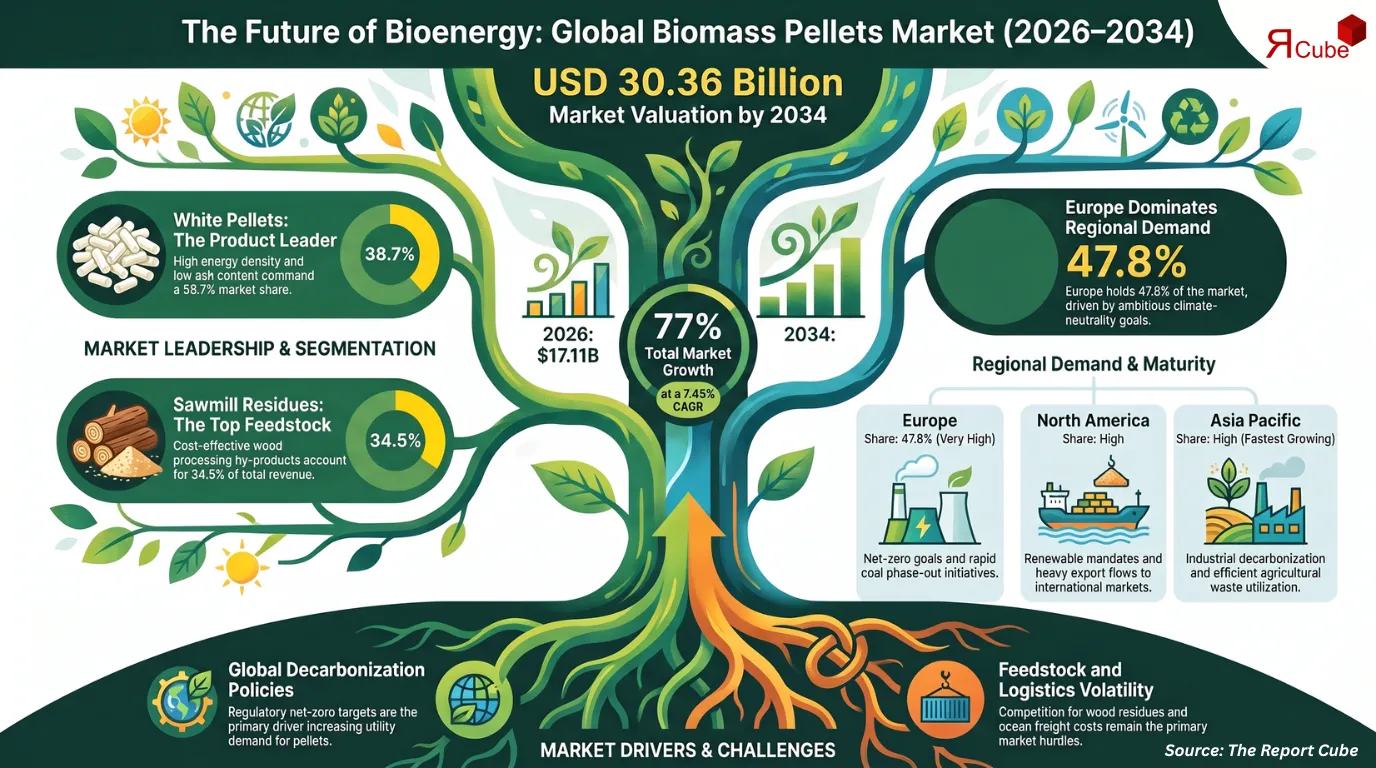
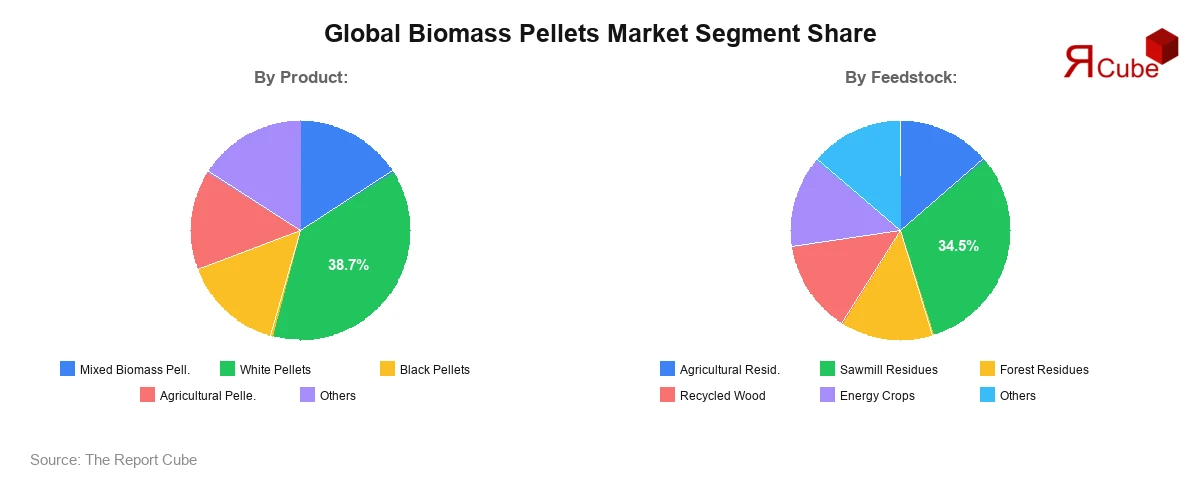
White Pellets segment leads the market with approximately 38.7% share.
By Feedstock:
Sawmill Residues dominate the market with nearly 34.5% of total revenue.
Regional Outlook:
Europe dominates the Global Biomass Pellets Market with an estimated 47.8% market share.
Global Biomass Pellets Market Insights & Analysis
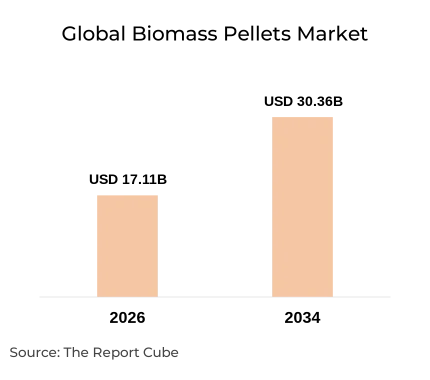
The Global Biomass Pellets Market is anticipated to register a CAGR of around 7.43% during the forecast period 2026-2034. The market size is valued at USD 17.11 billion in 2026 and is projected to reach USD 30.36 billion by 2034. Growth is supported by the accelerating transition toward renewable energy systems and increasing investments in low-carbon heating and power generation. Biomass pellets have become an essential renewable fuel because they utilize forestry by-products, agricultural residues, and recycled wood to produce reliable thermal energy with lower lifecycle greenhouse gas emissions than conventional fossil fuels. Electric utilities, district heating operators, and industrial facilities continue increasing pellet consumption as governments strengthen renewable energy targets and carbon reduction policies. At the same time, expanding pellet manufacturing capacity across North America, Europe, and Asia Pacific is improving global supply availability, while advancements in pellet processing technology are enhancing fuel quality, energy efficiency, and transportation economics, reinforcing the long-term outlook for biomass pellets market growth.
Investment activity across the biomass value chain continues to strengthen market fundamentals. Utility companies are modernizing coal-fired facilities through biomass co-firing and dedicated biomass conversion projects to extend plant life while reducing emissions. Major pellet producers are expanding production plants, storage terminals, and export infrastructure to meet growing international demand, particularly from Europe and East Asia. Improvements in feedstock preprocessing, drying systems, and pellet densification technologies have increased production efficiency while lowering operational costs and improving product consistency. In parallel, sustainability certification programs and responsible forest management practices are enhancing supply chain transparency and strengthening confidence among industrial buyers. Increasing utilization of agricultural residues such as rice husks, wheat straw, corn stover, and sugarcane bagasse is also broadening the feedstock base, supporting resource efficiency and creating additional opportunities for biomass pellets market expansion throughout the forecast period.
Global Biomass Pellets Market Impact Analysis
| Factor | Type | Specific Impact on Market | Magnitude | Business Implication |
|---|---|---|---|---|
| Global Decarbonization Policies | Regulatory | Renewable targets increase utility demand for biomass pellets | High | Supports long term supply contracts with power generators worldwide |
| Rising Demand for Clean Energy | Market | Industries replace coal and oil with pellet based biomass fuels | High | Expands sales into power, cement and steel production segments |
| Regional Production Concentration | Environmental | EU and North America dominate output but face feedstock limits | Medium | Drives investment toward Asia and South America capacity growth |
| Feedstock Availability and Cost | Market | Local forestry waste and straw lower raw material and transport cost | Medium | Encourages sourcing diversification and new low cost pellet plants |
| Pellet Production Technology Maturity | Technological | Improved processing raises fuel quality and thermal efficiency | Medium | Enables premium pricing and entry into demanding export markets |
| Investment and M&A Activity | Competitive | Capital inflows expand capacity and intensify global competition | High | Necessitates scale build up and strategic partnerships for growth |
| Price Volatility Versus Fossil Fuels | Market | Relative cost advantage shifts with carbon and fuel price trends | Medium | Requires dynamic pricing and hedging to protect pellet margins |
Global Biomass Pellets Market Dynamics
Key Driver: Global Decarbonization Strategies Continue to Increase Biomass Fuel Adoption
Global efforts to achieve net-zero emissions are significantly increasing the use of biomass pellets across electricity generation, industrial heating, and district heating networks. Governments and energy producers are replacing coal with renewable alternatives that can be integrated into existing thermal infrastructure without substantial capital investment. Biomass pellets provide dependable baseload energy while supporting greenhouse gas reduction targets and improving energy diversification. Their favorable combustion efficiency, standardized quality, and ease of storage make them an attractive renewable fuel for utilities and industrial users seeking practical decarbonization solutions. As more countries introduce stricter emissions regulations and renewable energy obligations, demand for certified biomass pellets continues to increase across both mature and developing energy markets.
Corporate sustainability commitments are creating another layer of demand across manufacturing, food processing, chemicals, pulp and paper, and other energy-intensive industries. Businesses are increasingly adopting biomass pellets to reduce operational carbon footprints while meeting environmental reporting requirements and investor expectations. Long-term supply agreements between pellet producers and industrial consumers are encouraging investment in new production facilities, logistics infrastructure, and feedstock procurement networks. These developments continue strengthening biomass pellets market size while creating stable demand across global renewable energy supply chains.
Industry Trend: Diversification of Feedstock Sources is Improving Supply Security
The biomass pellets industry is steadily expanding beyond conventional wood-based raw materials by incorporating a broader range of sustainable feedstocks. Manufacturers are increasingly utilizing agricultural residues including wheat straw, rice husks, sugarcane bagasse, palm kernel shells, and corn stover to improve raw material availability while reducing dependence on forest resources. Dedicated energy crops such as switchgrass and miscanthus are also gaining commercial importance because of their high biomass productivity and suitability for pellet manufacturing. This diversified approach supports year-round production while improving the resilience of biomass pellet supply chains.
Production technologies are evolving alongside feedstock diversification. Advanced drying equipment, automated pellet mills, digital quality monitoring systems, and energy-efficient densification processes are enabling manufacturers to produce pellets with improved durability, lower moisture content, and higher calorific value. At the same time, internationally recognized sustainability certification standards are becoming increasingly important for exporters serving European and Asian utilities. These technological and operational improvements continue enhancing product quality, supporting international trade, and reinforcing long-term biomass pellets market demand.
Book your FREE 30-minute expert consultation today
Contact UsMajor Challenge: Feedstock Availability and Logistics Costs Continue to Influence Profitability
Maintaining a reliable and cost-effective feedstock supply remains one of the most significant challenges for biomass pellet manufacturers. Demand for wood residues from lumber, paper, furniture, and construction industries frequently creates competition for raw materials, resulting in price fluctuations that directly affect production costs. Weather conditions, harvesting cycles, transportation limitations, and regional forestry regulations can also influence feedstock availability, making long-term production planning more complex. These factors require manufacturers to diversify sourcing strategies while investing in efficient inventory management systems.
Global biomass pellet trade also depends on efficient transportation and export infrastructure. Ocean freight rates, port congestion, container availability, and inland logistics costs can substantially affect delivered fuel prices, particularly for major importing regions that rely on overseas suppliers. In addition, compliance with evolving sustainability standards and traceability requirements requires continuous investment in certification, monitoring, and documentation systems. Smaller market participants may experience greater operational pressure when adapting to these requirements, creating challenges for profitability despite growing market demand.
Opportunity: Industrial Energy Transition and Expanding Asian Demand Create New Growth Potential
Rapid industrial decarbonization is opening new opportunities for biomass pellet producers as energy-intensive industries seek commercially viable alternatives to fossil fuels. Industrial boilers used in cement, food processing, pulp and paper, chemicals, and manufacturing operations are increasingly being upgraded to accommodate biomass-based fuels. This transition is supported by corporate environmental commitments, carbon pricing mechanisms, and renewable energy incentives that encourage cleaner industrial heat generation. Growing demand from these sectors is expected to diversify revenue streams beyond traditional power generation applications.
Asia Pacific continues to emerge as a strategic growth region for the Global Biomass Pellets Market. Countries including Japan and South Korea have established long-term renewable energy policies that support biomass power generation and encourage stable pellet imports. Meanwhile, Southeast Asian economies are expanding domestic pellet manufacturing by utilizing abundant agricultural residues and plantation by-products. Rising investments in export terminals, pellet production facilities, and cross-border supply partnerships are strengthening regional trade while creating new opportunities for producers to expand their presence in high-growth international markets through 2034.
Global Biomass Pellets Market Segment-wise Analysis
By Product:
- Mixed Biomass Pellets
- White Pellets
- Black Pellets
- Agricultural Pellets
- Others
White Pellets account for approximately 38.7% of the Global Biomass Pellets Market, making them the leading product segment. Their market leadership is supported by high energy density, low moisture content, and minimal ash generation, which enable efficient combustion and lower maintenance requirements. Produced primarily from clean sawdust and other untreated wood residues, white pellets meet stringent international quality standards required by residential heating systems, commercial boilers, and utility-scale power plants. Their standardized specifications also facilitate international trade, making them the preferred biomass fuel for countries with large renewable energy import requirements.
Steady investments in pellet production facilities, automated manufacturing technologies, and certified sustainable forestry practices continue to strengthen the competitiveness of the white pellets segment. European countries remain the largest consumers due to strong demand from district heating networks and biomass-fired power plants, while Japan and South Korea are increasing imports under long-term renewable energy programs. Growing consumer preference for cleaner heating fuels and rising replacement of coal in industrial applications are expected to sustain demand for white pellets, reinforcing their dominant contribution to the Global Biomass Pellets Market throughout the forecast period.
By Feedstock:
- Agricultural Residues
- Wheat Straw
- Rice Husk
- Palm Kernel Shell
- Cotton Stalk
- Corn Stover
- Sugarcane Bagasse
- Others
- Sawmill Residues
- Wood Chips
- Sawdust
- Bark Residues
- Wood Shavings
- Forest Residues
- Tops
- Branches
- Thinnings
- Low-Grade Roundwood
- Recycled Wood
- Pallet Wood
- Industrial Wood Residues
- Untreated Construction Wood
- Energy Crops
- Switchgrass
- Miscanthus
- Short Rotation Coppice
- Others
Sawmill Residues hold nearly 34.5% of the Global Biomass Pellets Market revenue, making them the largest feedstock segment. Wood chips, sawdust, bark residues, and wood shavings generated during lumber processing provide a reliable, cost-effective, and sustainable source of raw materials for pellet production. Their consistent physical properties improve pellet quality while reducing processing complexity and manufacturing costs. Utilizing these by-products also supports circular economy objectives by converting industrial wood waste into valuable renewable fuel instead of disposing of it.
Growing investments in the wood processing industry across North America and Europe continue ensuring stable feedstock availability for pellet manufacturers. Advances in material handling, drying technologies, and biomass preprocessing have further improved production efficiency and pellet consistency. In addition, increasing adoption of certified forest management practices has enhanced confidence among utilities and industrial buyers seeking sustainably sourced biomass fuels. As global demand for renewable energy expands, sawmill residues are expected to remain the preferred feedstock due to their dependable supply chain, economic advantages, and favorable environmental profile.
Regional Projection of Global Biomass Pellets Industry
- North America
- Europe
- Asia Pacific
- Middle East and Africa
- South America
Europe represents the largest regional market, accounting for an estimated 47.8% share of the Global Biomass Pellets Market. The region's leadership is driven by ambitious climate goals, well-established renewable energy infrastructure, and widespread adoption of biomass for electricity generation and district heating. Countries such as the United Kingdom, Germany, Sweden, Denmark, the Netherlands, and Italy continue increasing biomass utilization to reduce dependence on fossil fuels while strengthening energy security. Supportive policy frameworks and renewable energy incentives have encouraged long-term investments in biomass-fired power plants and heating networks across the region.
Strong import demand from European utilities continues supporting global pellet trade, with significant volumes sourced from North America and the Baltic region under long-term supply agreements. The region also maintains rigorous sustainability certification requirements that promote responsible forest management and transparent supply chains, enhancing market confidence among industrial users. Continuous modernization of district heating infrastructure, increasing investments in low-carbon energy systems, and growing emphasis on carbon neutrality are expected to preserve Europe's leading position in the Global Biomass Pellets Market through 2034.
Need insights for a specific region within this market?
Request Regional DataRegional Analysis of Global Biomass Pellets Market
The global biomass pellets market shows distinct regional demand patterns driven by policy support, feedstock access, and decarbonization targets.
| Cluster | Demand Level | Key Areas | System Dominance | Core Demand Logic | Growth Nature |
|---|---|---|---|---|---|
| North America | High | US Southeast, Canada, Midwest | Utility power & heating pellets | Renewable mandates and export flows | Steady policy-backed growth |
| Europe | Very High | Germany, UK, Nordics, Baltics | District heat & CHP pellets | Net-zero goals and coal phase-out | Mature yet expanding market |
| Asia Pacific | High | China, India, Japan, South Korea | Industrial and power gen pellets | Industrial decarbonization and waste use | Fastest-growing regional cluster |
| Middle East & Africa | Low | South Africa, GCC emerging hubs | Small-scale industrial pellets | Early-stage renewables diversification | Nascent but high potential |
| South America | Medium | Brazil, Chile, Argentina | Export-grade wood pellets | Rich biomass base and EU exports | Resource-led expansion |
Government Initiatives & Policies
- European Union Renewable Energy Directive (RED III) Implementation (2025): EU member states continued implementing RED III to increase renewable energy deployment while strengthening sustainability criteria for biomass fuels, supporting certified biomass pellet production and consumption across power generation and heating sectors.
- Japan Strategic Energy Plan (2025 Update): Japan continued promoting sustainable biomass utilization through its updated Strategic Energy Plan, encouraging renewable electricity generation, long-term biomass fuel procurement, and investments in low-carbon power infrastructure.
Global Biomass Pellets Industry Recent Developments
- 2026: Drax Group plc agreed to acquire Bluefield Solar Income Fund in a transaction valued at approximately GBP 561 million. The acquisition supports the company's broader renewable energy diversification strategy while reducing long-term dependence on biomass subsidy mechanisms and expanding its clean energy generation portfolio across multiple renewable technologies.
Why Choose This Report?
- Provides a comprehensive overview of the overall market analysis, encompassing key trends, consumer behavior analysis, and risk assessment to support strategic decision-making.
- Provides accurate, up-to-date insights into market size, segmentation, and emerging opportunities, helping to minimize risk while capitalizing on growth.
- Gives deep understanding of target audience preferences, investment habits, and communication channels for enhanced product development and marketing effectiveness.
- Delivers competitive analysis and benchmarking, uncovering the strengths and weaknesses of market competitors to guide business strategies.
- Consolidates comprehensive market intelligence, reducing research efforts while improving strategic planning efficiency.
- Facilitates customized market segmentation and risk mitigation strategies, fine-tuned to business objectives.
- Aids in identifying both market challenges and untapped opportunities within the industry to drive long-term business growth.
- Provides valuable information based on actual customer data, industry developments, and search trends.
Table of Contents
- Introduction
- Objective of the Study
- Product and Category Definition
- Market Segmentation
- Study Variables
- Research Methodology
- Secondary Data Points
- Breakdown of Secondary Sources
- Primary Data Points
- Breakdown of Primary Interviews
- Secondary Data Points
- Executive Summary
- Market Dynamics
- Emerging Opportunities
- Adoption Trends
- Demand Drivers
- Disruption Analysis (Challenges)
- Industry Analysis & Strategic Insights
- Supply/Value Chain Analysis
- Pricing Analysis
- Go-To-Market (GTM) Strategy
- BCG Matrix
- Recent Trends and Developments
- Import and Export Analysis
- Regulatory and Policy Landscape
- Region-wise policies
- Government Initiatives
- Global Biomass Pellets Market Overview and Forecast Analysis (2021-2034)
- Market Size, By Value, By Growth Rate (CAGR/USD Billion)
- Market Share, By Product
- Mixed Biomass Pellets
- White Pellets
- Black Pellets
- Agricultural Pellets
- Others
- Market Share, By Feedstock
- Agricultural Residues
- Wheat Straw
- Rice Husk
- Palm Kernel Shell
- Cotton Stalk
- Corn Stover
- Sugarcane Bagasse
- Others
- Sawmill Residues
- Wood Chips
- Sawdust
- Bark Residues
- Wood Shavings
- Forest Residues
- Tops
- Branches
- Thinnings
- Low-Grade Roundwood
- Recycled Wood
- Pallet Wood
- Industrial Wood Residues
- Untreated Construction Wood
- Energy Crops
- Switchgrass
- Miscanthus
- Short Rotation Coppice
- Others
- Agricultural Residues
- Market Share, By Grade
- Premium Residential Grade
- Industrial Grade
- Commercial Heating Grade
- Market Share, By Application
- District Heating
- Industrial Heat
- Power Generation
- Commercial Heating
- Residential Heating
- Medical and Healthcare
- Others
- Market Share, By Distribution Channel
- Direct Industrial Sales
- Retail Sales
- Distributor Sales
- Long-Term Supply Contracts
- Spot Sales
- Market Share, By End-User
- Industrial Boiler Operators
- Independent Power Producers
- Utilities
- Commercial Facilities
- Residential Consumers
- District Heating Operators
- Government and Municipal Facilities
- Others
- Market Share, By Region
- North America
- Europe
- Asia Pacific
- Middle East and Africa
- South America
- Market Share, By Company
- Revenue Shares & Analysis
- Competitive Landscape
- North America Biomass Pellets Market Overview and Forecast Analysis (2021-2034)
- Market Size, By Value, By Growth Rate (CAGR/USD Billion/Million)
- Market Share, By Product
- Market Share, By Feedstock
- Market Share, By Grade
- Market Share, By Application
- Market Share, By Distribution Channel
- Market Share, By End-User
- Market Share, By Country
- United States
- Canada
- Mexico
- Rest of North America
- Europe Biomass Pellets Market Overview and Forecast Analysis (2021-2034)
- Market Size, By Value, By Growth Rate (CAGR/USD Billion/Million)
- Market Share, By Product
- Market Share, By Feedstock
- Market Share, By Grade
- Market Share, By Application
- Market Share, By Distribution Channel
- Market Share, By End-User
- Market Share, By Country
- Germany
- United Kingdom
- France
- Italy
- Spain
- Netherlands
- Russia
- Poland
- Belgium
- Sweden
- Rest of Europe
- Asia Pacific Biomass Pellets Market Overview and Forecast Analysis (2021-2034)
- Market Size, By Value, By Growth Rate (CAGR/USD Billion/Million)
- Market Share, By Product
- Market Share, By Feedstock
- Market Share, By Grade
- Market Share, By Application
- Market Share, By Distribution Channel
- Market Share, By End-User
- Market Share, By Country
- China
- India
- Japan
- South Korea
- Australia
- Indonesia
- Thailand
- Malaysia
- Vietnam
- Philippines
- Singapore
- New Zealand
- Rest of Asia Pacific
- Middle East and Africa Biomass Pellets Market Overview and Forecast Analysis (2021-2034)
- Market Size, By Value, By Growth Rate (CAGR/USD Billion/Million)
- Market Share, By Product
- Market Share, By Feedstock
- Market Share, By Grade
- Market Share, By Application
- Market Share, By Distribution Channel
- Market Share, By End-User
- Market Share, By Country
- Saudi Arabia
- United Arab Emirates
- South Africa
- Egypt
- Nigeria
- Morocco
- Turkey
- Rest of Middle East and Africa
- South America Biomass Pellets Market Overview and Forecast Analysis (2021-2034)
- Market Size, By Value, By Growth Rate (CAGR/USD Billion/Million)
- Market Share, By Product
- Market Share, By Feedstock
- Market Share, By Grade
- Market Share, By Application
- Market Share, By Distribution Channel
- Market Share, By End-User
- Market Share, By Country
- Brazil
- Argentina
- Chile
- Colombia
- Peru
- Rest of South America
- Competitive Analysis, 2026
- Market Share of Key Players
- Competitive Mapping for Each Segment and Companies Operating Regionally
- North America Biomass Pellets Companies Share & Competitive Analysis, 2026
- Europe Biomass Pellets Companies Share & Competitive Analysis, 2026
- Asia Pacific Biomass Pellets Companies Share & Competitive Analysis, 2026
- Middle East and Africa Biomass Pellets Companies Share & Competitive Analysis, 2026
- South America Biomass Pellets Companies Share & Competitive Analysis, 2026
- Company Profile (Partial List)
- Premium Pellet Ltd.
- Company Overview
- Product Portfolio
- Strategic Alliances/Partnerships
- Recent Developments
- Enviva Inc.
- Company Overview
- Product Portfolio
- Strategic Alliances/Partnerships
- Recent Developments
- Valfei Products Inc.
- Company Overview
- Product Portfolio
- Strategic Alliances/Partnerships
- Recent Developments
- Drax Group plc
- Company Overview
- Product Portfolio
- Strategic Alliances/Partnerships
- Recent Developments
- Graanul Invest AS
- Company Overview
- Product Portfolio
- Strategic Alliances/Partnerships
- Recent Developments
- Andritz AG
- Company Overview
- Product Portfolio
- Strategic Alliances/Partnerships
- Recent Developments
- UPM-Kymmene Corporation
- Company Overview
- Product Portfolio
- Strategic Alliances/Partnerships
- Recent Developments
- German Pellets GmbH
- Company Overview
- Product Portfolio
- Strategic Alliances/Partnerships
- Recent Developments
- AS Graanul Invest
- Company Overview
- Product Portfolio
- Strategic Alliances/Partnerships
- Recent Developments
- Amandus Kahl GmbH & Co. KG
- Company Overview
- Product Portfolio
- Strategic Alliances/Partnerships
- Recent Developments
- Fram Renewable Fuels, LLC
- Company Overview
- Product Portfolio
- Strategic Alliances/Partnerships
- Recent Developments
- Highland Pellets LLC
- Company Overview
- Product Portfolio
- Strategic Alliances/Partnerships
- Recent Developments
- Groupe Savoie Inc.
- Company Overview
- Product Portfolio
- Strategic Alliances/Partnerships
- Recent Developments
- CM Biomass Partners A/S
- Company Overview
- Product Portfolio
- Strategic Alliances/Partnerships
- Recent Developments
- Stora Enso Oyj
- Company Overview
- Product Portfolio
- Strategic Alliances/Partnerships
- Recent Developments
- Lignetics, Inc.
- Company Overview
- Product Portfolio
- Strategic Alliances/Partnerships
- Recent Developments
- Pinnacle Renewable Energy Inc.
- Company Overview
- Product Portfolio
- Strategic Alliances/Partnerships
- Recent Developments
- Zilkha Biomass Energy LLC
- Company Overview
- Product Portfolio
- Strategic Alliances/Partnerships
- Recent Developments
- Energex Corporation
- Company Overview
- Product Portfolio
- Strategic Alliances/Partnerships
- Recent Developments
- CPM Holdings, Inc.
- Company Overview
- Product Portfolio
- Strategic Alliances/Partnerships
- Recent Developments
- Others (Partial List)
- Premium Pellet Ltd.
- Contact Us and Disclaimer
Top Key Players & Market Share Outlook
- Premium Pellet Ltd.
- Enviva Inc.
- Valfei Products Inc.
- Drax Group plc
- Graanul Invest AS
- Andritz AG
- UPM-Kymmene Corporation
- German Pellets GmbH
- AS Graanul Invest
- Amandus Kahl GmbH & Co. KG
- Fram Renewable Fuels, LLC
- Highland Pellets LLC
- Groupe Savoie Inc.
- CM Biomass Partners A/S
- Stora Enso Oyj
- Lignetics, Inc.
- Pinnacle Renewable Energy Inc.
- Zilkha Biomass Energy LLC
- Energex Corporation
- CPM Holdings, Inc.
Frequently Asked Questions






