



Build Your Custom Market Intelligence Report
Customize Your ReportAsia-Pacific Biomass Briquette Market Insights & Analysis
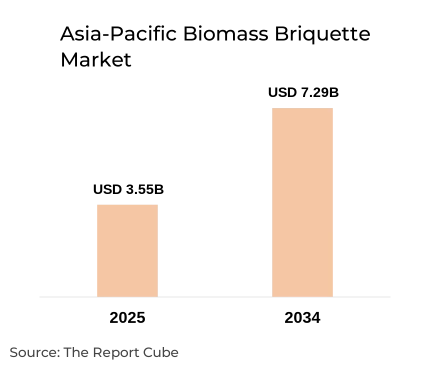
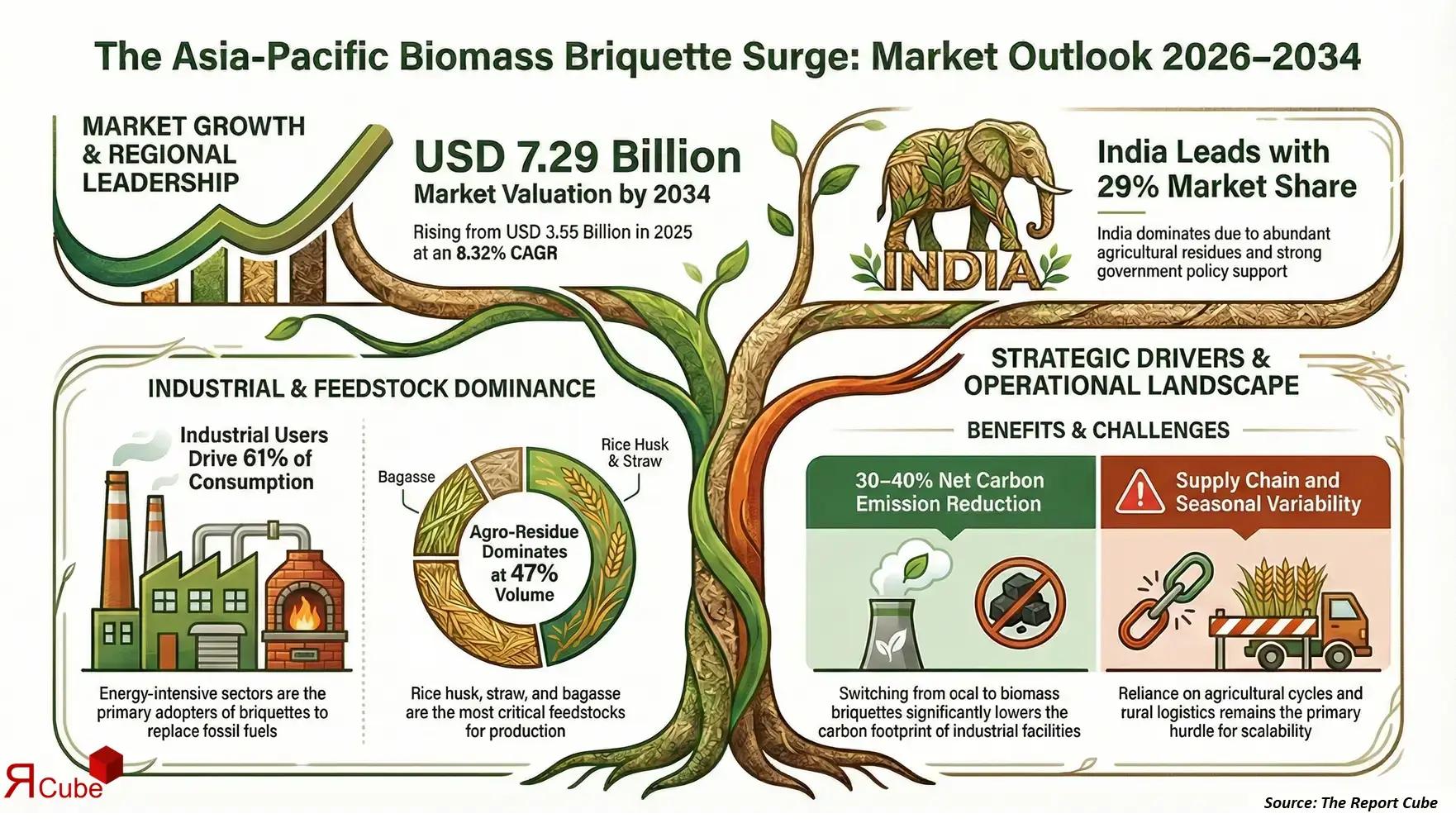
The Asia-Pacific Biomass Briquette Market is anticipated to register a CAGR of 8.32% during 2026-2034. The market size was valued at USD 3.55 Billion in 2025 and is projected to reach USD 7.29 Billion by 2034. the market is experiencing strong momentum as governments, industries, and utilities across the region accelerate the transition toward renewable and low-carbon energy sources. Biomass briquettes are increasingly adopted as cost-effective and sustainable alternatives to coal, firewood, and fossil fuels in industrial boilers, power generation, brick kilns, and institutional heating systems.
In 2025, industrial and commercial energy users accounted for more than 61% of total briquette consumption, reflecting widespread adoption in energy-intensive sectors. The region’s abundance of agricultural residues, forestry by-products, and wood waste provides a steady and economical feedstock base, enabling scalable briquette production across multiple countries.
Market expansion is further supported by rising energy demand, coal substitution policies, and waste-to-energy initiatives across Asia-Pacific economies. Countries such as India, China, and Southeast Asian nations are actively promoting biomass utilization to reduce open-field burning of agricultural residues and improve air quality. In 2025, agro-residue-based briquettes represented nearly 47% of total market volume, highlighting the strong linkage between biomass energy and agricultural waste management. Additionally, increasing fuel cost volatility and corporate decarbonization commitments are encouraging industrial users to adopt briquettes for long-term energy cost stability. These factors collectively underpin sustained market growth over the forecast period.
Asia-Pacific Biomass Briquette Market Recent Developments
- 2025: Om Greentech Industries expanded high-capacity briquetting systems for industrial fuel users.
- 2025: EcoStan India increased exports of biomass briquette machinery to Southeast Asia.
Government Initiatives & Policies
- National Biomass Energy & Co-firing Programs: Regional initiatives promoting biomass use in industrial boilers and power plants.
- Crop Residue Management & Clean Energy Policies: Government programs supporting biomass utilization to reduce stubble burning.
Asia-Pacific Biomass Briquette Market Dynamics
Key Driver: Coal Replacement and Renewable Energy Targets
The primary driver of the Asia-Pacific biomass briquette market is the growing replacement of coal with renewable and low-emission fuels. Governments and industries are under increasing pressure to reduce carbon emissions and meet renewable energy targets. In 2025, industrial facilities using biomass briquettes achieved an estimated 30-40% reduction in net carbon emissions compared to coal-based fuel usage. Briquettes offer consistent calorific value, easier handling, and compatibility with existing combustion systems, making them a practical transition fuel. This alignment with decarbonization goals continues to drive strong adoption across manufacturing, power generation, and processing industries.
Major Challenge: Feedstock Supply Variability and Logistics
A major challenge facing the market is variability in feedstock availability and logistics constraints. Biomass supply depends heavily on agricultural cycles, weather conditions, and regional harvesting practices, which can affect production consistency. Transportation of bulky biomass materials from rural collection points to briquetting facilities also adds cost pressure. In regions with underdeveloped logistics infrastructure, these challenges can limit scalability. Addressing supply chain efficiency and localized production remains essential for long-term market stability.
Industry Trends: Torrefied Briquettes and Industrial Co-firing
An important industry trend is the growing interest in torrefied briquettes and biomass co-firing applications. Torrefied briquettes offer higher energy density, improved hydrophobic properties, and better grindability, making them suitable for coal power plants. In 2025, pilot co-firing projects across Asia-Pacific increased demand for higher-grade biomass briquettes, particularly in Japan and South Korea. At the same time, industries are standardizing briquette specifications to improve combustion efficiency and reduce ash content.
Opportunity Ahead: Waste-to-Energy and Export Potential
Future opportunities lie in waste-to-energy initiatives and export-oriented biomass briquette production. Countries with surplus agricultural and forestry residues can develop export markets, particularly for Japan and South Korea, which rely on imported biomass fuels. Additionally, integrating briquette production with municipal and industrial biomass waste management can unlock new revenue streams. Companies that invest in feedstock diversification, quality control, and export logistics are well positioned to capture incremental growth.
Asia-Pacific Biomass Briquette Market Segment-wise Analysis
By Briquette Type:
- Agro Biomass Briquettes
- Sawdust Biomass Briquettes
- Wood Biomass Briquettes
- Charcoal / Carbonized Briquettes
- Torrefied Briquettes
- Others
Agro biomass briquettes dominate the market, accounting for approximately 47% of total revenue in 2025 due to widespread availability of crop residues and cost efficiency. Sawdust and wood biomass briquettes follow, supported by forestry and wood processing industries. Torrefied briquettes, while smaller in share, are the fastest-growing segment driven by power generation and export demand.
By Feedstock:
- Agricultural Residues (Rice Husk, Bagasse, Straw, etc.)
- Forestry Residues
- Wood Waste & Sawdust
- Industrial Biomass Waste
- Municipal Biomass Waste
Agricultural residues lead the feedstock segment with nearly 52% share in 2025, reflecting the region’s strong agricultural base. Forestry residues and wood waste follow, while industrial biomass waste shows growing adoption as industries seek circular economy solutions.
Regional Projection of Asia-Pacific Biomass Briquette Industry
- China
- India
- Japan
- South Korea
- Australia
- Indonesia
- Thailand
- Malaysia
- Vietnam
- Rest of Asia-Pacific
India leads the Asia-Pacific market with approximately 29% share in 2025, driven by abundant agricultural residues and strong policy support for biomass energy. China follows, supported by industrial fuel substitution and waste management initiatives. Japan and South Korea represent high-value markets due to biomass imports and co-firing programs, while Southeast Asia shows strong growth momentum from expanding agro-processing industries.
Why Choose This Report?
- Provides a comprehensive overview of the overall market analysis, encompassing renewable energy trends, policy drivers, and risk assessment.
- Provides accurate, up-to-date insights into market size, segmentation, and high-growth opportunities.
- Gives deep understanding of feedstock dynamics, briquette technologies, and industrial demand patterns.
- Delivers competitive analysis & benchmarking of leading global and regional players.
- Consolidate comprehensive market intelligence, reducing reasoning & streamlining research efforts.
- Facilitates customized market segmentation & risk mitigation strategies aligned with business objectives.
- Aids in identifying sustainability-driven growth opportunities and export potential.
- Provides valuable insights based on real-world industrial fuel usage and energy transition trends.
Table of Contents
- Introduction
- Objective of the Study
- Product/Category Definition
- Market Segmentation
- Study Variables
- Research Methodology
- Secondary Data Points
- Breakdown of Secondary Sources
- Primary Data Points
- Breakdown of Primary Interviews
- Secondary Data Points
- Executive Summary
- Market Dynamics
- Drivers
- Challenges
- Opportunity Assessment
- Recent Trends and Developments
- Policy and Regulatory Landscape
- Asia-Pacific Biomass Briquette Market Overview (2020-2034)
- Market Size, By Volume & Value (Kilotons / USD Million)
- Market Share, By Briquette Type
- Agro Biomass Briquettes
- Sawdust Biomass Briquettes
- Wood Biomass Briquettes
- Charcoal / Carbonized Briquettes
- Torrefied Briquettes
- Others
- Market Share, By Feedstock
- Agricultural Residues (Rice Husk, Bagasse, Straw, etc.)
- Forestry Residues
- Wood Waste & Sawdust
- Industrial Biomass Waste
- Municipal Biomass Waste
- Market Share, By Application
- Power Generation
- Industrial Heating & Boilers
- Residential Heating & Cooking
- Commercial & Institutional Use
- Cement, Brick & Other Kilns
- Others
- Market Share, By End User
- Utilities & IPPs
- Industrial Users
- Residential Users
- Commercial & Institutional Users
- Others
- Market Share, By Distribution Channel
- Direct Sales
- Distributors & Traders
- Online Channels
- Others
- Market Share, By Country
- China
- India
- Japan
- South Korea
- Australia
- Indonesia
- Thailand
- Malaysia
- Vietnam
- Rest of Asia-Pacific
- Market Share, By Company
- Revenue Shares
- Competitive Landscape
- China Biomass Briquette Market
- Market Size, By Volume & Value (USD Million)
- Market Share, By Briquette Type
- Market Share, By Application
- Market Share, By End User
- Market Share, By Key Regions
- India Biomass Briquette Market
- Market Size, By Volume & Value (USD Million)
- Market Share, By Briquette Type
- Market Share, By Application
- Market Share, By End User
- Market Share, By Key Regions
- Japan Biomass Briquette Market
- Market Size, By Volume & Value (USD Million)
- Market Share, By Briquette Type
- Market Share, By Application
- Market Share, By End User
- Market Share, By Key Regions
- South Korea Biomass Briquette Market
- Market Size, By Volume & Value (USD Million)
- Market Share, By Briquette Type
- Market Share, By Application
- Market Share, By End User
- Market Share, By Key Regions
- Australia Biomass Briquette Market
- Market Size, By Volume & Value (USD Million)
- Market Share, By Briquette Type
- Market Share, By Application
- Market Share, By End User
- Market Share, By Key Regions
- Indonesia Biomass Briquette Market
- Market Size, By Volume & Value (USD Million)
- Market Share, By Briquette Type
- Market Share, By Application
- Market Share, By End User
- Market Share, By Key Regions
- Thailand Biomass Briquette Market
- Market Size, By Volume & Value (USD Million)
- Market Share, By Briquette Type
- Market Share, By Application
- Market Share, By End User
- Market Share, By Key Regions
- Malaysia Biomass Briquette Market
- Market Size, By Volume & Value (USD Million)
- Market Share, By Briquette Type
- Market Share, By Application
- Market Share, By End User
- Market Share, By Key Regions
- Vietnam Biomass Briquette Market
- Market Size, By Volume & Value (USD Million)
- Market Share, By Briquette Type
- Market Share, By Application
- Market Share, By End User
- Market Share, By Key Regions
- Competitive Outlook & Company Profiles
- Enviva
- Company Overview
- Product Portfolio
- Strategic Alliances/Partnerships
- Recent Developments
- Pacific BioEnergy
- Company Overview
- Product Portfolio
- Strategic Alliances/Partnerships
- Recent Developments
- Drax Biomass
- Company Overview
- Product Portfolio
- Strategic Alliances/Partnerships
- Recent Developments
- Pfeifer Group
- Company Overview
- Product Portfolio
- Strategic Alliances/Partnerships
- Recent Developments
- Biomass Secure Power
- Company Overview
- Product Portfolio
- Strategic Alliances/Partnerships
- Recent Developments
- Lignetics
- Company Overview
- Product Portfolio
- Strategic Alliances/Partnerships
- Recent Developments
- Om Greentech Industries
- Company Overview
- Product Portfolio
- Strategic Alliances/Partnerships
- Recent Developments
- EcoStan India Pvt Ltd
- Company Overview
- Product Portfolio
- Strategic Alliances/Partnerships
- Recent Developments
- Radhe Engineering Co.
- Company Overview
- Product Portfolio
- Strategic Alliances/Partnerships
- Recent Developments
- Others
- Company Overview
- Product Portfolio
- Strategic Alliances/Partnerships
- Recent Developments
- Enviva
- Contact Us / Disclaimer
Top Key Players & Market Share Outlook
- Enviva
- Pacific BioEnergy
- Drax Biomass
- Pfeifer Group
- Biomass Secure Power
- Lignetics
- Om Greentech Industries
- EcoStan India Pvt Ltd
- Radhe Engineering Co.
- Others
Frequently Asked Questions






