



Build Your Custom Market Intelligence Report
Customize Your ReportUAE Renewable Energy Market Insights & Analysis
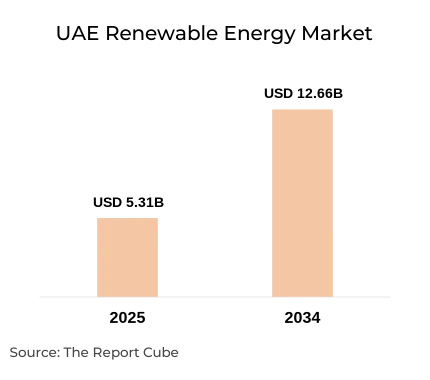
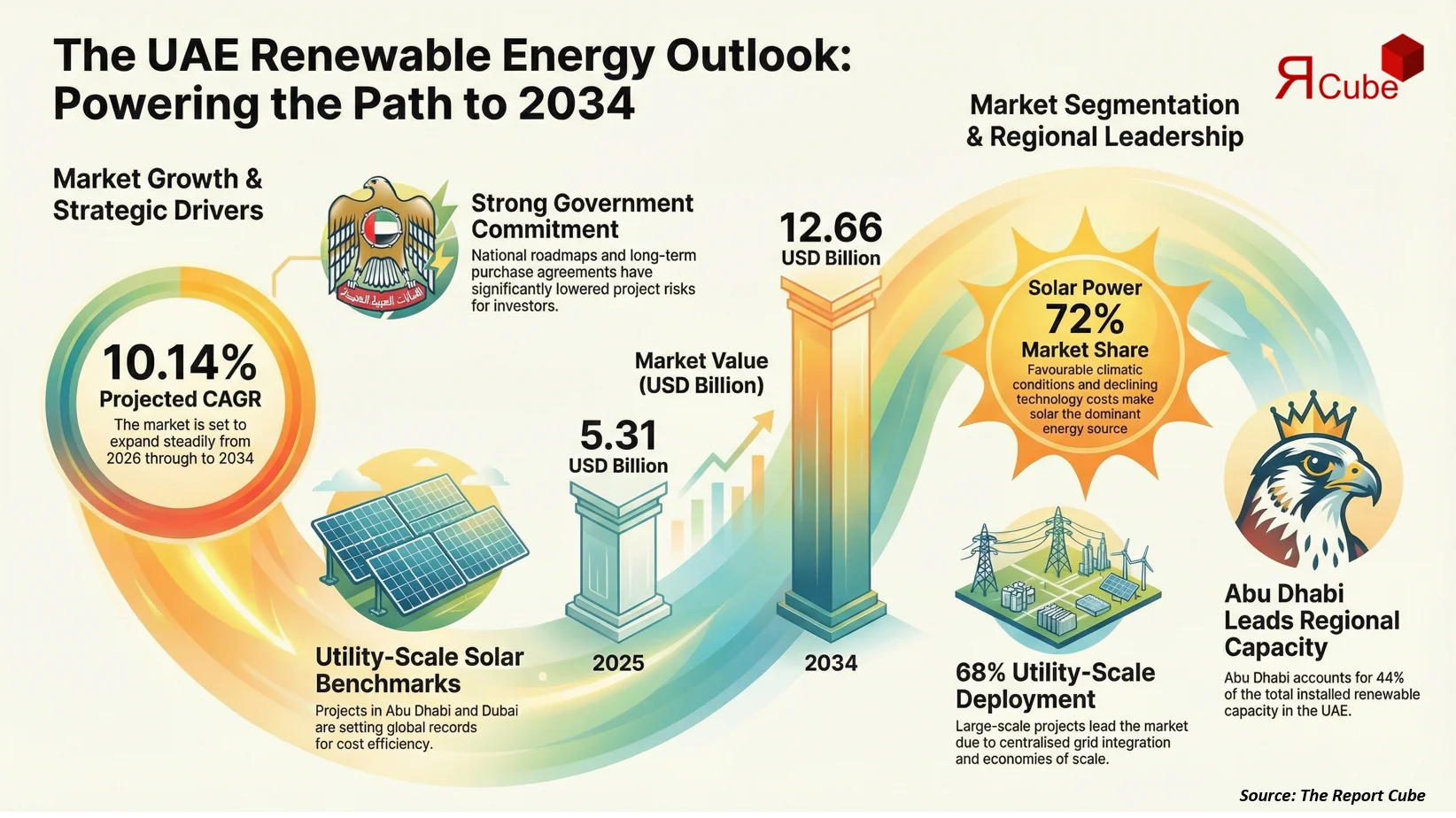
The UAE Renewable Energy Market is anticipated to register a CAGR of 10.14% during 2026-2034. The market size was valued at USD 5.31 billion in 2025 and is projected to reach USD 12.66 billion by 2034. The market is experiencing robust growth as the UAE accelerates its transition toward a low-carbon energy mix, driven by long-term sustainability goals, rising electricity demand, and diversification away from hydrocarbons. Renewable energy has become a strategic pillar of national energy planning, supporting energy security while aligning with global climate commitments.
This expansion is strongly supported by large-scale solar deployments, increasing private sector participation, and favorable regulatory frameworks. Utility-scale solar projects, particularly in Abu Dhabi and Dubai, are setting global benchmarks for cost efficiency, making renewable power increasingly competitive with conventional sources. Additionally, advancements in grid integration, energy storage, and digital monitoring are improving reliability, encouraging wider adoption across residential, commercial, and industrial users.
Moreover, the UAE’s strong investment pipeline, coupled with international partnerships and technology transfer, is reinforcing the market’s long-term outlook. As renewable capacity continues to scale, the market is expected to witness greater diversification across energy sources, applications, and regions through 2034.
UAE Renewable Energy Market Recent Developments
- 2025: Masdar advanced a new utility-scale solar project in Abu Dhabi to support national clean energy targets.
- 2025: DEWA expanded smart grid integration to optimize renewable energy distribution across Dubai.
Government Initiatives & Policies
- UAE Energy Strategy 2050: National roadmap targeting 50% clean energy contribution by mid-century.
- National Hydrogen Strategy: Supports green energy expansion and low-carbon fuel development.
UAE Renewable Energy Market Dynamics
Key Driver: Strong Government Commitment Toward Clean Energy Transition
The primary driver of the UAE Renewable Energy Market is the government’s strong and sustained commitment to clean energy transition. National strategies emphasize renewable deployment to reduce carbon intensity, meet rising power demand, and ensure long-term energy security. The UAE aims to significantly cut emissions while maintaining economic growth, positioning renewables as a core solution. Public-sector backing through long-term power purchase agreements, attractive tariffs, and infrastructure investments has lowered project risk, attracting global developers and investors. As electricity demand is projected to grow steadily due to population expansion and industrial development, renewables are increasingly viewed as the most scalable and cost-effective solution.
Book your FREE 30-minute expert consultation today
Contact UsIndustry Trends: Rapid Growth of Utility-Scale Solar Projects
Utility-scale solar power remains the dominant trend shaping the UAE Renewable Energy Market. Large photovoltaic installations benefit from high solar irradiation, vast land availability, and competitive bidding mechanisms. Record-low solar tariffs achieved in recent years have set global benchmarks, reinforcing solar power’s economic viability. This trend is further supported by advancements in panel efficiency, tracking systems, and energy storage integration. As a result, solar power is transitioning from a supplementary source to a baseload contributor within the national grid, driving capacity additions across multiple emirates.
Major Challenge: Grid Integration and Energy Storage Limitations
Despite strong growth, grid integration challenges pose a constraint to renewable expansion. The intermittent nature of solar and wind energy requires advanced grid management, storage solutions, and demand-side flexibility. While investments in smart grids are increasing, scaling energy storage remains capital-intensive. Balancing supply stability with growing renewable penetration requires continuous technological upgrades and coordinated infrastructure planning. These challenges may slow deployment timelines if not addressed effectively.
Opportunity: Expanding Commercial and Industrial Renewable Adoption
The growing adoption of renewable energy across commercial and industrial segments presents a significant opportunity. Rising electricity costs, sustainability commitments, and corporate decarbonization goals are encouraging businesses to invest in on-site solar and green power procurement. Distributed generation models, combined with net metering and long-term savings, are improving return on investment. As awareness and financing options improve, this segment is expected to contribute meaningfully to market expansion through 2034.
UAE Renewable Energy Market Segment-wise Analysis
By Type:
- Solar Power
- Wind Power
- Bioenergy
- Hydropower
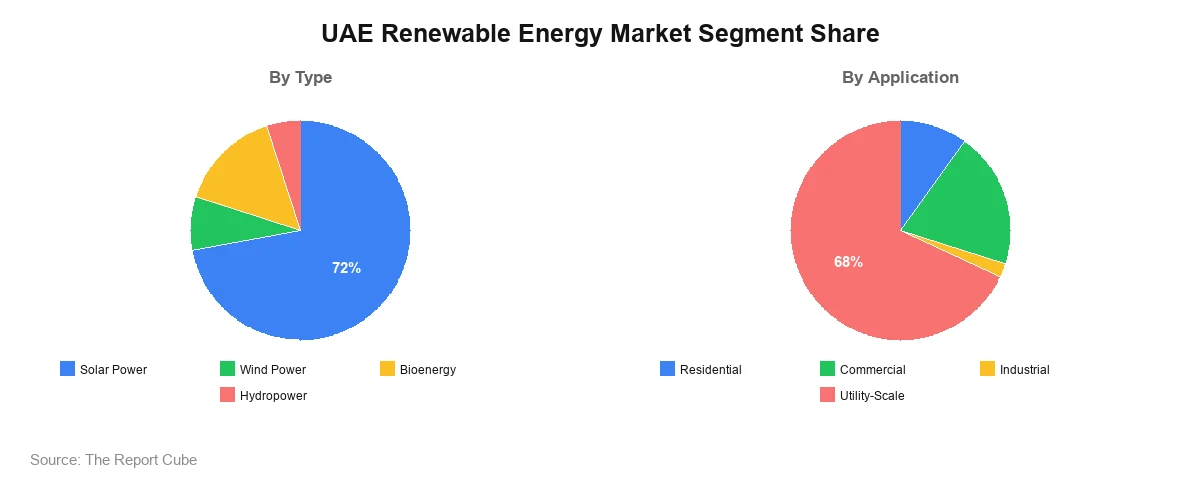
Solar power dominates the UAE Renewable Energy Market, accounting for approximately 72% of total renewable capacity in 2025. Its leadership is driven by favorable climatic conditions, declining technology costs, and strong policy support. Utility-scale solar projects form the backbone of renewable generation, while rooftop installations are gradually increasing. Wind and bioenergy remain niche but are gaining attention as diversification strategies, particularly for long-term energy resilience.
By Application:
- Residential
- Commercial
- Industrial
- Utility-Scale
Utility-scale applications lead the market, representing nearly 68% of total renewable energy deployment. Large projects benefit from economies of scale, long-term contracts, and centralized grid integration. However, commercial and industrial applications are emerging as high-growth segments due to sustainability targets and cost optimization needs. Residential adoption is gradually increasing, supported by net metering and rising environmental awareness.
Regional Projection of UAE Renewable Energy Industry
- Abu Dhabi
- Dubai
- Sharjah
- Ras Al Khaimah
Abu Dhabi leads the UAE Renewable Energy Market, contributing approximately 44% of total installed renewable capacity in 2025. The emirate benefits from large-scale solar developments, strong government backing, and advanced grid infrastructure. Dubai follows closely, driven by ambitious clean energy targets and smart city initiatives. Other emirates are gradually increasing adoption through localized renewable projects, contributing to balanced national growth.
Need insights for a specific region within this market?
Request Regional DataWhy Choose This Report?
- Provides a comprehensive overview of the overall market analysis, encompassing key trends, consumer behavior analysis, and risk assessment to support strategic decision-making.
- Provides accurate, up-to-date insights into market size, segmentation, and emerging opportunities, helping to minimize risk & capitalizing on growth.
- Gives deep understanding of target audience preferences, investment habits, and communication channels for enhanced product development & marketing effectiveness.
- Delivers competitive analysis & benchmarking, uncovering the strengths & weaknesses of market competitors to guide strategies.
- Consolidate comprehensive market intelligence, reducing reasoning & streamlining research efforts.
- Facilitates customized market segmentation & risk mitigation strategies, fine-tuned to the business objectives.
- Aids in identifying both market challenges & untapped opportunities within the industry to drive long-term business growth.
- Provides valuable information based on actual customer data & search trends.
Table of Contents
- Introduction
- Objective of the Study
- Product and Category Definition
- Market Segmentation
- Study Variables
- Research Methodology
- Secondary Data Points
- Breakdown of Secondary Sources
- Primary Data Points
- Breakdown of Primary Interviews
- Secondary Data Points
- Executive Summary
- Market Dynamics
- Drivers
- Challenges
- Opportunity Assessment
- Recent Trends and Developments
- Regulatory and Policy Landscape
- UAE Renewable Energy Market Overview (2021-2034)
- Market Size, By Value (USD Billion)
- Market Share, By Type
- Solar Power
- Wind Power
- Bioenergy
- Hydropower
- Geothermal
- Market Share, By Application
- Residential
- Commercial
- Industrial
- Utility-Scale
- Market Share, By Technology
- Solar PV
- CSP
- Onshore Wind
- Offshore Wind
- Market Share, By End-User
- Power Utilities
- Oil & Gas
- Manufacturing
- Others
- Market Share, By Region
- Dubai
- Abu Dhabi & Al Ain
- Sharjah & Northern Emirates
- Market Share, By Company
- Competition Characteristics
- Revenue Shares & Analysis
- Abu Dhabi Renewable Energy Market
- Market Size, By Value (USD Billion)
- Market Share, By Type
- Market Share, By Application
- Market Share, By Technology
- Market Share, By End-User
- Dubai Renewable Energy Market
- Market Size, By Value (USD Billion)
- Market Share, By Type
- Market Share, By Application
- Market Share, By Technology
- Market Share, By End-User
- Sharjah & Northern Emirates Renewable Energy Market
- Market Size, By Value (USD Billion)
- Market Share, By Type
- Market Share, By Application
- Market Share, By Technology
- Market Share, By End-User
- Competitive Outlook and Company Profiles
- Masdar
- Company Overview
- Project Portfolio
- Strategic Alliances/Partnerships
- Recent Developments
- Dubai Electricity and Water Authority (DEWA)
- Company Overview
- Project Portfolio
- Strategic Alliances/Partnerships
- Recent Developments
- Emirates Water and Electricity Company (EWEC)
- Company Overview
- Project Portfolio
- Strategic Alliances/Partnerships
- Recent Developments
- TAQA
- Company Overview
- Project Portfolio
- Strategic Alliances/Partnerships
- Recent Developments
- ACWA Power
- Company Overview
- Project Portfolio
- Strategic Alliances/Partnerships
- Recent Developments
- EDF Renewables
- Company Overview
- Project Portfolio
- Strategic Alliances/Partnerships
- Recent Developments
- ENGIE
- Company Overview
- Project Portfolio
- Strategic Alliances/Partnerships
- Recent Developments
- Jinko Power
- Company Overview
- Project Portfolio
- Strategic Alliances/Partnerships
- Recent Developments
- Yellow Door Energy
- Company Overview
- Project Portfolio
- Strategic Alliances/Partnerships
- Recent Developments
- TotalEnergies
- Company Overview
- Project Portfolio
- Strategic Alliances/Partnerships
- Recent Developments
- Others
- Masdar
- Contact Us and Disclaimer
Top Key Players & Market Share Outlook
- Masdar
- Dubai Electricity and Water Authority (DEWA)
- Emirates Water and Electricity Company (EWEC)
- TAQA
- ACWA Power
- EDF Renewables
- ENGIE
- Jinko Power
- Yellow Door Energy
- TotalEnergies
- Others
Frequently Asked Questions






