



Build Your Custom Market Intelligence Report
Customize Your ReportUAE Nuclear Energy Market Insights & Analysis
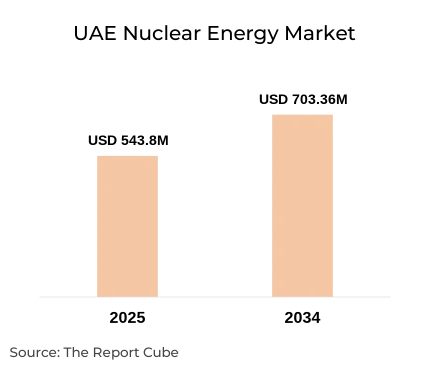
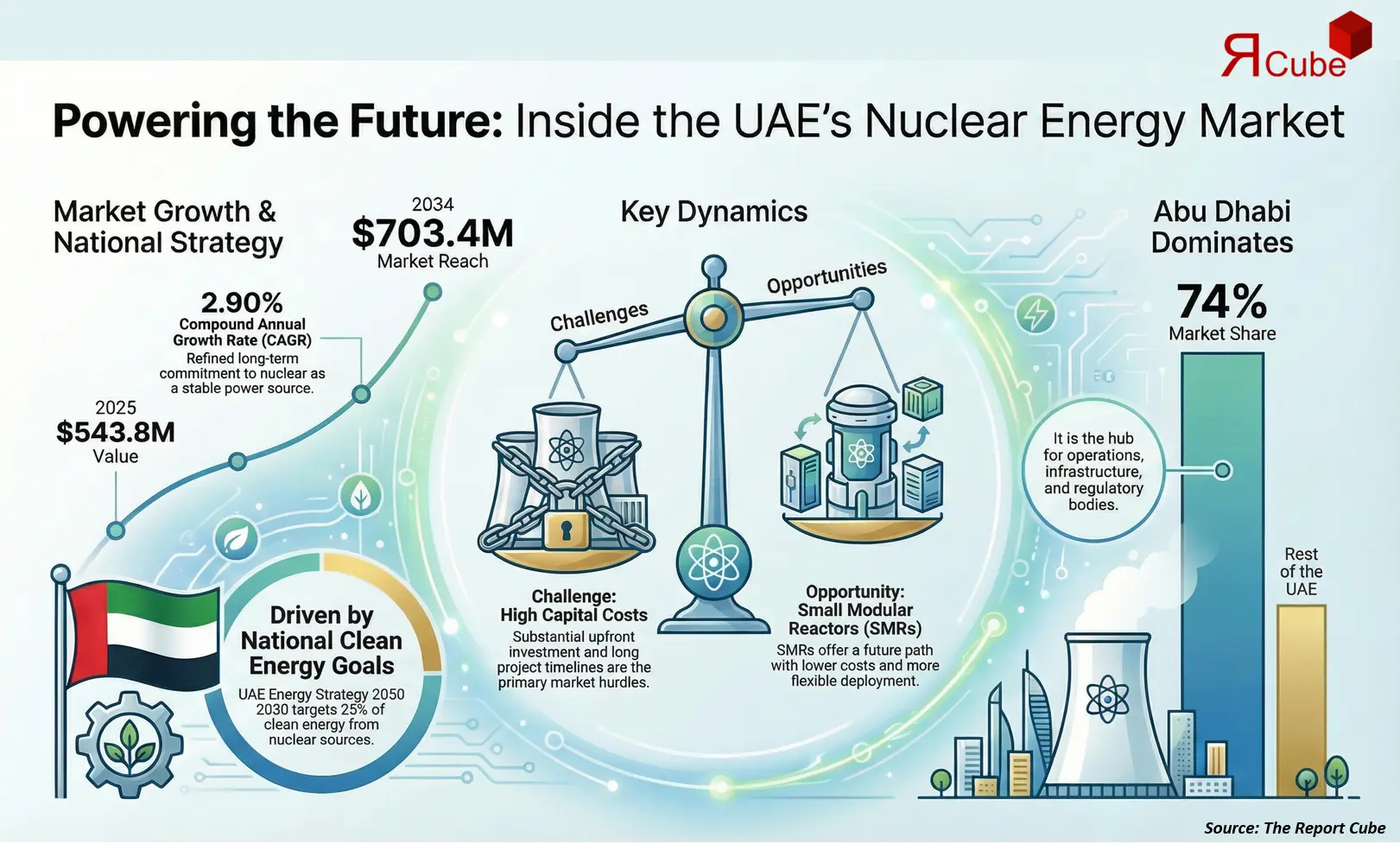
The UAE Nuclear Energy Market is anticipated to register a CAGR of 2.90% during the forecast period. The market size was valued at USD 543.8 million in 2025 and is projected to reach USD 703.36 million by 2034. This steady growth trajectory reflects the UAE’s long-term commitment to energy diversification, carbon reduction, and reliable baseload power generation through nuclear energy.
The UAE has emerged as a regional leader in peaceful nuclear energy deployment, anchored by the successful development of the Barakah Nuclear Energy Plant. Nuclear power plays a critical role in meeting rising electricity demand while supporting national net-zero ambitions. As renewable energy penetration increases, nuclear energy provides grid stability and consistent output, complementing intermittent solar generation. This strategic positioning has strengthened investor confidence and reinforced long-term policy alignment.
Moreover, the UAE’s strong regulatory framework, international partnerships, and emphasis on operational excellence continue to support market maturity. With increasing focus on fuel security, waste management, and next-generation reactor technologies, the UAE Nuclear Energy Market is evolving beyond generation into a holistic nuclear ecosystem, ensuring sustained relevance throughout the forecast period.
UAE Nuclear Energy Market Recent Developments
- 2025: Nawah Energy Company advanced operational optimization initiatives to enhance Barakah plant efficiency.
- 2025: ENEC strengthened international nuclear fuel supply agreements to ensure long-term energy security.
Government Initiatives & Policies
- UAE Energy Strategy 2050: National plan targeting 25% clean energy from nuclear sources.
- Net Zero by 2050 Initiative: Federal program integrating nuclear power into decarbonization strategy.
UAE Nuclear Energy Market Dynamics
Key Driver: National Commitment to Clean and Reliable Baseload Power
The primary driver of the UAE Nuclear Energy Market is the government’s strong commitment to clean, reliable, and large-scale baseload electricity generation. Nuclear energy significantly reduces dependence on fossil fuels while ensuring uninterrupted power supply to support industrial growth and urbanization. With electricity demand rising steadily due to population growth and economic diversification, nuclear power offers long-term cost stability and energy security. The successful commissioning of multiple reactors has demonstrated operational reliability, encouraging further investments across nuclear services, fuel management, and grid integration. This policy-backed commitment ensures nuclear energy remains a cornerstone of the UAE’s power mix.
Book your FREE 30-minute expert consultation today
Contact UsIndustry Trends: Expansion Beyond Generation into Full Nuclear Lifecycle
A key industry trend is the expansion of nuclear activities beyond power generation into fuel supply, waste management, and advanced nuclear services. Operators are increasingly focusing on lifecycle management, safety upgrades, and digital monitoring systems to enhance plant performance. Collaboration with global nuclear technology providers has accelerated knowledge transfer and workforce localization. Additionally, interest in Small Modular Reactor (SMR) feasibility studies is emerging as a long-term diversification strategy. These trends reflect the UAE’s intent to build a comprehensive nuclear value chain rather than relying solely on generation assets.
Major Challenge: High Capital Intensity and Long Development Timelines
Despite its benefits, nuclear energy faces challenges related to high upfront capital requirements and extended project timelines. Nuclear facilities require substantial investment in construction, safety systems, and regulatory compliance, which can strain budgets and delay returns. Additionally, public perception and the need for continuous safety assurance increase operational complexity. While the UAE has mitigated many risks through strong governance and international partnerships, capital intensity remains a structural challenge that may limit rapid capacity expansion in the near term.
Opportunity: SMR Development and Regional Nuclear Expertise Export
The growing global interest in Small Modular Reactors presents a significant opportunity for the UAE Nuclear Energy Market. SMRs offer flexible deployment, lower capital costs, and enhanced safety features, making them attractive for future applications. The UAE’s operational experience positions it to become a regional hub for nuclear expertise, consulting, and training services. Exporting regulatory, operational, and safety know-how to emerging nuclear markets could unlock new revenue streams and strengthen the UAE’s leadership in the global nuclear sector.
UAE Nuclear Energy Market Segment-wise Analysis
By Type:
- Nuclear Generation
- Nuclear Services
- Fuel Supply
- Waste Management
- Grid Integration
Nuclear Generation dominates the market, accounting for approximately 58% of total market share in 2025, driven by the operational reactors at Barakah. This segment benefits from long-term power purchase agreements and stable output. Nuclear Services follow, supported by maintenance, safety audits, and digital optimization initiatives. Fuel Supply and Waste Management collectively represent a growing share as operators prioritize fuel security and sustainable waste handling. Grid Integration is also gaining importance, ensuring seamless alignment between nuclear output and renewable energy sources.
By Reactor Type:
- Large Reactors
- SMR Projects
- Research Reactors
Large Reactors lead the market with nearly 82% share, reflecting the dominance of utility-scale nuclear facilities in the UAE. These reactors provide high-capacity, stable electricity generation. SMR Projects, while currently at an early stage, are attracting policy and research interest due to their scalability and flexibility. Research Reactors contribute a smaller share but play a vital role in training, innovation, and nuclear science development. Over time, SMRs are expected to gradually increase their contribution.
Regional Projection of UAE Nuclear Energy Industry
- Abu Dhabi
- Dubai
- Sharjah
- Northern Emirates
Abu Dhabi leads the UAE Nuclear Energy Market with an estimated 74% market share, supported by the location of the Barakah Nuclear Energy Plant and key operating entities. The emirate benefits from advanced infrastructure, skilled workforce concentration, and regulatory institutions. Dubai and Sharjah primarily contribute through grid integration, research collaboration, and energy policy alignment. The Northern Emirates hold a smaller share but are expected to benefit indirectly through grid stability and clean power distribution, reinforcing Abu Dhabi’s continued leadership.
Need insights for a specific region within this market?
Request Regional DataWhy Choose This Report?
- Provides a comprehensive overview of the overall market analysis, encompassing key trends, consumer behavior analysis, and risk assessment to support strategic decision-making.
- Provides accurate, up-to-date insights into market size, segmentation, and emerging opportunities, helping to minimize risk & capitalizing on growth.
- Gives deep understanding of target audience preferences, investment habits, and communication channels for enhanced product development & marketing effectiveness.
- Delivers competitive analysis & benchmarking, uncovering the strengths & weaknesses of market competitors to guide strategies.
- Consolidate comprehensive market intelligence, reducing reasoning & streamlining research efforts.
- Facilitates customized market segmentation & risk mitigation strategies, fine-tuned to the business objectives.
- Aids in identifying both market challenges & untapped opportunities within the industry to drive long-term business growth.
- Provides valuable information based on actual customer data & search trends.
Table of Contents
- Introduction
- Objective of the Study
- Product and Category Definition
- Market Segmentation
- Study Variables
- Research Methodology
- Secondary Data Points
- Breakdown of Secondary Sources
- Primary Data Points
- Breakdown of Primary Interviews
- Secondary Data Points
- Executive Summary
- Market Dynamics
- Drivers
- Challenges
- Opportunity Assessment
- Recent Trends and Developments
- Regulatory and Policy Landscape
- UAE Nuclear Energy Market Overview (2020-2034)
- Market Size, By Value (USD Billion)
- Market Share, By Type
- Nuclear Generation
- Nuclear Services
- Fuel Supply
- Waste Management
- Grid Integration
- Market Share, By Reactor Type
- Large Reactors
- SMR Projects
- Research Reactors
- Market Share, By Application
- Baseload Power
- Desalination
- Industrial Use
- Grid Balancing
- Market Share, By End User
- Utilities
- Government
- Large Industry
- Others
- Market Share, By Region (UAE)
- Abu Dhabi
- Dubai
- Sharjah
- Northern Emirates
- Market Share, By Company
- Competition Characteristics
- Revenue Shares & Analysis
- Abu Dhabi Nuclear Energy Market
- Market Size, By Value (USD Billion)
- Market Share, By Type
- Market Share, By Reactor Type
- Market Share, By Application
- Market Share, By End User
- Market Share, By Site Cluster
- Dubai Nuclear Energy Market
- Market Size, By Value (USD Billion)
- Market Share, By Type
- Market Share, By Reactor Type
- Market Share, By Application
- Market Share, By End User
- Market Share, By Grid Zone
- Sharjah and Northern Emirates Nuclear Energy Market
- Market Size, By Value (USD Billion)
- Market Share, By Type
- Market Share, By Reactor Type
- Market Share, By Application
- Market Share, By End User
- Market Share, By Interconnection
- Technology and Project Landscape
- Reactor Technology Overview (APR1400 and Others)
- New Build and Expansion Pipeline
- Refurbishment and Lifetime Extension
- Digitalization and Safety Systems
- Competitive Outlook and Company Profiles
- Emirates Nuclear Energy Corporation (ENEC)
- Company Overview
- Project Portfolio
- Strategic Alliances/Partnerships
- Recent Developments
- Nawah Energy Company
- Company Overview
- Operations Portfolio
- Strategic Alliances/Partnerships
- Recent Developments
- Korea Electric Power Corporation (KEPCO)
- Company Overview
- Project Portfolio
- Strategic Alliances/Partnerships
- Recent Developments
- Korea Hydro & Nuclear Power (KHNP)
- Company Overview
- Project Portfolio
- Strategic Alliances/Partnerships
- Recent Developments
- EDF (Électricité de France)
- Company Overview
- Services Portfolio
- Strategic Alliances/Partnerships
- Recent Developments
- Westinghouse Electric Company
- Company Overview
- Technology Portfolio
- Strategic Alliances/Partnerships
- Recent Developments
- Rosatom State Corporation
- Company Overview
- Project Portfolio
- Strategic Alliances/Partnerships
- Recent Developments
- China National Nuclear Corporation (CNNC)
- Company Overview
- Project Portfolio
- Strategic Alliances/Partnerships
- Recent Developments
- China General Nuclear Power Group (CGN)
- Company Overview
- Project Portfolio
- Strategic Alliances/Partnerships
- Recent Developments
- General Electric / GE Hitachi
- Company Overview
- Technology Portfolio
- Strategic Alliances/Partnerships
- Recent Developments
- Others
- Emirates Nuclear Energy Corporation (ENEC)
- Contact Us and Disclaimer
Top Key Players & Market Share Outlook
- Emirates Nuclear Energy Corporation (ENEC)
- Nawah Energy Company
- Korea Electric Power Corporation (KEPCO)
- Korea Hydro & Nuclear Power (KHNP)
- EDF (Électricité de France)
- Westinghouse Electric Company
- Rosatom State Corporation
- China National Nuclear Corporation (CNNC)
- China General Nuclear Power Group (CGN)
- General Electric / GE Hitachi
- Others
Frequently Asked Questions






