



Build Your Custom Market Intelligence Report
Customize Your ReportUAE Clean Energy Market Insights & Analysis
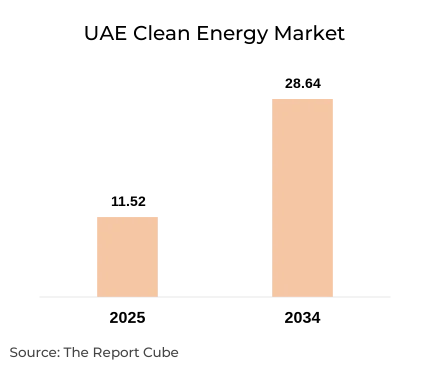
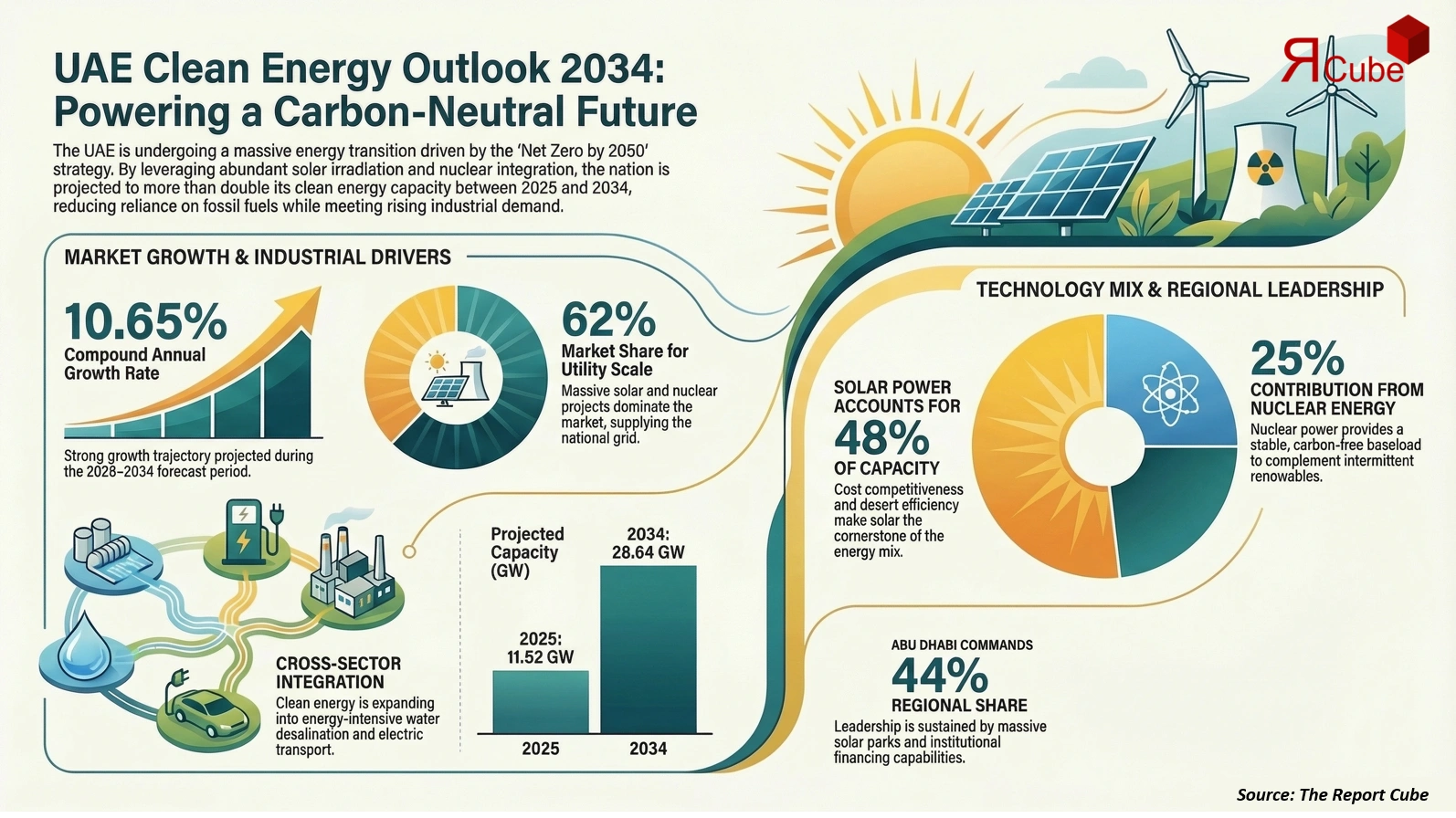
The UAE Clean Energy Market is anticipated to register a CAGR of 10.65% during the forecast period 2026-2034. The market capacity stood at 11.52 GW in 2025 and is projected to reach 28.64 GW by 2034. This strong growth trajectory reflects the UAE’s long-term commitment to energy diversification, carbon neutrality goals, and reduced reliance on fossil fuels, while ensuring energy security for a rapidly growing economy.
The UAE has positioned itself as a regional clean energy leader through aggressive renewable deployment, large-scale solar parks, nuclear power integration, and emerging green hydrogen initiatives. Government-backed utilities and private developers are actively expanding utility-scale solar and clean power projects to meet rising electricity demand from urbanization, industrial growth, and water desalination. Solar energy remains the cornerstone of the market, supported by abundant solar irradiation and declining technology costs.
In parallel, the integration of clean energy into transport, desalination, and industrial applications is reshaping the national energy mix. Investments in grid modernization, energy storage, and cross-sector electrification are strengthening system resilience. With strong policy support, international partnerships, and access to low-cost project financing, the UAE Clean Energy Market is expected to remain one of the fastest-growing renewable markets in the Middle East throughout the forecast period.
UAE Clean Energy Market Recent Developments
- 2025: Masdar expanded large-scale solar capacity under new utility-scale renewable power agreements in Abu Dhabi.
- 2025: DEWA advanced clean energy projects aligned with Dubai Clean Energy Strategy 2050 targets.
Government Initiatives & Policies
- UAE Net Zero by 2050 Strategy: National roadmap targeting economy-wide carbon neutrality.
- Dubai Clean Energy Strategy 2050: Aims to generate 100% of power from clean sources by 2050.
UAE Clean Energy Market Dynamics
Key Driver: Strong Government Commitment to Energy Transition
The primary driver of the UAE Clean Energy Market is the government’s strong and sustained commitment to transitioning toward low-carbon energy systems. Federal and emirate-level strategies have set clear renewable capacity targets, supported by regulatory clarity and long-term power purchase agreements. These policies reduce investor risk and enable large-scale deployment of solar, nuclear, and emerging clean technologies. In 2024, clean energy accounted for more than 27% of the UAE’s installed power capacity, reflecting rapid progress toward national goals. Government-backed entities play a central role in project development, ensuring consistent demand for clean energy solutions. This policy-driven environment continues to attract international developers and technology providers, accelerating market expansion and reinforcing the UAE’s leadership in regional energy transition efforts.
Book your FREE 30-minute expert consultation today
Contact UsIndustry Trends: Expansion of Solar and Green Hydrogen Projects
A key trend shaping the UAE Clean Energy Market is the rapid expansion of solar power alongside early-stage green hydrogen development. Utility-scale solar projects dominate capacity additions due to favorable economics and high efficiency in desert conditions. At the same time, the UAE is leveraging its renewable base to develop green hydrogen for export and domestic industrial use. Pilot hydrogen projects linked to solar and nuclear power are gaining momentum, positioning the country as a future clean fuel hub. Additionally, digital energy management, smart grids, and energy storage integration are becoming standard components of new projects. These trends indicate a shift from single-technology deployment toward an integrated clean energy ecosystem.
Major Challenge: Grid Integration and Intermittency Management
Despite rapid growth, managing grid stability and intermittency remains a major challenge for the UAE Clean Energy Market. High penetration of solar power creates variability in generation, requiring advanced grid management and energy storage solutions. While investments in battery storage and smart grid infrastructure are increasing, scaling these systems across all emirates requires significant capital and technical coordination. Furthermore, aligning clean energy generation with peak demand from cooling and desalination adds complexity. Addressing these challenges is essential to maintain system reliability while expanding renewable capacity at scale.
Opportunity: Clean Energy Integration in Desalination and Transport
The integration of clean energy into desalination and transport sectors presents a significant growth opportunity. The UAE’s water desalination plants are energy-intensive, and shifting them toward renewable-powered systems can substantially reduce emissions. Similarly, electrification of transport, including electric vehicles and green mobility infrastructure, is increasing clean power demand. These applications create stable, long-term consumption for renewable energy producers. As cross-sector integration accelerates, clean energy will move beyond power generation into a foundational role across the UAE’s economy.
UAE Clean Energy Market Segment-wise Analysis
By Technology Segment:
- Solar Power
- Wind Power
- Hydro Power
- Bioenergy
- Waste-to-Energy
- Nuclear Energy
- Green Hydrogen
- Other Clean Sources
Solar Power leads the technology segment, accounting for approximately 48% of total installed clean energy capacity in 2025. Its dominance is driven by cost competitiveness, scalability, and strong policy backing. Nuclear Energy follows, contributing nearly 25% of clean capacity, providing stable baseload power. Waste-to-Energy and Bioenergy are expanding steadily, particularly for municipal waste management. Green Hydrogen remains an emerging segment but is expected to record the fastest growth rate as pilot projects transition into commercial-scale operations during the forecast period.
By Application Segment:
- Utility Scale
- Commercial & Industrial
- Residential Rooftop
- Transport & Mobility
- Desalination & Water
Utility Scale applications dominate the market, holding nearly 62% share, driven by large solar and nuclear projects supplying national grids. Commercial & Industrial applications are growing as businesses adopt clean energy to reduce operating costs and meet sustainability goals. Desalination & Water applications are gaining strategic importance as utilities integrate renewable power into water production. Residential Rooftop remains smaller but shows steady growth in urban areas, while Transport & Mobility is emerging as a long-term demand driver.
Regional Projection of UAE Clean Energy Industry
- Abu Dhabi
- Dubai
- Sharjah
- Northern Emirates
Abu Dhabi leads the UAE Clean Energy Market with an estimated 44% share, supported by large-scale solar and nuclear projects and strong institutional backing. Dubai follows, driven by ambitious clean energy targets and extensive solar park development. Sharjah and the Northern Emirates are gradually expanding capacity through waste-to-energy and distributed renewable projects. Abu Dhabi’s leadership is expected to continue throughout the forecast period due to its scale, financing capability, and role as a clean energy innovation hub.
Need insights for a specific region within this market?
Request Regional DataWhy Choose This Report?
- Provides a comprehensive overview of the overall market analysis, encompassing key trends, consumer behavior analysis, and risk assessment to support strategic decision-making.
- Provides accurate, up-to-date insights into market size, segmentation, and emerging opportunities, helping to minimize risk & capitalizing on growth.
- Gives deep understanding of target audience preferences, investment habits, and communication channels for enhanced product development & marketing effectiveness.
- Delivers competitive analysis & benchmarking, uncovering the strengths & weaknesses of market competitors to guide strategies.
- Consolidate comprehensive market intelligence, reducing reasoning & streamlining research efforts.
- Facilitates customized market segmentation & risk mitigation strategies, fine-tuned to the business objectives.
- Aids in identifying both market challenges & untapped opportunities within the industry to drive long-term business growth.
- Provides valuable information based on actual customer data & search trends.
Table of Contents
- Introduction
- Objective of the Study
- Market and Technology Definition
- Market Segmentation
- Study Variables and Assumptions
- Research Methodology
- Secondary Data Points
- Breakdown of Secondary Sources
- Primary Data Points
- Breakdown of Primary Interviews
- Secondary Data Points
- Executive Summary
- Market Dynamics
- Drivers
- Challenges
- Opportunity Assessment
- Recent Trends and Developments
- Regulatory and Policy Landscape
- UAE Clean Energy Market Overview (2020-2034)
- Market Size, By Value (USD Billion)
- Market Share, By Technology Segment
- Solar Power
- Wind Power
- Hydro Power
- Bioenergy
- Waste-to-Energy
- Nuclear Energy
- Green Hydrogen
- Other Clean Sources
- Market Share, By Application Segment
- Utility Scale
- Commercial & Industrial
- Residential Rooftop
- Transport & Mobility
- Desalination & Water
- Market Share, By End-User Segment
- Power Utilities
- Oil & Gas
- Industrial Users
- Commercial Users
- Residential Users
- Public Sector
- Market Share, By Region
- Abu Dhabi
- Dubai
- Sharjah
- Northern Emirates
- Market Share, By Company
- Competition Characteristics
- Revenue Shares & Analysis
- Abu Dhabi Clean Energy Market
- Market Size, By Value (USD Billion)
- Market Share, By Technology Segment
- Market Share, By Application Segment
- Market Share, By End-User Segment
- Major Projects and Investments
- Dubai Clean Energy Market
- Market Size, By Value (USD Billion)
- Market Share, By Technology Segment
- Market Share, By Application Segment
- Market Share, By End-User Segment
- Major Projects and Investments
- Sharjah Clean Energy Market
- Market Size, By Value (USD Billion)
- Market Share, By Technology Segment
- Market Share, By Application Segment
- Market Share, By End-User Segment
- Major Projects and Investments
- Northern Emirates Clean Energy Market
- Market Size, By Value (USD Billion)
- Market Share, By Technology Segment
- Market Share, By Application Segment
- Market Share, By End-User Segment
- Major Projects and Investments
- Competitive Outlook and Company Profiles
- Masdar (Abu Dhabi Future Energy)
- Company Overview
- Clean Energy Portfolio
- Strategic Alliances/Partnerships
- Recent Developments
- Dubai Electricity and Water Authority (DEWA)
- Company Overview
- Clean Energy Portfolio
- Strategic Alliances/Partnerships
- Recent Developments
- Emirates Water and Electricity Company (EWEC)
- Company Overview
- Clean Energy Portfolio
- Strategic Alliances/Partnerships
- Recent Developments
- ACWA Power
- Company Overview
- Clean Energy Portfolio
- Strategic Alliances/Partnerships
- Recent Developments
- ENGIE
- Company Overview
- Clean Energy Portfolio
- Strategic Alliances/Partnerships
- Recent Developments
- EDF Renewables
- Company Overview
- Clean Energy Portfolio
- Strategic Alliances/Partnerships
- Recent Developments
- JinkoSolar
- Company Overview
- Clean Energy Portfolio
- Strategic Alliances/Partnerships
- Recent Developments
- Yellow Door Energy
- Company Overview
- Clean Energy Portfolio
- Strategic Alliances/Partnerships
- Recent Developments
- SirajPower
- Company Overview
- Clean Energy Portfolio
- Strategic Alliances/Partnerships
- Recent Developments
- AMEA Power
- Company Overview
- Clean Energy Portfolio
- Strategic Alliances/Partnerships
- Recent Developments
- Others
- Masdar (Abu Dhabi Future Energy)
- Contact Us and Disclaimer
Top Key Players & Market Share Outlook
- Masdar (Abu Dhabi Future Energy)
- Dubai Electricity and Water Authority (DEWA)
- Emirates Water and Electricity Company (EWEC)
- ACWA Power
- ENGIE
- EDF Renewables
- JinkoSolar
- Yellow Door Energy
- SirajPower
- AMEA Power
- Others
Frequently Asked Questions






