




Build Your Custom Market Intelligence Report
Customize Your ReportChina Solar Panel Manufacturing Market Key Highlights
By Technology:
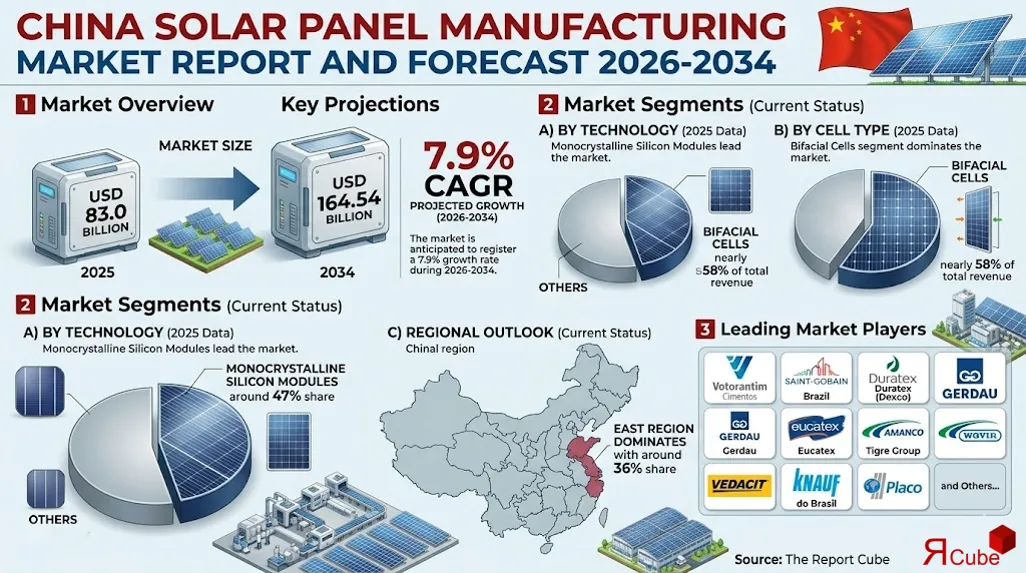
Monocrystalline Silicon Modules segment lead the market, with around 47% share.
By Cell Type:
Bifacial Cells segment dominate the market, accounting for nearly 58% of total revenue.
Regional Outlook:
East region dominates the China solar panel manufacturing market, with around 36% share.
China Solar Panel Manufacturing Market Insights & Analysis
The China Solar Panel Manufacturing Market is anticipated to register a 7.9% during 2026-2034. The market size was valued at USD 83.0 billion in 2025 and is projected to reach USD 164.54 billion by 2034. China has firmly established itself as the backbone of the global photovoltaic supply chain, producing nearly 80% of the world’s solar modules. This manufacturing strength has developed through continuous technological innovation, large-scale production capacity, and coordinated government support for renewable energy expansion. As global electricity demand rises and climate commitments intensify, China’s solar manufacturing ecosystem continues to attract large investments in wafer production, cell technology, and high-efficiency module assembly.
The industry’s evolution is closely tied to technological progress. Over the last five years, manufacturers rapidly transitioned from traditional multicrystalline cells to high-efficiency monocrystalline, PERC, and TopCon technologies. In 2025, China added more than 200 GW of new solar manufacturing capacity, reflecting strong domestic and export demand. Companies have increasingly invested in advanced production lines that reduce material loss while improving conversion efficiency above 25%. These upgrades are not just technical milestones; they directly improve project economics for developers worldwide. As a result, Chinese manufacturers remain at the center of global solar deployment.
Another important shift shaping the market is the integration of smart manufacturing and automation. Solar factories across provinces such as Jiangsu, Anhui, and Zhejiang now rely heavily on AI-driven quality inspection, robotics-based wafer slicing, and digital process monitoring. These innovations allow producers to maintain extremely high yields while lowering operational costs. As renewable electricity adoption accelerates worldwide, China’s manufacturing ecosystem continues to evolve into a highly sophisticated and technology-driven industrial network that supports the global transition toward cleaner energy.
China Solar Panel Manufacturing Market Dynamics
Key Driver: Rapid Expansion of Renewable Energy Targets in China and Global Markets
The most significant force accelerating the China solar panel manufacturing market is the strong expansion of renewable energy targets both domestically and internationally. China alone installed more than 210 GW of solar capacity in 2024, representing the largest annual solar deployment ever recorded globally. This rapid growth directly fuels demand for modules, wafers, and photovoltaic cells produced by Chinese manufacturers. Countries across Europe, Southeast Asia, and the Middle East rely heavily on imports from China to support their energy transition strategies.
Domestic policy frameworks also reinforce manufacturing growth. China’s carbon neutrality roadmap aims to achieve peak carbon emissions before 2030 and carbon neutrality by 2060. To support this objective, the government continues to promote large utility-scale solar farms and distributed rooftop systems. Manufacturing firms benefit from subsidies for high-efficiency modules, research funding for advanced cell technology, and tax incentives for renewable manufacturing facilities. These policy tools create a stable environment that encourages continuous investment in solar manufacturing infrastructure.
Book your FREE 30-minute expert consultation today
Contact UsIndustry Trends: Transition Toward High-Efficiency Solar Cell Technologies
Technology innovation has become a defining trend within China’s solar manufacturing industry. Traditional PERC modules dominated the market for several years, but manufacturers are now shifting quickly toward advanced technologies such as TopCon and heterojunction cells. These technologies offer higher conversion efficiency and improved performance in low-light environments. By 2025, TopCon production capacity in China surpassed 400 GW, reflecting strong industry adoption.
This transition is supported by continuous research collaboration between manufacturers, universities, and equipment suppliers. Many factories now integrate high-precision automation tools that improve wafer processing accuracy and reduce material waste. At the same time, module design has evolved to include larger wafer formats and bifacial technology that increases electricity generation from reflected sunlight. Together, these innovations allow Chinese manufacturers to produce modules that deliver greater output while maintaining competitive pricing.
Major Challenge: Volatility in Polysilicon Supply and Pricing
One major challenge for solar panel manufacturers in China relates to fluctuations in polysilicon supply and pricing. Polysilicon represents one of the most critical raw materials used in photovoltaic module production. Sudden increases in polysilicon prices can significantly raise manufacturing costs and disrupt project timelines for solar developers worldwide.
Although China has expanded domestic polysilicon production capacity in recent years, the industry occasionally experiences supply imbalances due to rapid demand growth. When global solar installations accelerate faster than expected, raw material shortages can emerge temporarily. Manufacturers must therefore continuously optimize their supply chain strategies, secure long-term procurement agreements, and invest in recycling technologies that recover silicon materials from production waste.
Opportunity: Export Expansion and Global Energy Transition
The global shift toward clean energy creates enormous opportunities for China’s solar manufacturing sector. Countries aiming to reduce reliance on fossil fuels increasingly invest in solar energy projects due to declining installation costs and fast construction timelines. As the world’s largest supplier of photovoltaic components, China stands to benefit significantly from this trend.
Export demand remains particularly strong in emerging markets such as Southeast Asia, Latin America, and the Middle East, where governments are expanding renewable energy capacity to support economic development. Chinese manufacturers are also forming strategic partnerships with overseas project developers, engineering firms, and energy utilities. These collaborations enable companies to integrate module manufacturing with full project development solutions, strengthening China’s influence across the global renewable energy value chain.
China Solar Panel Manufacturing Market Segment-wise Analysis
By Technology:
- Monocrystalline Silicon Modules
- Multicrystalline Silicon Modules
- Passivated Emitter Rear Cell (PERC) Modules
- TopCon Modules
- Heterojunction (HJT) Modules
- Thin-Film Modules
- Others
Among these technologies, monocrystalline silicon modules hold the leading position in the China solar panel manufacturing market, accounting for nearly 47% of total production capacity in 2025. The dominance of this segment is driven by its superior efficiency and improved long-term performance compared with traditional multicrystalline modules. Monocrystalline cells typically deliver conversion efficiencies above 23%, allowing solar developers to generate more electricity using fewer panels. This advantage is particularly important for utility-scale solar farms where land availability and project economics influence technology selection.
Chinese manufacturers have invested heavily in monocrystalline wafer production lines, enabling mass manufacturing of larger wafer formats such as M10 and G12. These larger wafers support higher module power ratings, often exceeding 600 watts per panel. As solar developers seek modules with greater energy output and lower installation costs, monocrystalline technology continues to strengthen its leadership within the manufacturing ecosystem.
By Cell Type:
- Monofacial Cells
- Bifacial Cells
Bifacial cells represent the fastest-growing and leading segment within the China solar panel manufacturing market, capturing around 58% of total module shipments in 2025. Unlike traditional monofacial panels that generate electricity only from the front surface, bifacial modules capture sunlight from both sides, increasing energy output by up to 15%. This efficiency improvement significantly enhances the financial returns of solar power projects.
The popularity of bifacial modules is particularly strong in large utility-scale installations located in desert regions and open landscapes. In these environments, sunlight reflected from the ground surface can be captured by the rear side of the panel. Chinese manufacturers have optimized module design using transparent backsheets and durable glass-glass structures to improve performance and durability, further accelerating adoption across international solar markets.
Regional Projection of China Solar Panel Manufacturing Industry
- North
- Northeast
- East
- South Central
- Southwest
- Northwest
The East region holds the leading share in the China solar panel manufacturing market, accounting for nearly 36% of the country’s production capacity. Provinces such as Jiangsu, Zhejiang, and Anhui have developed into major photovoltaic manufacturing hubs due to their well-established industrial infrastructure and access to global export ports. These regions host numerous large-scale solar manufacturing facilities that produce wafers, cells, and finished modules.
In addition to industrial infrastructure, the East region benefits from strong supply chain integration. Equipment suppliers, material producers, and research institutions operate within close proximity, enabling manufacturers to scale production efficiently while maintaining high quality standards. Local governments also support photovoltaic manufacturing through industrial parks, tax incentives, and renewable energy innovation programs. As global solar demand continues to rise, the East region is expected to remain the primary manufacturing base supporting China’s photovoltaic industry.
Government Initiatives & Policies
- China National Energy Administration Solar Development Plan (2025-2030): The policy supports large-scale solar manufacturing expansion and domestic photovoltaic innovation, encouraging advanced cell technologies such as TopCon and HJT while strengthening China’s global solar supply chain leadership.
- 14th Five-Year Renewable Energy Development Plan: China’s central government program prioritizes solar manufacturing capacity expansion, photovoltaic innovation, and utility-scale deployment to achieve carbon neutrality goals by 2060.
China Solar Panel Manufacturing Market Recent Developments
- 2025: Votorantim Cimentos announced a US$54.5 million investment to expand and modernize its Cuiabá and Nobres cement plants in Mato Grosso. The project, starting in 2025 and expected to conclude by late 2026, aims to increase production capacity while improving energy efficiency and reducing carbon emissions.
- 2025: Gerdau reported completion of key growth initiatives under its R$6.1 billion CAPEX program. The projects include the development of the Miguel Burnier sustainable mining platform and a new scrap processing facility in Pindamonhangaba, strengthening supply chain efficiency and reducing raw material costs.
- 2025: Weber (Quartzolit), Saint-Gobain inaugurated a highly automated mortar plant in Itaboraí, Rio de Janeiro. The facility introduces a compact factory design that can be constructed in about 90 days and produce around 70 tons of gray mortars annually.
Need insights for a specific region within this market?
Request Regional DataWhy Choose This Report?
- Provides a comprehensive overview of the overall market analysis, encompassing key trends, consumer behavior analysis, and risk assessment to support strategic decision-making.
- Provides accurate, up-to-date insights into market size, segmentation, and emerging opportunities, helping to minimize risk & capitalizing on growth.
- Gives deep understanding of target audience preferences, investment habits, and communication channels for enhanced product development & marketing effectiveness.
- Delivers competitive analysis & benchmarking, uncovering the strengths & weaknesses of market competitors to guide strategies.
- Consolidate comprehensive market intelligence, reducing reasoning & streamlining research efforts.
- Facilitates customized market segmentation & risk mitigation strategies, fine-tuned to the business objectives.
- Aids in identifying both market challenges & untapped opportunities within the industry to drive long-term business growth.
- Provides valuable information based on actual customer data & search trends.
Table of Contents
- Introduction
- Objective of the Study
- Product and Category Definition
- Market Segmentation
- Study Variables
- Research Methodology
- Secondary Data Points
- Breakdown of Secondary Sources
- Primary Data Points
- Breakdown of Primary Interviews
- Secondary Data Points
- Executive Summary
- Market Dynamics
- Drivers
- Challenges
- Opportunity Assessment
- Recent Trends and Developments
- Regulatory and Policy Landscape
- China Solar Panel Manufacturing Market Overview (2021-2034)
- Market Size, By Value (USD Billion)
- Market Size, By Production Volume (MW/GW)
- Market Share, By Technology
- Monocrystalline Silicon Modules
- Multicrystalline Silicon Modules
- Passivated Emitter Rear Cell (PERC) Modules
- TopCon Modules
- Heterojunction (HJT) Modules
- Thin-Film Modules
- Others
- Market Share, By Cell Type
- Monofacial Cells
- Bifacial Cells
- Market Share, By Installation Type
- Utility-Scale Solar Projects
- Commercial and Industrial Rooftop
- Residential Rooftop
- Off-Grid and Rural Electrification
- Market Share, By Application
- Power Generation Utilities
- Commercial and Industrial End Users
- Residential End Users
- Off-Grid and Hybrid Systems
- Market Share, By Manufacturing Stage
- Ingot and Wafer Production
- Solar Cell Production
- Module Assembly
- Market Share, By Module Power Rating
- Below 350 Watts
- 350 Watts to 500 Watts
- Above 500 Watts
- Market Share, By Distribution Channel
- Direct Sales to Project Developers
- Distributors and Wholesalers
- Engineering, Procurement and Construction (EPC) Contractors
- Online and Strategic Tenders
- Market Share, By Region
- North
- Northeast
- East
- South Central
- Southwest
- Northwest
- Market Share, By Company
- Revenue Shares & Analysis
- Competitive Landscape
- North China Solar Panel Manufacturing Market
- Market Size, By Value (USD Billion/Million)
- Market Size, By Production Volume (MW/GW)
- Market Share, By Technology
- Market Share, By Installation Type
- Market Share, By Application
- Market Share, By Manufacturing Stage
- Northeast China Solar Panel Manufacturing Market
- Market Size, By Value (USD Billion/Million)
- Market Size, By Production Volume (MW/GW)
- Market Share, By Technology
- Market Share, By Installation Type
- Market Share, By Application
- Market Share, By Manufacturing Stage
- East China Solar Panel Manufacturing Market
- Market Size, By Value (USD Billion/Million)
- Market Size, By Production Volume (MW/GW)
- Market Share, By Technology
- Market Share, By Installation Type
- Market Share, By Application
- Market Share, By Manufacturing Stage
- South Central China Solar Panel Manufacturing Market
- Market Size, By Value (USD Billion/Million)
- Market Size, By Production Volume (MW/GW)
- Market Share, By Technology
- Market Share, By Installation Type
- Market Share, By Application
- Market Share, By Manufacturing Stage
- Southwest China Solar Panel Manufacturing Market
- Market Size, By Value (USD Billion/Million)
- Market Size, By Production Volume (MW/GW)
- Market Share, By Technology
- Market Share, By Installation Type
- Market Share, By Application
- Market Share, By Manufacturing Stage
- Northwest China Solar Panel Manufacturing Market
- Market Size, By Value (USD Billion/Million)
- Market Size, By Production Volume (MW/GW)
- Market Share, By Technology
- Market Share, By Installation Type
- Market Share, By Application
- Market Share, By Manufacturing Stage
- Competitive Outlook and Company Profiles
- Votorantim Cimentos
- Company Overview
- Product Portfolio
- Strategic Alliances/Partnerships
- Recent Developments
- Saint-Gobain Brazil
- Company Overview
- Product Portfolio
- Strategic Alliances/Partnerships
- Recent Developments
- Duratex (Dexco)
- Company Overview
- Product Portfolio
- Strategic Alliances/Partnerships
- Recent Developments
- Gerdau
- Company Overview
- Product Portfolio
- Strategic Alliances/Partnerships
- Recent Developments
- Eucatex
- Company Overview
- Product Portfolio
- Strategic Alliances/Partnerships
- Recent Developments
- Tigre Group
- Company Overview
- Product Portfolio
- Strategic Alliances/Partnerships
- Recent Developments
- Amanco Wavin
- Company Overview
- Product Portfolio
- Strategic Alliances/Partnerships
- Recent Developments
- Vedacit
- Company Overview
- Product Portfolio
- Strategic Alliances/Partnerships
- Recent Developments
- Knauf do Brasil
- Company Overview
- Product Portfolio
- Strategic Alliances/Partnerships
- Recent Developments
- Placo
- Company Overview
- Product Portfolio
- Strategic Alliances/Partnerships
- Recent Developments
- Brasilit
- Company Overview
- Product Portfolio
- Strategic Alliances/Partnerships
- Recent Developments
- Suvinil
- Company Overview
- Product Portfolio
- Strategic Alliances/Partnerships
- Recent Developments
- Owens Corning
- Company Overview
- Product Portfolio
- Strategic Alliances/Partnerships
- Recent Developments
- Weber (Quartzolit)
- Company Overview
- Product Portfolio
- Strategic Alliances/Partnerships
- Recent Developments
- Sherwin-Williams
- Company Overview
- Product Portfolio
- Strategic Alliances/Partnerships
- Recent Developments
- EcoFIBER
- Company Overview
- Product Portfolio
- Strategic Alliances/Partnerships
- Recent Developments
- Others
- Votorantim Cimentos
- Contact Us and Disclaimer
Top Key Players & Market Share Outlook
- Votorantim Cimentos
- Saint-Gobain Brazil
- Duratex (Dexco)
- Gerdau
- Eucatex
- Tigre Group
- Amanco Wavin
- Vedacit
- Knauf do Brasil
- Placo
- Brasilit
- Suvinil
- Owens Corning
- Weber (Quartzolit)
- Sherwin-Williams
- EcoFIBER
Frequently Asked Questions






