



Build Your Custom Market Intelligence Report
Customize Your ReportMalaysia Industrial Robotics Market Key Highlights
By Robot Type:
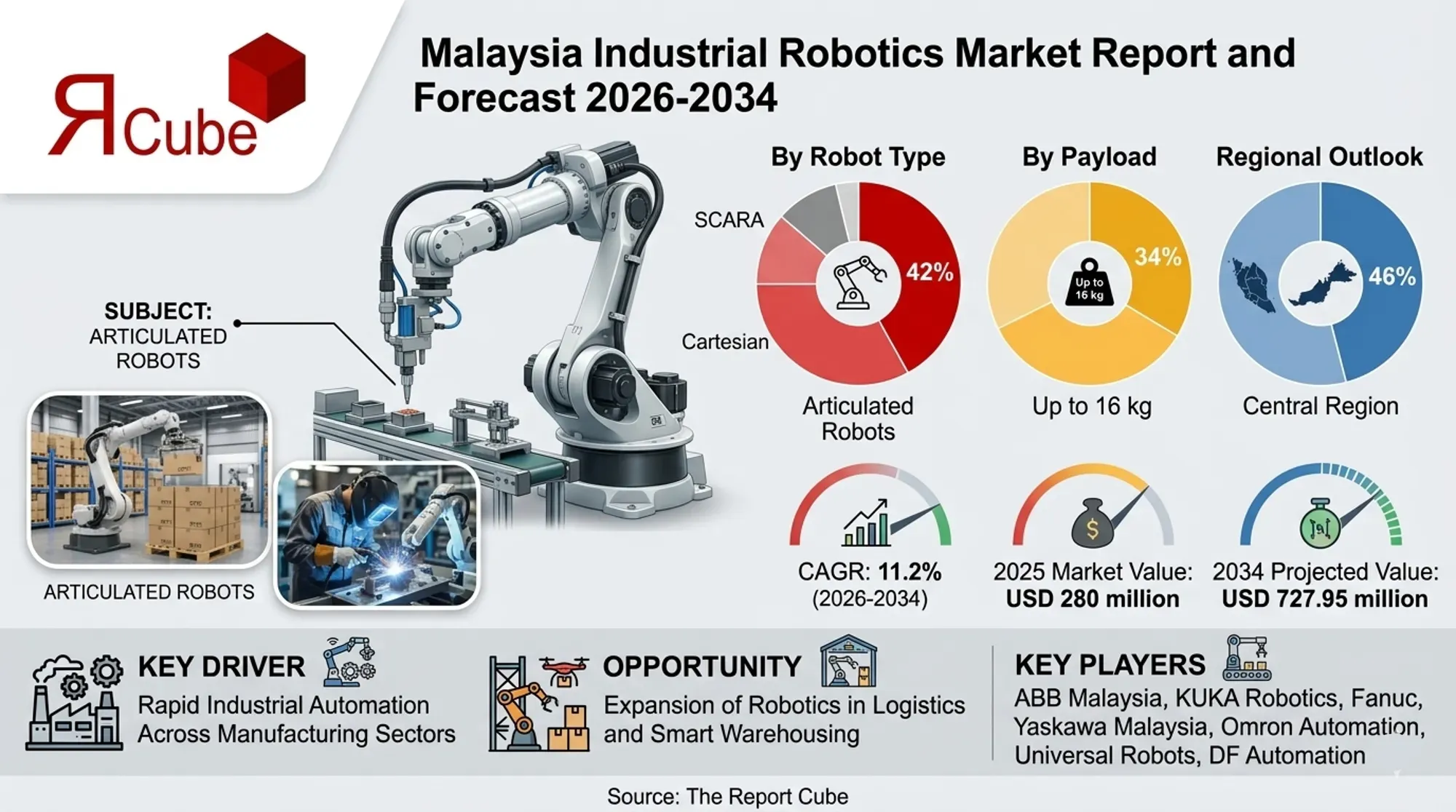
Articulated Robots segment leads the market, with around 42% market share.
By Payload:
Up to 16 kg segment dominates the market, accounting for nearly 34% of total revenue.
Regional Outlook:
Central region dominates the Malaysia industrial robotics market, with around 46% market share.
Government Initiatives & Policies
- Malaysia National Robotics Roadmap 2021-2030: The Malaysian government launched a national roadmap to accelerate robotics adoption in manufacturing and logistics sectors, encouraging Industry 4.0 integration and automation investments.
- Industry4WRD Policy by MITI: Malaysia’s national policy promoting Industry 4.0 technologies including robotics, AI, and smart automation to strengthen industrial productivity and digital transformation.
Malaysia Industrial Robotics Market Insights & Analysis
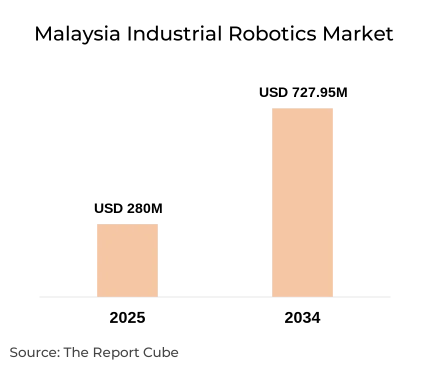
The Malaysia Industrial Robotics Market is anticipated to register a 11.2% during 2026-2034. the market size was valued at USD 280 million in 2025 and is projected to reach USD 727.95 million by 2034. Industrial robotics adoption in Malaysia is expanding rapidly as manufacturing companies continue to modernize production lines and improve operational efficiency. The country’s strong electronics, semiconductor, and automotive manufacturing base has created significant demand for automation technologies capable of increasing output while maintaining precision and consistency.
Malaysia is positioning itself as a key regional manufacturing hub within Southeast Asia, and robotics deployment has become central to achieving higher productivity levels. According to industry estimates, more than 1,800 industrial robots were installed in Malaysian factories during 2024, representing nearly 15% annual growth compared with previous years. Electrical and electronics manufacturing accounts for nearly 40% of total robot installations due to high-volume assembly processes and strict quality standards. Government support programs encouraging digital transformation have also accelerated adoption among small and medium enterprises that previously relied heavily on manual labor.
Investments from multinational manufacturers are further strengthening robotics demand. Global electronics brands operating in Malaysia are integrating advanced robotic arms and vision-guided systems to improve precision manufacturing for semiconductors, consumer electronics, and electric vehicle components. Automation suppliers are expanding local integration services, system design capabilities, and robotics training centers to support increasing demand. At the same time, collaborative robots are becoming popular among SMEs because they offer flexible automation without requiring large infrastructure changes. These developments are helping Malaysia transition from labor-intensive production toward advanced manufacturing ecosystems supported by robotics, AI, and smart factory technologies.
Malaysia Industrial Robotics Market Dynamics
Key Driver: Rapid Industrial Automation Across Manufacturing Sectors
Industrial automation across Malaysia’s manufacturing sector is the primary force driving the growth of the industrial robotics market. The country hosts thousands of electronics, semiconductor, and automotive component factories that depend on precision manufacturing processes. As global supply chains demand higher productivity and faster production cycles, manufacturers are adopting robotics to reduce production errors and increase operational efficiency. Robotics installations in electronics manufacturing alone account for nearly 45% of industrial robot demand in Malaysia because tasks such as PCB assembly, soldering, and inspection require consistent precision.
Automation also helps companies address workforce shortages in repetitive production roles. Many manufacturers report difficulty recruiting workers for repetitive tasks such as material handling and packaging. Industrial robots can operate continuously with minimal downtime, improving output consistency while lowering operational risk. Data from manufacturing associations indicates that factories integrating robotic automation have improved production efficiency by nearly 25% and reduced operational defects by almost 30%. These productivity improvements are encouraging more companies to deploy robots across assembly lines, machine tending operations, and logistics workflows.
Book your FREE 30-minute expert consultation today
Contact UsIndustry Trends: Integration of Smart Factories and Collaborative Robotics
One of the most prominent trends shaping the Malaysia industrial robotics market is the development of smart factories that integrate robotics, sensors, machine vision systems, and real-time data analytics. Manufacturers are shifting toward interconnected production environments where robots communicate with production management software and industrial IoT systems. This integration enables predictive maintenance, optimized machine performance, and real-time monitoring of production processes. Smart robotics platforms are also improving flexibility in manufacturing environments that produce multiple product variants.
Collaborative robots are gaining strong traction within Malaysia’s manufacturing ecosystem. These robots operate safely alongside human workers and are designed for small production cells rather than large automated lines. SMEs particularly benefit from collaborative robots because they can be deployed quickly and require lower capital investment compared with traditional industrial robots. In addition, modern robots equipped with vision systems and AI-based motion control are capable of performing complex tasks such as precision assembly and automated inspection. Technology suppliers are also expanding cloud-based robotics software that allows remote monitoring and performance optimization, strengthening the role of digital manufacturing technologies across Malaysia’s industrial sector.
Major Challenge: High Initial Investment and Integration Complexity
Although robotics adoption is growing steadily, high upfront investment remains a key challenge affecting wider deployment across Malaysia’s manufacturing sector. Industrial robots require substantial capital expenditure including hardware acquisition, system integration, safety infrastructure, and workforce training. For small and mid-sized enterprises, these costs can limit the pace of automation adoption even when long-term productivity benefits are clear. The cost of a fully integrated robotic workstation can range from USD 80,000 to more than USD 200,000 depending on complexity, which creates financial barriers for companies with limited automation budgets.
Integration challenges also affect implementation timelines. Robotic systems must be carefully configured to match existing production processes, requiring specialized engineering expertise and customized programming. Some factories operate legacy equipment that is not easily compatible with modern automation technologies. This can increase installation time and integration costs. Additionally, the need for skilled technicians capable of maintaining and programming robotics systems is growing rapidly. Training programs and technical education initiatives are expanding, yet many manufacturers still report shortages of automation specialists capable of supporting advanced robotics deployment.
Opportunity: Expansion of Robotics in Logistics and Smart Warehousing
Logistics and warehousing automation represents a major opportunity for the Malaysia industrial robotics market. As e-commerce and regional trade volumes expand, distribution centers are investing in robotic material handling solutions to improve efficiency and manage higher shipment volumes. Automated guided vehicles, robotic palletizing systems, and smart sorting robots are increasingly deployed in warehouses to streamline inventory movement and packaging processes. Industry estimates suggest that robotic automation can improve warehouse throughput by nearly 40% while reducing operational costs associated with manual handling.
Malaysia’s strategic geographic position as a logistics gateway for Southeast Asia further strengthens demand for automated logistics infrastructure. Ports, distribution centers, and cross-border trade facilities are modernizing operations through robotics and digital tracking technologies. Robotics suppliers are introducing integrated solutions combining robotic arms, autonomous mobile robots, and AI-driven inventory systems that enable real-time warehouse optimization. As logistics networks continue expanding to support regional trade and e-commerce growth, robotics adoption within the logistics sector is expected to accelerate significantly in the coming years.
Malaysia Industrial Robotics Market Segment-wise Analysis
By Robot Type:
- Articulated Robots
- SCARA Robots
- Cartesian Robots
- Cylindrical Robots
- Parallel Robots
- Collaborative Robots
- Others
Articulated robots dominate the Malaysia industrial robotics market, accounting for approximately 42% of total installations across manufacturing facilities. These robots are widely used in automotive assembly, welding, and heavy industrial manufacturing due to their multi-axis flexibility and ability to perform complex movements. Automotive component manufacturers rely heavily on articulated robots for welding and material handling processes that require high accuracy and repeatability. Electronics manufacturers also use these robots for automated assembly tasks that involve precise positioning and repetitive motion.
The versatility of articulated robots allows manufacturers to integrate them across multiple production processes including packaging, inspection, and palletizing. Many factories deploy six-axis articulated robots because they provide wide motion ranges and can handle various payload capacities. System integrators in Malaysia are increasingly offering modular robotic workcells that use articulated robots combined with vision systems and intelligent controllers. These integrated solutions improve production speed while reducing manual intervention. As manufacturing companies continue upgrading facilities toward smart factory environments, articulated robots are expected to remain the most widely deployed robotic systems within Malaysia’s industrial automation landscape.
By Payload:
- Up to 16 kg
- 16-60 kg
- 60-225 kg
- Above 225 kg
The up to 16 kg payload category holds the largest share in the Malaysia industrial robotics market, contributing nearly 34% of installations. These lightweight robots are widely used in electronics manufacturing, semiconductor production, and small component assembly processes where precision and speed are essential. Malaysia’s strong electronics manufacturing sector relies heavily on robots within this payload range for tasks such as PCB assembly, micro-component handling, inspection, and packaging. Their compact design allows easy integration into high-density production lines.
Robots within the up to 16 kg category also support collaborative automation environments where human workers and robots operate within the same workspace. These robots are easier to program, require smaller footprints, and often involve lower investment costs compared with heavy-duty robotic systems. As small and medium manufacturers increasingly adopt automation technologies, demand for lightweight robots is growing steadily. Robotics manufacturers are also developing advanced models equipped with vision systems, force sensors, and intelligent controllers that enable delicate handling of electronic components and precision assembly tasks.
Regional Projection of Malaysia Industrial Robotics Industry
- Northern
- Central
- Southern
- East
- Others
The Central region leads the Malaysia industrial robotics market, capturing nearly 46% of total robotic installations. This region hosts a large concentration of advanced manufacturing facilities, particularly in Selangor and Kuala Lumpur industrial zones where electronics, semiconductor, and automotive component production are highly developed. The presence of multinational manufacturers has accelerated robotics deployment to maintain competitive production standards and support export-oriented manufacturing operations. High-technology industrial parks and advanced manufacturing clusters within this region are major drivers of robotics adoption.
Many automation solution providers and robotics system integrators also operate within the Central region, making it easier for manufacturers to access integration services, technical support, and robotics maintenance capabilities. Government programs promoting Industry 4.0 transformation have focused strongly on industrial clusters in this region, encouraging companies to upgrade factories with advanced automation technologies. Additionally, the region benefits from strong logistics infrastructure, skilled engineering talent, and technology training institutions that support robotics deployment. As Malaysia continues strengthening its role as a regional manufacturing hub, the Central region is expected to remain the leading center for industrial robotics installations.
Malaysia Industrial Robotics Market Recent Developments
- 2025: ABB Robotics showcased several advanced industrial automation technologies at the China International Industry Fair 2025, including the OmniCore platform, IRB 6750S shelf robot, and IRB 920 SCARA variant. These innovations enhance autonomous manufacturing, high-speed assembly, and material handling capabilities across Asia-Pacific production facilities.
- 2025: Yaskawa Electric expanded its robotics solutions portfolio for Southeast Asian manufacturers by introducing high-precision robotic welding systems designed for automotive and heavy machinery industries. The new systems improve welding consistency and enable automated production lines for complex industrial components.
- 2025: Fanuc introduced advanced collaborative robots equipped with enhanced vision systems and AI-driven motion control for flexible manufacturing applications. These robots enable Malaysian manufacturers to automate inspection, packaging, and assembly processes while maintaining safe human-robot collaboration environments.
- 2025: Mitsubishi Electric launched next-generation MELFA industrial robots designed for high-speed electronics manufacturing and semiconductor assembly operations. The robots integrate intelligent controllers and predictive maintenance systems to improve productivity within smart factory environments.
Need insights for a specific region within this market?
Request Regional DataWhy Choose This Report?
- Provides a comprehensive overview of the overall market analysis, encompassing key trends, consumer behavior analysis, and risk assessment to support strategic decision-making.
- Provides accurate, up-to-date insights into market size, segmentation, and emerging opportunities, helping to minimize risk & capitalizing on growth.
- Gives deep understanding of target audience preferences, investment habits, and communication channels for enhanced product development & marketing effectiveness.
- Delivers competitive analysis & benchmarking, uncovering the strengths & weaknesses of market competitors to guide strategies.
- Consolidate comprehensive market intelligence, reducing reasoning & streamlining research efforts.
- Facilitates customized market segmentation & risk mitigation strategies, fine-tuned to the business objectives.
- Aids in identifying both market challenges & untapped opportunities within the industry to drive long-term business growth.
- Provides valuable information based on actual customer data & search trends.
Table of Contents
- Introduction
- Objective of the Study
- Product and Category Definition
- Market Segmentation
- Study Variables
- Research Methodology
- Secondary Data Points
- Breakdown of Secondary Sources
- Primary Data Points
- Breakdown of Primary Interviews
- Secondary Data Points
- Executive Summary
- Market Dynamics
- Drivers
- Challenges
- Opportunity Assessment
- Recent Trends and Developments
- Regulatory and Policy Landscape
- Malaysia Industrial Robotics Market Overview (2021-2034)
- Market Size, By Value (USD Million)
- Market Share, By Robot Type
- Articulated Robots
- SCARA Robots
- Cartesian Robots
- Cylindrical Robots
- Parallel Robots
- Collaborative Robots
- Others
- Market Share, By Payload
- Up to 16 kg
- 16-60 kg
- 60-225 kg
- Above 225 kg
- Market Share, By Component
- Robot Controllers
- Robot Arms
- End Effectors
- Drives and Motors
- Sensors and Vision Systems
- Software and Services
- Market Share, By Application
- Material Handling
- Welding and Soldering
- Assembly and Handling
- Painting and Coating
- Machine Tending
- Packaging and Palletizing
- Inspection and Testing
- Others
- Market Share, By End-User Industry
- Automotive
- Electrical and Electronics
- Metal and Machinery
- Food and Beverage
- Pharmaceutical and Medical Devices
- Logistics and Warehousing
- Others
- Market Share, By Region
- Northern
- Central
- Southern
- East
- Others
- Market Share, By Company
- Revenue Shares and Analysis
- Competitive Landscape
- Northern Malaysia Industrial Robotics Market
- Market Size, By Value (USD Million)
- Market Share, By Robot Type
- Market Share, By Payload
- Market Share, By Component
- Market Share, By Application
- Market Share, By End-User Industry
- Central Malaysia Industrial Robotics Market
- Market Size, By Value (USD Million)
- Market Share, By Robot Type
- Market Share, By Payload
- Market Share, By Component
- Market Share, By Application
- Market Share, By End-User Industry
- Southern Malaysia Industrial Robotics Market
- Market Size, By Value (USD Million)
- Market Share, By Robot Type
- Market Share, By Payload
- Market Share, By Component
- Market Share, By Application
- Market Share, By End-User Industry
- East Malaysia Industrial Robotics Market
- Market Size, By Value (USD Million)
- Market Share, By Robot Type
- Market Share, By Payload
- Market Share, By Component
- Market Share, By Application
- Market Share, By End-User Industry
- Competitive Outlook and Company Profiles
- ABB Malaysia
- Company Overview
- Product Portfolio
- Strategic Alliances/Partnerships
- Recent Developments
- KUKA Robotics
- Company Overview
- Product Portfolio
- Strategic Alliances/Partnerships
- Recent Developments
- Fanuc
- Company Overview
- Product Portfolio
- Strategic Alliances/Partnerships
- Recent Developments
- Yaskawa Malaysia
- Company Overview
- Product Portfolio
- Strategic Alliances/Partnerships
- Recent Developments
- Omron Automation
- Company Overview
- Product Portfolio
- Strategic Alliances/Partnerships
- Recent Developments
- Universal Robots
- Company Overview
- Product Portfolio
- Strategic Alliances/Partnerships
- Recent Developments
- DF Automation
- Company Overview
- Product Portfolio
- Strategic Alliances/Partnerships
- Recent Developments
- MAi Automation
- Company Overview
- Product Portfolio
- Strategic Alliances/Partnerships
- Recent Developments
- TSM Robotics
- Company Overview
- Product Portfolio
- Strategic Alliances/Partnerships
- Recent Developments
- Chin Tech EC
- Company Overview
- Product Portfolio
- Strategic Alliances/Partnerships
- Recent Developments
- Robopreneur
- Company Overview
- Product Portfolio
- Strategic Alliances/Partnerships
- Recent Developments
- PBA Robotics
- Company Overview
- Product Portfolio
- Strategic Alliances/Partnerships
- Recent Developments
- Mitsubishi Electric
- Company Overview
- Product Portfolio
- Strategic Alliances/Partnerships
- Recent Developments
- Festo Malaysia
- Company Overview
- Product Portfolio
- Strategic Alliances/Partnerships
- Recent Developments
- XTS Technologies
- Company Overview
- Product Portfolio
- Strategic Alliances/Partnerships
- Recent Developments
- RSI Automation
- Company Overview
- Product Portfolio
- Strategic Alliances/Partnerships
- Recent Developments
- MAKES Engineering
- Company Overview
- Product Portfolio
- Strategic Alliances/Partnerships
- Recent Developments
- Others
- ABB Malaysia
- Contact Us and Disclaimer
Top Key Players & Market Share Outlook
- ABB Malaysia
- KUKA Robotics
- Fanuc
- Yaskawa Malaysia
- Omron Automation
- Universal Robots
- DF Automation
- MAi Automation
- TSM Robotics
- Chin Tech EC
- Robopreneur
- PBA Robotics
- Mitsubishi Electric
- Festo Malaysia
- XTS Technologies
- RSI Automation
- MAKES Engineering
Frequently Asked Questions






