



Build Your Custom Market Intelligence Report
Customize Your ReportNigeria Real Estate Market Insights & Analysis
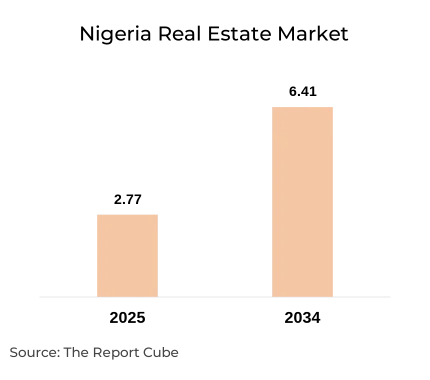
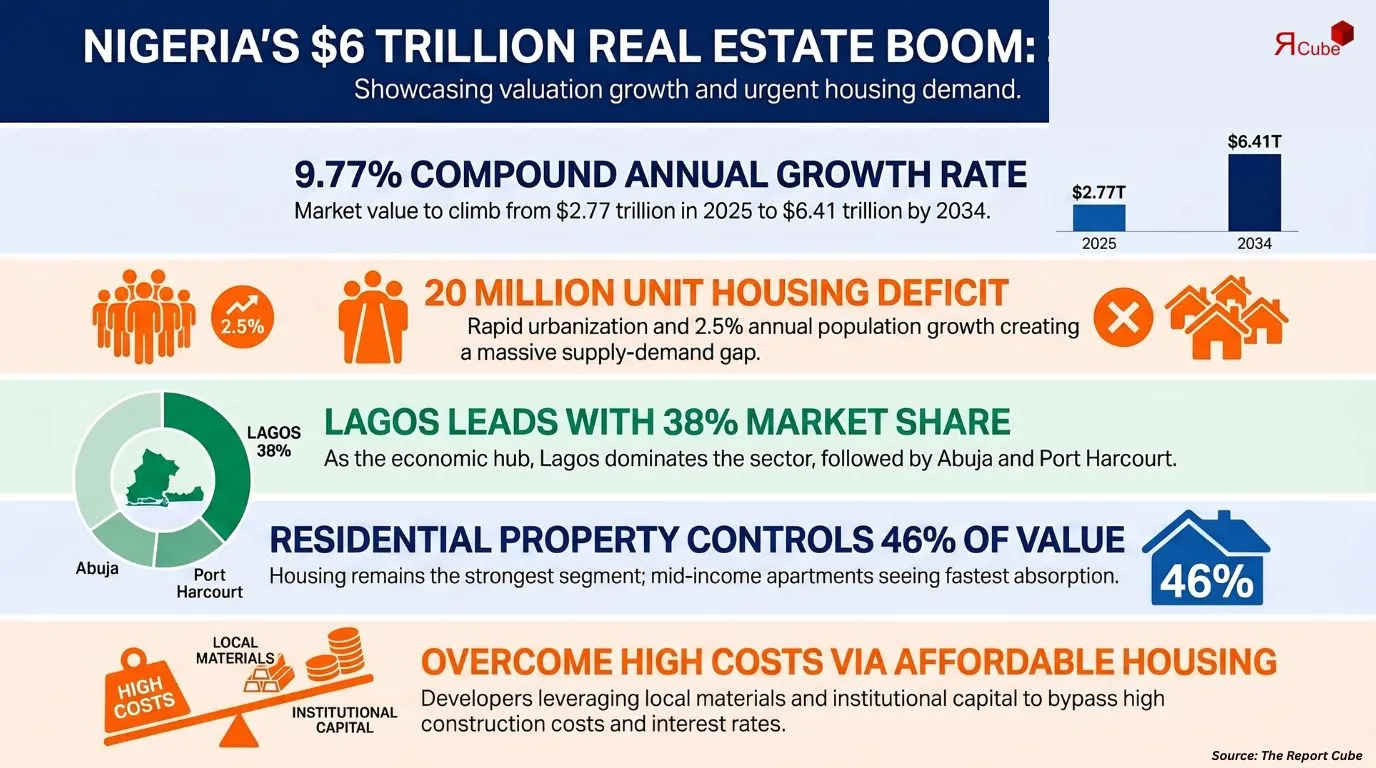
The Nigeria Real Estate Market is anticipated to register a CAGR of 9.77% during 2026-2034. The market size was valued at USD 2.77 trillion in 2025 and is projected to reach USD 6.41 trillion by 2034. This strong expansion is underpinned by rapid urbanization, sustained population growth exceeding 2.5% annually, and increasing infrastructure investments across major cities. Real estate has become a core pillar of Nigeria’s non-oil economy, attracting both domestic and foreign capital seeking long-term asset appreciation and inflation hedging.
Demand dynamics are largely shaped by Nigeria’s housing deficit, estimated at over 20 million units, which continues to widen due to rural-to-urban migration. Residential developments dominate new project pipelines, particularly in metropolitan hubs such as Lagos and Abuja, where employment concentration and lifestyle migration are highest. Alongside housing demand, commercial and mixed-use developments are expanding to support retail, office, and logistics needs linked to Nigeria’s growing services and consumer sectors.
Furthermore, policy reforms encouraging public-private partnerships, coupled with gradual improvements in mortgage accessibility, are strengthening market confidence. Developers are increasingly adopting phased construction and flexible pricing models to match buyer affordability. As a result, the Nigeria Real Estate Market is transitioning from fragmented growth toward more structured, large-scale developments, setting a stable foundation for long-term expansion.
Nigeria Real Estate Market Recent Developments
- 2025: Mixta Africa launched a large-scale mixed-income residential project in Lagos to address urban housing demand.
- 2025: Landmark Africa expanded its commercial real estate footprint with a new lifestyle and retail destination.
Government Initiatives & Policies
- National Housing Programme: Federal initiative supporting affordable housing delivery through public-private collaboration.
- Infrastructure Corporation of Nigeria (InfraCorp): Investment platform accelerating infrastructure and real estate-linked projects.
Nigeria Real Estate Market Dynamics
Key Driver: Rapid Urbanization and Housing Deficit
Rapid urbanization remains the primary growth driver of the Nigeria Real Estate Market. With over 54% of Nigerians projected to live in urban areas by 2035, demand for residential housing continues to outpace supply. Major cities are experiencing sustained inflows of working-age populations seeking employment and improved living standards. This imbalance has elevated demand across affordable, mid-income, and luxury housing segments. Developers are responding with high-density apartments and gated communities to maximize land utilization. Additionally, rising middle-class aspirations are fueling demand for better-quality housing, reinforcing steady absorption rates and long-term market momentum.
Book your FREE 30-minute expert consultation today
Contact UsIndustry Trends: Shift Toward Mixed-Use and Master-Planned Developments
A notable trend in Nigeria’s real estate sector is the shift toward mixed-use and master-planned developments. Developers increasingly integrate residential, commercial, retail, and leisure components within single projects to create self-sustaining communities. This approach reduces infrastructure strain and enhances property value. Lagos and Abuja are leading this trend, where land scarcity and traffic congestion make integrated developments more attractive. Moreover, smart infrastructure planning, improved security, and lifestyle amenities are becoming key differentiators, shaping buyer preferences and influencing pricing strategies across new developments.
Major Challenge: High Construction Costs and Financing Constraints
High construction costs present a significant challenge to market expansion. Fluctuating exchange rates, dependence on imported building materials, and rising energy costs directly impact project budgets. Additionally, limited access to long-term financing and high interest rates constrain both developers and buyers. Mortgage penetration remains below 1% of GDP, restricting affordability for many households. These constraints often delay project delivery timelines and increase final property prices, limiting broader market participation and slowing large-scale housing delivery.
Opportunity: Affordable Housing and Institutional Investment Growth
Affordable housing development represents a major opportunity within the Nigeria Real Estate Market. Government-backed incentives and growing interest from institutional investors are encouraging scalable housing solutions. Pension funds and private equity firms are increasingly viewing residential real estate as a stable, income-generating asset class. By leveraging standardized designs and local materials, developers can improve cost efficiency and unlock mass-market demand. This convergence of policy support and institutional capital is expected to accelerate affordable housing supply over the forecast period.
Nigeria Real Estate Market Segment-wise Analysis
By Property:
- Residential
- Commercial
- Industrial
- Retail
- Land
The Residential segment leads the Nigeria Real Estate Market, accounting for approximately 46% of total market value in 2025. This dominance is driven by persistent housing shortages and strong urban population growth. Residential demand spans affordable apartments to high-end estates, with mid-income housing showing the fastest absorption. Commercial and retail properties follow, supported by expanding business activity and consumer spending, while industrial real estate is gaining momentum due to logistics and warehousing demand.
By Buyer Type:
- Owner-Occupier
- Individual Investor
- Institutional Investor
- Public Sector
Owner-occupiers represent the largest buyer group, contributing nearly 52% of transactions in 2025. This reflects strong end-user demand for primary residences. Individual investors remain active, particularly in rental-focused residential properties. Institutional investors, although smaller in share, are expanding rapidly, driven by interest in commercial, mixed-use, and large-scale residential developments offering predictable long-term returns.
Regional Projection of Nigeria Real Estate Industry
- Lagos
- Abuja
- Port Harcourt
- Other South West
Lagos leads the Nigeria Real Estate Market, accounting for approximately 38% of total market value in 2025. As the country’s economic hub, Lagos benefits from high population density, diversified economic activity, and continuous infrastructure upgrades. Demand spans residential, commercial, and retail properties, with premium pricing sustained by land scarcity. Abuja follows, driven by administrative functions and planned urban development, while Port Harcourt’s market is supported by energy-sector-linked demand.
Need insights for a specific region within this market?
Request Regional DataWhy Choose This Report?
- Provides a comprehensive overview of the overall market analysis, encompassing key trends, consumer behavior analysis, and risk assessment to support strategic decision-making.
- Provides accurate, up-to-date insights into market size, segmentation, and emerging opportunities, helping to minimize risk & capitalizing on growth.
- Gives deep understanding of target audience preferences, investment habits, and communication channels for enhanced product development & marketing effectiveness.
- Delivers competitive analysis & benchmarking, uncovering the strengths & weaknesses of market competitors to guide strategies.
- Consolidate comprehensive market intelligence, reducing reasoning & streamlining research efforts.
- Facilitates customized market segmentation & risk mitigation strategies, fine-tuned to the business objectives.
- Aids in identifying both market challenges & untapped opportunities within the industry to drive long-term business growth.
- Provides valuable information based on actual customer data & search trends.
Table of Contents
- Introduction
- Objective of the Study
- Product and Category Definition
- Market Segmentation
- Study Variables
- Research Methodology
- Secondary Data Points
- Breakdown of Secondary Sources
- Primary Data Points
- Breakdown of Primary Interviews
- Secondary Data Points
- Executive Summary
- Market Dynamics
- Drivers
- Challenges
- Opportunity Assessment
- Recent Trends and Developments
- Regulatory and Policy Landscape
- Nigeria Real Estate Market Overview (2021-2034)
- Market Size, By Value (NGN / USD)
- Market Share, By Segment
- Residential
- Commercial
- Industrial
- Retail
- Land
- Market Share, By Buyer Type
- Owner-Occupier
- Individual Investor
- Institutional Investor
- Public Sector
- Market Share, By Use Type
- Affordable Housing
- Mid-Income Housing
- Luxury Housing
- Mixed-Use
- Market Share, By Region
- Lagos
- Abuja
- Port Harcourt
- Other South West
- Market Share, By Company
- Revenue Shares
- Competitive Landscape
- Lagos Real Estate Market
- Market Size, By Value (NGN / USD)
- Market Share, By Segment
- Market Share, By Buyer Type
- Market Share, By Use Type
- Market Share, By Sub-Region
- Market Share, By Key Corridor
- Abuja Real Estate Market
- Market Size, By Value (NGN / USD)
- Market Share, By Segment
- Market Share, By Buyer Type
- Market Share, By Use Type
- Market Share, By District
- Port Harcourt Real Estate Market
- Market Size, By Value (NGN / USD)
- Market Share, By Segment
- Market Share, By Buyer Type
- Market Share, By Use Type
- Market Share, By Axis
- Other Regions Real Estate Market
- Market Size, By Value (NGN / USD)
- Market Share, By Segment
- Market Share, By Buyer Type
- Market Share, By Use Type
- Market Share, By State Cluster
- Competitive Outlook and Company Profiles
- Julius Berger Nigeria
- Company Overview
- Project Portfolio
- Strategic Alliances/Partnerships
- Recent Developments
- Sujimoto Construction
- Company Overview
- Project Portfolio
- Strategic Alliances/Partnerships
- Recent Developments
- UPDC PLC
- Company Overview
- Project Portfolio
- Strategic Alliances/Partnerships
- Recent Developments
- Landmark Africa
- Company Overview
- Project Portfolio
- Strategic Alliances/Partnerships
- Recent Developments
- Mixta Africa
- Company Overview
- Project Portfolio
- Strategic Alliances/Partnerships
- Recent Developments
- Brains and Hammers
- Company Overview
- Project Portfolio
- Strategic Alliances/Partnerships
- Recent Developments
- Rendeavour
- Company Overview
- Project Portfolio
- Strategic Alliances/Partnerships
- Recent Developments
- Persianas Group
- Company Overview
- Project Portfolio
- Strategic Alliances/Partnerships
- Recent Developments
- Eko Development
- Company Overview
- Project Portfolio
- Strategic Alliances/Partnerships
- Recent Developments
- Adron Homes
- Company Overview
- Project Portfolio
- Strategic Alliances/Partnerships
- Recent Developments
- Others
- Julius Berger Nigeria
- Contact Us and Disclaimer
Top Key Players & Market Share Outlook
- Julius Berger Nigeria
- Sujimoto Construction
- UPDC PLC
- Landmark Africa
- Mixta Africa
- Brains and Hammers
- Rendeavour
- Persianas Group
- Eko Development
- Adron Homes
- Others
Frequently Asked Questions






