



Build Your Custom Market Intelligence Report
Customize Your ReportMalaysia Renewable Energy Solar Farm Market Key Highlights
By Project Type:
Utility-scale Solar Farms segment leads the market, with around 46% market share.
By Technology:
Monocrystalline Silicon segment dominates the market, accounting for nearly 52% of total revenue.
Regional Outlook:
Central region dominates the Malaysia renewable energy solar farm market, with around 38% market share.
Malaysia Renewable Energy Solar Farm Market Insights & Analysis
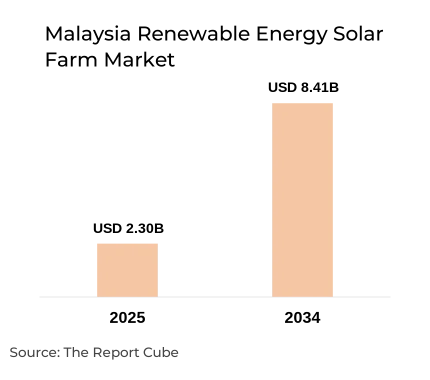
The Malaysia Renewable Energy Solar Farm Market is anticipated to register a 15.5% CAGR during 2026-2034. The market size was valued at USD 2.3 billion in 2025 and is projected to reach USD 8.41 billion by 2034. Malaysia’s energy landscape is experiencing a steady transformation as solar power becomes central to the national decarbonization strategy. Rising electricity demand from manufacturing clusters, data centers, and rapidly expanding urban infrastructure has pushed policymakers and utilities to accelerate renewable energy investments. Solar farms have emerged as the most scalable renewable option due to Malaysia’s favorable solar irradiation levels, averaging 4.5-5.5 kWh/m² daily across most regions.
Government policy has played a strong role in shaping this growth trajectory. Initiatives such as the National Energy Transition Roadmap and the fifth round of the Large Scale Solar (LSS) program have unlocked large investment flows into solar infrastructure development. The government targets at least 31% renewable electricity capacity by 2025 and aims to reach 40% by 2035. These targets have encouraged independent power producers, engineering firms, and infrastructure developers to actively participate in solar project bidding. Financial incentives, including tax allowances and green financing facilities through Malaysian development banks, are further improving project viability and attracting private capital.
Malaysia Renewable Energy Solar Farm Market Dynamics
Key Driver: Rising National Commitment Toward Clean Energy and Decarbonization
Malaysia’s long-term decarbonization strategy stands as the most important force driving the solar farm market. The country has pledged to reduce carbon intensity by 45% by 2030 compared with 2005 levels, which requires a rapid expansion of renewable power generation. Solar farms provide the fastest path to increasing clean electricity capacity because they can be deployed faster than hydro or nuclear infrastructure. As a result, solar energy has become a key pillar in Malaysia’s energy transition roadmap.
The industrial sector also contributes significantly to solar demand. Malaysia hosts large electronics manufacturing hubs and is becoming a regional center for cloud computing and data center infrastructure. These facilities consume substantial electricity and increasingly rely on renewable power procurement to meet sustainability goals set by global parent companies. Long-term solar power purchase agreements provide predictable energy costs while helping corporations meet carbon neutrality targets.
Book your FREE 30-minute expert consultation today
Contact UsIndustry Trends: Integration of Energy Storage and Floating Solar Technologies
Solar technology adoption in Malaysia is evolving beyond traditional ground-mounted installations. Developers are increasingly integrating battery energy storage systems with solar farms to improve grid stability and provide consistent power supply during evening demand peaks. This trend is particularly important as renewable penetration rises, since energy storage allows utilities to balance intermittent generation.
Floating solar farms represent another growing trend in the Malaysian market. The country possesses numerous reservoirs and water bodies that provide ideal conditions for floating photovoltaic installations. By placing solar panels on water surfaces, developers reduce land acquisition challenges and improve panel efficiency because water helps cool the modules. Floating systems can also reduce water evaporation from reservoirs, creating an additional environmental benefit.
Major Challenge: Grid Integration and Land Availability Constraints
While solar energy deployment is expanding rapidly, grid integration remains a notable challenge for Malaysia’s renewable energy market. The national electricity grid was originally designed around centralized fossil fuel power plants, which provide consistent generation. Integrating large volumes of solar power requires grid upgrades, improved transmission infrastructure, and smart energy management systems capable of handling intermittent renewable supply.
Land availability also presents a practical constraint for solar farm development, particularly in densely populated or industrial regions. Utility-scale solar installations require large land parcels, which can create competition with agriculture, urban expansion, or conservation areas. Developers must carefully assess land suitability and environmental impact before launching new projects.
Opportunity: Expanding Corporate Renewable Power Demand and Regional Energy Exports
Malaysia’s solar farm market holds strong opportunities through rising corporate demand for renewable electricity. Multinational technology firms and manufacturing companies increasingly seek renewable power to meet global sustainability commitments. Solar farms linked with long-term power purchase agreements provide an attractive solution for both energy suppliers and corporate buyers.
Regional electricity trade also offers a promising opportunity. Southeast Asia is exploring cross-border power trading under the ASEAN Power Grid initiative. Malaysia’s growing renewable energy capacity, particularly from solar farms, could position the country as an exporter of clean electricity to neighboring markets in the future.
Malaysia Renewable Energy Solar Farm Market Segment-wise Analysis
By Project Type:
- Utility-scale Solar Farms
- Commercial and Industrial Solar Farms
- Community and Cooperative Solar Farms
- Hybrid Solar Farms with Storage
- Floating Solar Farms
Utility-scale solar farms hold the leading position in the Malaysia Renewable Energy Solar Farm Market, accounting for nearly 46% of total installed capacity in 2025. These projects typically exceed 50 MW and are designed to supply electricity directly to the national grid through long-term contracts with utilities or power buyers. The Large Scale Solar (LSS) program has been instrumental in expanding this segment by creating competitive bidding opportunities for developers and engineering companies.
Utility-scale installations offer economies of scale that reduce the cost of electricity generation. Large land parcels allow developers to deploy thousands of photovoltaic modules and advanced tracking systems that maximize power output. The segment also attracts strong investment from infrastructure funds and energy companies seeking stable long-term revenue streams.
By Technology:
- Monocrystalline Silicon
- Polycrystalline Silicon
- Thin-film Photovoltaic
- Bifacial Photovoltaic
- Others
Monocrystalline silicon technology leads the Malaysian solar farm market, capturing nearly 52% of installations. These panels are widely preferred because of their higher efficiency, often exceeding 21% conversion efficiency compared with other photovoltaic technologies. High efficiency allows developers to generate more electricity from the same land area, which is particularly important for large utility-scale projects.
Monocrystalline modules also perform better under Malaysia’s tropical climate conditions. Their improved heat tolerance helps maintain stable energy output even during high ambient temperatures. As developers focus on maximizing energy yield, this technology has become the standard choice for new solar farm developments.
Regional Projection of Malaysia Renewable Energy Solar Farm Industry
- Northern
- Central
- Southern
- East
- Others
The Central region dominates the Malaysia Renewable Energy Solar Farm Market with nearly 38% of installed capacity. This region includes economically important states such as Selangor and Negeri Sembilan, which host major industrial clusters and infrastructure networks. High electricity demand from manufacturing facilities, logistics hubs, and commercial centers has encouraged large investments in solar power generation across the region.
Another advantage of the Central region lies in its well-developed grid infrastructure. Proximity to major transmission lines and substations reduces project connection costs and improves operational efficiency for solar farms. Developers often prioritize locations where grid integration is easier, allowing projects to reach commercial operation faster.
Government Initiatives & Policies
- Malaysia National Energy Transition Roadmap (NETR): Malaysia launched the NETR program to accelerate renewable energy deployment and solar capacity expansion toward achieving 70% renewable energy in the power mix by 2050.
- Large Scale Solar (LSS PETRA) Program: The Energy Commission continues competitive solar project bidding through LSS initiatives to boost utility-scale solar capacity and attract private sector investment.
Malaysia Renewable Energy Solar Farm Market Recent Developments
- 2025: Solarvest Holdings was selected by Tenaga Nasional Berhad to construct a 500 MW large-scale solar park under Malaysia’s fifth round of the national large-scale solar initiative, significantly expanding renewable electricity capacity and supporting the country’s renewable energy mix and long-term net-zero objectives.
- 2025: Cypark Resources announced that its consortium with Sunview was shortlisted by the Energy Commission to develop a 99.99 MW large-scale solar photovoltaic plant in Port Dickson under the LSS PETRA 5+ bidding exercise, strengthening the company’s pipeline of utility-scale solar assets.
- 2025: Samaiden Group secured a RM100.75 million EPCC contract for a utility-scale solar photovoltaic project awarded under the Large Scale Solar 5 program, covering engineering, procurement, construction, testing, and commissioning for the project.
- 2025: Gentari partnered with Gamuda to develop 1.5 GW of solar photovoltaic power plants integrated with battery energy storage systems in Malaysia, targeting rising power demand from hyperscale data centers and strengthening the country’s renewable energy capacity pipeline.
Need insights for a specific region within this market?
Request Regional DataWhy Choose This Report?
- Provides a comprehensive overview of the overall market analysis, encompassing key trends, consumer behavior analysis, and risk assessment to support strategic decision-making.
- Provides accurate, up-to-date insights into market size, segmentation, and emerging opportunities, helping to minimize risk & capitalizing on growth.
- Gives deep understanding of target audience preferences, investment habits, and communication channels for enhanced product development & marketing effectiveness.
- Delivers competitive analysis & benchmarking, uncovering the strengths & weaknesses of market competitors to guide strategies.
- Consolidate comprehensive market intelligence, reducing reasoning & streamlining research efforts.
- Facilitates customized market segmentation & risk mitigation strategies, fine-tuned to the business objectives.
- Aids in identifying both market challenges & untapped opportunities within the industry to drive long-term business growth.
- Provides valuable information based on actual customer data & search trends.
Table of Contents
- Introduction
- Objective of the Study
- Product and Category Definition
- Market Segmentation
- Study Variables
- Research Methodology
- Secondary Data Points
- Breakdown of Secondary Sources
- Primary Data Points
- Breakdown of Primary Interviews
- Secondary Data Points
- Executive Summary
- Market Dynamics
- Drivers
- Challenges
- Opportunity Assessment
- Recent Trends and Developments
- Regulatory and Policy Landscape
- Malaysia Renewable Energy Solar Farm Market Overview (2021-2034)
- Market Size, By Value (USD Billion)
- Market Size, By Installed Capacity (MW)
- Market Share, By Project Type
- Utility-scale Solar Farms
- Commercial and Industrial Solar Farms
- Community and Cooperative Solar Farms
- Hybrid Solar Farms with Storage
- Floating Solar Farms
- Market Share, By Technology
- Monocrystalline Silicon
- Polycrystalline Silicon
- Thin-film Photovoltaic
- Bifacial Photovoltaic
- Others
- Market Share, By Mounting Structure
- Fixed-tilt Ground-mounted
- Single-axis Tracking
- Dual-axis Tracking
- Rooftop-mounted Solar Farms
- Market Share, By End User
- Utility and Independent Power Producers
- Commercial and Industrial Customers
- Government and Public Sector
- Residential Aggregators and Cooperatives
- Others
- Market Share, By Contract Type
- Power Purchase Agreements
- Build-Own-Operate
- Engineering Procurement and Construction
- Leasing and Third-party Ownership
- Market Share, By Region
- Northern
- Central
- Southern
- East
- Others
- Market Share, By Company
- Revenue Shares and Analysis
- Competitive Landscape
- Northern Malaysia Renewable Energy Solar Farm Market
- Market Size, By Value (USD Billion/Million)
- Market Size, By Installed Capacity (MW)
- Market Share, By Project Type
- Market Share, By Technology
- Market Share, By Mounting Structure
- Market Share, By End User
- Market Share, By Contract Type
- Central Malaysia Renewable Energy Solar Farm Market
- Market Size, By Value (USD Billion/Million)
- Market Size, By Installed Capacity (MW)
- Market Share, By Project Type
- Market Share, By Technology
- Market Share, By Mounting Structure
- Market Share, By End User
- Market Share, By Contract Type
- Southern Malaysia Renewable Energy Solar Farm Market
- Market Size, By Value (USD Billion/Million)
- Market Size, By Installed Capacity (MW)
- Market Share, By Project Type
- Market Share, By Technology
- Market Share, By Mounting Structure
- Market Share, By End User
- Market Share, By Contract Type
- East Malaysia Renewable Energy Solar Farm Market
- Market Size, By Value (USD Billion/Million)
- Market Size, By Installed Capacity (MW)
- Market Share, By Project Type
- Market Share, By Technology
- Market Share, By Mounting Structure
- Market Share, By End User
- Market Share, By Contract Type
- Competitive Outlook and Company Profiles
- Solarvest Holdings
- Company Overview
- Project Portfolio
- Strategic Alliances and Partnerships
- Recent Developments
- Tenaga Nasional
- Company Overview
- Project Portfolio
- Strategic Alliances and Partnerships
- Recent Developments
- Cypark Resources
- Company Overview
- Project Portfolio
- Strategic Alliances and Partnerships
- Recent Developments
- Samaiden Group
- Company Overview
- Project Portfolio
- Strategic Alliances and Partnerships
- Recent Developments
- Sunview Group
- Company Overview
- Project Portfolio
- Strategic Alliances and Partnerships
- Recent Developments
- Pekat Group
- Company Overview
- Project Portfolio
- Strategic Alliances and Partnerships
- Recent Developments
- Malakoff Corporation
- Company Overview
- Project Portfolio
- Strategic Alliances and Partnerships
- Recent Developments
- YTL Power International
- Company Overview
- Project Portfolio
- Strategic Alliances and Partnerships
- Recent Developments
- Gentari
- Company Overview
- Project Portfolio
- Strategic Alliances and Partnerships
- Recent Developments
- Plus Solar
- Company Overview
- Project Portfolio
- Strategic Alliances and Partnerships
- Recent Developments
- Ditrolic Energy
- Company Overview
- Project Portfolio
- Strategic Alliances and Partnerships
- Recent Developments
- BM Greentech
- Company Overview
- Project Portfolio
- Strategic Alliances and Partnerships
- Recent Developments
- Coara Solar
- Company Overview
- Project Portfolio
- Strategic Alliances and Partnerships
- Recent Developments
- ET Solar Malaysia
- Company Overview
- Project Portfolio
- Strategic Alliances and Partnerships
- Recent Developments
- Leader Energy
- Company Overview
- Project Portfolio
- Strategic Alliances and Partnerships
- Recent Developments
- GSPARX
- Company Overview
- Project Portfolio
- Strategic Alliances and Partnerships
- Recent Developments
- Others
- Solarvest Holdings
- Contact Us and Disclaimer
Top Key Players & Market Share Outlook
- Solarvest Holdings
- Tenaga Nasional
- Cypark Resources
- Samaiden Group
- Sunview Group
- Pekat Group
- Malakoff Corporation
- YTL Power International
- Gentari
- Plus Solar
- Ditrolic Energy
- BM Greentech
- Coara Solar
- ET Solar Malaysia
- Leader Energy
- GSPARX
Frequently Asked Questions