



Build Your Custom Market Intelligence Report
Customize Your ReportMalaysia Renewable Energy for Mining Market Key Highlights
By Power Source:
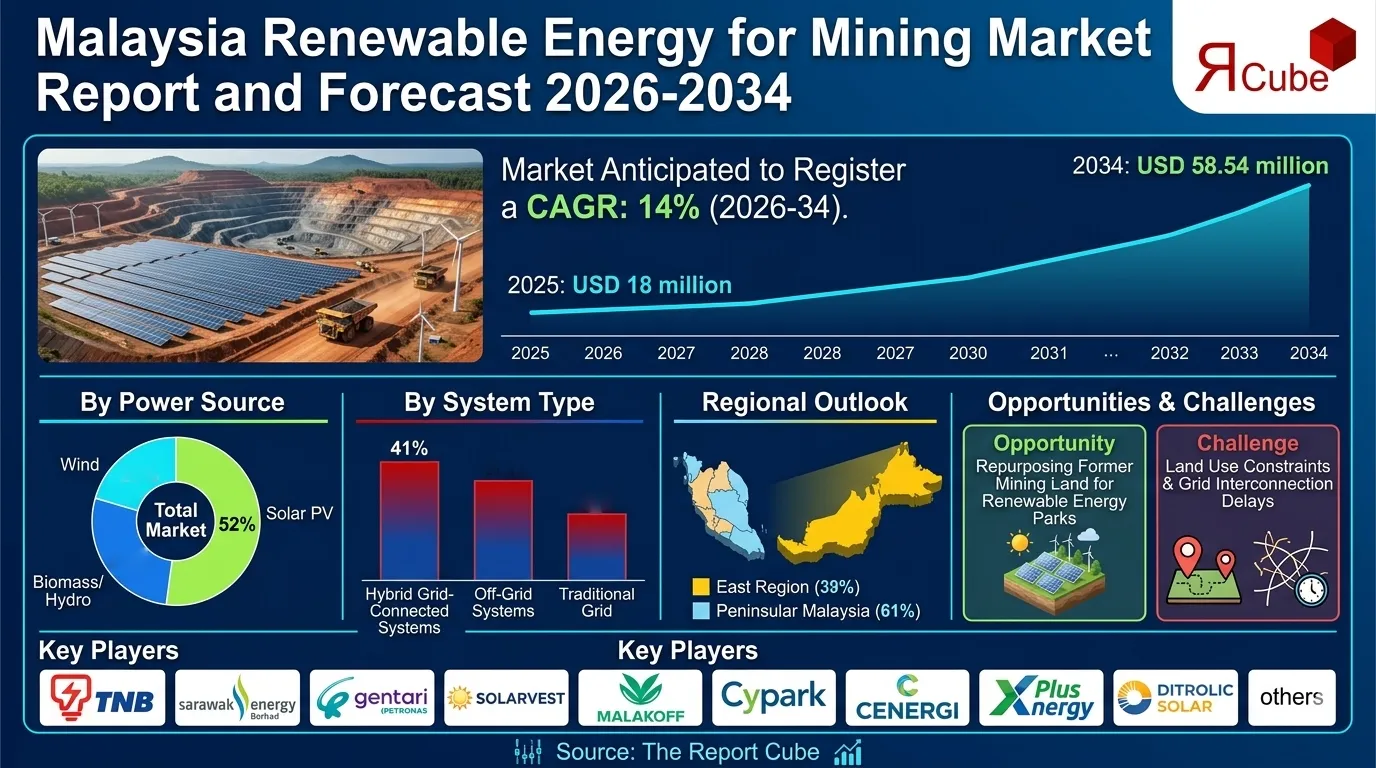
Solar Photovoltaic (PV) segment leads the market, with around 52% share.
By System Type:
Hybrid Grid-Connected Systems segment dominates the market, accounting for nearly 41% of total revenue.
Regional Outlook:
East region dominates the malaysia renewable energy for mining market, with around 39% share.
Government Initiatives & Policies
- National Energy Transition Roadmap (NETR) 2025 Update: Expands large-scale solar (LSS5+), green industrial clusters, and renewable integration for heavy industries including mining.
- Large Scale Solar 5+ (LSS PETRA 5+) Program by Energy Commission Malaysia: Supports utility-scale renewable capacity through competitive bidding and long-term PPAs with Tenaga Nasional Berhad.
Malaysia Renewable Energy for Mining Market Insights & Analysis
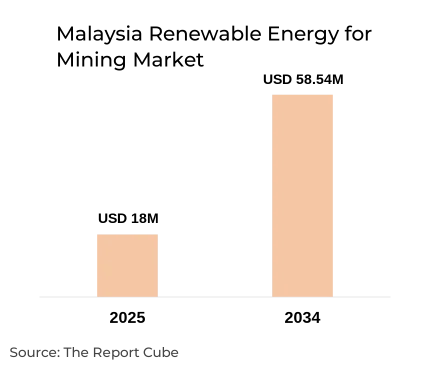
The Malaysia Renewable Energy for Mining Market is anticipated to register a CAGR: 14% during 2026-34. The market size was valued at USD 18 million in 2025 and is projected to reach USD 58.54 million by 2034. The market is gaining momentum as Malaysia accelerates decarbonization in heavy industries and integrates renewable energy into energy-intensive sectors, including metal mining, quarries, and mineral processing operations.
Malaysia’s mining and quarrying sector contributes significantly to industrial GDP, particularly in bauxite, tin, limestone, rare earth elements, and aggregates. Rising electricity tariffs and corporate sustainability commitments are prompting mine operators to explore solar PV, hybrid systems, and battery-backed microgrids. Industrial electricity demand in Malaysia is estimated to grow at over 4% annually through 2030, with mining-intensive states such as Sarawak, Johor, and Perak emerging as renewable deployment hubs. Renewable integration reduces fuel volatility exposure and supports ESG reporting requirements tied to export markets.
Solar PV remains the backbone of renewable deployment for mining, driven by favorable irradiation levels averaging 4.5-5.5 kWh/m²/day across peninsular Malaysia. Ground-mounted solar farms co-located near quarries and mineral processing plants are becoming common. In East Malaysia, hydropower from Sarawak Energy Berhad complements solar generation, enabling stable hybrid configurations for energy-intensive smelting and mineral processing facilities. Battery Energy Storage Systems (BESS) adoption is expanding to manage intermittency and ensure operational continuity during peak extraction cycles.
Investment activity under the National Energy Transition Roadmap (NETR) and LSS5+ program is catalyzing large-scale renewable capacity additions that indirectly benefit mining supply chains. The increasing use of third-party Power Purchase Agreements (PPAs) enables mining firms to access clean electricity without upfront capital expenditure. As sustainability-linked financing gains traction, renewable-powered mining operations are positioned to attract preferential funding terms and global investor interest, reinforcing long-term growth prospects.
Malaysia Renewable Energy for Mining Market Dynamics
Key Driver: Decarbonization Mandates and Industrial Electricity Cost Optimization
Malaysia’s commitment to achieving net-zero emissions by 2050 is accelerating renewable deployment across industrial sectors. Mining companies are under pressure to reduce Scope 2 emissions linked to electricity consumption. Grid tariffs for industrial users have shown upward adjustments, increasing operational expenditure sensitivity. Solar PV installations can reduce energy costs by 15-25% over a project lifecycle under long-term PPAs. Furthermore, multinational mineral buyers increasingly require low-carbon sourcing certifications. Renewable adoption enables Malaysian mining operators to align with global supply chain sustainability frameworks. Hybrid renewable systems combining solar, hydropower, and battery storage improve reliability, ensuring uninterrupted extraction and processing operations. These economic and compliance benefits collectively drive strong adoption momentum.
Book your FREE 30-minute expert consultation today
Contact UsIndustry Trends: Growth of Hybrid Renewable Systems and Battery Integration
Hybrid grid-connected systems are gaining strong traction, accounting for nearly 41% of installations in 2025. Mining operations require stable baseload power, which standalone solar cannot guarantee. Integration of BESS with smart inverters and microgrid control systems enables load balancing and demand-side management. Floating solar PV is emerging in former mining ponds, particularly in Perak and Johor, repurposing degraded land into energy assets. Digital energy management platforms allow predictive maintenance and real-time monitoring, reducing downtime by up to 18%. Partnerships between EPC providers and independent power producers are accelerating turnkey renewable project deployment for large quarries and mineral processing plants.
Major Challenge: Land Use Constraints and Grid Interconnection Delays
Land acquisition for large-scale solar installations can be complex, particularly in environmentally sensitive or rehabilitated mining zones. Environmental impact assessments and permitting timelines may extend project development cycles. Additionally, grid interconnection approvals and transmission capacity constraints in certain regions slow deployment. In remote mining sites, upgrading substations and transmission infrastructure increases capital expenditure. Weather variability during monsoon seasons may also affect solar generation patterns. These structural constraints require careful project structuring, hybrid system design, and proactive regulatory coordination to ensure timely implementation.
Opportunity: Repurposing Former Mining Land for Renewable Energy Parks
Malaysia possesses significant tracts of former tin and mineral mining land suitable for solar farm development. Repurposing such sites reduces land acquisition costs while supporting environmental rehabilitation goals. Floating solar on abandoned mining lakes presents dual benefits of energy generation and evaporation reduction. Mining firms adopting captive renewable plants can secure long-term energy independence and hedge against tariff volatility. The expansion of sustainability-linked loans and green sukuk financing mechanisms further strengthens the economic case for renewable-powered mining infrastructure. Over time, integrated renewable hubs could transform former mining corridors into clean energy clusters, stimulating regional economic diversification.
Malaysia Renewable Energy for Mining Market Segment-wise Analysis
By Power Source:
- Solar Photovoltaic (PV)
- Onshore Wind
- Hydropower (Small and Large)
- Biomass and Biogas
- Waste-to-Energy
- Hybrid Renewable Systems
- Others
Solar Photovoltaic (PV) leads with approximately 52% market share in 2025 due to cost competitiveness and rapid scalability. Levelized cost of electricity (LCOE) for utility-scale solar in Malaysia has declined by nearly 35% over the past five years. Ground-mounted solar installations near mining clusters in Sarawak and Johor are expanding under LSS5+ tenders. Floating solar installations on reclaimed mining lakes enhance land utilization efficiency. Hydropower supports heavy industrial mining in East Malaysia, but solar remains the primary driver of capacity additions. Strong irradiation levels and competitive EPC pricing position solar PV as the dominant power source through 2034.
By Ownership Model:
- Utility-owned Projects
- Independent Power Producer (IPP) Projects
- Mine-owned Captive Power
- Third-party Power Purchase Agreements (PPAs)
Third-party PPAs account for nearly 38% of project deployment models, reflecting mining firms’ preference for asset-light renewable adoption. Under long-term PPAs, developers finance, build, and operate renewable systems while mines secure stable energy pricing. Independent Power Producers are increasingly active in hybrid grid-connected solutions. Utility-owned projects dominate large hydropower supply in Sarawak. Captive solar installations are emerging among larger mining operators seeking full energy control. Flexible financing structures and sustainability-linked agreements are expected to expand PPA adoption significantly during the forecast period.
Regional Projection of Malaysia Renewable Energy for Mining Industry
- Northern
- Central
- Southern
- East
- Others
The East region holds approximately 39% market share, supported by Sarawak’s hydropower capacity and energy-intensive industrial corridors. The Sarawak Corridor of Renewable Energy (SCORE) hosts metal smelting and mineral processing facilities benefiting from renewable integration. Southern Malaysia, particularly Johor, is emerging as a renewable-industrial hub due to large-scale solar investments and cross-border industrial growth. Northern states such as Perak are repurposing former mining areas into renewable energy parks. Central Malaysia benefits from proximity to industrial demand centers but faces higher land costs. Regional renewable deployment closely aligns with mining and heavy industrial concentration patterns.
Malaysia Renewable Energy for Mining Market Recent Developments
- 2025: Solarvest Holdings Berhad entered a joint venture with Press Metal Aluminium Holdings to co-develop a 100 MWac solar PV plant in Mukah, Sarawak, under a PPA with Syarikat Sesco Berhad, expanding renewable supply for industrial and mining-related value chains.
- 2025: Malakoff Corporation Berhad received government notification for a 470 MW large-scale solar project in Perak under the LSS5+ programme, marking Malaysia’s largest single-site solar development supporting industrial decarbonization.
- 2025: Samaiden Group Berhad secured approval to develop a 99.99 MW solar plant in Johor under the LSS PETRA 5+ programme, backed by a 21-year PPA with Tenaga Nasional Berhad.
- 2025: YTL Power International announced a 500 MW solar-powered AI cloud data center in Johor with battery storage integration, reinforcing large-scale renewable deployment for energy-intensive sectors.
Need insights for a specific region within this market?
Request Regional DataWhy Choose This Report?
- Provides a comprehensive overview of the overall market analysis, encompassing key trends, consumer behavior analysis, and risk assessment to support strategic decision-making.
- Provides accurate, up-to-date insights into market size, segmentation, and emerging opportunities, helping to minimize risk & capitalizing on growth.
- Gives deep understanding of target audience preferences, investment habits, and communication channels for enhanced product development & marketing effectiveness.
- Delivers competitive analysis & benchmarking, uncovering the strengths & weaknesses of market competitors to guide strategies.
- Consolidate comprehensive market intelligence, reducing reasoning & streamlining research efforts.
- Facilitates customized market segmentation & risk mitigation strategies, fine-tuned to the business objectives.
- Aids in identifying both market challenges & untapped opportunities within the industry to drive long-term business growth.
- Provides valuable information based on actual customer data & search trends.
Table of Contents
- Introduction
- Objective of the Study
- Product and Category Definition
- Market Segmentation
- Study Variables
- Research Methodology
- Secondary Data Points
- Breakdown of Secondary Sources
- Primary Data Points
- Breakdown of Primary Interviews
- Secondary Data Points
- Executive Summary
- Market Dynamics
- Drivers
- Challenges
- Opportunity Assessment
- Recent Trends and Developments
- Regulatory and Policy Landscape
- Malaysia Renewable Energy for Mining Market Overview (2021-2034)
- Market Size, By Value (USD Million)
- Market Share, By Power Source
- Solar Photovoltaic (PV)
- Onshore Wind
- Hydropower (Small and Large)
- Biomass and Biogas
- Waste-to-Energy
- Hybrid Renewable Systems
- Others
- Market Share, By System Type
- On-grid Systems
- Off-grid Systems
- Hybrid Grid-Connected Systems
- Market Share, By Ownership Model
- Utility-owned Projects
- Independent Power Producer (IPP) Projects
- Mine-owned Captive Power
- Third-party Power Purchase Agreements (PPAs)
- Market Share, By Mining Activity
- Metal Mining
- Non-metallic Mineral Mining
- Coal and Lignite Mining
- Quarries and Aggregates
- Others
- Market Share, By Technology and Solution
- Ground-mounted Solar PV
- Rooftop and Building-integrated Solar PV
- Floating Solar PV
- Battery Energy Storage Systems
- Smart Inverters and Control Systems
- Microgrid and Energy Management Systems
- Market Share, By Service
- Engineering, Procurement and Construction (EPC)
- Operations and Maintenance (O&M)
- Project Development and Consulting
- Financing and Leasing Solutions
- Market Share, By Region
- Northern
- Central
- Southern
- East
- Others
- Market Share, By Company
- Revenue Shares & Analysis
- Competitive Landscape
- Northern Malaysia Renewable Energy for Mining Market
- Market Size, By Value (USD Million)
- Market Share, By Power Source
- Market Share, By System Type
- Market Share, By Ownership Model
- Market Share, By Mining Activity
- Market Share, By Technology and Solution
- Market Share, By Service
- Central Malaysia Renewable Energy for Mining Market
- Market Size, By Value (USD Million)
- Market Share, By Power Source
- Market Share, By System Type
- Market Share, By Ownership Model
- Market Share, By Mining Activity
- Market Share, By Technology and Solution
- Market Share, By Service
- Southern Malaysia Renewable Energy for Mining Market
- Market Size, By Value (USD Million)
- Market Share, By Power Source
- Market Share, By System Type
- Market Share, By Ownership Model
- Market Share, By Mining Activity
- Market Share, By Technology and Solution
- Market Share, By Service
- East Malaysia Renewable Energy for Mining Market
- Market Size, By Value (USD Million)
- Market Share, By Power Source
- Market Share, By System Type
- Market Share, By Ownership Model
- Market Share, By Mining Activity
- Market Share, By Technology and Solution
- Market Share, By Service
- Competitive Outlook and Company Profiles
- Tenaga Nasional Berhad (TNB)
- Company Overview
- Product Portfolio
- Strategic Alliances/Partnerships
- Recent Developments
- Sarawak Energy Berhad
- Company Overview
- Product Portfolio
- Strategic Alliances/Partnerships
- Recent Developments
- Gentari (Petronas)
- Company Overview
- Product Portfolio
- Strategic Alliances/Partnerships
- Recent Developments
- Solarvest Holdings Berhad
- Company Overview
- Product Portfolio
- Strategic Alliances/Partnerships
- Recent Developments
- Malakoff Corporation Berhad
- Company Overview
- Product Portfolio
- Strategic Alliances/Partnerships
- Recent Developments
- Cypark Resources Berhad
- Company Overview
- Product Portfolio
- Strategic Alliances/Partnerships
- Recent Developments
- Cenergi SEA Berhad
- Company Overview
- Product Portfolio
- Strategic Alliances/Partnerships
- Recent Developments
- Plus Xnergy Holding
- Company Overview
- Product Portfolio
- Strategic Alliances/Partnerships
- Recent Developments
- Ditrolic Solar
- Company Overview
- Product Portfolio
- Strategic Alliances/Partnerships
- Recent Developments
- Samaiden Group Berhad
- Company Overview
- Product Portfolio
- Strategic Alliances/Partnerships
- Recent Developments
- Sunview Group Berhad
- Company Overview
- Product Portfolio
- Strategic Alliances/Partnerships
- Recent Developments
- Pekat Group Berhad
- Company Overview
- Product Portfolio
- Strategic Alliances/Partnerships
- Recent Developments
- Gading Kencana Sdn Bhd
- Company Overview
- Product Portfolio
- Strategic Alliances/Partnerships
- Recent Developments
- Bio Eneco
- Company Overview
- Product Portfolio
- Strategic Alliances/Partnerships
- Recent Developments
- First Solar Malaysia
- Company Overview
- Product Portfolio
- Strategic Alliances/Partnerships
- Recent Developments
- YTL Power International
- Company Overview
- Product Portfolio
- Strategic Alliances/Partnerships
- Recent Developments
- Others
- Tenaga Nasional Berhad (TNB)
- Contact Us and Disclaimer
List of Figure
List of Table
Top Key Players & Market Share Outlook
- Tenaga Nasional Berhad (TNB)
- Sarawak Energy Berhad
- Gentari (Petronas)
- Solarvest Holdings Berhad
- Malakoff Corporation Berhad
- Cypark Resources Berhad
- Cenergi SEA Berhad
- Plus Xnergy Holding
- Ditrolic Solar
- Samaiden Group Berhad
- Sunview Group Berhad
- Pekat Group Berhad
- Gading Kencana Sdn Bhd
- Bio Eneco
- First Solar Malaysia
- YTL Power International
Frequently Asked Questions






