



Build Your Custom Market Intelligence Report
Customize Your ReportMalaysia Green Hydrogen Market Key Highlights
By Energy Source:
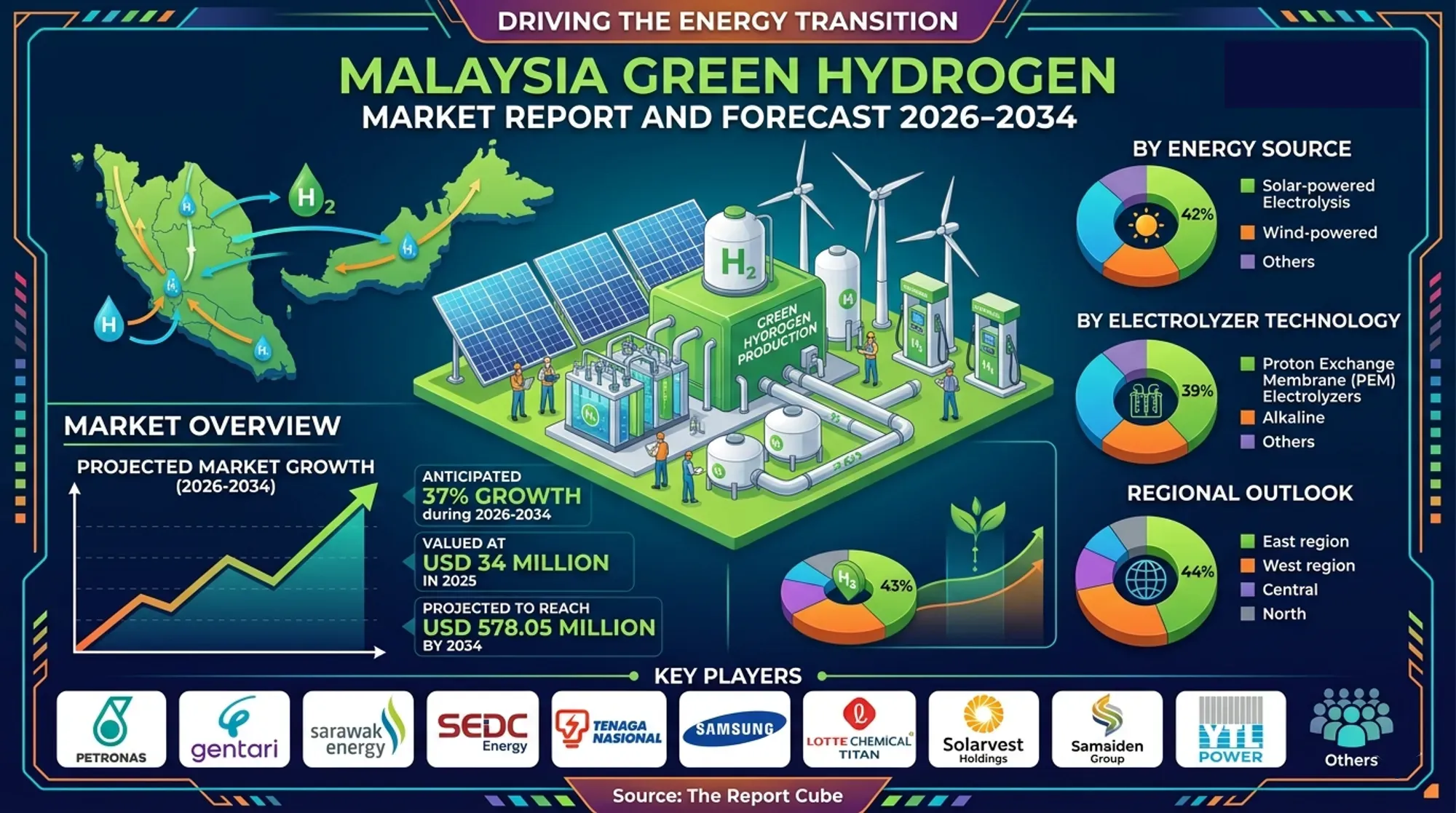
Solar-powered Electrolysis segment lead the market, with around 42% share.
By Electrolyzer Technology:
Proton Exchange Membrane (PEM) Electrolyzers segment dominate the market, accounting for nearly 39% of total revenue.
Regional Outlook:
East region dominates the Malaysia green hydrogen market, with around 44% share.
Government Initiatives & Policies
- Malaysia National Energy Transition Roadmap (NETR): Government framework promoting green hydrogen production, renewable integration, and export opportunities in Malaysia’s low-carbon economy.
- Hydrogen Economy and Technology Roadmap (HETR): National strategy supporting hydrogen innovation, investment, and commercialization through partnerships and technology deployment.
Malaysia Green Hydrogen Market Insights & Analysis
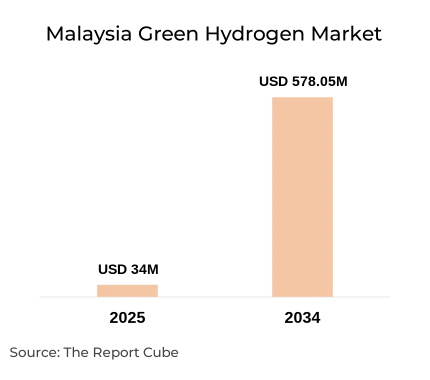
The Malaysia Green Hydrogen Market is anticipated to register a 37% during 2026-2034. the market size was valued at USD 34 million in 2025 and is projected to reach USD 578.05 million by 2034. The growth trajectory reflects Malaysia’s increasing commitment toward clean energy transition and industrial decarbonization. Hydrogen produced from renewable energy sources such as solar, hydropower, and wind is emerging as a strategic pillar in the country’s climate roadmap. Malaysia’s abundant hydropower resources, particularly in Sarawak, combined with growing solar capacity across Peninsular Malaysia, provide strong foundations for scaling green hydrogen production. Government-backed roadmaps and investment incentives are encouraging partnerships between domestic utilities and global technology providers to accelerate the development of electrolyzer infrastructure and hydrogen export value chains.
Malaysia is positioning itself as a regional hydrogen hub within Southeast Asia, supported by strong energy companies and infrastructure development. Investments from national oil and gas companies, renewable developers, and international industrial partners are driving the construction of large-scale hydrogen production facilities integrated with renewable power plants. Sarawak has emerged as a key hydrogen production center due to its hydropower capacity exceeding 5 GW and its access to export-oriented ports. Additionally, industrial sectors such as ammonia manufacturing, refining, and steel production are exploring hydrogen as a cleaner fuel alternative. Growing international demand for green ammonia and methanol, particularly from Japan and South Korea, is strengthening Malaysia’s potential as a hydrogen exporter. With supportive policy frameworks, expanding renewable capacity, and cross-border energy collaborations, Malaysia’s green hydrogen ecosystem is expected to mature rapidly during the forecast period.
Malaysia Green Hydrogen Market Dynamics
Key Driver: Accelerating National Energy Transition and Industrial Decarbonization
Malaysia’s push toward decarbonization and renewable energy expansion represents the primary growth driver for the green hydrogen market. The country has committed to reducing carbon intensity by 45% relative to 2005 levels by 2030 while targeting net-zero emissions by 2050. Green hydrogen is increasingly recognized as a critical enabler for hard-to-abate sectors such as refining, steel manufacturing, and heavy transport. National initiatives including the National Energy Transition Roadmap encourage large-scale investments in hydrogen production facilities integrated with solar and hydropower plants. In 2025 alone, Malaysia announced multiple hydrogen demonstration projects linked to renewable generation exceeding 1 GW capacity.
Another important factor is Malaysia’s strategic geographic location within ASEAN’s energy trade network. The country possesses strong maritime infrastructure and liquefied natural gas export expertise, which can be adapted to support hydrogen and ammonia exports. Industrial players including power utilities and oil and gas companies are investing in hydrogen production technologies to future-proof their energy portfolios. The ability to produce hydrogen using renewable electricity not only supports domestic decarbonization but also creates a potential export commodity for energy-importing economies. As a result, the national focus on energy transition, renewable integration, and hydrogen export capability is accelerating market development across Malaysia.
Book your FREE 30-minute expert consultation today
Contact UsIndustry Trends: Rapid Integration of Renewable Power and Electrolyzer Technologies
One of the defining industry trends in the Malaysia green hydrogen market is the rapid integration of renewable electricity with advanced electrolyzer technologies. Solar photovoltaic deployment across Malaysia has expanded rapidly, with installed solar capacity surpassing 2.7 GW by 2025. This growing renewable electricity supply provides the clean power needed for electrolysis-based hydrogen production. Hybrid renewable systems combining solar, hydropower, and energy storage are being designed to ensure continuous hydrogen production and improved plant efficiency.
Electrolyzer innovation is also shaping the industry landscape. Proton exchange membrane electrolyzers are gaining popularity because they can operate efficiently under variable renewable electricity conditions and provide faster response times compared with traditional alkaline systems. International technology providers from Japan, South Korea, and Europe are partnering with Malaysian developers to deploy modular electrolyzer systems exceeding 100 MW capacity. Additionally, digital monitoring systems and predictive analytics are being integrated into hydrogen plants to improve operational efficiency and reduce maintenance costs.
Another trend shaping the market is the emergence of hydrogen derivatives such as green ammonia and methanol for export markets. These derivatives are easier to transport and store compared with pure hydrogen, enabling Malaysia to participate in the global hydrogen trade. Industrial partnerships between local utilities and international chemical companies are strengthening Malaysia’s position in the emerging hydrogen economy.
Major Challenge: High Capital Investment for Hydrogen Infrastructure Development
Although the Malaysia green hydrogen market demonstrates strong growth potential, the development of hydrogen infrastructure requires substantial capital investment. Building electrolysis plants, renewable energy farms, storage facilities, and transport systems involves large upfront costs that can exceed several hundred million dollars for large-scale projects. Hydrogen production facilities also require advanced equipment such as electrolyzers, compressors, storage tanks, and safety systems, increasing the total project cost.
Another financial challenge relates to the cost competitiveness of green hydrogen compared with conventional hydrogen produced from natural gas. Grey hydrogen remains significantly cheaper in many markets due to established infrastructure and mature supply chains. Green hydrogen projects must therefore rely on government incentives, long-term power purchase agreements, or international partnerships to remain financially viable during the early stages of development.
Infrastructure limitations also present challenges for scaling hydrogen distribution and export. Dedicated pipelines, port facilities, and hydrogen carriers must be developed to enable large-scale trade. Without sufficient infrastructure investments, production capacity may grow faster than distribution networks. Addressing these cost and infrastructure barriers will be critical for ensuring the long-term growth of the Malaysia green hydrogen market.
Opportunity: Export-Oriented Hydrogen Economy and Regional Energy Trade
Malaysia has a strong opportunity to develop an export-oriented hydrogen economy serving energy-importing countries across Asia. Nations such as Japan and South Korea have announced large hydrogen import targets as part of their carbon neutrality strategies. These countries lack sufficient renewable resources domestically, creating opportunities for hydrogen-producing nations to become key suppliers. Malaysia’s access to renewable energy resources and well-established maritime export infrastructure provides a strong advantage in meeting this demand.
The development of hydrogen derivatives such as green ammonia is particularly promising because these fuels can be transported using existing shipping infrastructure. Malaysian companies are exploring ammonia production facilities linked to renewable hydrogen plants to support export agreements with international buyers. Furthermore, cross-border partnerships with technology providers and global energy firms are strengthening Malaysia’s hydrogen supply chain capabilities.
Another opportunity lies in the integration of hydrogen into domestic energy systems. Hydrogen can support grid balancing, energy storage, and backup power generation for renewable electricity systems. Mobility applications such as hydrogen fuel cell buses and heavy-duty trucks are also being explored in several pilot projects. As technology costs decline and infrastructure expands, Malaysia could establish itself as a leading hydrogen production and export hub in Southeast Asia.
Malaysia Green Hydrogen Market Segment-wise Analysis
By Energy Source:
- Solar-powered Electrolysis
- Wind-powered Electrolysis
- Hydropower-based Electrolysis
- Biomass and Waste-to-Hydrogen
- Hybrid Renewable Systems
Solar-powered electrolysis holds the largest share in the Malaysia green hydrogen market, accounting for approximately 42% of production capacity in 2025. Malaysia’s strong solar irradiation levels and rapidly expanding photovoltaic installations make solar energy a reliable source for hydrogen generation. Government solar programs and corporate renewable power agreements have increased solar capacity significantly, enabling developers to integrate electrolyzers with solar farms. Large industrial players are constructing solar-hydrogen hybrid facilities capable of producing thousands of tons of green hydrogen annually.
Solar-powered electrolysis also offers operational flexibility. Electrolyzers connected to solar plants can ramp production up or down depending on electricity availability, improving energy utilization efficiency. In addition, solar energy provides relatively lower operational costs compared with other renewable sources in Malaysia. These advantages encourage companies to adopt solar-driven hydrogen production systems. As solar deployment continues to expand across Malaysia, this segment is expected to remain the leading energy source for hydrogen generation during the forecast period.
By Electrolyzer Technology:
- Alkaline Electrolyzers
- Proton Exchange Membrane (PEM) Electrolyzers
- Solid Oxide Electrolyzers
- Others
Proton Exchange Membrane (PEM) electrolyzers dominate the Malaysia green hydrogen market, accounting for nearly 39% of the total electrolyzer installations. PEM technology is favored for its high efficiency, rapid response to fluctuating renewable electricity supply, and compact system design. These features make PEM electrolyzers particularly suitable for integration with intermittent renewable sources such as solar and wind.
In Malaysia, PEM electrolyzers are increasingly deployed in pilot hydrogen projects and industrial demonstration plants. Technology providers from Japan, Europe, and South Korea are collaborating with Malaysian energy companies to deploy PEM electrolyzer systems exceeding 50-100 MW capacity. These projects aim to support hydrogen production for ammonia manufacturing, refining operations, and export markets. PEM technology also offers high hydrogen purity levels, which are important for industrial and mobility applications. With ongoing improvements in catalyst materials and membrane durability, PEM electrolyzers are expected to remain a key technology supporting the expansion of hydrogen production across Malaysia.
Regional Projection of Malaysia Green Hydrogen Industry
- Northern
- Central
- Southern
- East
- Others
The East region leads the Malaysia green hydrogen market, accounting for approximately 44% of the total hydrogen production capacity. This dominance is primarily attributed to Sarawak’s vast hydropower resources and strong government support for hydrogen development. Sarawak has been actively promoting itself as a regional hydrogen hub through investments in large-scale hydropower plants and hydrogen infrastructure. The region possesses more than 5 GW of hydropower capacity, providing abundant renewable electricity for hydrogen electrolysis.
Several flagship hydrogen projects are being developed in East Malaysia, focusing on the production of green hydrogen and its derivatives such as ammonia and methanol for export markets. International partnerships with technology providers and energy companies are helping accelerate project development and improve production efficiency. The region’s strategic port infrastructure also enables easier export of hydrogen derivatives to international markets. With continued investments in renewable energy and hydrogen infrastructure, the East region is expected to maintain its leading position in Malaysia’s green hydrogen industry.
Malaysia Green Hydrogen Market Recent Developments
- 2025: PETRONAS collaborated with Tenaga Nasional Berhad and Terengganu Inc to launch the Hybrid Hydro Floating Solar and Green Hydrogen Hub project integrating floating solar and hydropower to produce green hydrogen, ammonia, and methanol while supporting Malaysia’s National Energy Transition Roadmap.
- 2025: Tenaga Nasional Berhad announced its participation in the Terengganu green hydrogen hub initiative, leveraging its renewable infrastructure and grid capabilities to enable large-scale hydrogen production and strengthen Malaysia’s position in the regional hydrogen value chain.
- 2025: SEDC Energy expanded Sarawak’s hydrogen development program by advancing plans for commercial-scale hydrogen production supported by hydropower expansion and international technology partnerships aimed at building an export-focused hydrogen ecosystem.
- 2025: Gentari accelerated multiple green hydrogen feasibility studies across Malaysia and international markets, focusing on renewable-powered electrolysis projects that could support ammonia production and regional hydrogen trade.
- 2025: Yinson GreenTech explored hydrogen fuel solutions for maritime applications and clean mobility infrastructure, supporting Malaysia’s transition toward low-carbon transportation technologies.
Need insights for a specific region within this market?
Request Regional DataWhy Choose This Report?
- Provides a comprehensive overview of the overall market analysis, encompassing key trends, consumer behavior analysis, and risk assessment to support strategic decision-making.
- Provides accurate, up-to-date insights into market size, segmentation, and emerging opportunities, helping to minimize risk & capitalizing on growth.
- Gives deep understanding of target audience preferences, investment habits, and communication channels for enhanced product development & marketing effectiveness.
- Delivers competitive analysis & benchmarking, uncovering the strengths & weaknesses of market competitors to guide strategies.
- Consolidate comprehensive market intelligence, reducing reasoning & streamlining research efforts.
- Facilitates customized market segmentation & risk mitigation strategies, fine-tuned to the business objectives.
- Aids in identifying both market challenges & untapped opportunities within the industry to drive long-term business growth.
- Provides valuable information based on actual customer data & search trends.
Table of Contents
- Introduction
- Objective of the Study
- Product and Category Definition
- Market Segmentation
- Study Variables
- Research Methodology
- Secondary Data Points
- Breakdown of Secondary Sources
- Primary Data Points
- Breakdown of Primary Interviews
- Secondary Data Points
- Executive Summary
- Market Dynamics
- Drivers
- Challenges
- Opportunity Assessment
- Recent Trends and Developments
- Regulatory and Policy Landscape
- Malaysia Green Hydrogen Market Overview (2021-2034)
- Market Size, By Value (USD Million)
- Market Share, By Energy Source
- Solar-powered Electrolysis
- Wind-powered Electrolysis
- Hydropower-based Electrolysis
- Biomass and Waste-to-Hydrogen
- Hybrid Renewable Systems
- Market Share, By Electrolyzer Technology
- Alkaline Electrolyzers
- Proton Exchange Membrane (PEM) Electrolyzers
- Solid Oxide Electrolyzers
- Others
- Market Share, By Application
- Ammonia and Fertilizers
- Refining and Petrochemicals
- Steel and Industrial Processing
- Power Generation and Grid Balancing
- Mobility and Transportation
- Export-focused Hydrogen and Derivatives
- Others
- Market Share, By End User
- Power Utilities
- Industrial Manufacturers
- Oil and Gas Companies
- Transportation and Logistics Operators
- Independent Power Producers
- Others
- Market Share, By Region
- Northern
- Central
- Southern
- East
- Others
- Market Share, By Company
- Revenue Shares & Analysis
- Competitive Landscape
- Northern Malaysia Green Hydrogen Market
- Market Size, By Value (USD Million)
- Market Share, By Energy Source
- Market Share, By Electrolyzer Technology
- Market Share, By Application
- Market Share, By End User
- Central Malaysia Green Hydrogen Market
- Market Size, By Value (USD Million)
- Market Share, By Energy Source
- Market Share, By Electrolyzer Technology
- Market Share, By Application
- Market Share, By End User
- Southern Malaysia Green Hydrogen Market
- Market Size, By Value (USD Million)
- Market Share, By Energy Source
- Market Share, By Electrolyzer Technology
- Market Share, By Application
- Market Share, By End User
- East Malaysia Green Hydrogen Market
- Market Size, By Value (USD Million)
- Market Share, By Energy Source
- Market Share, By Electrolyzer Technology
- Market Share, By Application
- Market Share, By End User
- Competitive Outlook and Company Profiles
- PETRONAS
- Company Overview
- Product Portfolio
- Strategic Alliances/Partnerships
- Recent Developments
- Gentari
- Company Overview
- Product Portfolio
- Strategic Alliances/Partnerships
- Recent Developments
- Sarawak Energy
- Company Overview
- Product Portfolio
- Strategic Alliances/Partnerships
- Recent Developments
- SEDC Energy
- Company Overview
- Product Portfolio
- Strategic Alliances/Partnerships
- Recent Developments
- Tenaga Nasional
- Company Overview
- Product Portfolio
- Strategic Alliances/Partnerships
- Recent Developments
- Samsung E&A
- Company Overview
- Product Portfolio
- Strategic Alliances/Partnerships
- Recent Developments
- Lotte Chemical Titan
- Company Overview
- Product Portfolio
- Strategic Alliances/Partnerships
- Recent Developments
- Solarvest Holdings
- Company Overview
- Product Portfolio
- Strategic Alliances/Partnerships
- Recent Developments
- Samaiden Group
- Company Overview
- Product Portfolio
- Strategic Alliances/Partnerships
- Recent Developments
- YTL Power
- Company Overview
- Product Portfolio
- Strategic Alliances/Partnerships
- Recent Developments
- Malakoff Corporation
- Company Overview
- Product Portfolio
- Strategic Alliances/Partnerships
- Recent Developments
- Envision Energy
- Company Overview
- Product Portfolio
- Strategic Alliances/Partnerships
- Recent Developments
- Sumitomo Corporation
- Company Overview
- Product Portfolio
- Strategic Alliances/Partnerships
- Recent Developments
- Mitsui & Co.
- Company Overview
- Product Portfolio
- Strategic Alliances/Partnerships
- Recent Developments
- Yinson GreenTech
- Company Overview
- Product Portfolio
- Strategic Alliances/Partnerships
- Recent Developments
- Faradays Energy
- Company Overview
- Product Portfolio
- Strategic Alliances/Partnerships
- Recent Developments
- Green Hydrogen Asia
- Company Overview
- Product Portfolio
- Strategic Alliances/Partnerships
- Recent Developments
- Others
- PETRONAS
- Contact Us and Disclaimer
Top Key Players & Market Share Outlook
- PETRONAS
- Gentari
- Sarawak Energy
- SEDC Energy
- Tenaga Nasional
- Samsung E&A
- Lotte Chemical Titan
- Solarvest Holdings
- Samaiden Group
- YTL Power
- Malakoff Corporation
- Envision Energy
- Sumitomo Corporation
- Mitsui & Co.
- Yinson GreenTech
- Faradays Energy
- Green Hydrogen Asia
Frequently Asked Questions






