



Build Your Custom Market Intelligence Report
Customize Your ReportPhilippines Ammonia Market Key Highlights
By Application:
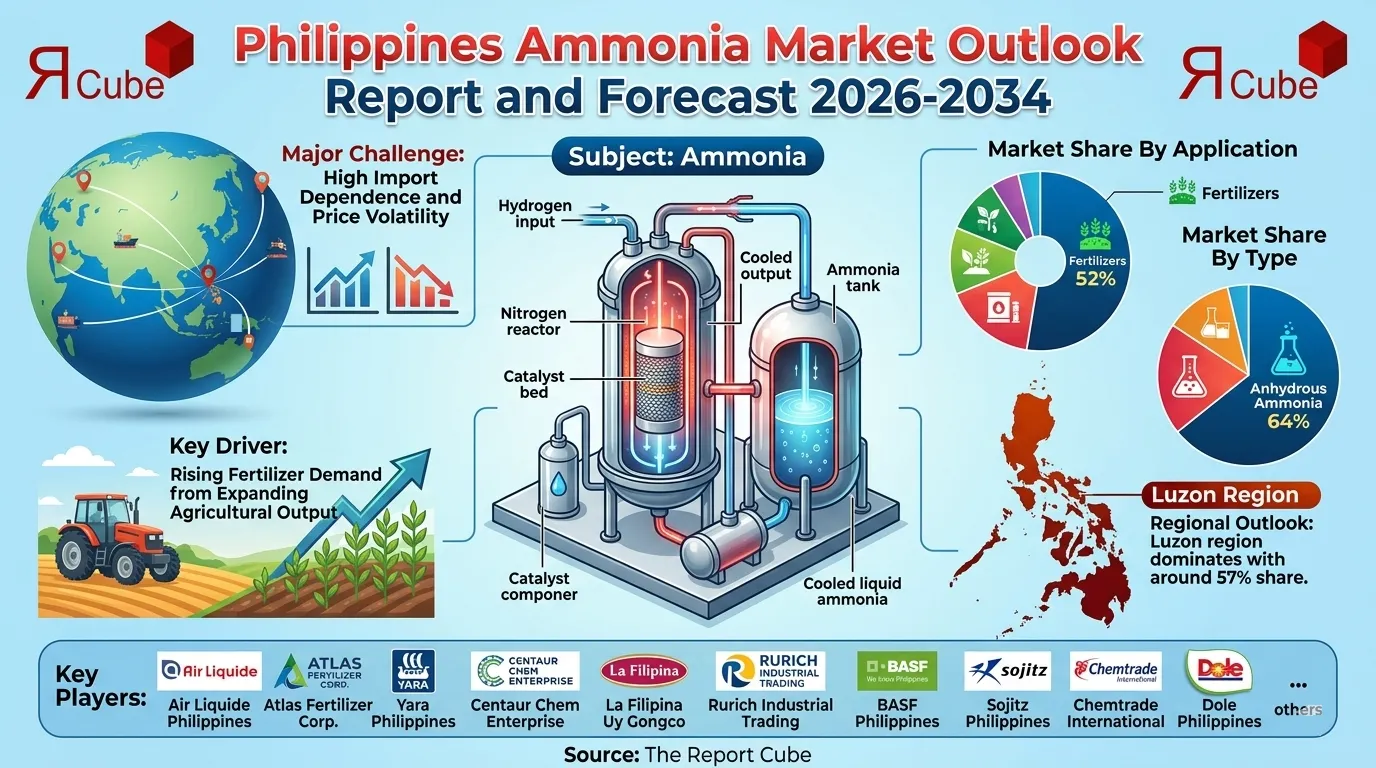
Fertilizers segment leads the market, with around 52% share.
By Type:
Anhydrous Ammonia segment dominates the market, accounting for nearly 64% of total revenue.
Regional Outlook:
Luzon region dominates the philippines ammonia market outlook, with around 57% share.
Government Initiatives & Policies
- Philippine Development Plan (2023-2028) - Agriculture Modernization and Fertilizer Support Programs (Updated 2025 Implementation Guidelines): Focuses on boosting local crop productivity and stabilizing fertilizer supply chains to reduce import dependence.
- Department of Energy (DOE) National Hydrogen Roadmap (2025 Update): Promotes ammonia as a hydrogen carrier and co-firing fuel for power generation to support decarbonization targets.
Philippines Ammonia Market Insights & Analysis
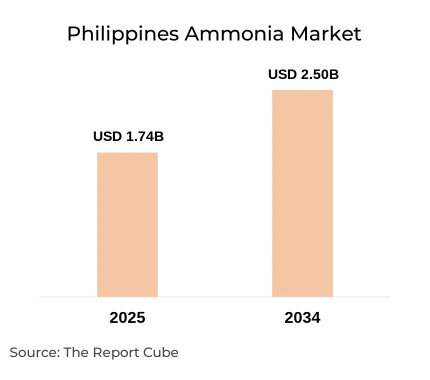
The Philippines Ammonia Market is anticipated to register a CAGR 4.10% during 2026-34. The market size was valued at USD 1.74 billion in 2025 and is projected to reach USD 2.50 billion by 2034. Ammonia demand in the Philippines is closely tied to agriculture, industrial manufacturing, cold chain logistics, and emerging clean energy initiatives.
Fertilizer production remains the backbone of ammonia consumption, supported by the country’s strong reliance on agriculture, which contributes nearly 9% to national GDP and employs over 22% of the workforce. Urea and ammonium phosphate production account for a significant share of ammonia utilization, especially for rice, corn, and coconut farming. The Philippines imports a large portion of its raw ammonia and finished fertilizers, making supply chain stability a strategic priority. As a result, policy efforts in 2025 emphasized domestic blending facilities and storage infrastructure expansion.
Industrial applications are steadily expanding, particularly in nitric acid production and chemical intermediates used in plastics, textiles, and automotive components. The country’s manufacturing sector grew by approximately 5.5% year-over-year in 2025, indirectly driving ammonia demand in downstream processes such as acrylonitrile and caprolactam production. In parallel, cold storage capacity across Luzon and Mindanao increased by nearly 12% in 2024-2025, boosting ammonia-based refrigeration installations in food processing and logistics hubs.
The energy transition narrative is gradually reshaping market dynamics. The Philippines’ hydrogen roadmap recognizes ammonia as a potential hydrogen carrier and co-firing fuel in coal-fired plants. Pilot feasibility studies in 2025 explored ammonia blending ratios of up to 20% for thermal power units. While commercial-scale deployment remains in early stages, the strategic alignment with decarbonization goals is expected to open incremental demand streams by 2030 and beyond.
Philippines Ammonia Market Dynamics
Key Driver: Rising Fertilizer Demand from Expanding Agricultural Output
The Philippines continues to prioritize food security, which directly supports ammonia demand in fertilizer manufacturing. Rice production targets exceeded 20 million metric tons in 2025, necessitating consistent nitrogen-based fertilizer application. Urea production and ammonium nitrate blending facilities rely heavily on imported ammonia feedstock. Government subsidy programs for smallholder farmers enhanced fertilizer accessibility, stabilizing consumption even during commodity price fluctuations. Moreover, climate variability has encouraged higher fertilizer application rates to improve crop resilience and yields. With agriculture modernization programs expanding irrigation coverage and mechanization, ammonia consumption within fertilizer production is projected to maintain steady growth, reinforcing the segment’s dominant market share throughout the forecast period.
Book your FREE 30-minute expert consultation today
Contact UsIndustry Trends: Integration of Low-Carbon Ammonia and Hydrogen Applications
The global shift toward low-emission ammonia is influencing procurement strategies in the Philippines. Importers and distributors are increasingly evaluating suppliers with blue or green ammonia production capabilities. This aligns with power sector decarbonization plans, where ammonia co-firing can reduce carbon intensity by 10-20% depending on blending ratios. Industrial users are also exploring ammonia cracking technologies for hydrogen extraction. Additionally, digital monitoring systems in ammonia storage terminals are enhancing safety compliance and reducing leakage incidents. The trend toward sustainability certification and carbon accounting is reshaping supplier selection criteria, particularly among multinational food processing and chemical companies operating in Luzon and Mindanao.
Major Challenge: High Import Dependence and Price Volatility
The Philippines imports a substantial share of its ammonia requirements, exposing the market to global price fluctuations. International ammonia prices experienced swings of over 30% between 2023 and 2025 due to energy cost volatility. Shipping constraints and geopolitical risks further impact procurement costs. Limited domestic ammonia synthesis capacity restricts supply flexibility. Storage and handling infrastructure also require continuous investment to meet safety standards, especially in densely populated regions. These structural constraints can pressure margins for fertilizer producers and industrial users, potentially affecting downstream pricing and demand stability.
Opportunity: Expansion of Cold Chain Infrastructure and Industrial Processing
The rapid expansion of e-commerce grocery platforms and processed food exports is accelerating cold storage investments. Ammonia-based refrigeration remains a cost-effective solution for large-scale industrial cooling. Cold storage capacity in the Philippines is projected to expand by over 15% by 2030, particularly in Luzon and Mindanao. Food & beverage manufacturers prefer ammonia refrigeration due to its energy efficiency and lower environmental impact compared to synthetic refrigerants. This structural expansion creates sustained demand for aqueous ammonia and refrigeration-grade anhydrous ammonia. Furthermore, growth in water treatment facilities and pharmaceutical manufacturing presents additional diversified application avenues.
Philippines Ammonia Market Segment-wise Analysis
By Application:
- Fertilizers
- Urea Production
- Ammonium Nitrate Production
- Ammonium Phosphate Production
- Other Nitrogen Fertilizers
- Industrial Chemicals
- Nitric Acid Production
- Caprolactam Production
- Acrylonitrile Production
- Other Chemical Intermediates
- Refrigeration
- Industrial Refrigeration
- Cold Storage and Warehouses
- Food & Beverage Processing Refrigeration
- Power & Energy
- Ammonia as Fuel/Co-firing
- Hydrogen Carrier Applications
- Water Treatment
- Municipal Water Treatment
- Industrial Water Treatment
- Pharmaceuticals and Healthcare
- Others
Fertilizers account for approximately 52% of total ammonia consumption in 2025. Urea production represents the largest sub-segment due to its widespread use in rice and corn cultivation. Ammonium phosphate demand is increasing for high-value crops such as bananas and pineapples, particularly in Mindanao. Nitrogen fertilizer consumption per hectare rose by nearly 4% annually over the past three years, reflecting productivity enhancement strategies. Government procurement programs and private distributor networks ensure steady demand cycles. This dominance is expected to continue as agricultural output targets expand and fertilizer application intensity remains high.
By Type:
- Anhydrous Ammonia
- Aqueous Ammonia
Anhydrous ammonia holds nearly 64% revenue share due to its higher nitrogen concentration and suitability for large-scale fertilizer production and industrial synthesis. It is preferred in urea manufacturing and nitric acid production, offering cost efficiency in bulk processing. Aqueous ammonia is widely used in water treatment and certain refrigeration systems but contributes a smaller revenue share. Industrial buyers favor anhydrous ammonia for high-volume applications, supported by established storage and handling infrastructure in Luzon’s industrial corridors. Continued growth in fertilizer and chemical manufacturing will sustain its leading position.
Regional Projection of Philippines Ammonia Industry
- Luzon
- Visayas
- Mindanao
Luzon leads with around 57% market share, driven by concentrated industrial zones, fertilizer blending facilities, and major ports for ammonia imports. Metro Manila and nearby provinces host chemical manufacturers, cold storage facilities, and water treatment plants. Mindanao follows due to its strong agricultural base and export-oriented banana and pineapple plantations. Visayas contributes moderately, supported by regional food processing and municipal infrastructure projects. Port accessibility and logistics infrastructure significantly influence regional ammonia distribution patterns across the archipelago.
Philippines Ammonia Market Recent Developments
- 2025: Brenntag Philippines expanded its distribution partnership with Momentive Performance Materials, strengthening specialty chemical distribution across industrial sectors and enhancing its ammonia-linked portfolio in construction and manufacturing segments.
- 2025: Air Liquide Philippines announced acquisition agreements to strengthen its regional gases footprint, reinforcing supply chain capabilities that support ammonia and hydrogen-related applications across Asia, including the Philippine market.
- 2025: Yara Philippines (Yara International) entered advanced negotiations with Air Products for low-emission ammonia projects, signaling potential future supply opportunities aligned with Asia’s clean energy demand.
- 2025: BASF Philippines (BASF SE) confirmed major global capital investments focused on Asian production expansion, supporting long-term specialty chemical supply growth across the Philippines.
Need insights for a specific region within this market?
Request Regional DataWhy Choose This Report?
- Provides a comprehensive overview of the overall market analysis, encompassing key trends, consumer behavior analysis, and risk assessment to support strategic decision-making.
- Provides accurate, up-to-date insights into market size, segmentation, and emerging opportunities, helping to minimize risk & capitalizing on growth.
- Gives deep understanding of target audience preferences, investment habits, and communication channels for enhanced product development & marketing effectiveness.
- Delivers competitive analysis & benchmarking, uncovering the strengths & weaknesses of market competitors to guide strategies.
- Consolidate comprehensive market intelligence, reducing reasoning & streamlining research efforts.
- Facilitates customized market segmentation & risk mitigation strategies, fine-tuned to the business objectives.
- Aids in identifying both market challenges & untapped opportunities within the industry to drive long-term business growth.
- Provides valuable information based on actual customer data & search trends.
Table of Contents
- Introduction
- Objective of the Study
- Product and Category Definition
- Market Segmentation
- Study Variables
- Research Methodology
- Secondary Data Points
- Breakdown of Secondary Sources
- Primary Data Points
- Breakdown of Primary Interviews
- Secondary Data Points
- Executive Summary
- Market Dynamics
- Drivers
- Challenges
- Opportunity Assessment
- Recent Trends and Developments
- Regulatory and Policy Landscape
- Philippines Ammonia Market Overview (2021-2034)
- Market Size, By Value (USD Billion)
- Market Share, By Application
- Fertilizers
- Urea Production
- Ammonium Nitrate Production
- Ammonium Phosphate Production
- Other Nitrogen Fertilizers
- Industrial Chemicals
- Nitric Acid Production
- Caprolactam Production
- Acrylonitrile Production
- Other Chemical Intermediates
- Refrigeration
- Industrial Refrigeration
- Cold Storage and Warehouses
- Food & Beverage Processing Refrigeration
- Power & Energy
- Ammonia as Fuel/Co-firing
- Hydrogen Carrier Applications
- Water Treatment
- Municipal Water Treatment
- Industrial Water Treatment
- Pharmaceuticals and Healthcare
- Others
- Fertilizers
- Market Share, By Type
- Anhydrous Ammonia
- Aqueous Ammonia
- Market Share, By End User
- Agriculture and Fertilizer Producers
- Chemical Manufacturers
- Food & Beverage Industry
- Cold Chain & Logistics
- Power & Utilities
- Water Treatment Facilities
- Pharmaceutical & Healthcare Sector
- Other
- Market Share, By Region
- Luzon
- Visayas
- Mindanao
- Market Share, By Company
- Revenue Shares & Analysis
- Competitive Landscape
- Luzon Ammonia Market
- Market Size, By Value (USD Billion/Million)
- Market Share, By Application
- Fertilizers
- Industrial Chemicals
- Refrigeration
- Power & Energy
- Water Treatment
- Pharmaceuticals and Healthcare
- Other Applications
- Market Share, By Type
- Anhydrous Ammonia
- Aqueous Ammonia
- Market Share, By End User
- Agriculture and Fertilizer Producers
- Chemical Manufacturers
- Food & Beverage Industry
- Cold Chain & Logistics
- Power & Utilities
- Water Treatment Facilities
- Pharmaceutical & Healthcare Sector
- Other Industrial Users
- Visayas Ammonia Market
- Market Size, By Value (USD Billion/Million)
- Market Share, By Application
- Fertilizers
- Industrial Chemicals
- Refrigeration
- Power & Energy
- Water Treatment
- Pharmaceuticals and Healthcare
- Other Applications
- Market Share, By Type
- Anhydrous Ammonia
- Aqueous Ammonia
- Market Share, By End User
- Agriculture and Fertilizer Producers
- Chemical Manufacturers
- Food & Beverage Industry
- Cold Chain & Logistics
- Power & Utilities
- Water Treatment Facilities
- Pharmaceutical & Healthcare Sector
- Other Industrial Users
- Mindanao Ammonia Market
- Market Size, By Value (USD Billion/Million)
- Market Share, By Application
- Fertilizers
- Industrial Chemicals
- Refrigeration
- Power & Energy
- Water Treatment
- Pharmaceuticals and Healthcare
- Other Applications
- Market Share, By Type
- Anhydrous Ammonia
- Aqueous Ammonia
- Market Share, By End User
- Agriculture and Fertilizer Producers
- Chemical Manufacturers
- Food & Beverage Industry
- Cold Chain & Logistics
- Power & Utilities
- Water Treatment Facilities
- Pharmaceutical & Healthcare Sector
- Other Industrial Users
- Competitive Outlook and Company Profiles
- NAVER Cloud Corp.
- Company Overview
- Product Portfolio
- Strategic Alliances/Partnerships
- Recent Developments
- Kakao Cloud
- Company Overview
- Product Portfolio
- Strategic Alliances/Partnerships
- Recent Developments
- KT Cloud
- Company Overview
- Product Portfolio
- Strategic Alliances/Partnerships
- Recent Developments
- NHN Cloud
- Company Overview
- Product Portfolio
- Strategic Alliances/Partnerships
- Recent Developments
- Samsung SDS
- Company Overview
- Product Portfolio
- Strategic Alliances/Partnerships
- Recent Developments
- LG CNS
- Company Overview
- Product Portfolio
- Strategic Alliances/Partnerships
- Recent Developments
- SK C&C
- Company Overview
- Product Portfolio
- Strategic Alliances/Partnerships
- Recent Developments
- Megazone Cloud
- Company Overview
- Product Portfolio
- Strategic Alliances/Partnerships
- Recent Developments
- Bespin Global
- Company Overview
- Product Portfolio
- Strategic Alliances/Partnerships
- Recent Developments
- Gabia
- Company Overview
- Product Portfolio
- Strategic Alliances/Partnerships
- Recent Developments
- Metanet Tplatform
- Company Overview
- Product Portfolio
- Strategic Alliances/Partnerships
- Recent Developments
- AWS Korea
- Company Overview
- Product Portfolio
- Strategic Alliances/Partnerships
- Recent Developments
- Google Cloud Korea
- Company Overview
- Product Portfolio
- Strategic Alliances/Partnerships
- Recent Developments
- Microsoft Korea
- Company Overview
- Product Portfolio
- Strategic Alliances/Partnerships
- Recent Developments
- Oracle Korea
- Company Overview
- Product Portfolio
- Strategic Alliances/Partnerships
- Recent Developments
- Equinix Korea
- Company Overview
- Product Portfolio
- Strategic Alliances/Partnerships
- Recent Developments
- Cloudflare Korea
- Company Overview
- Product Portfolio
- Strategic Alliances/Partnerships
- Recent Developments
- Others
- NAVER Cloud Corp.
- Contact Us and Disclaimer
Top Key Players & Market Share Outlook
- Air Liquide Philippines
- Atlas Fertilizer Corp.
- Yara Philippines
- Centaur Chem Enterprise
- La Filipina Uy Gongco
- Rurich Industrial Trading
- BASF Philippines
- Sojitz Philippines
- Chemtrade International
- Dole Philippines
- Yokogawa Philippines
- Brenntag Philippines
- Sytengco Philippines
- Mabuhay Vinyl Corp.
- International Chem. Ind.
- Neco Philippines
Frequently Asked Questions






