



Build Your Custom Market Intelligence Report
Customize Your ReportUAE District Cooling Market Insights & Analysis
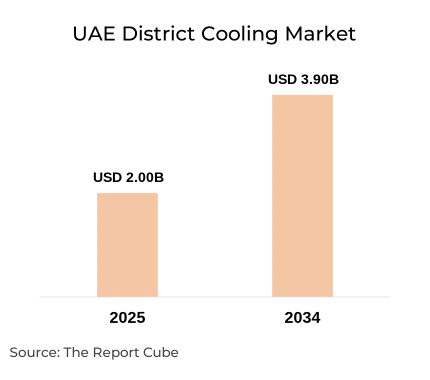
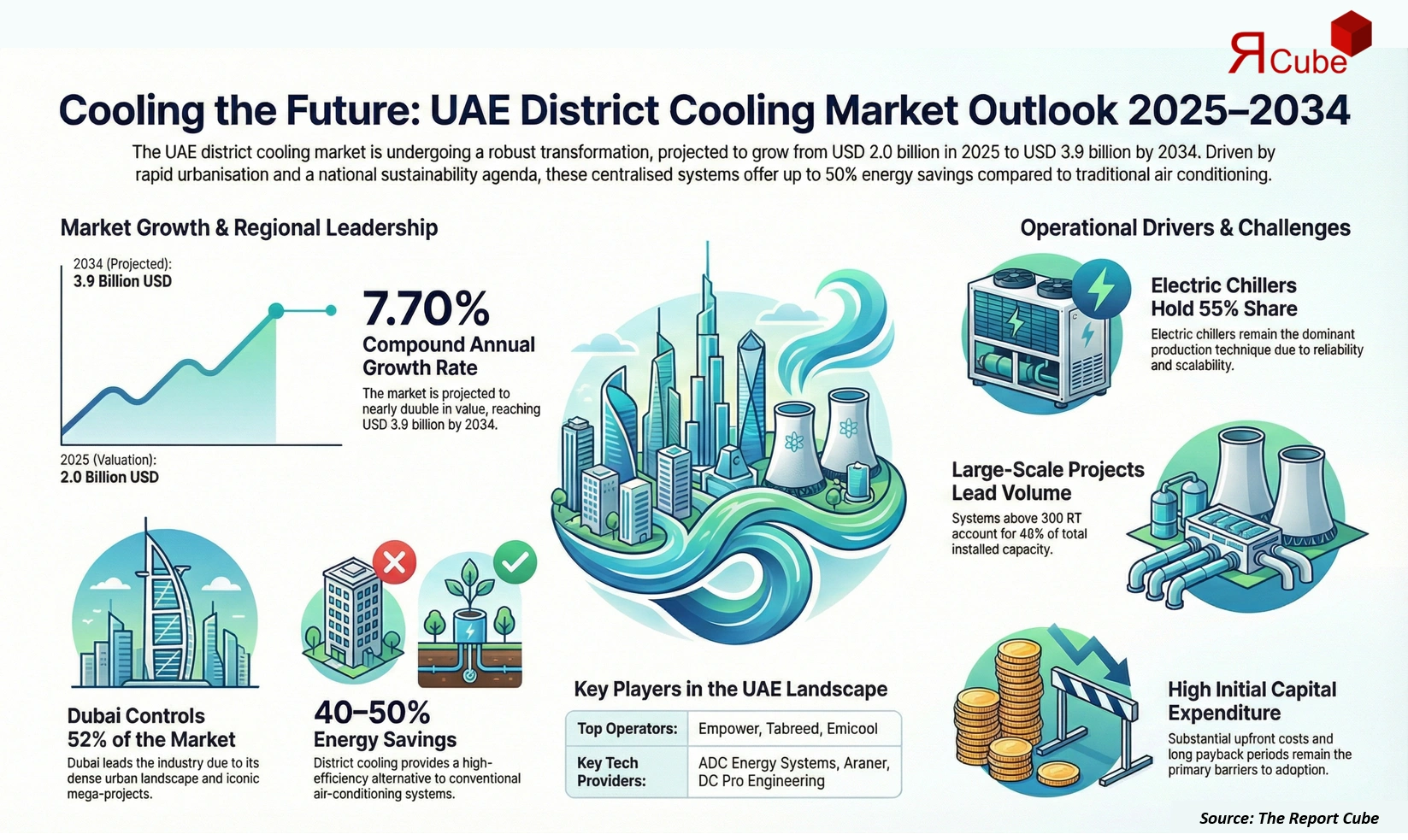
The UAE District Cooling Market is anticipated to register a CAGR of 7.70% during the forecast period 2026-2034. The market size was valued at USD 2.0 billion in 2025 and is projected to reach USD 3.9 billion by 2034. This robust growth trajectory is closely linked to the UAE’s rapid urbanization, rising demand for energy-efficient cooling solutions, and the continued expansion of large-scale real estate developments across residential, commercial, and mixed-use segments.
District cooling has become a strategic component of the UAE’s sustainability agenda, offering up to 40-50% energy savings compared to conventional air-conditioning systems. As cities grow denser and ambient temperatures remain high for most of the year, centralized cooling networks provide a cost-effective and environmentally responsible alternative. Government-backed infrastructure projects, smart city initiatives, and stricter building efficiency regulations are accelerating adoption, particularly in high-density urban zones.
Furthermore, the UAE’s commitment to reducing carbon emissions and water consumption has positioned district cooling as a preferred solution for large developments such as airports, malls, business districts, and hospitality complexes. Leading operators are expanding capacity, upgrading production technologies, and investing in advanced monitoring systems. Together, these factors are reinforcing the UAE District Cooling Market as a critical pillar of the country’s long-term energy transition strategy.
UAE District Cooling Market Recent Developments
- 2025: Empower commissioned additional cooling capacity in Dubai to support new mixed-use real estate developments.
- 2025: Tabreed expanded its district cooling plant portfolio, integrating higher-efficiency electric chiller systems.
Government Initiatives & Policies
- UAE Energy Strategy 2050: National program promoting energy efficiency and sustainable cooling infrastructure.
- Dubai Clean Energy Strategy 2050: Supports low-carbon district energy solutions across urban developments.
UAE District Cooling Market Dynamics
Key Driver: Rising Urbanization and Demand for Energy-Efficient Cooling
The primary driver of the UAE District Cooling Market is the rapid pace of urbanization combined with growing demand for energy-efficient cooling systems. With population growth concentrated in urban centers, the need to cool large residential towers, commercial complexes, and public infrastructure has intensified. District cooling systems offer significant reductions in electricity consumption and peak load demand, making them highly attractive in a region with high cooling requirements. In the UAE, cooling accounts for nearly 70% of peak electricity demand during summer months. By adopting centralized cooling networks, utilities and developers can optimize energy use while reducing operational costs. This efficiency advantage, supported by favorable regulations, continues to propel market expansion.
Book your FREE 30-minute expert consultation today
Contact UsIndustry Trends: Shift Toward Advanced and Hybrid Cooling Technologies
A key trend shaping the market is the shift toward advanced production techniques, including hybrid systems that combine electric chillers with free cooling and absorption cooling. Operators are increasingly investing in high-efficiency chillers, thermal energy storage, and smart monitoring platforms to improve system performance. Electric chillers remain dominant due to their reliability and scalability, but free cooling is gaining traction during cooler months to reduce energy consumption. Additionally, integration of digital control systems enables predictive maintenance and real-time optimization, lowering lifecycle costs. These technological advancements are enhancing service reliability and strengthening the long-term competitiveness of district cooling providers.
Major Challenge: High Initial Capital and Infrastructure Costs
Despite strong growth prospects, high upfront capital investment remains a significant challenge for the UAE District Cooling Market. Establishing district cooling networks requires substantial expenditure on plants, pipelines, and distribution infrastructure, often before customer demand fully materializes. This long payback period can deter private investment, particularly in smaller developments. Moreover, retrofitting existing buildings to connect with district cooling systems can be complex and costly. While economies of scale improve profitability over time, initial financial barriers may slow adoption in less densely populated areas, posing a constraint on market penetration.
Opportunity: Expansion of Sustainable Real Estate and Mega Projects
The continued development of sustainable real estate and mega infrastructure projects presents a major opportunity for the market. New master-planned communities, airports, and tourism zones are increasingly designed with district cooling integration from the planning stage. This reduces installation complexity and enhances economic viability. With the UAE positioning itself as a global hub for sustainable urban development, district cooling is expected to play a central role in meeting energy efficiency targets. Operators that align with green building standards and offer flexible capacity expansion stand to gain long-term contracts, strengthening revenue visibility across the forecast period.
UAE District Cooling Market Segment-wise Analysis
By Volume (RT, ‘000 Tons of Refrigeration):
- Below 50 RT
- 50-150 RT
- 150-300 RT
- Above 300 RT
The Above 300 RT segment dominates the market, accounting for nearly 48% of total installed capacity in 2025. This dominance is driven by large-scale developments such as business districts, airports, and mega residential complexes that require high cooling loads. Systems in this range benefit from economies of scale, resulting in lower per-unit cooling costs. The 150-300 RT segment also shows steady growth, particularly in mid-sized commercial projects. Smaller capacity segments cater mainly to localized developments but contribute a relatively modest share of overall market revenue.
By Production Technique:
- Free Cooling
- Absorption Cooling
- Electric Chillers
- Other Techniques
Electric Chillers lead the production technique segment, holding approximately 55% market share due to their efficiency, reliability, and adaptability to varying load conditions. Absorption cooling follows, particularly in projects utilizing waste heat or cogeneration systems. Free cooling, while climate-dependent, is gaining adoption as operators seek to reduce energy use during cooler periods. The growing emphasis on hybrid systems reflects a balanced approach toward cost optimization and sustainability, ensuring long-term operational efficiency.
Regional Projection of UAE District Cooling Industry
- Dubai
- Abu Dhabi
- Sharjah & Northern Emirates
Dubai leads the UAE District Cooling Market with an estimated 52% market share, supported by its dense urban landscape and extensive portfolio of large-scale developments. Iconic mixed-use projects and continuous real estate expansion drive sustained demand for district cooling services. Abu Dhabi follows, leveraging district cooling in government buildings and cultural districts. Sharjah and the Northern Emirates represent emerging growth regions, where rising urbanization and infrastructure investments are gradually increasing adoption. Dubai’s early adoption and scale advantages are expected to maintain its leadership throughout the forecast period.
Need insights for a specific region within this market?
Request Regional DataWhy Choose This Report?
- Provides a comprehensive overview of the overall market analysis, encompassing key trends, consumer behavior analysis, and risk assessment to support strategic decision-making.
- Provides accurate, up-to-date insights into market size, segmentation, and emerging opportunities, helping to minimize risk & capitalizing on growth.
- Gives deep understanding of target audience preferences, investment habits, and communication channels for enhanced product development & marketing effectiveness.
- Delivers competitive analysis & benchmarking, uncovering the strengths & weaknesses of market competitors to guide strategies.
- Consolidate comprehensive market intelligence, reducing reasoning & streamlining research efforts.
- Facilitates customized market segmentation & risk mitigation strategies, fine-tuned to the business objectives.
- Aids in identifying both market challenges & untapped opportunities within the industry to drive long-term business growth.
- Provides valuable information based on actual customer data & search trends.
Table of Contents
- Introduction
- Objective of the Study
- Product and Market Definition
- Market Segmentation
- Study Variables and Assumptions
- Research Methodology
- Secondary Data Points
- Breakdown of Secondary Sources
- Primary Data Points
- Breakdown of Primary Interviews
- Secondary Data Points
- Executive Summary
- Market Dynamics
- Drivers
- Challenges
- Opportunity Assessment
- Recent Trends and Developments
- Regulatory and Policy Landscape
- UAE District Cooling Market Overview (2021-2034)
- Market Size, By Value (USD Billion)
- Market Size, By Volume (RT, ‘000 Tons of Refrigeration)
- Market Share, By Production Technique
- Free Cooling
- Absorption Cooling
- Electric Chillers
- Other Techniques
- Market Share, By Application
- Hospitality
- Commercial & Retail
- Residential
- Government & Transport
- Industrial
- Other Uses
- Market Share, By Customer Type
- Real Estate Developers
- Government Entities
- Industrial Users
- Mixed‑Use Projects
- Market Share, By Region
- Dubai
- Abu Dhabi
- Sharjah & Northern Emirates
- Market Share, By Company
- Market Share, By Connected RT
- Competition Characteristics
- Revenue Shares & Analysis
- Dubai District Cooling Market
- Market Size, By Value (USD Billion)
- Market Size, By Volume (RT)
- Market Share, By Production Technique
- Market Share, By Application
- Market Share, By Customer Type
- Market Share, By Company
- Abu Dhabi District Cooling Market
- Market Size, By Value (USD Billion)
- Market Size, By Volume (RT)
- Market Share, By Production Technique
- Market Share, By Application
- Market Share, By Customer Type
- Market Share, By Company
- Sharjah & Northern Emirates District Cooling Market
- Market Size, By Value (USD Billion)
- Market Size, By Volume (RT)
- Market Share, By Production Technique
- Market Share, By Application
- Market Share, By Customer Type
- Market Share, By Company
- Competitive Outlook and Company Profiles
- Emirates Central Cooling Systems Corporation (Empower)
- Company Overview
- Service Portfolio
- Operational Footprint in UAE
- Strategic Initiatives
- Recent Developments
- National Central Cooling Company PJSC (Tabreed)
- Company Overview
- Service Portfolio
- Operational Footprint in UAE
- Strategic Initiatives
- Recent Developments
- Emirates District Cooling LLC (Emicool)
- Company Overview
- Service Portfolio
- Operational Footprint in UAE
- Strategic Initiatives
- Recent Developments
- Pal Cooling Holding LLC
- Company Overview
- Service Portfolio
- Operational Footprint in UAE
- Strategic Initiatives
- Recent Developments
- ADC Energy Systems LLC
- Company Overview
- Service Portfolio
- Operational Footprint in UAE
- Strategic Initiatives
- Recent Developments
- Engie (District Energy)
- Company Overview
- Service Portfolio
- Operational Footprint in UAE
- Strategic Initiatives
- Recent Developments
- Veolia (Energy Services)
- Company Overview
- Service Portfolio
- Operational Footprint in UAE
- Strategic Initiatives
- Recent Developments
- ARANER (District Cooling Engineering)
- Company Overview
- Service Portfolio
- Operational Footprint in UAE
- Strategic Initiatives
- Recent Developments
- DC Pro Engineering
- Company Overview
- Service Portfolio
- Operational Footprint in UAE
- Strategic Initiatives
- Recent Developments
- Qatar District Cooling Company (Qatar Cool)*
- Company Overview
- Regional Relevance to GCC
- Strategic Initiatives
- Recent Developments
- Others
- Emirates Central Cooling Systems Corporation (Empower)
- Contact Us and Disclaimer
Top Key Players & Market Share Outlook
- Emirates Central Cooling Systems Corporation (Empower)
- National Central Cooling Company PJSC (Tabreed)
- Emirates District Cooling LLC (Emicool)
- Pal Cooling Holding LLC
- ADC Energy Systems LLC
- Engie (District Energy)
- Veolia (Energy Services)
- ARANER (District Cooling Engineering)
- DC Pro Engineering
- Qatar District Cooling Company (Qatar Cool)*
- Others
Frequently Asked Questions






