



Build Your Custom Market Intelligence Report
Customize Your ReportKey Highlights
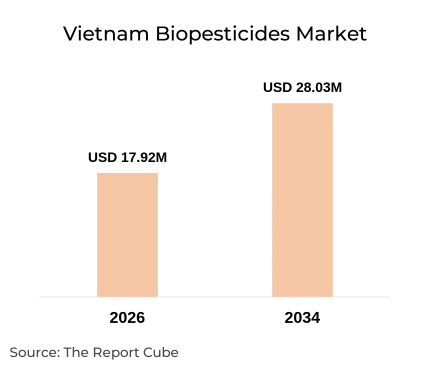
- The Vietnam Biopesticides Market was valued at USD 17.92 million in 2026, based on supplied estimates.
- Market size is forecast to reach USD 28.03 million by 2034.
- The market is projected to expand at a CAGR of 5.75% during 2026-2034.
- By product type, Bioherbicides led with an estimated 31.0% share in 2026.
- By region, the Mekong River Delta led with an estimated 34.0% share in 2026.
- Government support for biological crop protection, including Decision 885/QĐ-TTg and Circular 75/2025/TT-BNNMT, is a major growth driver.
- Circular 75/2025/TT-BNNMT added 55 biological plant-protection products to Vietnam’s permitted list, widening the commercial portfolio.
Market Outlook
The Vietnam Biopesticides Market covers biological crop-protection products derived from microorganisms, plant extracts and naturally occurring biochemical substances. These products manage insect pests, plant diseases, weeds and nematodes. They are increasingly used within integrated pest management, which combines biological control, crop monitoring, cultural practices and selective chemical use to reduce reliance on conventional pesticides across Vietnamese agriculture.
Demand comes from horticulture, cash crops and row crops. Vietnam produces rice, coffee, pepper, tea, vegetables and tropical fruits, creating crop-specific pest and disease management needs. According to Vietnam’s Plant Production and Protection Department, registered biopesticide trade names rose from 768 in 2021 to 810 in 2023, and the biological share of pesticide use reached 18.49% in 2022.
The Vietnam Biopesticides Market is estimated at USD 17.92 million in 2026 and is forecast to reach USD 28.03 million by 2034, a CAGR of 5.75%. Growth depends on export-oriented horticulture, residue compliance and wider dealer and cooperative distribution. Competition spans domestic manufacturers, global crop-protection groups and biological specialists, with formulation stability and farmer adoption shaping future direction.
Government Regulations
Vietnam’s biopesticides sector is regulated mainly by the Ministry of Agriculture and Environment and its Plant Production and Protection Department under the Law on Plant Protection and Quarantine. Decision 885/QĐ-TTg approved the Organic Agriculture Development Project for 2020-2030, supporting environmentally sustainable production. Circular 75/2025/TT-BNNMT, issued on 26 December 2025 and effective from 10 February 2026, sets the lists of permitted and prohibited plant-protection products and added 55 biological products and six new biological active ingredients. Circular 28/2026/TT-BNNMT, issued on 30 June 2026 and effective from 15 August 2026, amended it. Manufacturers and importers must register products, comply with listing requirements and meet quality and labelling obligations, which raises entry barriers for unregistered products and favours companies with established regulatory capability.
Vietnam Biopesticides Market Dynamics
Vietnam Biopesticides Market dynamics are shaped by agricultural modernisation, sustainability policy, export quality requirements and farmer purchasing behaviour. Government initiatives and food-safety expectations support adoption, while higher application costs, formulation stability and a preference for conventional pesticides moderate penetration. The balance of these forces determines how quickly biological products move from niche use to mainstream crop-protection programmes.
|
Factor |
Type |
Specific Impact on Market |
Magnitude |
|---|---|---|---|
|
Government support and product registration |
Driver |
Expanding permitted biological product lists and organic agriculture policy encourage adoption |
High |
|
Export-oriented horticulture |
Driver |
Residue and quality requirements raise demand for biological pest management |
Medium-High |
|
Horticultural and plantation crop expansion |
Opportunity |
Fruit, vegetable, coffee and pepper cultivation create crop-specific demand |
Medium-High |
|
Higher costs and farmer preference for chemicals |
Challenge |
Price sensitivity and slower action limit smallholder uptake |
Medium-High |
|
Formulation stability and shelf life |
Challenge |
Storage sensitivity restricts product reliability and reach |
Medium |
|
Integration into IPM programmes |
Trend |
Biologicals are positioned as components of integrated programmes |
Medium |
Growth Drivers: Government Support for Biological Crop Protection
Vietnam’s policy framework encourages wider use of biological crop-protection products. Decision 885/QĐ-TTg established the Organic Agriculture Development Project for 2020-2030, and the Plant Production and Protection Department reported that biological pesticides rose from 16.67% of total pesticide use in 2020 to 18.49% in 2022. Updated product lists under Circular 75/2025/TT-BNNMT further widened approved biological options, strengthening supply for the Vietnam Biopesticides Market.
Market Opportunities: Biological Crop Protection in Horticulture
Vietnam’s fruit and vegetable production offers a clear opening for biological formulations. Crops such as durian, dragon fruit, mango and bananas face insect, fungal and soil-borne disease pressure, while export markets emphasise residue compliance. The Ministry of Agriculture and Environment reported agricultural, forestry and fishery exports of about USD 70.09 billion in 2025, supporting demand for crop-protection practices that protect quality and market access.
Industry Challenges: Adoption Barriers and Product Performance
The Plant Production and Protection Department identified price sensitivity, shorter storage periods and a preference for conventional pesticides as barriers to wider use. Biological products can act more slowly and may need more frequent applications. Microbial formulations are also sensitive to temperature and humidity, so quality control, shelf life and technical support remain essential for manufacturers seeking to build farmer confidence.
Need Specific Data, Let’s Customize the Report for You
Request CustomizationMarket Trends: Integration of Biopesticides into IPM Programmes
Biopesticides are increasingly treated as components of integrated pest management rather than full replacements for conventional products. Vietnam’s registered portfolio includes microbial, botanical and biochemical products, and domestic development has included Bacillus thuringiensis, Beauveria bassiana, Metarhizium anisopliae and Trichoderma. A May 2025 FAO and Plant Production and Protection Department project supports nature-based pest management and biological pesticide application.
Vietnam Biopesticides Market Segment Analysis
The Vietnam Biopesticides Market is segmented by product type, source type, crop type, application method, formulation, end-user and distribution channel. Segment shares below are supplied 2026 analyst estimates rather than officially published statistics. Only the leading segment’s share is shown in each category.
By Product Type
- Bioinsecticides
- Biofungicides
- Bioherbicides
- Other Biopesticides
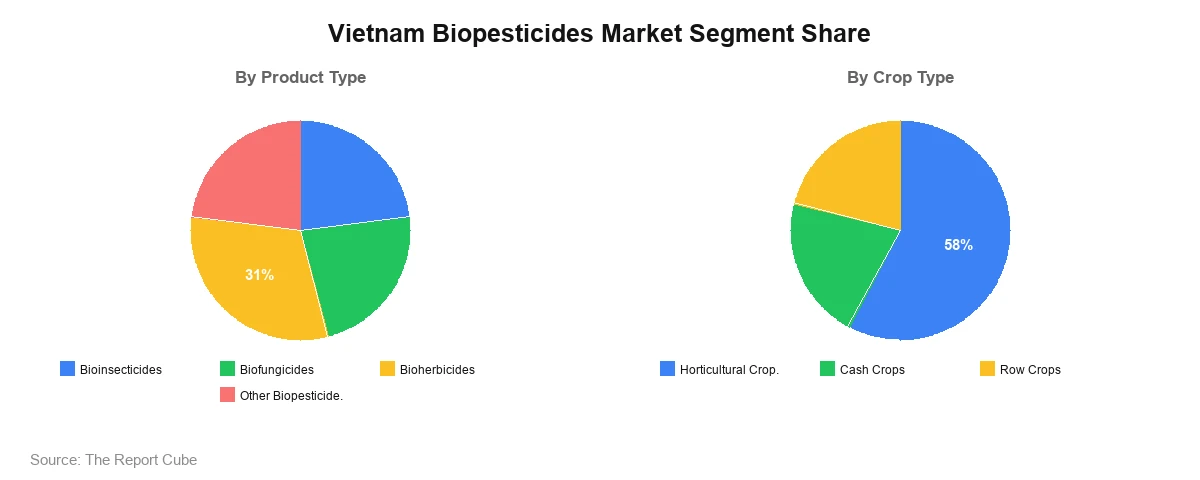
Bioherbicides lead the product category with an estimated 31% share in 2026, supported by weed management needs across horticultural and plantation systems and demand for alternatives to selected synthetic herbicides. Bioinsecticides form the second major segment, driven by insect pest pressure on fruit, vegetables and cash crops, and are expected to show comparatively stronger growth as biological insect management gains acceptance. Biofungicides and other biopesticides, including bionematicides, serve disease and soil-pest management and remain smaller commercial categories.
By Crop Type
- Horticultural Crops
- Cash Crops
- Row Crops
Horticultural crops lead with an estimated 58% share in 2026, reflecting intensive pest and disease management in fruit and vegetable production and the importance of residue compliance for exports. Cash crops, including coffee, pepper, tea, rubber and cashew, form the second major segment, supported by plantation-scale demand for fungal and soil-borne disease management. Row crops such as rice, maize, pulses and oilseeds represent the smallest segment, with adoption limited by price sensitivity and the established use of conventional products.
Vietnam Biopesticides Market Regional Analysis
Regional demand in the Vietnam Biopesticides Market reflects crop composition, climate, input distribution networks and export-oriented production. Regional shares below are supplied 2026 analyst estimates, not official regional sales statistics. The Mekong River Delta leads, while the Central Highlands benefits from coffee, pepper and fruit cultivation.
|
Region |
Estimated Market Share |
Key Growth Factors |
Industry Trends |
|---|---|---|---|
|
Mekong River Delta |
34% |
Rice, fruit and vegetable production; durian and tropical fruit supply chains |
Demand for insecticides, fungicides and soil-treatment products |
|
Northern Vietnam |
- |
Vegetable and fruit cultivation; improving distribution networks |
Gradual uptake through controlled cultivation and farmer awareness |
|
Central Highlands |
- |
Coffee, pepper and fruit plantations |
Growing use of microbial and botanical products for fungal and soil-borne issues |
|
Southeast Vietnam |
- |
Commercial farming, processing and input distribution |
Plantation and fruit crop demand |
|
North-Central and Central Coast |
- |
Diversified crops and varied climatic conditions |
Crop-specific adoption dependent on dealer coverage and training |
The Mekong River Delta holds an estimated 34% share in 2026. Its concentration of rice, fruit and vegetable production creates sustained demand for biological insecticides, fungicides and soil-treatment products, and durian and other tropical fruit chains favour formulations for insect, fungal and soil-borne problems.
Northern Vietnam holds an estimated 23% share. Vegetable and fruit production, improving agricultural distribution and growing farmer awareness support wider adoption of biological crop-protection products, particularly in controlled cultivation systems that value residue-conscious pest management.
Competitive Landscape
The Vietnam Biopesticides Market includes domestic agricultural chemical companies, international crop-protection groups and specialist biological technology providers. Competition depends on product registration status, efficacy under local climatic conditions, formulation quality, pricing, technical support and distribution reach. The table summarises supplied companies by general capability and does not represent market share or ranking.
|
Company |
Competitive Strength |
Primary Segment Served |
|---|---|---|
|
Vietnam Pesticide Joint Stock Company (VIPESCO) |
Domestic market presence and distribution |
Crop-protection distribution |
|
Marrone Bio Innovations |
Microbial and natural-product-based solutions |
Bioinsecticides, biofungicides |
|
UPL Limited |
International portfolio and agricultural distribution |
Broad crop protection |
|
Sumitomo Chemical |
Research and crop-protection capabilities |
Crop protection |
|
Corteva Agriscience |
Crop-protection innovation and research |
Commercial crop protection |
|
BiOWiSH Technologies |
Microbial and biological technologies |
Microbial products |
|
Andermatt Biocontrol |
Biocontrol technologies |
Biological pest management |
|
Bio-Viet Agro |
Domestic agricultural product presence |
Biological agricultural inputs |
|
Kimitec Group |
Agricultural biotechnology solutions |
Biological and biotechnological inputs |
|
Certis Biologicals |
Microbial and biological portfolio |
Biological crop protection |
|
STK Bio-Ag Technologies |
Biological crop-protection technologies |
Biological crop protection |
|
Seipasa |
Botanical and biological formulations |
Botanical products |
|
De Sangosse |
Formulation and agricultural distribution |
Crop-protection inputs |
|
Koppert Biological Systems |
Biological pest management |
Biological control, biopesticides |
|
Syngenta Crop Protection |
Agricultural research and technologies |
Broad crop protection |
Koppert Biological Systems: Koppert is a Netherlands-based company founded in 1967 that develops biological crop-protection and pollination solutions, including biological control agents and microbial products. Its competitive position rests on specialisation in integrated pest management and technical support for growers. Its Vietnam-specific portfolio and market presence should be verified against company disclosures before publication.
Corteva Agriscience: Corteva is an agricultural science company headquartered in the United States, formed in 2019 as a separate listed company. It offers seed and crop-protection products, including biologicals within its wider portfolio. Its competitive strength lies in research capability, global distribution and integrated crop-protection solutions. Vietnam-specific biopesticide details require verification against company disclosures.
Recent Developments and Updates
- December 2025: Vietnam issued Circular 75/2025/TT-BNNMT, effective 10 February 2026, updating lists of permitted and prohibited plant-protection products. It added 55 biological products and six new biological active ingredients, expanding the approved biopesticide portfolio.
- June 2026: Vietnam issued Circular 28/2026/TT-BNNMT on 30 June 2026, amending Circular 75/2025/TT-BNNMT, effective 15 August 2026. The amendment shows continuing regulatory change affecting registration and market access for biological products.
- May 2025: FAO and Vietnam’s Plant Production and Protection Department launched a nature-based agriculture project covering sustainable pest management, biological pesticide application and farmer awareness, strengthening technical capacity for biological crop protection.
Vietnam Biopesticides Market Future Outlook
The Vietnam Biopesticides Market is expected to grow steadily from USD 17.92 million in 2026 to USD 28.03 million by 2034, a CAGR of 5.75%. Demand should be supported by export-oriented horticulture, plantation crops, integrated pest management and updated product registration. Bioinsecticides and biofungicides may benefit from adoption on commercial farms, while locally adapted microbial and botanical formulations offer product development opportunities.
Competition is likely to centre on registration capability, formulation quality, shelf life, technical support and distribution through dealers and cooperatives. Partnerships among domestic manufacturers, research institutions and international biological companies may accelerate innovation. Price sensitivity, storage requirements and farmer preference for conventional pesticides will continue to limit adoption. These values are projections and depend on regulation, agricultural conditions and execution.
Vietnam Biopesticides Market Report Coverage
This Vietnam Biopesticides Market report summarises the supplied valuation, forecast, segmentation, regional framework and competitive ecosystem for 2026-2034.
|
Parameter |
Details |
|---|---|
|
Market Name |
Vietnam Biopesticides Market |
|
Market Size (Base Year) |
USD 17.92 million (2026) |
|
Market Size (Forecast Year) |
USD 28.03 million (2034) |
|
CAGR |
5.75% |
|
Base Year |
2026 |
|
Historical Period |
2021-2025 |
|
Forecast Period |
2026-2034 |
|
Geographic Scope |
Vietnam |
|
Segmentation |
By Product Type; By Source Type; By Crop Type; By Application Method; By Formulation; By End-User; By Distribution Channel |
|
Regions Covered |
Northern Vietnam, North-Central and Central Coast, Central Highlands, Southeast Vietnam, Mekong River Delta |
|
Key Companies |
VIPESCO; Marrone Bio Innovations; UPL; Sumitomo Chemical; Corteva Agriscience; BiOWiSH Technologies; Andermatt Biocontrol; Bio-Viet Agro; Kimitec; Certis Biologicals; STK Bio-Ag Technologies; Seipasa; De Sangosse; Koppert Biological Systems; Syngenta Crop Protection |
|
Customization |
Available as per requirement |
Why Choose This Vietnam Biopesticides Market Report?
- Presents the supplied 2026 valuation, 2034 forecast and 5.75% CAGR.
- Segments the market by product, source, crop, application method, formulation, end-user and channel.
- Analyses drivers, opportunities, challenges and trends with regulatory context.
- Provides regional assessment across five Vietnamese regions.
- Profiles key domestic and international companies by capability.
- Highlights opportunities in horticulture, microbial formulations and IPM.
- Supports strategic decisions on registration, distribution and product development.
Table of Contents
- Introduction
- Objective of the Study
- Product Definition
- Market Segmentation
- Study Variables
- Research Methodology
- Secondary Data Points
- Companies Interviewed
- Primary Data Points
- Breakdown of Primary Interviews
- Secondary Data Points
- Executive Summary
- Market Dynamics
- Drivers
- Challenges
- Opportunity Assessment
- Recent Trends and Developments
- Policy and Regulatory Landscape
- Vietnam Biopesticides Market Overview and Forecast Analysis (2021-2034)
- Market Size, By Value, By Growth Rate (CAGR/USD Millions)
- Demand – Supply Trends
- Market Share, By Product Type
- Bioinsecticides
- Biofungicides
- Bioherbicides
- Other Biopesticides
- Market Share, By Source Type
- Microbial
- Bacteria-based
- Fungi-based
- Virus-based
- Other Microbial Agents
- Botanical
- Neem-based
- Plant Extract-based
- Essential Oil-based
- Other Botanical Extracts
- Biochemical
- Pheromones
- Semiochemicals
- Natural Biochemical Substances
- Microbial
- Market Share, By Crop Type
- Horticultural Crops
- Fruits
- Vegetables
- Flowers and Ornamental Crops
- Cash Crops
- Coffee
- Pepper
- Rubber
- Tea
- Cashew
- Row Crops
- Rice
- Maize
- Other Cereals and Grains
- Horticultural Crops
- Market Share, By Application Method
- Foliar Spray
- Soil Treatment
- Seed Treatment
- Drip Irrigation and Chemigation
- Post-Harvest Treatment
- Trunk Injection and Bait Application
- Market Share, By Formulation
- Liquid
- Solid
- Others
- Market Share, By Distribution Channel
- Agricultural Input Retailers and Dealers
- Direct Manufacturer Sales
- Agricultural Cooperatives and Farmer Groups
- Online and E-commerce Channels
- Market Share, By Region
- Northern Vietnam
- North-Central and Central Coast
- Central Highlands
- Southeast Vietnam
- Mekong River Delta
- Market Share, By Competitors
- Competition Characteristics
- Revenue Shares
- Bioinsecticides Vietnam Biopesticides Market Overview, 2021-2034F
- By Value (USD Million)
- By Source Type – Market Size & Forecast 2021-2034, USD Million
- Microbial (Bacteria-based, Fungi-based, Virus-based, Other Microbial Agents)
- Botanical (Neem-based, Plant Extract-based, Essential Oil-based, Other Botanical Extracts)
- Biochemical (Pheromones, Semiochemicals, Natural Biochemical Substances)
- Biofungicides Vietnam Biopesticides Market Overview, 2021-2034F
- By Value (USD Million)
- By Source Type – Market Size & Forecast 2021-2034, USD Million
- Microbial (Bacteria-based, Fungi-based, Virus-based, Other Microbial Agents)
- Botanical (Neem-based, Plant Extract-based, Essential Oil-based, Other Botanical Extracts)
- Biochemical (Pheromones, Semiochemicals, Natural Biochemical Substances)
- Bioherbicides Vietnam Biopesticides Market Overview, 2021-2034F
- By Value (USD Million)
- By Source Type – Market Size & Forecast 2021-2034, USD Million
- Microbial (Bacteria-based, Fungi-based, Virus-based, Other Microbial Agents)
- Botanical (Neem-based, Plant Extract-based, Essential Oil-based, Other Botanical Extracts)
- Biochemical (Pheromones, Semiochemicals, Natural Biochemical Substances)
- Other Biopesticides Vietnam Biopesticides Market Overview, 2021-2034F
- By Value (USD Million)
- By Source Type – Market Size & Forecast 2021-2034, USD Million
- Microbial (Bacteria-based, Fungi-based, Virus-based, Other Microbial Agents)
- Botanical (Neem-based, Plant Extract-based, Essential Oil-based, Other Botanical Extracts)
- Biochemical (Pheromones, Semiochemicals, Natural Biochemical Substances)
- Competitive Outlook (Company Profile – Partial List)
- Vietnam Pesticide Joint Stock Company (VIPESCO)
- Company Overview
- Business Segments
- Strategic Alliances/Partnerships
- Recent Developments
- UPL Limited
- Company Overview
- Business Segments
- Strategic Alliances/Partnerships
- Recent Developments
- Corteva Agriscience
- Company Overview
- Business Segments
- Strategic Alliances/Partnerships
- Recent Developments
- Sumitomo Chemical
- Company Overview
- Business Segments
- Strategic Alliances/Partnerships
- Recent Developments
- Bayer Crop Science
- Company Overview
- Business Segments
- Strategic Alliances/Partnerships
- Recent Developments
- BASF Agricultural Solutions
- Company Overview
- Business Segments
- Strategic Alliances/Partnerships
- Recent Developments
- Marrone Bio Innovations
- Company Overview
- Business Segments
- Strategic Alliances/Partnerships
- Recent Developments
- OAU Organic Agriculture Joint Stock Company
- Company Overview
- Business Segments
- Strategic Alliances/Partnerships
- Recent Developments
- Vietnam Fumigation Joint Stock Company (VFC)
- Company Overview
- Business Segments
- Strategic Alliances/Partnerships
- Recent Developments
- Vietnam Pesticide Joint Stock Company (VIPESCO)
- Contact Us & Disclaimer
Top Key Players & Market Share Outlook
- Vietnam Pesticide Joint Stock Company (VIPESCO)
- UPL Limited
- Corteva Agriscience
- Sumitomo Chemical
- Bayer Crop Science
- BASF Agricultural Solutions
- Marrone Bio Innovations
- OAU Organic Agriculture Joint Stock Company
- Vietnam Fumigation Joint Stock Company (VFC)
Frequently Asked Questions