



Build Your Custom Market Intelligence Report
Customize Your ReportGermany Body Lotion Market Key Highlights
By Product Type:
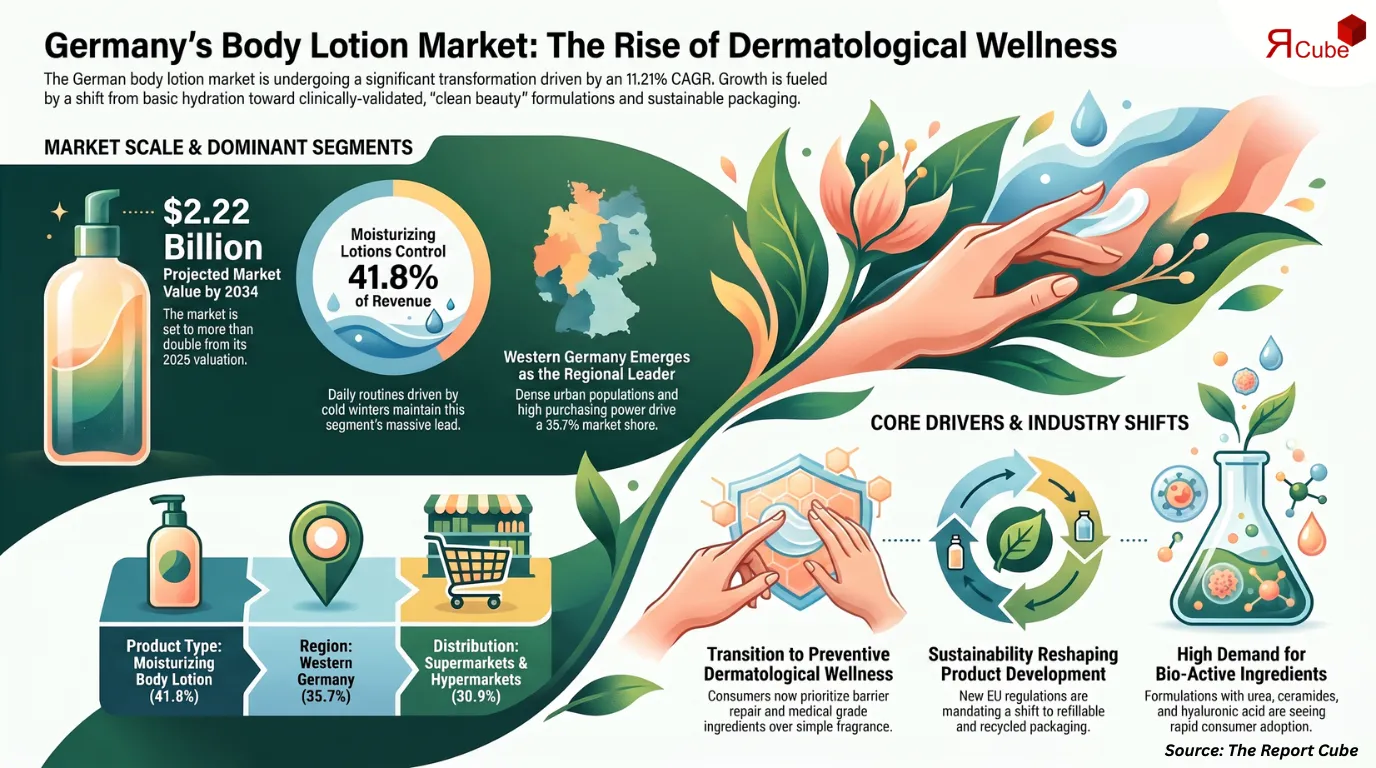
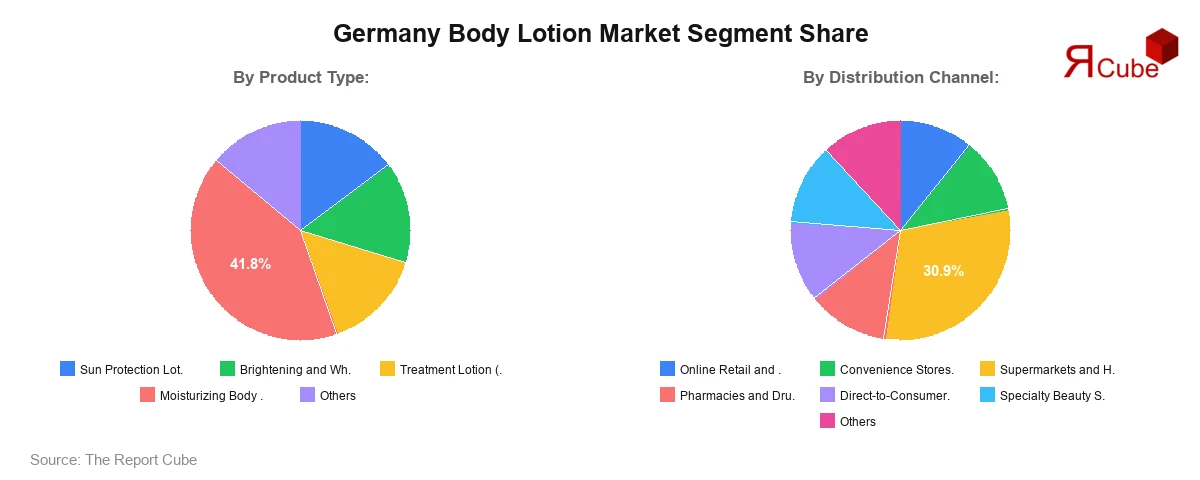
Moisturizing Body Lotion segment leads the market with approximately 41.8% share.
By Distribution Channel:
Supermarkets and Hypermarkets account for nearly 30.9% of total market revenue.
Regional Outlook:
Western Germany dominates the Germany Body Lotion Market with around 35.7% market share.
Germany Body Lotion Market Insights & Analysis
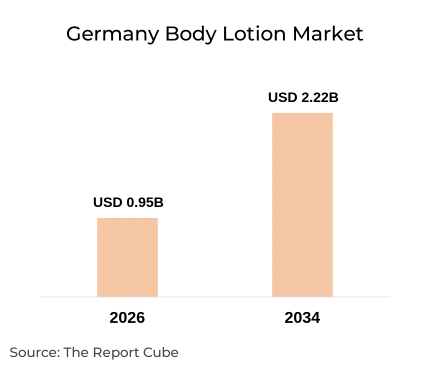
The Germany Body Lotion Market is anticipated to register a CAGR of around 11.21% during the forecast period 2026-2034. The market size is valued at USD 0.95 billion in 2026 and is projected to reach USD 2.22 billion by 2034. Steady demand for dermatologically tested skincare products, increasing preference for premium moisturizers, and growing awareness of year-round skin protection continue to support market expansion. Germany's climatic conditions, characterized by cold winters and low humidity during much of the year, have made daily body moisturization a routine practice for many households. This pattern has encouraged manufacturers to broaden their product portfolios with formulations designed for hydration, barrier repair, anti-aging care, and sensitive skin. Products containing ceramides, urea, hyaluronic acid, glycerin, panthenol, and plant-derived emollients continue gaining wider acceptance as consumers place greater emphasis on ingredient quality, product safety, and proven skincare performance.
Business investment across Germany's skincare industry remains focused on formulation science, sustainable manufacturing, and premium product innovation. Domestic manufacturers and international beauty companies continue expanding research capabilities to develop microbiome-friendly formulations, refillable packaging formats, and environmentally responsible production processes. Pharmacy skincare and dermocosmetic brands have strengthened their market position as consumers increasingly seek clinically validated products recommended by healthcare professionals. Digital retail has further accelerated market growth by improving access to premium skincare collections, subscription services, and personalized product recommendations. Continuous investment in sustainable packaging materials, recycled plastics, and responsibly sourced botanical ingredients reflects broader environmental commitments across the German cosmetics industry. These structural developments are expected to reinforce long-term demand for body lotions across both mass-market and premium product categories.
Germany Body Lotion Market Impact Analysis
| Factor | Type | Specific Impact on Market | Magnitude | Business Implication |
|---|---|---|---|---|
| Rising Skincare Awareness | Consumer | More buyers use daily body care for hydration and skin health | High | Supports growth of core moisturizing and dermo cosmetic lotions |
| Demand for Natural Formulas | Market | Shift toward organic, clean ingredient lotions across segments | High | Drives portfolio reformulation and eco certified product launches |
| Stable Body Care Category Growth | Market | Body care sales rise steadily with positive multi year CAGR trends | Medium | Enables long term planning and brand building in lotion lines |
| Strict Cosmetic Safety Regulation | Regulatory | Formulations must comply with EU and national rules on ingredients | High | Raises compliance costs but builds trust in well regulated brands |
| E commerce and Omnichannel Expansion | Technological | Online and omnichannel retail broaden access to niche lotion brands | Medium | Requires strong digital presence and data driven promotion tactics |
| Sustainability and Eco Packaging Focus | Environmental | Growing preference for recyclable and low impact packaging formats | Medium | Encourages investment in green packaging and circular initiatives |
| Premiumization and Segment Diversification | Competitive | Rise of premium, targeted lotions such as anti aging and sensitive skin | Medium | Supports higher margins through specialized benefit led positioning |
Germany Body Lotion Market Dynamics
Key Driver: Rising Focus on Preventive Skin Care and Dermatological Wellness
Daily skincare has become an essential component of personal wellness across Germany, creating favorable conditions for sustained growth in the body lotion industry. Dry indoor environments during winter, increased exposure to environmental pollutants, and an aging population have encouraged regular use of moisturizing products beyond seasonal demand. Dermatologists frequently recommend consistent hydration to maintain the skin barrier, particularly for individuals experiencing eczema, irritation, or excessive dryness. This medical perspective has strengthened confidence in body lotions formulated with clinically recognized ingredients such as ceramides, urea, glycerin, niacinamide, and oat extracts. Demand continues to rise across all age groups as consumers prioritize products that combine hydration with long-term skin protection.
Product innovation has evolved alongside these changing expectations. Manufacturers are introducing specialized formulations targeting sensitive skin, intensive repair, anti-aging support, and fragrance-free care while maintaining high dermatological safety standards. Premium skincare brands continue investing in clinical efficacy studies and ingredient transparency to strengthen consumer trust. As preventive skincare becomes a permanent part of everyday routines rather than an occasional purchase, the Germany Body Lotion Market is expected to experience stable long-term demand supported by repeat consumption and expanding premium product adoption.
Industry Trend: Clean Beauty and Sustainable Product Development Reshape Market Competition
Environmental responsibility has become an important purchasing consideration within Germany's personal care sector. Body lotion manufacturers are reformulating products to eliminate unnecessary additives while increasing the use of naturally derived oils, botanical extracts, biodegradable ingredients, and vegan formulations. Certifications associated with cruelty-free production, organic sourcing, and environmentally responsible manufacturing continue gaining importance among consumers seeking products that align with personal sustainability values. This transition is particularly visible within premium skincare, where ingredient transparency increasingly influences purchasing decisions.
Packaging innovation has advanced alongside formulation improvements. Companies are investing in refill systems, lightweight containers, post-consumer recycled plastics, and recyclable packaging materials to reduce environmental impact throughout the product lifecycle. Sustainability initiatives now extend beyond packaging to include renewable energy use, responsible sourcing of raw materials, and lower manufacturing emissions. These developments are strengthening brand differentiation while supporting Germany's broader environmental objectives, positioning sustainable skincare as a long-term driver of product innovation across the body lotion market.
Book your FREE 30-minute expert consultation today
Contact UsMajor Challenge: Cost Inflation Across Ingredients, Packaging, and Manufacturing
Maintaining competitive pricing has become increasingly challenging as manufacturers face higher production costs across multiple stages of the value chain. Natural oils, specialty active ingredients, fragrance compounds, packaging materials, transportation, and energy expenses have all experienced upward pricing pressure during recent years. At the same time, compliance with evolving European cosmetic regulations and environmental standards requires continuous investment in product testing, documentation, formulation updates, and packaging redesign. These factors increase operating costs for both established brands and emerging skincare companies.
Competitive intensity further limits pricing flexibility as retailers continue expanding private-label skincare ranges alongside internationally recognized cosmetic brands. Promotional pricing across supermarkets, pharmacies, and online marketplaces places additional pressure on profit margins, particularly within the mid-priced segment. Companies are therefore balancing cost management with continued investment in product quality, sustainability, and innovation to maintain long-term competitiveness without compromising consumer confidence.
Opportunity: Premium Skincare Innovation and Omnichannel Retail Expansion
Premiumization continues to reshape purchasing behavior across Germany's skincare industry. Consumers increasingly seek body lotions that deliver multiple skincare benefits through scientifically developed formulations containing peptides, ceramides, niacinamide, probiotics, collagen-supporting ingredients, and advanced hydration complexes. Demand has expanded beyond basic moisturization toward products that improve skin elasticity, strengthen the protective barrier, and address age-related concerns. This transition creates opportunities for manufacturers to introduce higher-value product ranges supported by clinical evidence and dermatologist endorsements.
Retail transformation is creating additional avenues for market growth. While supermarkets and pharmacies remain central purchasing destinations, online retail platforms and direct-to-consumer business models continue expanding their influence. Subscription programs, virtual skincare consultations, educational content, and personalized product recommendations have strengthened customer engagement while increasing repeat purchases. The integration of physical retail with digital commerce is expected to broaden market reach and support sustainable revenue growth throughout the forecast period.
Germany Body Lotion Market Segment-wise Analysis
By Product Type:
- Sun Protection Lotion
- Brightening and Whitening Lotion
- Treatment Lotion (Anti-aging, Firming, Medicated)
- Moisturizing Body Lotion
- Others
Moisturizing Body Lotion holds the largest share of the Germany Body Lotion Market, contributing approximately 41.8% of total revenue in 2026. Demand remains consistently high because regular moisturization has become an essential part of daily skincare across German households. The country's cold winters, low humidity, and widespread use of indoor heating often lead to dry skin, encouraging consumers to use body lotions throughout the year rather than only during seasonal changes. Products formulated with ceramides, urea, glycerin, shea butter, panthenol, and hyaluronic acid continue to experience strong demand, particularly among consumers seeking long-lasting hydration and skin barrier repair. Established skincare brands are also introducing lightweight, fast-absorbing formulations that appeal to consumers looking for convenience without compromising product performance.
The segment continues to benefit from rising demand for multifunctional skincare products that combine moisturization with anti-aging, skin-firming, soothing, and protective benefits. Premium formulations enriched with botanical extracts, vitamins, probiotics, and dermatologist-recommended ingredients are gaining wider acceptance across pharmacies, beauty retailers, and online platforms. Manufacturers are investing in clinical testing and ingredient innovation to differentiate their products while responding to growing expectations for fragrance-free, hypoallergenic, and sustainable skincare solutions. These developments are expected to reinforce the leadership of the moisturizing body lotion segment throughout the forecast period.
By Distribution Channel:
- Online Retail and E-Commerce
- Convenience Stores
- Supermarkets and Hypermarkets
- Pharmacies and Drug Stores
- Direct-to-Consumer Brands
- Specialty Beauty Stores
- Others
Supermarkets and Hypermarkets account for nearly 30.9% of the Germany Body Lotion Market, making them the largest distribution channel. Their leadership is supported by extensive retail networks, competitive pricing strategies, and the convenience of offering personal care products alongside everyday household purchases. Large retail chains provide consumers with access to a broad portfolio of international, domestic, and private-label skincare brands across multiple price categories. Frequent promotional campaigns, seasonal discounts, and loyalty programs further encourage higher purchase volumes, particularly for products intended for daily use.
Retailers continue expanding shelf space dedicated to premium skincare, natural formulations, and dermatologist-developed brands as consumer preferences become more sophisticated. Many supermarket chains have also integrated omnichannel shopping services, including click-and-collect options and home delivery, improving accessibility for busy consumers. While e-commerce continues to record strong growth, physical retail outlets remain the preferred purchasing destination for body lotions because shoppers often compare packaging, ingredients, fragrances, and product sizes before making a purchase. This balanced retail ecosystem is expected to support stable market expansion over the coming years.
Regional Projection of Germany Body Lotion Industry
- Northern Germany
- Western Germany
- Eastern Germany
- Southern Germany
- Others
Western Germany leads the Germany Body Lotion Market with an estimated market share of around 35.7% in 2026. The region benefits from a dense urban population, comparatively higher household purchasing power, and one of the country's most developed retail landscapes. Metropolitan areas such as Cologne, Düsseldorf, Dortmund, and Bonn are home to a large network of supermarkets, pharmacies, specialty beauty stores, and premium department stores, ensuring broad availability of domestic and international skincare brands. Consumers in the region demonstrate strong spending on premium personal care products, particularly those offering clinically proven formulations, sensitive-skin benefits, and environmentally responsible packaging.
The presence of major cosmetic manufacturers, research facilities, and distribution centers further strengthens Western Germany's position within the national skincare industry. Companies continue introducing innovative body care products through collaborations with retail chains, pharmacies, and digital commerce platforms to address evolving consumer preferences. Rising awareness of preventive skincare, healthy aging, and clean-label cosmetics has accelerated demand for high-performance moisturizers formulated with scientifically validated ingredients. Supported by continuous product innovation, strong retail penetration, and sustained consumer expenditure on personal care, Western Germany is expected to retain its leading position in the Germany Body Lotion Market throughout the forecast period.
Need insights for a specific region within this market?
Request Regional DataGermany Body Lotion Market Regional Analysis
The Germany body lotion market shows distinct regional patterns driven by income, retail formats, and brand penetration.
| Cluster | Demand Level | Key Areas | System Dominance | Core Demand Logic | Growth Nature |
|---|---|---|---|---|---|
| Northern Germany | High | Hamburg, Bremen, Hanover | Moisturizing & spa lotions | Urban dermocosmetic focus | Steady premium upgrade |
| Western Germany | Very High | Cologne, Düsseldorf, Ruhr | Dermocosmetic & pharmacy lines | Dense drugstore networks | Replacement plus mix shift |
| Eastern Germany | Medium | Berlin, Leipzig, Dresden | Value and midrange lotions | Price‑sensitive mass retail | Penetration‑led volume |
| Southern Germany | Very High | Munich, Stuttgart, Nuremberg | Natural & dermatological lines | Affluent wellness consumers | Fast premiumization |
| Others (smaller cities) | Medium | Regional towns & rural belts | Mass and family lotions | Functional daily care needs | Gradual modern trade shift |
Government Initiatives & Policies
- EU Packaging and Packaging Waste Regulation (PPWR) Implementation (2025-2026): Germany has initiated implementation of the EU Packaging and Packaging Waste Regulation, encouraging recyclable packaging, eco-modulated producer fees, and reduced packaging waste. The policy supports sustainable packaging innovation across the cosmetics and personal care industry, including body lotion manufacturers.
- National Packaging Law Alignment (VerpackDG) (2026): The German government is updating national packaging legislation to align with EU Regulation (EU) 2025/40. The framework strengthens producer responsibility, promotes recyclable materials, and incentivizes the use of recycled content in consumer packaging used by cosmetic manufacturers.
Germany Body Lotion Industry Recent Developments
- 2025: Beiersdorf AG strengthened its NIVEA Body portfolio by introducing improved body lotion formulations with lighter packaging and increased use of recycled materials. The company also achieved climate-neutral operations across its European production facilities, supporting its long-term sustainability strategy.
- 2025: Weleda AG recorded its highest annual revenue, driven by strong demand for natural cosmetics and significant investments in product innovation. The company expanded its skincare portfolio while reinforcing its position in certified natural body care across the DACH region.
Why Choose This Report?
- Provides a comprehensive overview of the overall market analysis, encompassing key trends, consumer behavior analysis, and risk assessment to support strategic decision-making.
- Provides accurate, up-to-date insights into market size, segmentation, and emerging opportunities, helping to minimize risk while capitalizing on growth.
- Gives deep understanding of target audience preferences, investment habits, and communication channels for enhanced product development and marketing effectiveness.
- Delivers competitive analysis and benchmarking, uncovering the strengths and weaknesses of market competitors to guide business strategies.
- Consolidates comprehensive market intelligence, reducing research efforts and streamlining strategic planning.
- Facilitates customized market segmentation and risk mitigation strategies tailored to business objectives.
- Aids in identifying both market challenges and untapped opportunities within the industry to drive long-term business growth.
- Provides valuable information based on actual customer trends, retail developments, and evolving consumer demand.
Table of Contents
- Introduction
- Objective of the Study
- Product and Category Definition
- Market Segmentation
- Study Variables
- Research Methodology
- Secondary Data Points
- Breakdown of Secondary Sources
- Primary Data Points
- Breakdown of Primary Interviews
- Secondary Data Points
- Executive Summary
- Market Dynamics
- Emerging Opportunities
- Adoption Trends
- Demand Drivers
- Disruption Analysis (Challenges)
- Industry Analysis and Strategic Insights
- Supply and Value Chain Analysis
- Pricing Analysis
- Go-To-Market Strategy
- BCG Matrix
- Recent Trends and Developments
- Import and Export Analysis
- Regulatory and Policy Landscape
- Region-wise Policies
- Government Initiatives
- Germany Body Lotion Market Overview and Forecast Analysis (2021-2034)
- Market Size, By Value, By Growth Rate (CAGR/EUR Million)
- Market Share, By Product Type
- Sun Protection Lotion
- Brightening and Whitening Lotion
- Treatment Lotion (Anti-aging, Firming, Medicated)
- Moisturizing Body Lotion
- Others
- Market Share, By Skin Type
- Oily Skin
- Sensitive Skin
- Combination Skin
- Normal Skin
- Dry Skin
- Market Share, By Ingredient Type
- Vegan and Cruelty-Free
- Conventional
- Natural and Organic
- Market Share, By End User
- Babies and Children
- Male
- Female
- Market Share, By Packaging Type
- Sachets and Travel Packs
- Bottles
- Jars and Tubs
- Tubes
- Market Share, By Price Range
- Luxury
- Mid-Range
- Premium
- Economy
- Market Share, By Distribution Channel
- Online Retail and E-Commerce
- Convenience Stores
- Supermarkets and Hypermarkets
- Pharmacies and Drug Stores
- Direct-to-Consumer Brands
- Specialty Beauty Stores
- Others
- Market Share, By Region
- Northern
- Western
- Eastern
- Southern
- Others
- Market Share, By Company
- Revenue Shares and Analysis
- Competitive Landscape
- Northern Germany Body Lotion Market Overview and Forecast Analysis (2021-2034)
- Market Size, By Value, By Growth Rate (CAGR/EUR Million)
- Market Share, By Product Type
- Market Share, By Skin Type
- Market Share, By Ingredient Type
- Market Share, By End User
- Market Share, By Packaging Type
- Market Share, By Price Range
- Market Share, By Distribution Channel
- Western Germany Body Lotion Market Overview and Forecast Analysis (2021-2034)
- Market Size, By Value, By Growth Rate (CAGR/EUR Million)
- Market Share, By Product Type
- Market Share, By Skin Type
- Market Share, By Ingredient Type
- Market Share, By End User
- Market Share, By Packaging Type
- Market Share, By Price Range
- Market Share, By Distribution Channel
- Eastern Germany Body Lotion Market Overview and Forecast Analysis (2021-2034)
- Market Size, By Value, By Growth Rate (CAGR/EUR Million)
- Market Share, By Product Type
- Market Share, By Skin Type
- Market Share, By Ingredient Type
- Market Share, By End User
- Market Share, By Packaging Type
- Market Share, By Price Range
- Market Share, By Distribution Channel
- Southern Germany Body Lotion Market Overview and Forecast Analysis (2021-2034)
- Market Size, By Value, By Growth Rate (CAGR/EUR Million)
- Market Share, By Product Type
- Market Share, By Skin Type
- Market Share, By Ingredient Type
- Market Share, By End User
- Market Share, By Packaging Type
- Market Share, By Price Range
- Market Share, By Distribution Channel
- Competitive Analysis, 2026
- Market Share of Key Players
- Competitive Mapping for Each Segment and Companies Operating by Region
- Northern Germany Body Lotion Companies Share and Competitive Analysis, 2026
- Western Germany Body Lotion Companies Share and Competitive Analysis, 2026
- Eastern Germany Body Lotion Companies Share and Competitive Analysis, 2026
- Southern Germany Body Lotion Companies Share and Competitive Analysis, 2026
- Company Profile
- Henkel AG and Co. KGaA
- Company Overview
- Product Portfolio
- Strategic Alliances and Partnerships
- Recent Developments
- Beiersdorf AG
- Company Overview
- Product Portfolio
- Strategic Alliances and Partnerships
- Recent Developments
- The Estée Lauder Companies Inc.
- Company Overview
- Product Portfolio
- Strategic Alliances and Partnerships
- Recent Developments
- L'Oréal Deutschland GmbH
- Company Overview
- Product Portfolio
- Strategic Alliances and Partnerships
- Recent Developments
- Pierre Fabre Dermo-Cosmétique Deutschland GmbH
- Company Overview
- Product Portfolio
- Strategic Alliances and Partnerships
- Recent Developments
- Kneipp GmbH
- Company Overview
- Product Portfolio
- Strategic Alliances and Partnerships
- Recent Developments
- Weleda AG
- Company Overview
- Product Portfolio
- Strategic Alliances and Partnerships
- Recent Developments
- Unilever Deutschland GmbH
- Company Overview
- Product Portfolio
- Strategic Alliances and Partnerships
- Recent Developments
- Procter and Gamble Germany GmbH and Co. Operations oHG
- Company Overview
- Product Portfolio
- Strategic Alliances and Partnerships
- Recent Developments
- Sebapharma GmbH and Co. KG
- Company Overview
- Product Portfolio
- Strategic Alliances and Partnerships
- Recent Developments
- Others (Partial List)
- Henkel AG and Co. KGaA
- Contact Us and Disclaimer
Top Key Players & Market Share Outlook
- Henkel AG & Co. KGaA
- Beiersdorf AG
- The Estée Lauder Companies Inc.
- L'Oréal Deutschland GmbH
- Pierre Fabre Dermo-Cosmétique Deutschland GmbH
- Kneipp GmbH
- Weleda AG
- Unilever Deutschland GmbH
- Procter & Gamble Germany GmbH & Co. Operations oHG
- Sebapharma GmbH & Co. KG
- Others
Frequently Asked Questions






