



Build Your Custom Market Intelligence Report
Customize Your ReportKey Takeaways
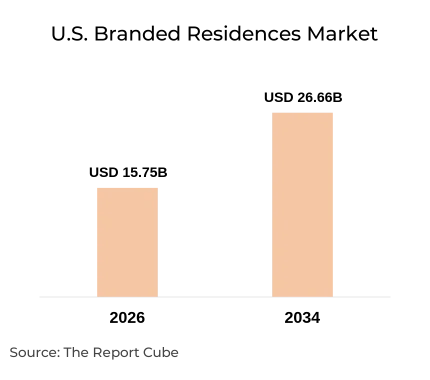
- The U.S. Branded Residences Market is valued at USD 15.75 billion in 2026.
- Market value is projected to reach USD 26.66 billion by 2034 at a 6.80% CAGR.
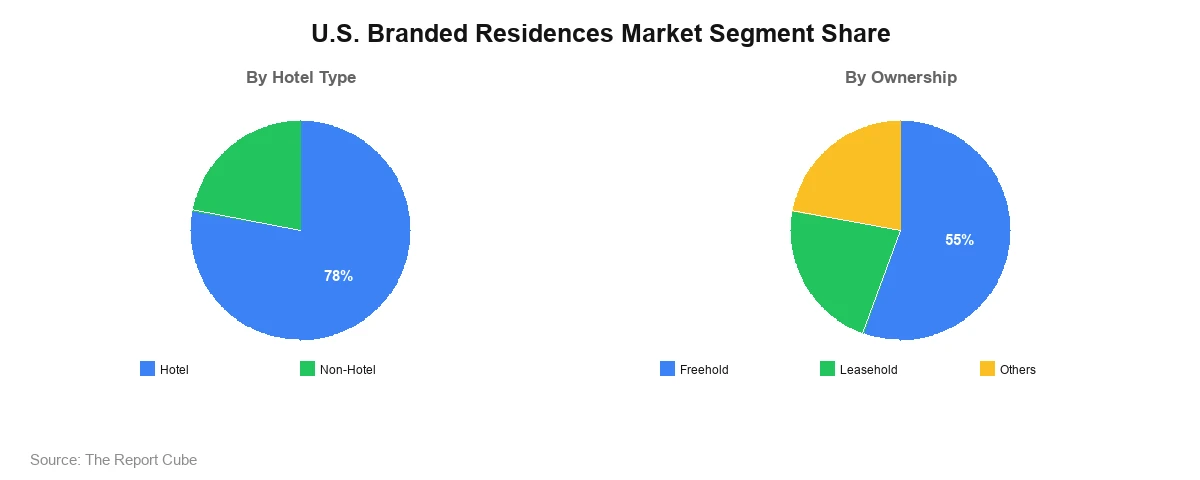
- Hotel-branded residences lead the hotel type category with an estimated 78% share in 2026.
- Freehold leads the ownership category with an estimated 55% share in 2026.
- The West leads regional demand with an estimated 28% share in 2026.
- Ritz-Carlton, Four Seasons, St. Regis, Rosewood, and Mandarin Oriental are among the key players.
- Wellness, lifestyle, and service-led positioning is a prominent market trend.
Market Overview
Branded residences are privately owned homes developed, designed, or serviced under the name of an established hospitality, lifestyle, or luxury brand. Owners typically gain access to concierge support, housekeeping, wellness facilities, dining, and property management associated with that brand. Applications include urban condominiums, resort homes, and mixed-use towers attached to hotels or standalone residential developments.
This U.S. Branded Residences Market Analysis covers a market valued at USD 15.75 billion in 2026, shaped by residential development activity, developer interest in differentiated projects, and owner demand for service-led living. The U.S. Census Bureau reported annualized residential construction spending of USD 882.3 billion in August 2026, which provides wider sector context.
Purchasers choose branded residences for service access, design identity, and brand recognition. Reported industry trends include expansion beyond traditional hotel brands and greater emphasis on wellness and lifestyle services. The U.S. branded residences market is projected to grow at a CAGR of 6.80% during 2026–2034, reaching USD 26.66 billion by 2034.
U.S. Branded Residences Market Dynamics
The U.S. branded residences market depends on residential development activity, the appeal of branded living, and the willingness of owners to pay for services and differentiation. Construction conditions, brand partnerships, site availability, and operating standards influence project timing, pricing, adoption, and competition among developers and brand owners.
|
Factor |
Type |
Specific Impact on Market |
Magnitude |
|---|---|---|---|
|
Developer interest in differentiated projects |
Driver |
Supports brand partnerships and a growing pipeline of branded schemes |
Medium–High |
|
Residential construction and redevelopment activity |
Driver |
Provides the sites, capital, and project base that branded developments require |
Medium |
|
Brand partnerships in resort and lifestyle destinations |
Opportunity |
Opens projects positioned around leisure, wellness, and hospitality services |
Medium |
|
Dependence on development feasibility |
Challenge |
Construction conditions can affect project timing and costs |
Medium |
|
Maintaining the brand promise after sale |
Challenge |
Requires alignment of service standards and owner expectations over the property lifecycle |
Medium |
|
Lifestyle, wellness, and service emphasis |
Trend |
Shapes amenity planning and brand positioning |
Medium–High |
U.S. Branded Residences Market Growth Drivers
The U.S. Branded Residences Market Growth outlook is supported by developer interest in differentiated residential projects. Branded residences allow developers to position projects around established service, design, or lifestyle identities. Savills reported that global branded-residence schemes were expected to rise from 764 at the end of 2024 to 910 by the end of 2025.
Residential construction and redevelopment activity provides the project base for branded developments. The U.S. Census Bureau reported residential construction spending at an annualized USD 882.3 billion in August 2026. This figure reflects the wider residential construction sector and does not measure branded-project spending, so it serves as contextual evidence only.
U.S. Branded Residences Market Opportunities
Developers can evaluate partnerships with established brands to differentiate new residential projects in competitive markets and strengthen market positioning. The Ritz-Carlton’s residences portfolio describes whole-ownership properties with optional concierge and other hospitality services, illustrating a commercial model. It does not demonstrate market-wide returns, so each project still requires feasibility review.
Coastal, island, and mountain destinations offer opportunities for projects positioned around leisure, wellness, and hospitality services. Knight Frank’s 2026 survey highlights growing activity beyond traditional urban locations. Project-level feasibility, local regulations, and demand still need careful assessment, because destination appeal alone does not confirm strong sales performance or development viability.
U.S. Branded Residences Industry Challenges
Branded residential projects require coordination between developers, brand owners, design teams, and service operators. Wider construction conditions can affect project timing and development costs. The U.S. Census Bureau data showed total construction spending in August 2026 was 1.7% below August 2025, illustrating that the broader construction environment can fluctuate over time.
Owners may expect hospitality-level service, amenities, and consistent quality throughout a property’s lifecycle. Developers and operators must align service standards, ongoing management, and owner expectations after sale. This operational risk is inferred from the business model and is not a quantified government-reported market statistic, so its impact is assessed qualitatively.
Need Specific Data, Let’s Customize the Report for You
Request CustomizationU.S. Branded Residences Market Trends
U.S. Branded Residences Market Trends include expansion beyond traditional hotel brands. Knight Frank’s 2026 survey reports a broader mix of participating brands and projects across urban, coastal, and resort destinations. This suggests that branded positioning is broadening beyond a hotel-led format toward a wider range of lifestyle and service identities.
Branded residences are increasingly marketed around more than the physical property. Wellness, privacy, amenities, and hospitality-led services form part of the proposition, and Knight Frank identifies wellness and service-oriented living as themes in its recent industry analysis. These themes influence design programs, amenity planning, and the operating relationships between developers and service providers.
U.S. Branded Residences Market Segment Analysis
The U.S. Branded Residences Market Share is distributed across hotel type, ownership structure, and price tier classifications, each reflecting different development models and service expectations. Estimated 2026 shares are limited to the leading segment in each category where supplied.
By Hotel Type
- Hotel
- Non-Hotel
Hotel-branded residences lead the hotel type category with an estimated 78% share in 2026, supported by the service platforms, brand recognition, and operating experience of hospitality companies such as The Ritz-Carlton Hotel Company L.L.C., Four Seasons Hotels Limited, St. Regis Hotels & Resorts, Rosewood Hotel Group, and Mandarin Oriental Hotel Group Limited. These operators can link residential ownership with concierge, housekeeping, dining, and wellness services. Non-hotel branded residences follow, reflecting developments that use lifestyle or other non-hospitality identities. Knight Frank’s 2026 survey notes a broader mix of participating brands, which indicates room for diversification beyond traditional hotel names, although separate non-hotel data was not supplied. Demand for both formats is driven by owner interest in service-led living, developer interest in differentiation, and the availability of urban, coastal, and resort sites.
By Ownership
- Freehold
- Leasehold
- Others
Freehold leads the ownership category with an estimated 55% share in 2026, reflecting the whole-ownership model described in portfolios such as The Ritz-Carlton Residences, where owners hold the property and may choose optional concierge and other services. Leasehold follows as an alternative tenure structure that can suit particular sites, developers, and jurisdictions, while Others covers remaining ownership arrangements. Share data for these categories was not supplied and is not estimated here. Demand across ownership structures is influenced by owner preferences for long-term property control, project financing structures, local property law, and the service arrangements agreed between developers and brand operators.
Regional Analysis
|
Region |
Estimated Market Share |
Key Growth Factors |
Industry Trends |
|---|---|---|---|
|
West |
28% |
Standalone luxury developments such as Four Seasons Private Residences Las Vegas in Henderson, Nevada |
Resort-style, fully serviced living in destination communities |
|
Southwest |
- |
Ritz-Carlton projects announced and under construction in Houston and The Woodlands, Texas (regional mapping to be confirmed) |
Entry of established brands into new metropolitan markets |
|
North |
- |
Planned Ritz-Carlton Residences in Tysons, Virginia (regional mapping to be confirmed) |
Hotel-branded and combined residential towers in urban districts |
|
Midwest |
- |
Regional project evidence not supplied |
Qualitative assessment pending validation |
West leads the regional landscape with an estimated 28% share in 2026. Four Seasons Private Residences Las Vegas, a 171-residence project in Henderson, Nevada, is scheduled for delivery in 2026 and illustrates standalone branded development in the region. Share data for other regions was not supplied, so regional comparisons beyond the West remain qualitative.
Projects in other regions show where activity is emerging. Ritz-Carlton announced its first Houston branded residences and hotel in September 2025, offering 114 residences, and a Ritz-Carlton condominium project in Tysons, Virginia is expected to begin construction in 2026. These announcements indicate development interest, but they do not quantify regional market shares.
Market Share & Competitive Landscape
The U.S. Branded Residences Market includes luxury and upper-upscale hospitality brands that operate or license residential offerings alongside developers. The table summarizes the supplied companies by general capability and does not represent numerical market share. U.S.-specific project activity for each company requires validation.
|
Company |
Competitive Strength |
Primary Segment Served |
|---|---|---|
|
The Ritz-Carlton Hotel Company L.L.C. |
Whole-ownership residences with optional concierge and other services |
Luxury hotel-branded freehold residences |
|
Four Seasons Hotels Limited |
Branded residential experience since 1985, including standalone private residences |
Luxury standalone and hotel-linked residences |
|
St. Regis Hotels & Resorts |
Luxury hospitality brand with residential positioning |
Luxury hotel-branded residences |
|
Rosewood Hotel Group |
Boutique ultra-luxury positioning, including a Florida residences project listed for 2026 delivery |
Luxury and ultra-luxury residences |
|
Autograph Collection Hotels |
Hospitality brand with residential affiliations |
Upper-upscale branded residences |
|
W Hotels |
Lifestyle-oriented hospitality brand |
Upper-upscale lifestyle residences |
|
Waldorf Astoria Hotels & Resorts |
Luxury hospitality heritage and service platform |
Luxury hotel-branded residences |
|
Auberge Resorts Collection |
Resort and destination-focused hospitality positioning |
Resort and lifestyle residences |
|
Westin Hotels & Resorts |
Wellness-oriented hospitality brand |
Upper-upscale branded residences |
|
Mandarin Oriental Hotel Group Limited |
Luxury hospitality and service expertise |
Luxury hotel-branded residences |
|
Others |
Developers, regional operators, and non-hotel brands |
Local and lifestyle-branded projects |
Key Companies in the U.S. Branded Residences Market
Four Seasons Hotels Limited: Four Seasons Hotels Limited is headquartered in Toronto, Canada, and has offered branded residential products since 1985. Its Four Seasons Private Residences Las Vegas project, comprising 171 high-rise residences and six villas in Henderson, Nevada, is scheduled for 2026 delivery. Competitive strength lies in personalized service and standalone residential experience.
The Ritz-Carlton Hotel Company L.L.C.: The Ritz-Carlton Hotel Company operates within Marriott International, headquartered in Bethesda, Maryland. In September 2025, the brand announced its first Houston branded residences and hotel, with 114 residences, while a Woodlands condominium project broke ground in October 2025. Its strength lies in whole-ownership residences with optional services.
Recent Developments
|
Year / Month |
Company |
Development |
|---|---|---|
|
September 2025 |
The Ritz-Carlton |
Announced its first Houston branded residences and hotel: a 44-story Uptown District tower with 154 hotel rooms and 114 residences. No construction timeline was provided. |
|
October 2025 |
The Ritz-Carlton / Howard Hughes Corp. |
Ground was broken on a 15-story luxury condominium project in The Woodlands, Texas. |
|
October 2025 |
Ritz-Carlton / Renaissance Centro |
Announced Ritz-Carlton Residences in Tysons, Virginia, with 102 condominiums. Construction is expected in 2026 and occupancy is anticipated in late 2028 (planned, not completed). |
|
January 2026 |
Kempinski |
Debuted in U.S. branded residences with Kempinski Residences Miami Design District. |
|
Late 2026 |
Four Seasons |
Four Seasons Private Residences Las Vegas, announced in 2023, is scheduled for delivery (planned, not a completed event). |
U.S. Branded Residences Market Future Outlook
The U.S. Branded Residences Market Forecast indicates expansion from USD 15.75 billion in 2026 to USD 26.66 billion by 2034 at a CAGR of 6.80%, based on supplied estimates. Growth is expected to depend on developer participation, brand partnerships, project feasibility, and owner interest in service-led living, while hotel-branded and freehold formats may remain the leading structures within current segment estimates.
Wellness, hospitality-led services, and destination-based development may shape project design, while Savills’ global pipeline data and announced U.S. projects point to continued developer activity. Risks include construction cost and timing fluctuations, project feasibility, and the need to maintain service standards after sale. The projected values are conditional estimates, and actual outcomes depend on market conditions, regulation, capital availability, and developer execution.
U.S. Branded Residences Market Report Coverage
This U.S. Branded Residences Market Report summarizes the supplied valuation, forecast assumptions, segmentation, regional framework, and competitive ecosystem.
|
Parameter |
Details |
|---|---|
|
Market Name |
U.S. Branded Residences Market |
|
Market Size 2026 |
USD 15.75 billion |
|
Market Size 2034 |
USD 26.66 billion |
|
Forecast Period |
2026–2034 |
|
CAGR |
6.80% |
|
Base Year |
2026 |
|
Historical Years |
2021-2025 |
|
Forecast Years |
2026–2034 |
|
Segments Covered |
By Hotel Type; By Ownership; By Price Tier |
|
Regions Covered |
West, Southwest, North, Midwest |
|
Key Companies |
The Ritz-Carlton Hotel Company L.L.C., Four Seasons Hotels Limited, St. Regis Hotels & Resorts, Rosewood Hotel Group, Autograph Collection Hotels, W Hotels, Waldorf Astoria Hotels & Resorts, Auberge Resorts Collection, Westin Hotels & Resorts, Mandarin Oriental Hotel Group Limited |
|
Customization |
Available as per client requirements |
Why Choose This U.S. Branded Residences Market Report?
- Market coverage spans branded residential offerings across hotel and non-hotel formats, ownership structures, and price tiers.
- Valuation and forecast figures present the supplied 2026 base, 2034 projection, and 6.80% CAGR clearly.
- Segmentation covers hotel type, ownership, and price tier categories for structured comparison.
- Regional insights cover the West, Southwest, North, and Midwest, with the West’s estimated 28% share highlighted.
- Competitive profiling covers ten supplied hospitality brands and operators active in branded residential development.
- Trend analysis addresses brand expansion, wellness, and service-led positioning relevant to project planning.
- Forecast context supports development planning, partnership evaluation, and market-entry assessment without guaranteeing outcomes.
Table of Contents
- Introduction
- Objective of the Study
- Product Definition
- Market Segmentation
- Study Variables
- Research Methodology
- Secondary Data Points
- Companies Interviewed
- Primary Data Points
- Breakdown of Primary Interviews
- Secondary Data Points
- Executive Summary
- Market Dynamics
- Drivers
- Challenges
- Opportunity Assessment
- Recent Trends and Developments
- Policy and Regulatory Landscape
- U.S. Branded Residences Market Overview and Forecast Analysis (2021-2034)
- Market Size, By Value, By Growth Rate (CAGR/USD Billions)
- Demand – Supply Trends
- Market Share, By Hotel Type
- Hotel
- Non-Hotel
- Market Share, By Ownership
- Freehold
- Leasehold
- Others
- Market Share, By Price Tier
- Luxury
- Upper-Upscale
- Upscale
- Upper-Midscale/Midscale
- Market Share, By Region
- West
- Southwest
- North
- Midwest
- Market Share, By Competitors
- Competition Characteristics
- Revenue Shares
- Hotel U.S. Branded Residences Market Overview, 2021-2034F
- By Value (USD Million)
- By Ownership – Market Size & Forecast 2021-2034, USD Million
- Freehold
- Leasehold
- Others
- Non-Hotel U.S. Branded Residences Market Overview, 2021-2034F
- By Value (USD Million)
- By Ownership – Market Size & Forecast 2021-2034, USD Million
- Freehold
- Leasehold
- Others
- Competitive Outlook (Company Profile – Partial List)
- The Ritz-Carlton Hotel Company L.L.C.
- Company Overview
- Business Segments
- Strategic Alliances/Partnerships
- Recent Developments
- Four Seasons Hotels Limited
- Company Overview
- Business Segments
- Strategic Alliances/Partnerships
- Recent Developments
- St. Regis Hotels & Resorts
- Company Overview
- Business Segments
- Strategic Alliances/Partnerships
- Recent Developments
- Rosewood Hotel Group
- Company Overview
- Business Segments
- Strategic Alliances/Partnerships
- Recent Developments
- Autograph Collection Hotels
- Company Overview
- Business Segments
- Strategic Alliances/Partnerships
- Recent Developments
- W Hotels
- Company Overview
- Business Segments
- Strategic Alliances/Partnerships
- Recent Developments
- Waldorf Astoria Hotels & Resorts
- Company Overview
- Business Segments
- Strategic Alliances/Partnerships
- Recent Developments
- Auberge Resorts Collection
- Company Overview
- Business Segments
- Strategic Alliances/Partnerships
- Recent Developments
- Westin Hotels & Resorts
- Company Overview
- Business Segments
- Strategic Alliances/Partnerships
- Recent Developments
- Mandarin Oriental Hotel Group Limited
- Company Overview
- Business Segments
- Strategic Alliances/Partnerships
- Recent Developments
- The Ritz-Carlton Hotel Company L.L.C.
- Contact Us & Disclaimer
Top Key Players & Market Share Outlook
- The Ritz-Carlton Hotel Company L.L.C.
- Four Seasons Hotels Limited
- St. Regis Hotels & Resorts
- Rosewood Hotel Group
- Autograph Collection Hotels
- W Hotels
- Waldorf Astoria Hotels & Resorts
- Auberge Resorts Collection
- Westin Hotels & Resorts
- Mandarin Oriental Hotel Group Limited
Frequently Asked Questions