



Build Your Custom Market Intelligence Report
Customize Your ReportBrazil Liqueur Market Insights & Analysis
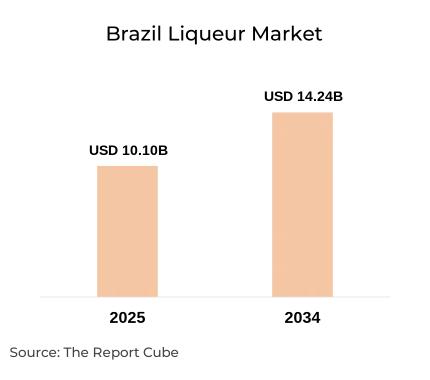
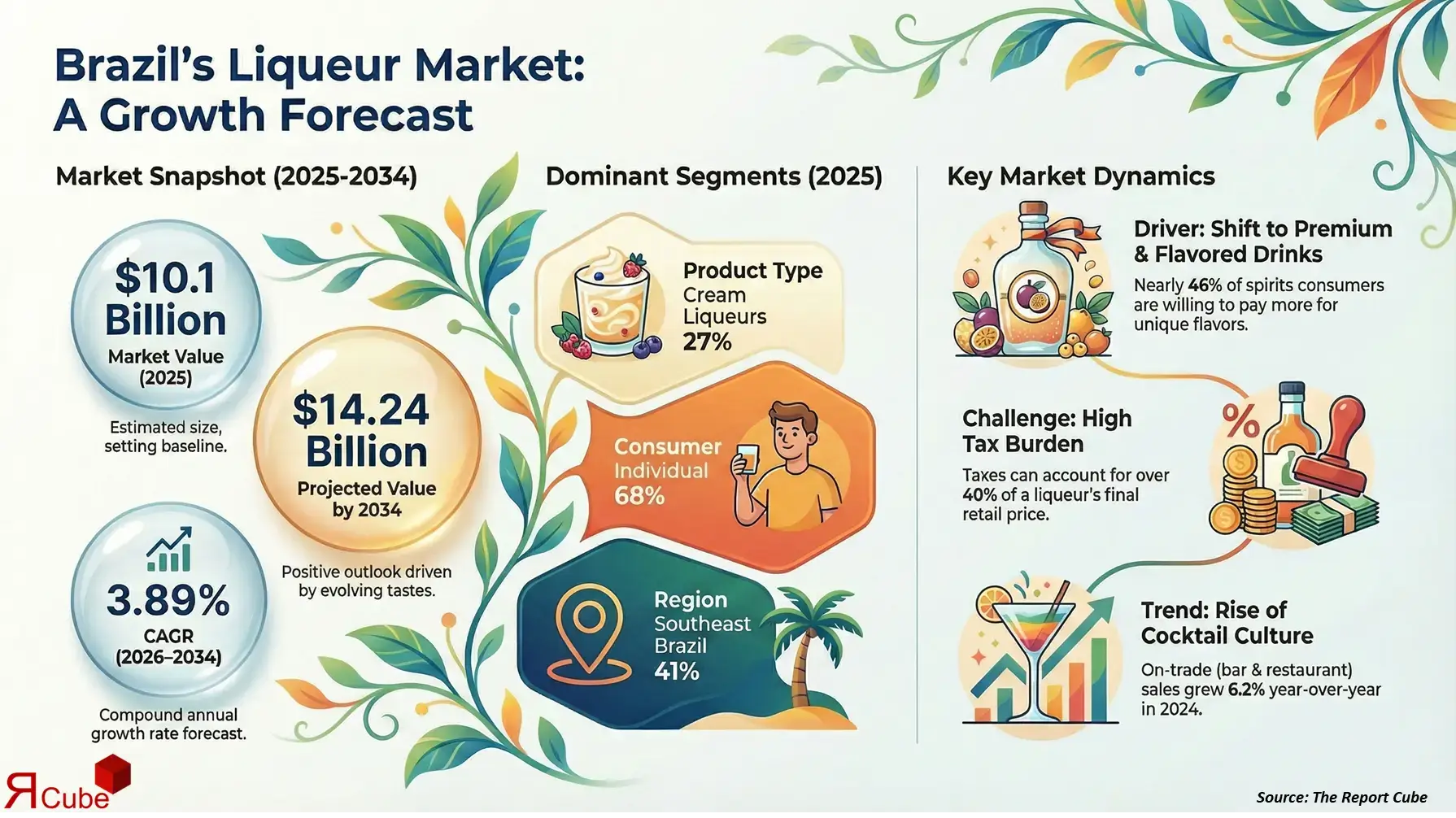
The Brazil Liqueur Market is anticipated to register a CAGR of 3.89% during 2026-2034. The market size was valued at USD 10.1 billion in 2025 and is projected to reach USD 14.24 billion by 2034. This growth reflects Brazil’s steadily evolving alcoholic beverage landscape, supported by rising disposable income levels, expanding urban populations, and the country’s strong social drinking culture. Liqueurs hold a unique position within Brazil’s spirits industry due to their versatility, being consumed both as standalone drinks and as key ingredients in cocktails and desserts. Increasing acceptance of premium and flavored alcoholic beverages among younger consumers, combined with steady demand from hospitality venues, continues to support the market’s positive outlook.
Beyond headline growth figures, the Brazil liqueur industry is benefiting from deeper structural shifts in consumer behavior and retail distribution. Consumers are showing greater interest in fruit-based liqueurs, coffee-infused variants, and dessert-style offerings that align with Brazil’s culinary traditions and café culture. The expansion of modern retail formats, specialty liquor stores, and online alcohol platforms has improved product accessibility and brand visibility. In addition, marketing strategies centered on lifestyle positioning and mixology education are strengthening consumer engagement. Leading multinational brands continue to dominate shelf space, while regional producers compete by emphasizing authenticity, local flavors, and value pricing.
Brazil Liqueur Market Recent Developments
- 2025: Diageo expanded its premium cream and coffee liqueur portfolio to target Brazil’s growing home-cocktail segment.
- 2025: Campari Group enhanced regional distribution networks to strengthen penetration in Northeast and Central-West Brazil.
Government Initiatives & Policies
- Responsible Alcohol Consumption Program: National health initiatives promoting awareness, labeling standards, and controlled marketing of alcoholic beverages.
- Beverage Tax Policy Review: Federal discussions on excise tax restructuring impacting pricing and competitiveness of alcoholic beverages.
Brazil Liqueur Market Dynamics
Key Driver: Rising Demand for Premium and Flavored Alcoholic Beverages
The most influential driver shaping the Brazil liqueur market is the growing consumer shift toward premium, flavored alcoholic beverages. Urban consumers, particularly those aged between 25 and 40, are increasingly experimenting with fruit liqueurs, coffee liqueurs, and chocolate-based variants that offer differentiated taste experiences. Market surveys indicate that nearly 46% of Brazilian spirits consumers are willing to pay a premium for unique flavors and perceived quality. This trend is further supported by the rapid expansion of cocktail culture in bars and at-home settings, where liqueurs are valued for their versatility. Premium positioning, attractive packaging, and brand storytelling are enabling manufacturers to capture higher margins while maintaining steady volume growth.
Major Challenge: High Tax Burden and Price Sensitivity
One of the most persistent challenges facing the Brazil liqueur industry is the high tax burden applied to alcoholic beverages. Multiple layers of federal and state taxes can account for over 40% of the final retail price, significantly affecting affordability. This creates a highly price-sensitive environment, particularly outside major metropolitan regions. Inflationary pressures have also constrained discretionary spending, pushing some consumers toward lower-priced alternatives or informal markets. For producers, balancing compliance costs, pricing strategies, and profitability remains complex. Smaller and emerging brands face additional hurdles in scaling distribution while remaining competitive against well-established multinational players.
Industry Trends: Expansion of On-Trade Consumption and Cocktail Culture
A notable trend in the Brazil liqueur market is the renewed growth of on-trade consumption driven by bars, lounges, and restaurants. As social venues continue to recover, operators are emphasizing signature cocktails and premium drink menus that prominently feature cream, herbal, and coffee liqueurs. Industry data suggests that on-trade liqueur sales grew by approximately 6.2% year-over-year in 2024, outpacing off-trade growth. Seasonal promotions, mixology events, and collaborations with beverage brands are enhancing product visibility. This trend strengthens brand recognition and encourages trial, particularly among younger consumers seeking experiential drinking occasions.
Opportunity Ahead: Localization and Region-Specific Product Innovation
Looking ahead, one of the strongest opportunities lies in region-specific flavor innovation and localization strategies. Brazil’s diverse agricultural base provides access to native fruits, cocoa, and coffee varieties that can be incorporated into differentiated liqueur offerings. Brands that align products with regional taste preferences and cultural celebrations are better positioned to gain traction beyond core urban markets. Additionally, tourism-driven demand in coastal and leisure regions creates scope for premium and souvenir-oriented liqueur products. Strategic partnerships with local producers and hospitality groups can further unlock untapped demand and reinforce long-term market growth.
Brazil Liqueur Market Segment-wise Analysis
By Product Type:
- Cream Liqueurs
- Fruit Liqueurs
- Herbal and Bitter Liqueurs
- Coffee Liqueurs
- Chocolate and Dessert Liqueurs
- Other Specialty Liqueurs
Among product categories, cream liqueurs represent the leading segment, accounting for an estimated 27% of total market revenue in 2025. Their smooth texture, dessert compatibility, and suitability for both standalone consumption and cocktails make them popular across age groups. Coffee liqueurs closely follow, benefiting from Brazil’s strong coffee culture and high per-capita coffee consumption. Fruit liqueurs also maintain solid demand, supported by tropical flavor preferences. Cream liqueurs generate higher average selling prices, contributing disproportionately to revenue despite moderate volume growth.
By Consumer Segment:
- Individual
- Institutional
The individual consumer segment dominates the Brazil liqueur market, contributing approximately 68% of total sales. Growth in this segment is driven by home entertainment, gifting occasions, and increased experimentation with cocktail recipes. Institutional consumers, including hotels, bars, and restaurants, account for the remaining share but play a critical role in brand positioning and trial generation. Institutional demand is more concentrated in premium and imported liqueurs, while individual consumers support volume-led growth across mid-range and flavored offerings.
Regional Projection of Brazil Liqueur Industry
- Southeast Brazil
- South Brazil
- Northeast Brazil
- North Brazil
- Central-West Brazil
Southeast Brazil leads the national market, accounting for roughly 41% of total liqueur consumption in 2025. The region benefits from high urban density, stronger purchasing power, and a vibrant nightlife culture centered around São Paulo and Rio de Janeiro. South Brazil follows with stable demand supported by established retail infrastructure and consistent consumption patterns. Northeast Brazil is emerging as a high-growth region due to tourism and hospitality expansion, while North and Central-West Brazil contribute smaller shares but offer long-term growth potential as distribution networks improve.
Why Choose This Report?
- Provides a comprehensive overview of the overall market analysis, encompassing key trends, consumer behavior analysis, and risk assessment to support strategic decision-making.
- Provides accurate, up-to-date insights into market size, segmentation, and emerging opportunities, helping to minimize risk & capitalizing on growth.
- Gives deep understanding of target audience preferences, investment habits, and communication channels for enhanced product development & marketing effectiveness.
- Delivers competitive analysis & benchmarking, uncovering the strengths & weaknesses of market competitors to guide strategies.
- Consolidate comprehensive market intelligence, reducing reasoning & streamlining research efforts.
- Facilitates customized market segmentation & risk mitigation strategies, fine-tuned to the business objectives.
- Aids in identifying both market challenges & untapped opportunities within the industry to drive long-term business growth.
- Provides valuable information based on actual customer data & search trends.
Table of Contents
- Introduction
- Objective of the Study
- Product and Category Definition
- Market Segmentation
- Study Variables
- Research Methodology
- Secondary Data Points
- Breakdown of Secondary Sources
- Primary Data Points
- Breakdown of Primary Interviews
- Secondary Data Points
- Executive Summary
- Market Dynamics
- Drivers
- Challenges
- Opportunity Assessment
- Recent Trends and Developments
- Regulatory and Policy Landscape
- Brazil Liqueur Market Overview (2020–2035)
- Market Size, By Value (USD Billion)
- Market Size, By Volume (Million Liters)
- Market Share, By Product Type
- Cream Liqueurs
- Fruit Liqueurs
- Herbal and Bitter Liqueurs
- Coffee Liqueurs
- Chocolate and Dessert Liqueurs
- Other Specialty Liqueurs
- Market Share, By Packaging
- Glass Bottles
- PET Bottles
- Cans and Others
- Market Share, By Distribution Channel
- Supermarkets
- Hypermarkets
- Retail Stores
- Convenience Stores
- Food Service
- Specialty Stores
- Market Share, By Consumer Segment
- Individual
- Institutional
- Market Share, By Price Tier
- Economy
- Standard
- Premium
- Super-Premium and Above
- Market Share, By Region
- Southeast Brazil
- South Brazil
- Northeast Brazil
- North Brazil
- Central-West Brazil
- Market Share, By Company
- Revenue Shares
- Competitive Landscape
- Brazil Liqueur Market – By Region
- Southeast Brazil Liqueur Market
- Market Size, By Value
- Market Share, By Product Type
- Market Share, By Packaging
- Market Share, By Distribution Channel
- Market Share, By Consumer Segment
- South Brazil Liqueur Market
- Market Size, By Value
- Market Share, By Product Type
- Market Share, By Packaging
- Market Share, By Distribution Channel
- Market Share, By Consumer Segment
- Northeast Brazil Liqueur Market
- Market Size, By Value
- Market Share, By Product Type
- Market Share, By Packaging
- Market Share, By Distribution Channel
- Market Share, By Consumer Segment
- North Brazil Liqueur Market
- Market Size, By Value
- Market Share, By Product Type
- Market Share, By Packaging
- Market Share, By Distribution Channel
- Market Share, By Consumer Segment
- Central-West Brazil Liqueur Market
- Market Size, By Value
- Market Share, By Product Type
- Market Share, By Packaging
- Market Share, By Distribution Channel
- Market Share, By Consumer Segment
- Southeast Brazil Liqueur Market
- Competitive Outlook and Company Profiles
- Diageo
- Company Overview
- Product Portfolio (Liqueur Brands)
- Presence and Strategy in Brazil
- Strategic Alliances / Partnerships
- Recent Developments
- Pernod Ricard
- Company Overview
- Product Portfolio (Liqueur Brands)
- Presence and Strategy in Brazil
- Strategic Alliances / Partnerships
- Recent Developments
- Davide Campari-Milano N.V. (Campari Group)
- Company Overview
- Product Portfolio
- Key Brands in Brazil (e.g., Aperol, Campari)
- Strategic Alliances / Partnerships
- Recent Developments
- Rémy Cointreau
- Company Overview
- Product Portfolio
- Distribution and Positioning in Brazil
- Strategic Alliances / Partnerships
- Recent Developments
- Bacardi Limited
- Company Overview
- Product Portfolio (Including Liqueurs)
- On-trade and Off-trade Focus in Brazil
- Strategic Alliances / Partnerships
- Recent Developments
- Brown-Forman Corporation
- Company Overview
- Liqueur and Flavored Spirit Portfolio
- Route-to-Market in Brazil
- Strategic Alliances / Partnerships
- Recent Developments
- Beam Suntory (Suntory Global Spirits)
- Company Overview
- Liqueur and RTD Portfolio
- Growth Strategy in Brazil
- Strategic Alliances / Partnerships
- Recent Developments
- Mast‑Jägermeister SE
- Company Overview
- Core Liqueur Brand(s)
- Brand Positioning in Brazil
- Strategic Alliances / Partnerships
- Recent Developments
- Lucas Bols
- Company Overview
- Liqueur Portfolio
- Cocktail and Mixology Partnerships
- Strategic Alliances / Partnerships
- Recent Developments
- Ambev
- Company Overview
- Liqueur and Spirits Portfolio
- Distribution Strength and On-trade Network
- Strategic Alliances / Partnerships
- Recent Developments
- Others
- Diageo
- Contact Us and Disclaimer
Top Key Players & Market Share Outlook
- Diageo
- Pernod Ricard
- Davide Campari-Milano N.V. (Campari Group)
- Rémy Cointreau
- Bacardi Limited
- Brown-Forman Corporation
- Beam Suntory (Suntory Global Spirits)
- Mast-Jägermeister SE
- Lucas Bols
- Ambev
- Others
Frequently Asked Questions






