




Build Your Custom Market Intelligence Report
Customize Your ReportGermany Liqueur Market Insights & Analysis
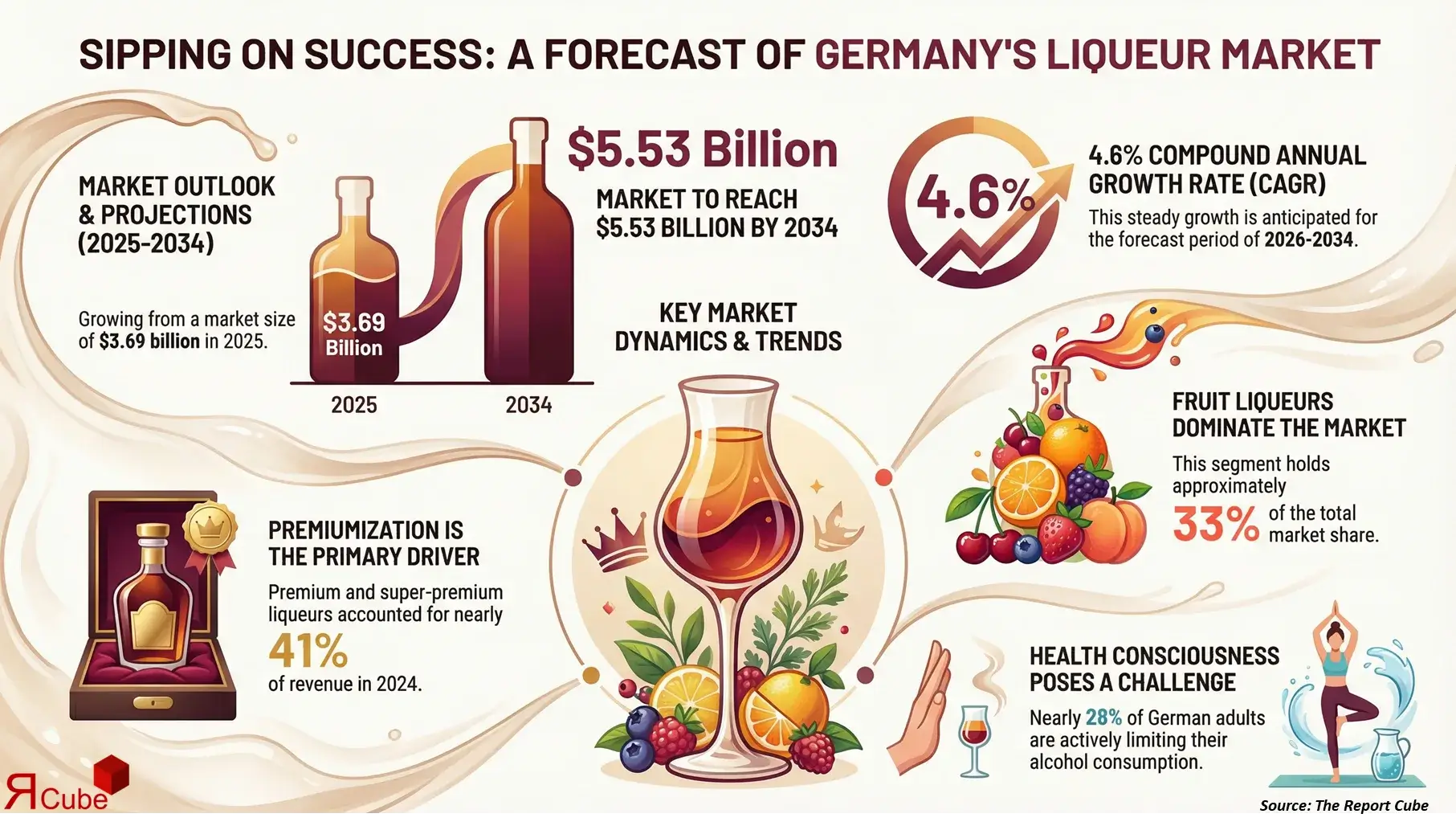
The Germany Liqueur Market is anticipated to register a CAGR of 4.6% during the forecast period of 2026-2034. The market size was valued at USD 3.69 billion in 2025 and is projected to reach USD 5.53 billion by 2034. Germany represents one of Europe’s most established alcoholic beverage markets, supported by strong consumer familiarity with spirits, a mature retail infrastructure, and deep-rooted drinking traditions. Liqueurs hold a stable position within the broader spirits category, driven by their versatility in cocktails, desserts, and casual consumption occasions. Rising premiumization, flavor innovation, and evolving consumer preferences toward indulgent yet refined alcoholic beverages continue to strengthen market fundamentals.
Beyond traditional consumption, the market is increasingly shaped by lifestyle changes and experiential drinking trends. Younger adult consumers are exploring fruit-forward, cream-based, and herbal variants as alternatives to high-proof spirits. Supporting keywords such as flavored spirits, premium alcoholic beverages, artisanal liqueurs, and low-alcohol indulgence are becoming closely associated with category growth. Germany’s strong food service sector, combined with tourism recovery and on-trade revival, further accelerates demand. Additionally, the expansion of specialty liquor stores and curated retail shelves has improved product visibility. Together, these factors position the Germany liqueur industry for steady, value-driven expansion through 2034.
Germany Liqueur Market Recent Developments
- 2025: Pernod Ricard expanded its premium liqueur portfolio in Germany, focusing on fruit-infused and low-sugar variants.
- 2025: Campari Group introduced limited-edition herbal liqueurs tailored to German regional taste preferences.
Government Initiatives & Policies
- German National Nutrition Strategy: Encourages responsible alcohol consumption and transparent labeling standards.
- EU Alcohol Labelling Regulation: Mandates clearer ingredient and nutritional disclosures across alcoholic beverages.
Germany Liqueur Market Dynamics
Key Driver: Premiumization and Flavor Diversification
The primary driver of the Germany liqueur market is the ongoing shift toward premiumization and flavor diversification within alcoholic beverages. German consumers are increasingly willing to pay higher prices for superior taste profiles, natural ingredients, and distinctive brand stories. Market data indicates that premium and super-premium liqueurs accounted for nearly 41% of total liqueur revenue in Germany during 2024. Fruit liqueurs with berry and citrus notes, along with cream-based indulgent variants, are gaining popularity across both retail and food service channels. This trend is reinforced by cocktail culture growth, where liqueurs play a central role in mixology, supporting consistent volume and value growth.
Major Challenge: Health Awareness and Alcohol Moderation Trends
Rising health consciousness and alcohol moderation trends present a notable challenge for the Germany liqueur market. A growing segment of consumers is reducing alcohol intake due to wellness considerations, calorie awareness, and lifestyle changes. Recent surveys suggest that nearly 28% of German adults actively limit their alcohol consumption, directly impacting overall spirits volumes. While liqueurs benefit from lower alcohol content compared to hard spirits, concerns around sugar levels and additives remain. Producers must balance indulgence with transparency, reformulating products with reduced sugar or natural ingredients to retain relevance among health-aware consumers.
Industry Trends: Growth of Cream and Dessert Liqueurs
An important industry trend is the rising demand for cream and dessert liqueurs, driven by at-home consumption and experiential indulgence. These products are increasingly used in desserts, coffee-based drinks, and seasonal recipes, particularly during winter and festive periods. Cream liqueurs recorded an estimated 6% year-on-year growth in Germany in 2024, outperforming traditional segments. Supporting keywords such as coffee liqueurs, dessert spirits, and indulgent alcoholic beverages are frequently appearing in consumer searches and retail promotions. This trend highlights the category’s ability to blend alcohol with comfort-driven consumption occasions.
Opportunity Ahead: Expansion Through Specialty and Food Service Channels
Significant growth opportunities lie in the expansion of specialty retail and food service distribution channels. Upscale bars, cafes, and dessert-focused restaurants are increasingly incorporating premium liqueurs into menus, driving trial and brand exposure. Specialty liquor stores, which account for roughly 18% of liqueur sales in Germany, are becoming key platforms for limited editions and artisanal offerings. As experiential retail and curated selections gain traction, manufacturers can leverage these channels to introduce innovative flavors, strengthen brand loyalty, and capture higher margins.
Germany Liqueur Market Segment-wise Analysis
By Product Type:
- Cream Liqueurs
- Fruit Liqueurs
- Herbal Liqueurs
- Coffee Liqueurs
- Dessert Liqueurs
- Others
Fruit liqueurs dominate the German market, accounting for approximately 33% of total market share in 2025. Their popularity stems from Germany’s long-standing preference for fruit-based spirits and digestifs. Variants made from berries, cherries, and citrus fruits appeal to both traditional consumers and younger demographics seeking approachable flavor profiles. Fruit liqueurs are widely used in cocktails and desserts, enhancing their versatility and year-round demand. While herbal liqueurs retain cultural significance, fruit liqueurs lead due to broader consumption occasions and consistent innovation.
By Distribution Channel:
- Supermarkets
- Hypermarkets
- Retail Stores
- Convenience Stores
- Food Service
- Specialty Stores
Supermarkets and hypermarkets collectively represent the leading distribution channel, contributing nearly 46% of total liqueur sales in Germany. These channels benefit from high footfall, competitive pricing, and extensive shelf space, making them the preferred choice for mainstream consumers. Promotional offers and seasonal displays further stimulate impulse purchases. However, specialty stores are growing faster, particularly for premium and imported liqueurs, as consumers seek expert recommendations and exclusive products.
Regional Projection of Germany Liqueur Industry
- North Germany
- South Germany
- East Germany
- West Germany
West Germany leads the national liqueur market, accounting for approximately 38% of total revenue in 2025. The region benefits from higher population density, stronger purchasing power, and a vibrant food service sector. Major urban centers support cocktail culture and premium consumption trends. South Germany follows closely, driven by tourism and hospitality demand, while North and East Germany show steady growth supported by regional brands and traditional consumption patterns.
Why Choose This Report?
- Provides a comprehensive overview of the overall market analysis, encompassing key trends, consumer behavior analysis, and risk assessment to support strategic decision-making.
- Provides accurate, up-to-date insights into market size, segmentation, and emerging opportunities, helping to minimize risk & capitalizing on growth.
- Gives deep understanding of target audience preferences, investment habits, and communication channels for enhanced product development & marketing effectiveness.
- Delivers competitive analysis & benchmarking, uncovering the strengths & weaknesses of market competitors to guide strategies.
- Consolidate comprehensive market intelligence, reducing reasoning & streamlining research efforts.
- Facilitates customized market segmentation & risk mitigation strategies, fine-tuned to the business objectives.
- Aids in identifying both market challenges & untapped opportunities within the industry to drive long-term business growth.
- Provides valuable information based on actual customer data & search trends.
Table of Contents
- Introduction
- Objective of the Study
- Product and Category Definition
- Market Segmentation
- Study Variables
- Research Methodology
- Secondary Data Points
- Breakdown of Secondary Sources
- Primary Data Points
- Breakdown of Primary Interviews
- Secondary Data Points
- Executive Summary
- Market Dynamics
- Drivers
- Challenges
- Opportunity Assessment
- Recent Trends and Developments
- Regulatory and Policy Landscape
- Germany Liqueur Market Overview (2020–2034)
- Market Size, By Value (EUR Billion)
- Market Share, By Product Type
- Cream Liqueurs
- Fruit Liqueurs
- Herbal Liqueurs
- Coffee Liqueurs
- Dessert Liqueurs
- Others
- Market Share, By Packaging
- Glass Bottles
- PET Bottles
- Cans and Others
- Market Share, By Distribution Channel
- Supermarkets
- Hypermarkets
- Retail Stores
- Convenience Stores
- Food Service
- Specialty Stores
- Market Share, By Consumer Segment
- Individual
- Institutional
- Market Share, By Region
- North Germany
- South Germany
- East Germany
- West Germany
- Market Share, By Company
- Revenue Shares
- Competitive Landscape
- Germany Liqueur Market – Regional Analysis
- North Germany
- Market Size, By Value
- Market Share, By Product Type
- Market Share, By Packaging
- Market Share, By Distribution Channel
- Market Share, By Consumer Segment
- South Germany
- Market Size, By Value
- Market Share, By Product Type
- Market Share, By Packaging
- Market Share, By Distribution Channel
- Market Share, By Consumer Segment
- East Germany
- Market Size, By Value
- Market Share, By Product Type
- Market Share, By Packaging
- Market Share, By Distribution Channel
- Market Share, By Consumer Segment
- West Germany
- Market Size, By Value
- Market Share, By Product Type
- Market Share, By Packaging
- Market Share, By Distribution Channel
- Market Share, By Consumer Segment
- North Germany
- Competitive Outlook and Company Profiles
- Diageo
- Company Overview
- Product Portfolio (Liqueur Brands)
- Strategic Alliances / Partnerships in Germany
- Recent Developments
- Pernod Ricard
- Company Overview
- Product Portfolio (Liqueur Brands)
- Strategic Alliances / Partnerships in Germany
- Recent Developments
- Davide Campari-Milano N.V. (Campari Group)
- Company Overview
- Product Portfolio
- Strategic Alliances / Partnerships in Germany
- Recent Developments
- Rémy Cointreau
- Company Overview
- Product Portfolio
- Strategic Alliances / Partnerships in Germany
- Recent Developments
- Bacardi Limited
- Company Overview
- Product Portfolio
- Strategic Alliances / Partnerships in Germany
- Recent Developments
- Brown‑Forman Corporation
- Company Overview
- Product Portfolio
- Strategic Alliances / Partnerships in Germany
- Recent Developments
- Beam Suntory (Suntory Global Spirits)
- Company Overview
- Product Portfolio
- Strategic Alliances / Partnerships in Germany
- Recent Developments
- Lucas Bols
- Company Overview
- Product Portfolio
- Strategic Alliances / Partnerships in Germany
- Recent Developments
- Mast‑Jägermeister SE
- Company Overview
- Product Portfolio (Herbal/Bitter Liqueurs)
- Distribution and Branding Strategy in Germany
- Recent Developments
- Behn / Dooley’s
- Company Overview
- Product Portfolio
- Strategic Alliances / Partnerships
- Recent Developments
- Others
- Diageo
- Contact Us and Disclaimer
Top Key Players & Market Share Outlook
- Diageo
- Pernod Ricard
- Davide Campari-Milano N.V. (Campari Group)
- Rémy Cointreau
- Bacardi Limited
- Brown-Forman Corporation
- Beam Suntory (Suntory Global Spirits)
- Lucas Bols
- Mast-Jägermeister SE
- Behn / Dooley’s
- Others
Frequently Asked Questions






